
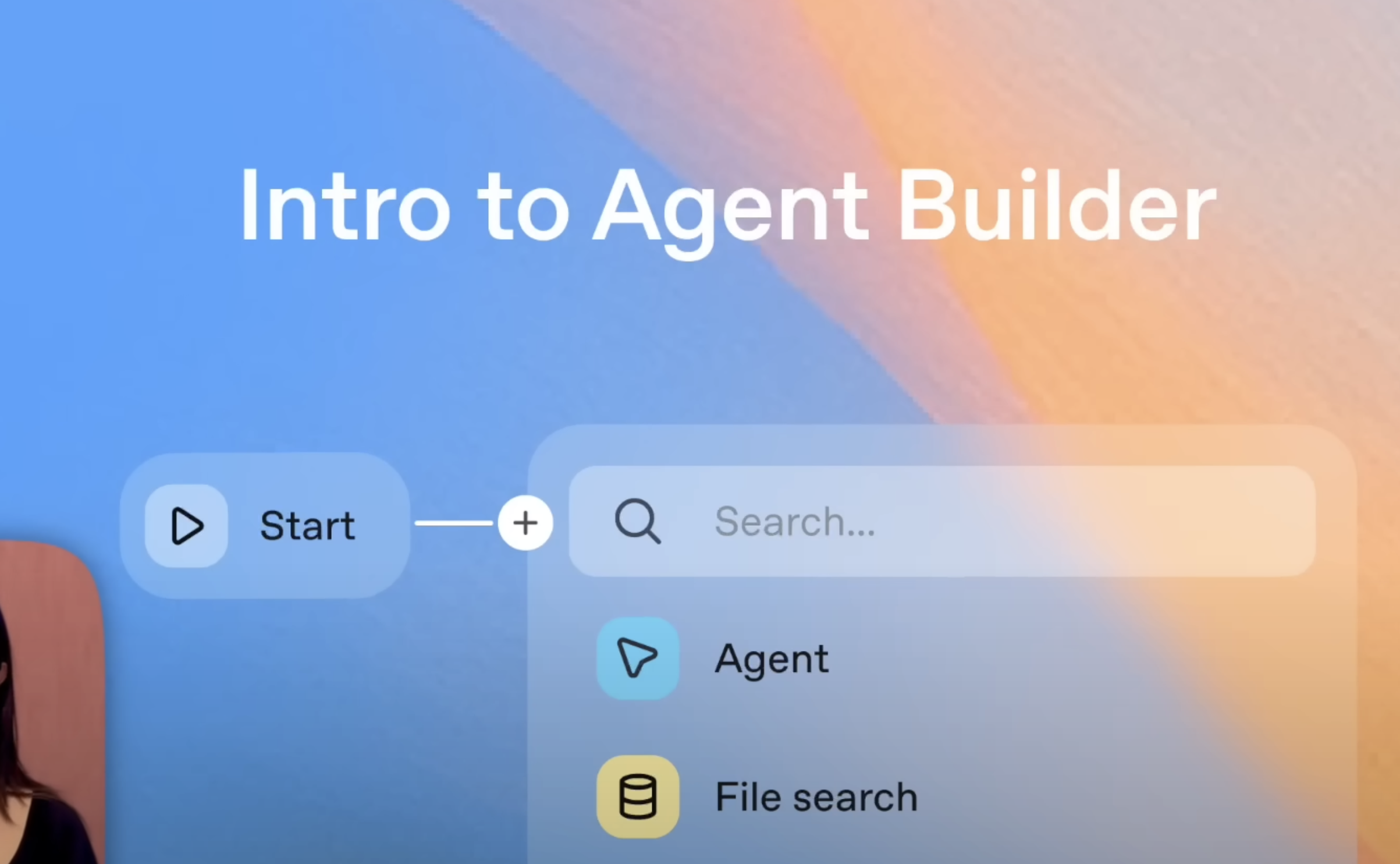
OpenAI’s DevDay 2025 marks a turning point: from a simple API provider, the publisher becomes an end-to-end AI platform. Its two flagship announcements – AgentKit and the Apps SDK – now make it possible to build, without multiplying tools, autonomous server-side agents and interactive client-side ChatGPT applications.
For developers, prototyping speeds up significantly; for product teams, the offering unlocks direct access to ≈ 800 million weekly users; for executives, governance building blocks finally reduce the gap between enthusiasm and control.
If your organization is considering industrializing language-model-based workflows within the next 18 months, these two SDKs should be at the very top of your shortlist of candidate technologies.
What was announced at DevDay 2025?
AgentKit at a glance
AgentKit is an all-in-one assembly line for AI agents. A visual Agent Builder translates multi-step logic into a drag-and-drop canvas. The Connector Registry then links these agents to SaaS applications or internal systems.
ChatKit embeds a white-label conversational interface into any product, while built-in Guardrails modules ensure compliance with internal policies. Everything is built on the new Responses API, which merges conversation, tool calls, and conditional logic into a single request.
Apps SDK at a glance
The Apps SDK allows third-party publishers to ship full applications inside ChatGPT itself. Apps can display cards, forms, or charts, authenticate the user via their back end, and rely on the Model Context Protocol (MCP) for their tool calls. Concretely, ChatGPT becomes an app store sharing the same user pool as above.
AgentKit orchestrates autonomous reasoning and system-to-system actions, while the Apps SDK polishes the user experience.
Thanks to MCP, an AgentKit workflow can render its output in an application card, and conversely an app can delegate complex reasoning to an AgentKit agent. Back-end autonomy and front-end reach are thus brought together.
Understanding these new offerings
| Criteria | AgentKit | Apps SDK |
|---|---|---|
| Main function | Creation and orchestration of autonomous agents | Integration of third-party applications into ChatGPT |
| Interface | Drag-and-drop visual canvas | GUI components (cards, sliders…) |
| Key standard | Responses API | MCP* |
| Distribution | ChatKit widget & API | ChatGPT App Store + contextual suggestions |
* MCP: Model Context Protocol.
From model provider to platform provider
OpenAI now controls orchestration, interface, and distribution. New monetization levers are emerging (marketplace fees, model usage, in-chat transactions), and the publisher can impose de facto standards ahead of its competitors.
Impact for developers and start-ups
The no-code Agent Builder drastically reduces time-to-MVP, and the ChatGPT directory offers built-in discovery.
In return, some start-ups specialized in orchestration or plug-ins risk functional redundancy, a classic phenomenon when an infrastructure provider moves up the stack.
Advantages for enterprises
Admin consoles, audit logs, and policy-level guardrails directly address CIO concerns about data management and compliance.
Early feedback – Klarna resolves 67% of tickets, Clay increases lead yield tenfold – demonstrates a tangible ROI.
Detailed analysis of AgentKit
Agent Builder interface
The drag-and-drop visual canvas makes it possible to chain model calls, tool triggers, and conditional branches as easily as assembling graphical blocks.
Every change is versioned; Marketing can test a qualification flow while Engineering experiments on a dedicated branch. Preview panes show execution traces in real time, bringing the prompt → test → deployment loop down to a few minutes.
Connector registry
From launch, connectors to Dropbox, Salesforce, Slack, or SharePoint are available. IT teams can approve or ban each connector and restrict data access field by field. A service not listed? Publish your own MCP-compliant connector to guarantee portability.
ChatKit
ChatKit provides a production-ready chat widget. Colors, typography, avatar: everything is customizable so the user sees your brand, not OpenAI’s. The widget streams messages as the reasoning unfolds, delivering the expected responsiveness.
Evaluations and guardrails
AgentKit includes a library of guardrails and proprietary evaluation modules. Each run is traceable; you measure accuracy, spot policy violations, and choose a fail-open or fail-closed mode. Compliance teams finally have complete audit logs, essential for a confident deployment.
Internal architecture
All requests go through the Responses API, capable of handling multi-turn reasoning and tool calls in a single exchange.
A lightweight SDK drives memory and sub-agents, while MCP standardizes the exposure of functions and UI. Loose coupling between reasoning, action, and presentation makes maintenance and evolution easier.
Detailed analysis of the Apps SDK
Conversation and graphical interface: the fusion
ChatGPT apps turn a text response into an interactive experience. Ask a real-estate service for properties under a budget: a map appears in the chat.
Request an evolving playlist: the audio player appears instantly. The user no longer switches between tabs; they converse, explore, and act in a single flow.
Developer flow
An app consists of:
- an MCP server that exposes tools and handles authentication;
- a JavaScript/HTML bundle containing the graphical interface.
Engineers code bespoke logic or use schema-driven no-code forms. Since the spec is open, your assets will work tomorrow on any MCP-compatible assistant, thereby protecting the investment.
Distribution and monetization
Validated apps will appear in a dedicated App Store and can be invoked by name or suggested contextually. An agentic commerce protocol will enable purchasing without leaving the chat, positioning ChatGPT as both a discovery and payment channel.
Strategic analysis
OpenAI’s rise
By moving up the value chain, from model publisher to application platform, OpenAI captures more revenue and increases switching costs for its customers, while consolidating its authority in the ecosystem.
Zapier and n8n dominate classic automation but lack multi-step reasoning. Google Vertex AI bets on model choice and cloud integration. Anthropic focuses on safety. Meta pushes open-source with Llama to commoditize the model layer. AgentKit responds with a turnkey solution, favoring speed over total openness.
| Capability | OpenAI | Anthropic | Zapier / n8n | |
|---|---|---|---|---|
| Visual builder | Yes | Yes (no-code console) | No | Yes (automation) |
| Number of connectors | <100 (launch) | 100+ | DIY | 5 000+ |
| Built-in UI kit | ChatKit | Custom code | None | None |
| Open standards | MCP | MCP + A2A | Partial | Webhooks |
| Self-hosting | No | GCP only | Possible | Yes (n8n) |
Impact on startups and SaaS
Startups offering orchestration or plugin frameworks see their differentiators integrated for free into AgentKit. Survivors will bet on niche models, proprietary data, or multi-vendor abstraction to stay relevant.
Use cases
Support automation
At Klarna, an agent resolves 67 % of tickets end-to-end (internal data 2024). The approach: start with FAQ deflection, add controlled transactional actions, then automate refunds once confidence scores are established.
Sales and marketing agents
Clay deploys a prospecting agent that searches for leads, writes personalized emails, and logs everything in HubSpot, increasing qualified leads tenfold in two quarters (positive net ROI despite token cost). A great example of organic marketing strategies. See also our complete guide to content marketing.
Internal assistants
Finance queries Slack for real-time expense reports; HR automates onboarding. Deployments follow a path: sandbox, limited pilot, controlled rollout with weekly reviews.
Analytics and research agents
Consulting firms equip their analysts with agents capable of ingesting thousands of PDFs, generating structured memos, and citing sources. Human review before delivery preserves trust and reduces the research cycle from days to hours.