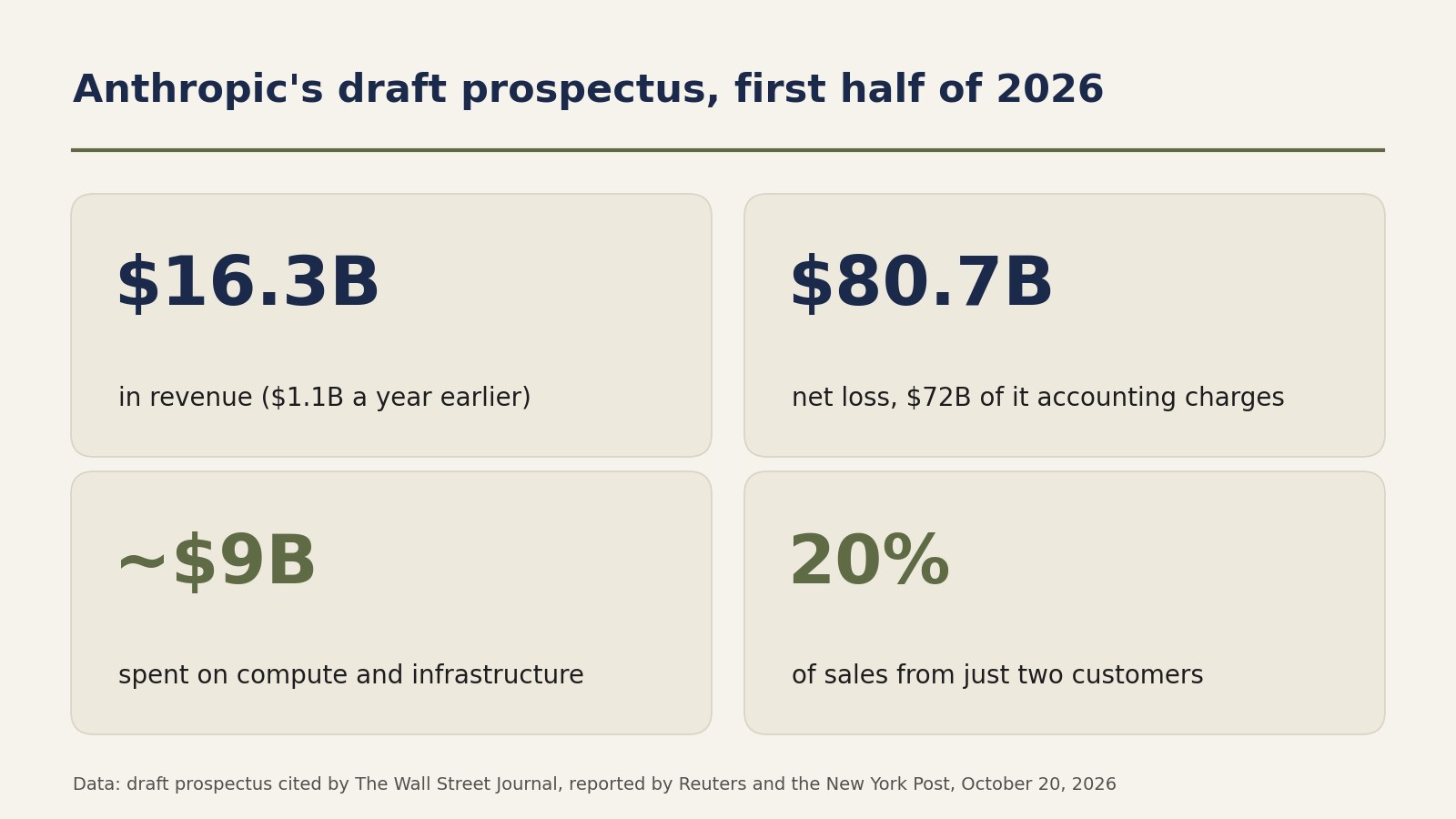

Anthropic, the company behind Claude, posted a net loss of $80.7 billion in the first half of 2026. The Wall Street Journal, which reviewed a draft of the company’s prospectus for its initial public offering, reported the figure on Tuesday, October 20, 2026. About $72 billion of the loss came from accounting charges tied to changes in the value of convertible notes and other instruments the company issued to raise money. Revenue over the same period reached $16.3 billion, up from $1.1 billion a year earlier.
The document is not public. Anthropic confidentially submitted a draft S-1 registration statement to the Securities and Exchange Commission on June 1, 2026. The company declined to comment on the Journal’s figures, which Reuters, Bloomberg and the New York Post picked up within hours.
Revenue up nearly fifteenfold
First-half revenue already exceeds the roughly $4.6 billion Anthropic brought in during all of 2025, according to an earlier draft of the prospectus that Reuters first reported in late September. That version also showed a 2025 net loss of $42 billion.
The quarterly breakdown comes from other sources. In late September, the Financial Times put second-quarter revenue at $11.5 billion, based on the earlier draft. Subtracting that from the first-half total leaves about $4.8 billion for the first quarter.
For the third quarter, Reuters reported last week that revenue rose 45% from the prior quarter to $16.8 billion. The news agency cited an investor who attended a pre-IPO meeting with Anthropic’s leadership in San Francisco.
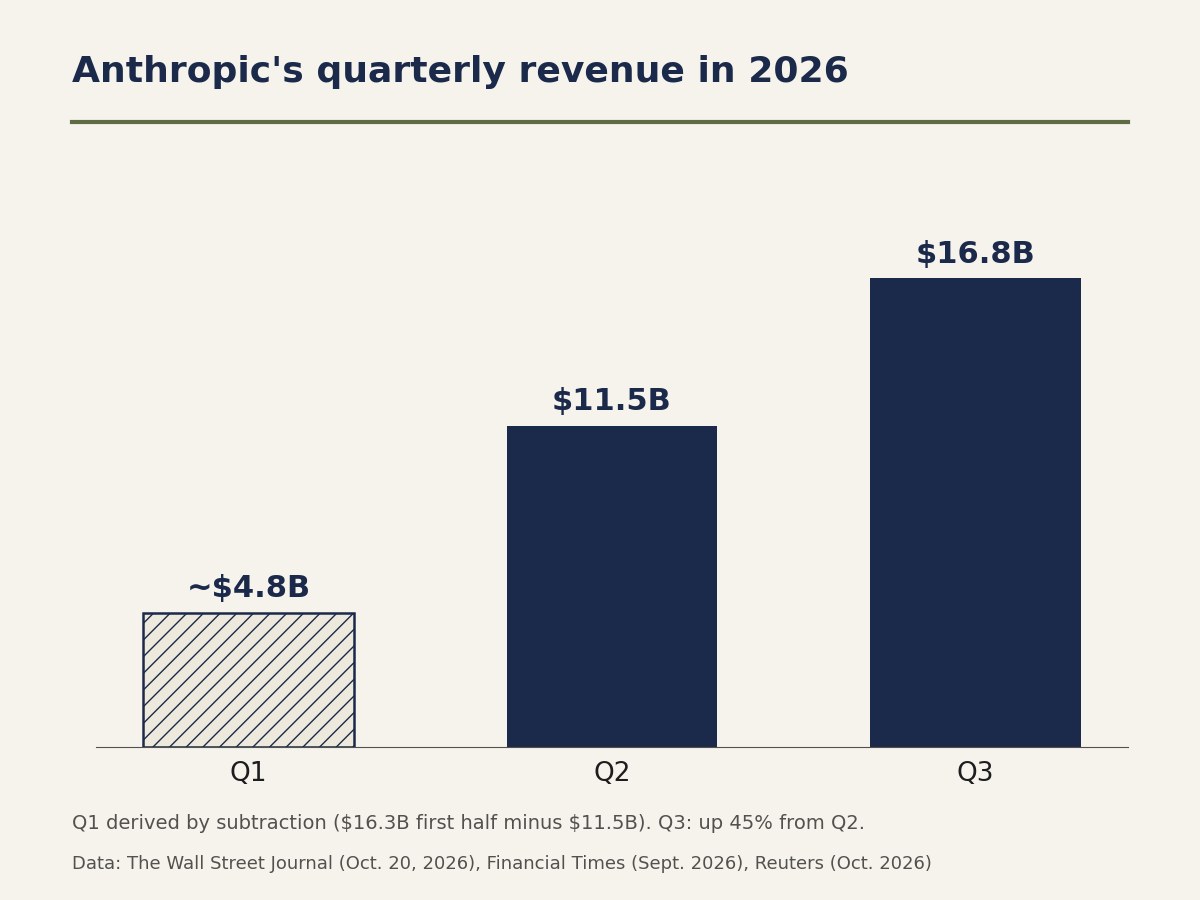
On Reddit, some users read the numbers as growth driven by Claude Code that has flattened out since June. The published figures point to a slowdown instead: revenue more than doubled from the first quarter to the second, then grew 45% in the third.
Two customers, a fifth of sales
About 20% of first-half revenue came from two customers. None of the published reports name them. Anthropic expects a “significant portion” of its revenue to keep coming from a “limited number of customers for the foreseeable future,” according to the draft cited by the Journal. The Financial Times, which reviewed the September version, had already reported that two customers accounted for nearly a quarter of 2025 sales.
Nearly $9 billion on compute in six months
Spending on computing capacity and infrastructure came to nearly $9 billion in the half, compared with $2.3 billion a year earlier and $7.3 billion for all of 2025. That is more than half of the period’s revenue.
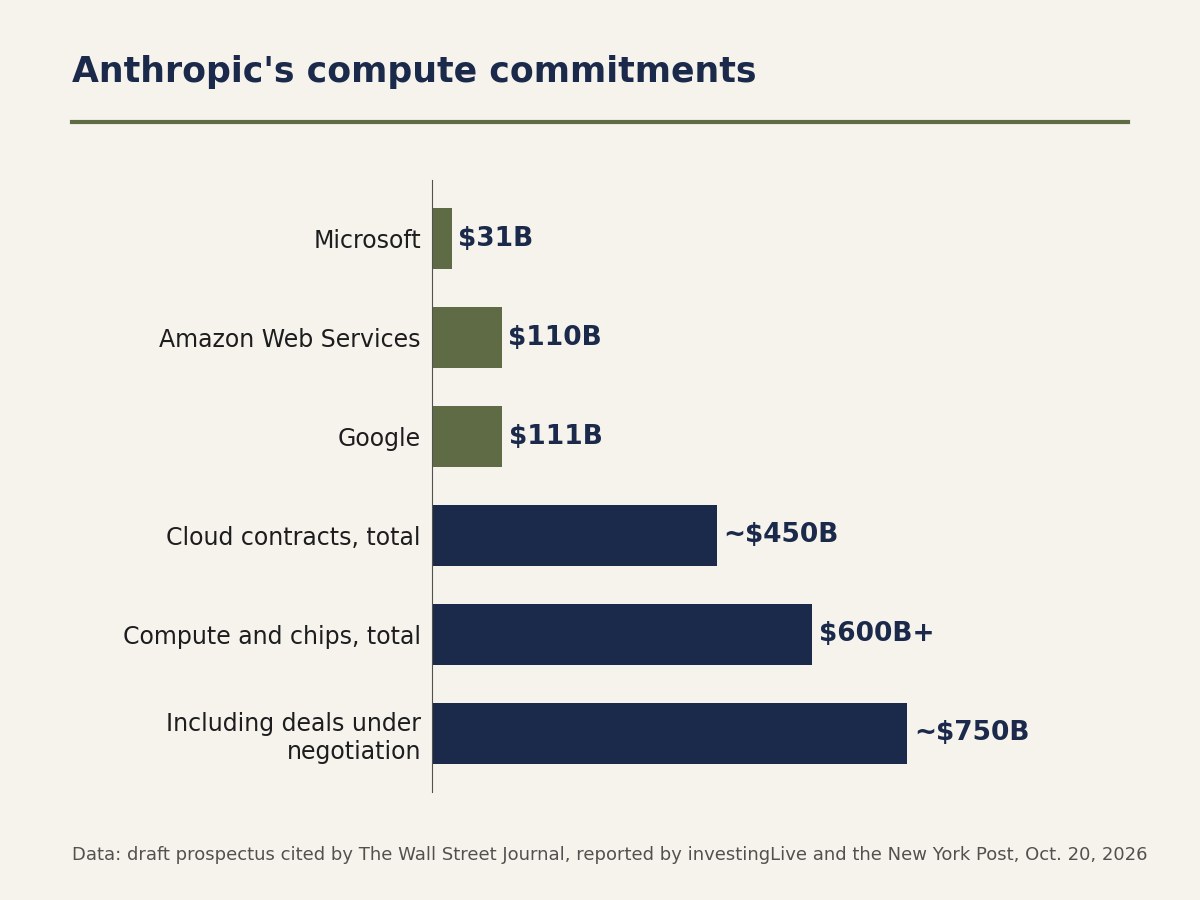
Future commitments are far larger. According to the Journal, Anthropic has signed about $450 billion in mostly noncancelable cloud contracts running seven to 10 years, including $111 billion with Google, $110 billion with Amazon Web Services and $31 billion with Microsoft. Add chip leases and the total tops $600 billion, and deals still under negotiation could add up to $150 billion more. In September, Reuters put those commitments at $518 billion.
Cloud suppliers turned competitors
Anthropic says it has sought more computing capacity than its major cloud partners were willing to provide, and that those partners increasingly see it as a competitor. In posts on October 19 about AI agents inside companies, Microsoft, which is both an investor in and a supplier to Anthropic, wrote that no frontier AI model can be trusted.
Anthropic also leases data centers for its own use and works with third-party operators. According to TechCrunch, the document flags their “limited operating history,” which could make them less reliable than the big cloud providers. Most of Anthropic’s capacity is in the United States, and the company has signed letters of intent for new sites abroad, in countries the published excerpts do not name.
In passages quoted by the New York Post, Anthropic writes that opposition to data centers has “become more organized and coordinated across jurisdictions,” and that its high public profile “may draw particular attention to projects associated with us.”
The risks Anthropic flags
Risk factors take up roughly a third of the document, according to the Journal. Anthropic warns that it could be held liable for harm caused by its models’ behavior and that the damages might exceed its insurance coverage. The September version already mentioned “existential risks to humanity,” TechCrunch reported at the time.
What the Amodeis earn
According to the draft, Dario Amodei, the chief executive, and his sister Daniela, the president, each drew a base salary of about $655,000 in 2025. With stock and option awards, total compensation came to about $18 million for him and $16.5 million for her. The co-founders have each pledged 80% of their stakes to philanthropy. The company also said on October 18 that it would commit 5% of its shares to a public benefit fund.
Still a draft
The first-half figures come from a draft that only The Wall Street Journal says it has read. Reuters, Bloomberg and the New York Post attribute them to the Journal. The numbers could still change before the public filing. As of the night of October 20 to 21, 2026, no public version of Anthropic’s S-1 had appeared on EDGAR, the SEC’s filing database.
The $80.7 billion loss needs context. Strip out the $72 billion in accounting charges and it shrinks to about $8.7 billion, based on simple subtraction from the published figures. The third-quarter figure comes from an investor meeting, outside the draft prospectus. None of the published reports break down revenue among the API, Claude Code and subscriptions.
What it means
The draft offers the first detailed look at Anthropic’s results for the six months through June 2026. The company gets a large share of its sales from a handful of very large accounts and spends more than half of its revenue on compute. It has committed hundreds of billions of dollars to suppliers that have become competitors and that do not give it all the capacity it asks for.
For businesses and freelancers that rely on Claude every day, computing capacity is the most concrete issue. The published excerpts describe a company that asks its cloud partners for more capacity than they provide and that is turning to less proven operators. They do not say whether that affects the usage limits on Claude subscriptions.
Several questions remain open: who the two customers behind 20% of sales are, whether any of the new overseas sites are in Europe, and how the final risk factors will be worded. In exchange for its confidential review, the SEC asks companies to make the registration statement and the earlier drafts public at least 15 days before the investor roadshow. If the November listing goes ahead, the full text will have to appear on EDGAR in the coming weeks. The New York Post reports a valuation that could reach $2 trillion.
Sources
- Anthropic recorded net loss of over $80 billion in first half of this year, WSJ reports, Reuters (via TradingView), October 20, 2026
- Anthropic books staggering $81B loss, warns of data center backlash as Amodei siblings draw modest salaries, New York Post, October 20, 2026
- Anthropic IPO draft shows nearly 15-fold revenue jump and $600 billion in compute deals, investingLive, October 20, 2026
- Anthropic’s cloud partnerships are getting messy, TechCrunch, October 20, 2026
- Anthropic’s prospectus details losses, growth, and, yes, a warning that its AI could end humanity, TechCrunch, September 28, 2026
- Anthropic confidentially submits draft S-1 to the SEC, Anthropic, June 1, 2026
- Enhanced Accommodations for Issuers Submitting Draft Registration Statements, SEC, March 3, 2025
Header image: MACCUS chart, data from The Wall Street Journal as reported by Reuters and the New York Post, October 20, 2026