
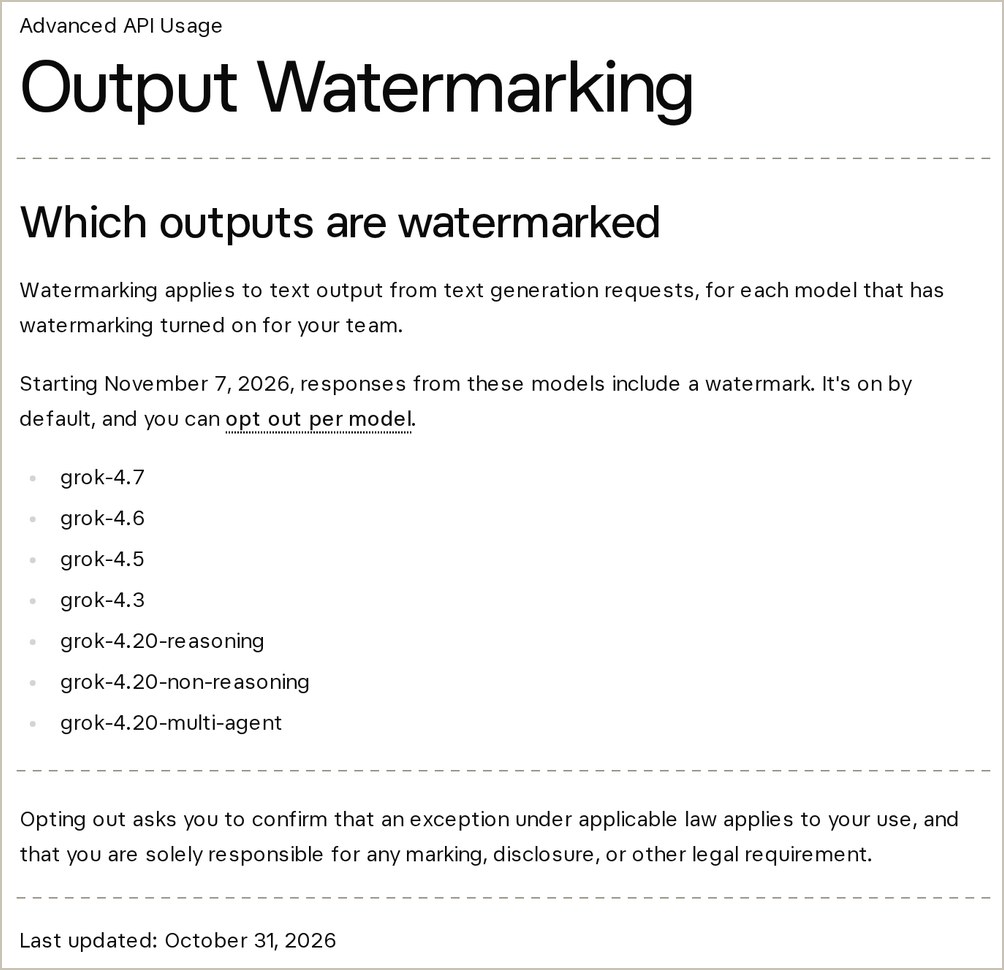
Starting November 7, 2026, text generated by seven Grok models through the SpaceXSI API will carry an invisible watermark. SpaceXSI, formerly xAI and now the SpaceX unit that builds Grok, says so on a developer docs page titled “Output Watermarking,” last updated October 31. The watermark is on by default, and customers who turn it off must declare themselves solely responsible for marking. The company gives a one-line reason: it watermarks text “to comply with the EU AI Act.”
SpaceXSI is the second model maker in a matter of days to put a date on this kind of marking. The first was Anthropic, which told customers by email that it is extending Claude’s watermark to four older models starting November 3. The watermark isn’t in the SpaceXSI API release notes, whose latest entry is dated October 27. TeslaNorth and Crypto Briefing reported the change on October 31, and the Chinese outlet IT Home followed on November 1.
According to Euronews, Elon Musk said in early October that SpaceXAI, the name xAI took after SpaceX acquired it, would become SpaceXSI. The docs now use the new name, but the release notes still refer to “the xAI API,” and web and email addresses still use the x.ai domain.
Seven models, every text API and every endpoint
The watermark covers seven models starting November 7: grok-4.7, grok-4.6, grok-4.5, grok-4.3 and three versions of grok-4.20 (reasoning, non-reasoning and multi-agent). TokenPost and Crypto Briefing list only five, folding the three grok-4.20 versions into one. The coding model grok-build-0.1, which is in early access and appears in the API pricing table, isn’t among the seven.
Marking applies to every text generation API, including the Responses API and the Chat Completions API, at every SpaceXSI endpoint: the global one (api.x.ai) and the regional ones. It covers ordinary text responses, structured outputs and tool call arguments, the parameters a model fills in when it asks an application to run a function.
Developers don’t need to add any parameter to their requests. The response format stays the same except for one addition: an x-watermark HTTP header. A value of true means the response was generated with the watermark; any other value, or no header at all, means it wasn’t.
IT Home wrote on November 1 that the watermark was already enabled on the API in every region. The page’s introduction does use the present tense (“The watermark is enabled on every SpaceXSI API endpoint”), but the section on models says responses start carrying the watermark on November 7. Developers can settle the question for their own requests by reading the x-watermark header.
A mark hidden in token choices
Readers can’t see the watermark. It’s applied during generation: according to SpaceXSI, “it slightly shapes which tokens the model picks, so it adds no characters, markup, or hidden text to the response.” The page says it doesn’t change response quality or speed but gives no figures to back that up.
Detection is statistical. The SpaceXSI tool scores a piece of text and returns one of three verdicts: watermarked, not watermarked or uncertain. Longer text gives a stronger signal. “Access to watermark detection is granted by application,” according to the page, which links to an online form but doesn’t say who qualifies.
Opting out comes with conditions
Only team admins can turn the watermark off, which they do in the SpaceXSI Console. In the team settings, the “Model output watermarking” row shows one of three states: on for all models, off for all models, or custom. The setting is per model and applies to every API key on the team. It takes effect on new requests within five minutes, and the watermark can be turned back on later.
To turn off a model’s watermark, the admin has to confirm “that an exception under applicable law applies to your use, and that you are solely responsible for any marking, disclosure, or other legal requirement.” Every opt-in and opt-out is recorded in the team’s audit log.
Some models may be locked on for a given team. Those models appear in the list without a checkbox, and their watermark can’t be turned off from the Console. For a locked model, the docs point to the team admin first, then to support@x.ai.
The EU’s December 2 deadline
Article 50 of the EU AI Act requires providers of AI systems that generate synthetic audio, image, video or text content to ensure that the outputs are “marked in a machine-readable format and detectable as artificially generated or manipulated.” The transparency rules have applied since August 2, 2026. Providers of systems placed on the market before August 2 have until December 2, 2026, to comply, under Article 111 as amended by the Digital Omnibus package. November 7 falls 25 days before that deadline.
The SpaceXSI page cites the AI Act without naming an article or a date, and without saying which exceptions could justify turning the watermark off. The regulation exempts AI systems to the extent that they “perform an assistive function for standard editing or do not substantially alter the input data provided by the deployer or the semantics thereof,” along with certain uses authorized by law in criminal matters. Customer companies have obligations of their own under the same regulation, such as Article 4 on AI literacy among their staff.
Three approaches to the same obligation
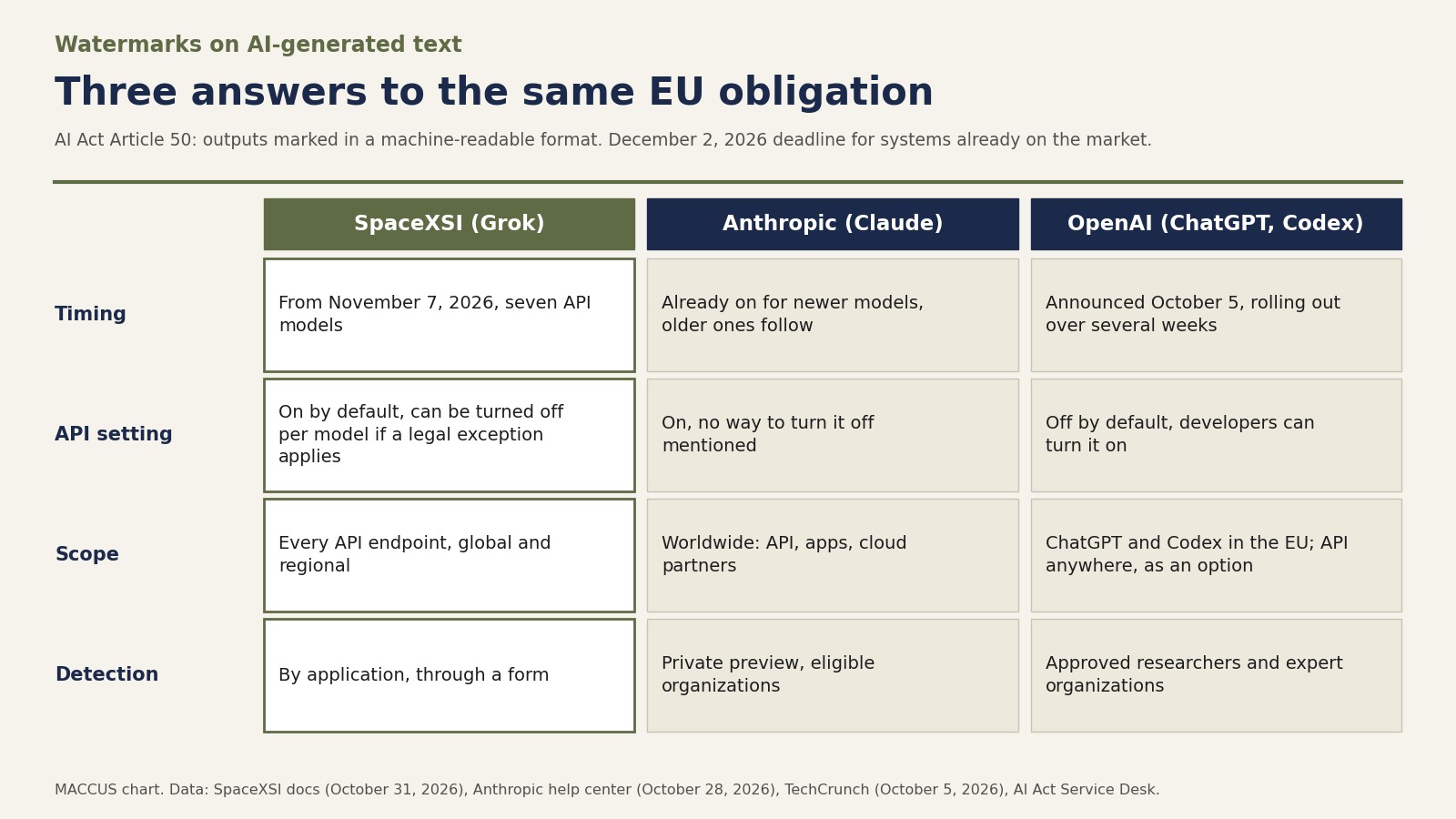
According to Anthropic’s help center, updated October 28, the company watermarks all text generated by its recent models worldwide: on its API, in its apps and through AWS, Google Cloud and Microsoft Foundry. The page mentions no way to turn the watermark off. Anthropic’s detection tool is in private preview, open to organizations eligible under EU law, such as regulators, media outlets and independent researchers.
OpenAI went the other way on its API: according to TechCrunch, the watermark stays off by default there, and developers can turn it on for select models. The outlet reported on October 5 that OpenAI would roll out the watermark, called textGrain, to ChatGPT and Codex over the following weeks, in the European Union only. OpenAI is giving detector access first to approved researchers and expert organizations.
SpaceXSI sits in between: the watermark is on by default for seven models on its API, at every endpoint, and a customer team can turn it off if it accepts sole responsibility for marking.
What the docs leave out
The page covers the API only. It says nothing about the Grok apps or Grok on X, and nothing about images and videos made with Grok Imagine. The docs list Google Cloud Vertex AI and Microsoft Foundry as platforms that offer Grok, but their pages don’t mention the watermark.
As with response quality, the page gives no figures on how reliable detection is. Its only word on how well the mark survives editing, paraphrasing or translation is that longer text gives a stronger signal. In one OpenAI test reported by TechCrunch, replacing 10% of the words with synonyms cut the detection rate from about 92% to 66%.
What it means
The default setting puts the burden on whoever wants to drop the watermark. A team that leaves it on has nothing to do. A team that turns it off has to state that a legal exception covers its use and declare itself solely responsible for marking. That choice stays on record, model by model, in an audit log.
Businesses, agencies and developers that call Grok through the API from in-house tools or automated workflows will get watermarked text from the seven covered models starting November 7 unless they turn it off. Without detector access, they have no way to check already-published text for the mark. Their only signal is the x-watermark header, which they see at generation time.
The three companies are meeting the same obligation with three different watermarks, each with a restricted detector. Article 50, however, asks for technical solutions that are “interoperable” as far as technically feasible. For model training, Google, Microsoft, OpenAI and Anthropic committed on October 30 to honor the same robots.txt signal. SpaceXSI, Anthropic and OpenAI have announced no shared tool for reading their watermarks.
On November 7, the x-watermark header will show whether the watermark starts on schedule. Still unanswered: whether the Grok apps, Grok Imagine and the Vertex AI and Foundry platforms are covered, who can get access to the detector, and which exceptions SpaceXSI will accept. The December 2 deadline applies to every provider of systems that generate text, audio, images or video and were on the market before August 2.
Sources
- Output Watermarking, SpaceXSI (API docs), last updated October 31, 2026
- Release Notes, SpaceXSI (API docs), accessed November 1, 2026
- Article 50: Transparency obligations for providers and deployers of certain AI systems, European Commission (AI Act Service Desk), accessed November 1, 2026
- Article 111: AI systems already placed on the market or put into service and general-purpose AI models already placed on the market, European Commission (AI Act Service Desk), accessed November 1, 2026
- How Claude marks AI-generated content, Anthropic (Help Center), updated October 28, 2026
- OpenAI will start watermarking ChatGPT’s text in the EU, TechCrunch, October 5, 2026
- 响应欧盟 AI 法案,Grok 模型生成的文本将添加隐形水印, IT Home, November 1, 2026
- Musk to follow Trump and rebrand SpaceXAI as SpaceXSI, Euronews, October 5, 2026
Header image: MACCUS chart. Data: SpaceXSI docs (October 31, 2026), Anthropic Help Center (October 28, 2026), TechCrunch (October 5, 2026), AI Act Service Desk (European Commission).