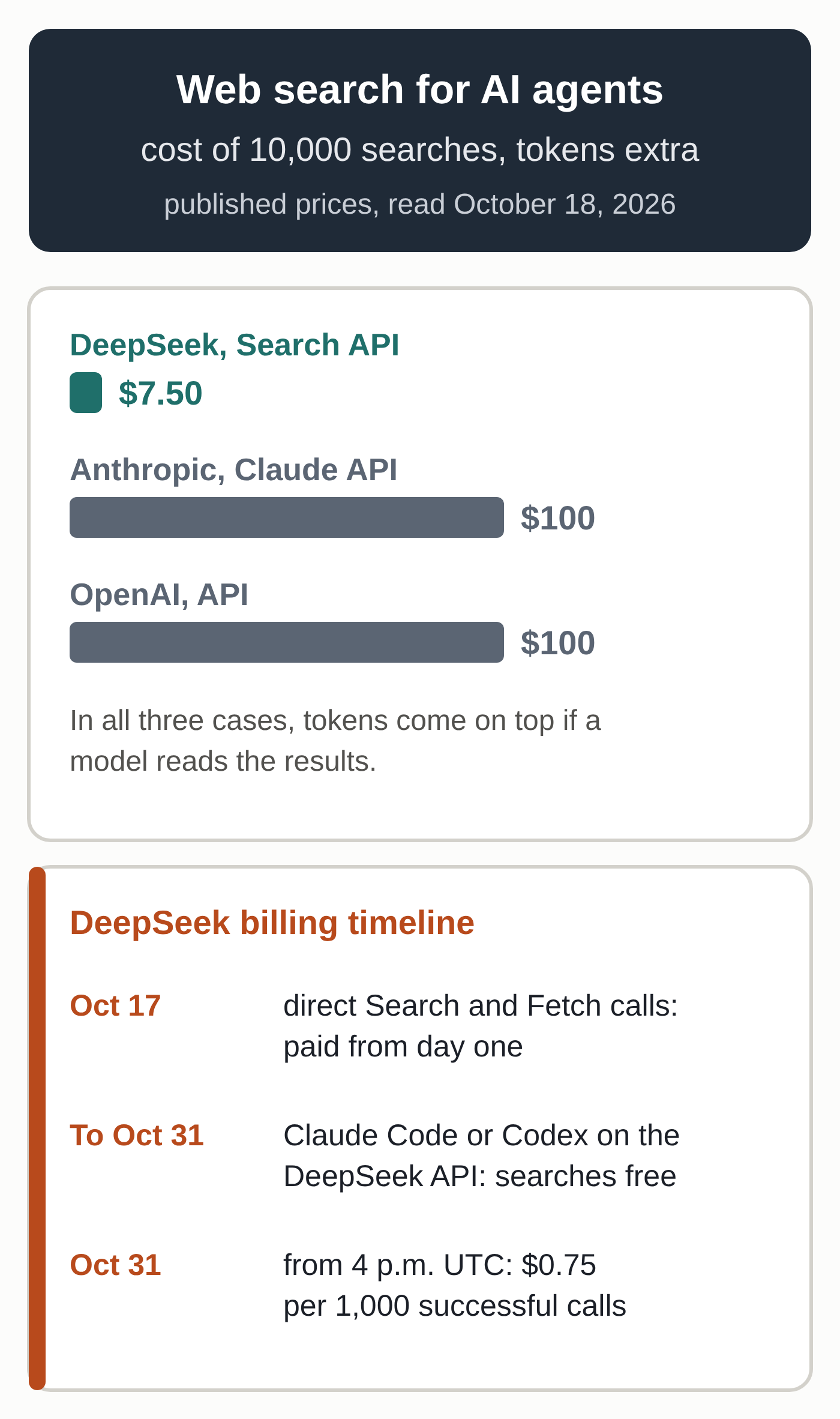
On October 17, 2026, DeepSeek opened two APIs to every developer, both powered by its in-house search engine: Search, which queries the web, and Fetch, which reads a page. Each costs $0.75 per 1,000 successful calls. Anthropic and OpenAI charge $10 per 1,000 web searches on their APIs. Each search is about 13 times cheaper at DeepSeek, not counting tokens.
Web searches from Claude Code or Codex running on the DeepSeek API stay free until October 31, 2026, at 4 p.m. UTC (noon Eastern), and are billed at the same rate after that. On October 17, the Chinese company also updated its fast model, DeepSeek-V4.1-Flash-1017, across its website, app and API.
Two APIs billed per call
Search takes a query and returns a list of pages: title, URL, a short snippet for display, a summary of roughly 600 to 800 characters meant for a model, and the publication date. DeepSeek adds two scores of its own: relevance (0 to 3) and authority (0 to 4). Fetch takes a single URL and returns the page text as Markdown. Both live at api.deepseek.com and use your regular DeepSeek API key, according to the Search & Fetch guide, which we read on October 18.
A query can run from 1 to 128 characters, supports the site:, -site:, lang:, after: and before: operators plus exact phrases in quotes, and returns 1 to 50 results (10 by default). The need_content option adds the page text to the response, which can save you a Fetch call per result.
Only successful calls are billed: errors, searches with no results and timeouts cost nothing. The price doesn’t depend on the number of results, so a call that returns 50 results costs the same as one that returns 10. Each API is capped at 5 requests per second per account, and Fetch adds a per-domain limit.
How the price compares with Anthropic and OpenAI
Take a monitoring agent that runs 10,000 searches a month, a little over 300 a day. At DeepSeek, those calls cost $7.50. On the Claude API, where Anthropic charges $10 per 1,000 searches, the bill comes to $100, and OpenAI charges the same for its web search tool.
| Service | Price per 1,000 searches | Also billed |
|---|---|---|
| DeepSeek, Search API | $0.75 | tokens, if a model reads the results |
| Anthropic, Claude API web search | $10 | tokens for the pages Claude reads |
| OpenAI, API web search | $10 | search content tokens, at the model’s rate |
Prices are from the official pages as of October 18, 2026. At OpenAI, the “preview” version of the tool costs $25 per 1,000 calls on non-reasoning models, search content included. For reading pages, the gap runs the other way: the web fetch tool on the Claude API is billed on tokens alone, while DeepSeek’s Fetch costs $0.75 per 1,000 calls.
The roughly 13-to-1 gap applies only to the price of a call. Search is a raw API: your program calls it, gets JSON back and decides what to do with it. At Anthropic and OpenAI, web search is a tool the model calls on its own during a conversation.
Either way, having a model read the results costs tokens. As of October 18, we could find no independent comparison of result quality.
Free searches end October 31
Claude Code, Anthropic’s coding agent, can also run on DeepSeek’s models. According to DeepSeek’s integration page, you point it at https://api.deepseek.com/anthropic with a DeepSeek API key. Its web searches then go through DeepSeek’s engine, and summarizing the pages uses extra tokens.
Search and Fetch calls made through Claude Code, Codex (OpenAI’s coding agent) or DeepSeek Harness, the company’s own tool, “are currently free for DeepSeek API users,” according to DeepSeek’s announcement. Per-call billing starts October 31, 2026, at 4 p.m. UTC, which is noon in New York, 5 p.m. in Paris and midnight on November 1 in Beijing. For Codex, DeepSeek notes that web search works only with its deepseek-v4-pro model and that its setup script turns it off by default.
Nothing changes if you use Claude Code with a Claude subscription or an Anthropic API key: your searches go through Anthropic, on its terms. Direct calls to Search and Fetch from your own scripts have been billed since the APIs opened on October 17. Chinese tech site IT Home reported the billing notice on October 18.
A Flash model update the same day
DeepSeek-V4.1-Flash-1017 replaces the September 10 version under the same API model name, deepseek-flash, at the same price. DeepSeek calls it “a Pareto improvement in performance and cost”: better scores, faster task completion and shorter outputs, which lowers the cost per task. The Hugging Face model card describes it as a minor update, released under the MIT license. In September, DeepSeek put V4.1-Flash at 552 billion parameters.
In DeepSeek’s own benchmark table, the model rises from 74.2 to 77.0 on DeepSWE v1.1, ahead of Claude Opus 5 (74.0). On Terminal-Bench 4.0, run with Claude Code, it climbs from 31.2 to 42.3, but Opus 5 stays ahead at 51.8, as it does on ProgramBench, NL2Repo and HLE.
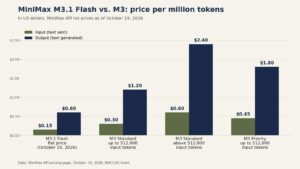
Off-peak, Flash pricing stays at $0.15 per million input tokens on a cache miss and $0.60 per million output tokens. Prices double during peak hours, 1 a.m. to 4 a.m. and 6 a.m. to 10 a.m. UTC, Monday through Friday, excluding Chinese public holidays. That covers most of the office morning in Paris or Berlin. On the US East Coast, they fall on Sunday through Thursday evenings and in the early hours of weekdays. Two days later, on October 19, MiniMax launched M3.1 Flash at the same $0.15 and $0.60, with no peak-hour surcharge.
Open questions
DeepSeek says its engine serves “hundreds of millions of requests daily worldwide.” Only the Chinese version of the announcement adds that the engine indexes on the order of 100 billion pages and filters out SEO spam, GEO (generative engine optimization) manipulation and low-quality AI-generated content. As of October 18, we could find no independent verification of those claims.
Site owners get little to go on: the guide only says fetching “is subject to the target site’s availability and access policies.” It doesn’t say which user agent Fetch sends or whether it respects robots.txt.
Then there’s the data question. Every query goes to DeepSeek with whatever it contains: a prospect’s name, a competitor’s URL, the topic of a client file. DeepSeek’s privacy policy, last updated February 10, 2026, says that “we directly collect, process and store your Personal Data in People’s Republic of China.” The terms of its API platform, in effect since April 29, 2026, are governed by the laws of mainland China.