On November 13, 2026, the Chinese AI company DeepSeek opened the tools behind its chatbot app to developers: web search with citations, file and link reading, safety checks and voice. Apps built on its models can now offer most of the same features.
Developers switch on the built-in search, file input, link reading and safety checks with a few settings in DeepSeek’s API, the interface that other software uses to call its models. Voice and document text recognition (OCR) are separate APIs, and OCR costs $0.225 per 1,000 pages.
The release follows DeepSeek’s October 17 launch of its web search and page-reading APIs, Search and Fetch, at $0.75 per 1,000 calls. Both keep that price. The built-in features run on deepseek-flash, the cheaper of DeepSeek’s two API models, in its existing V4.1-Flash-1017 version. DeepSeek did not announce a new model.
For French-language products, voice is the weak point. DeepSeek’s speech-to-text service understands French, but its text-to-speech service doesn’t speak it. Both voice services are half price for now, and DeepSeek doesn’t say for how long.
Five app features developers can switch on
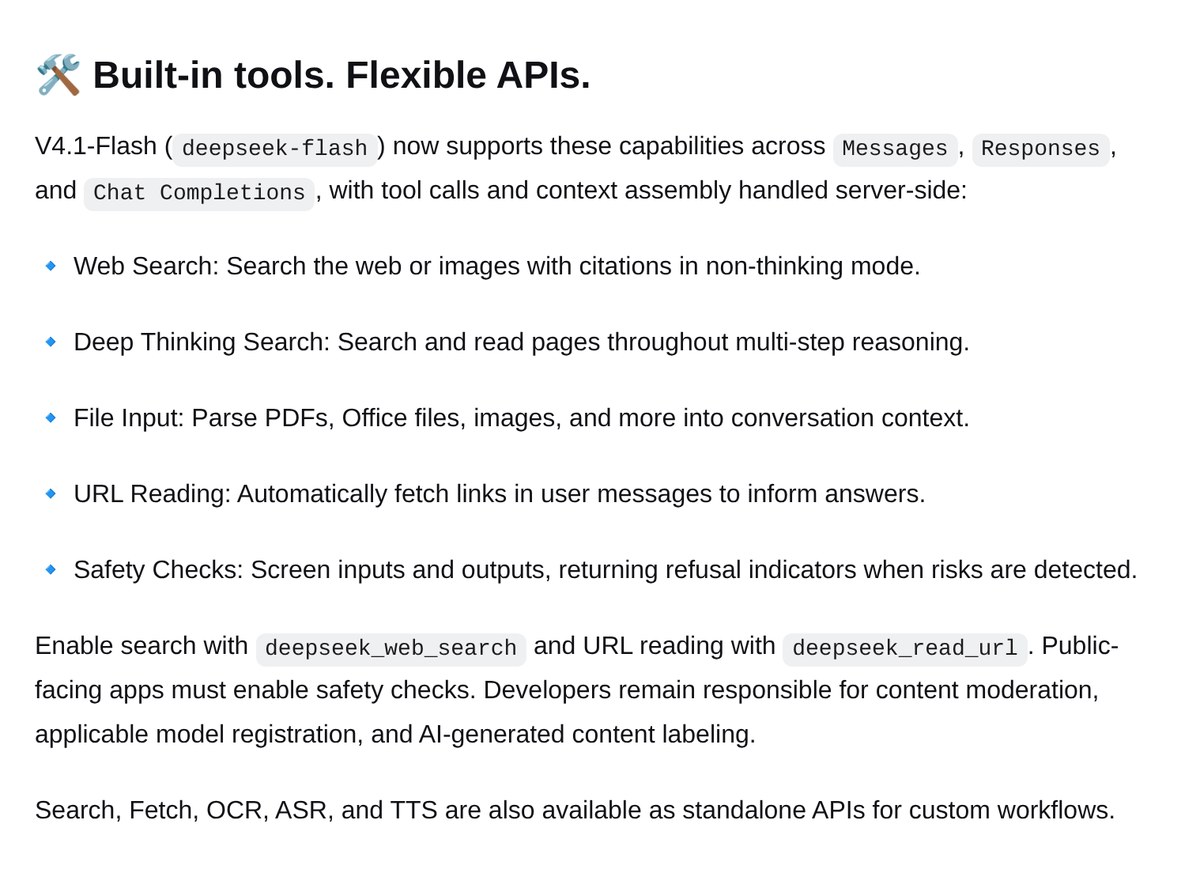
“Search, files, links, safety, and voice. The capabilities behind the DeepSeek App are now available through the DeepSeek API,” the company wrote in its November 13 post. According to its change log, a developer turns on an option in the API request. DeepSeek’s servers then run the searches or page reads themselves and add the results to the conversation.
The model decides on its own whether to search the web. Requests can use the format of Claude maker Anthropic’s API, called Messages, or OpenAI’s two formats, Responses and Chat Completions. DeepSeek announces the features for deepseek-flash only.
DeepSeek describes five features:
- web search over text or images, with citations in the answer, through the deepseek_web_search tool with thinking mode (step-by-step reasoning) turned off;
- search in thinking mode, where the model searches and opens pages at several steps of its reasoning;
- file input: PDFs, Word and PowerPoint documents and images, read as plain text or with their layout and figures, then added to the conversation;
- link reading, with the deepseek_read_url tool: the model spots the web addresses (URLs) in the user’s message and reads the pages, up to the first 10 distinct URLs;
- safety checks, which screen the user’s prompts and the model’s answers and return a refusal when they detect a risk.
Tool fees, on top of tokens
Tools used during a conversation are billed on top of tokens, the chunks of text the model reads and writes. The standalone OCR, speech-to-text and text-to-speech APIs are billed by the page, the second and the character, respectively.
| Tool | List price | Current price |
|---|---|---|
| Web search (text or image) | $0.75 per 1,000 searches | same |
| Page reading (Fetch) | $0.75 per 1,000 fetches | same |
| File parsing and OCR | $0.225 per 1,000 pages | same |
| Speech to text | $0.116 per hour of audio | $0.058 |
| Text to speech | $0.45 per 10,000 characters | $0.225 |
For voice, the pricing page shows a “Limited-time price (50% off)” with no end date. Search and page reading cost the same whether the developer calls the APIs directly or the model uses them during a conversation. A file attached to a conversation is billed once, by the page; later questions about it cost tokens.
Token prices for deepseek-flash have not changed, Pandaily, a news site that covers Chinese tech, noted on November 14. At peak hours, the model costs $0.30 per million input tokens (text sent to it) and $1.20 per million output tokens (text it writes). Off-peak, both prices are halved.
The input price is the cache-miss rate, for text not stored from an earlier request. Peak hours run from 1 a.m. to 4 a.m. and from 6 a.m. to 10 a.m. UTC (universal time), Monday through Friday, except on Chinese public holidays. The safety checks also use tokens, billed as output tokens.
Standalone APIs for documents and voice
OCR handles documents of up to 1,000 pages
The OCR API recognizes the text in a PDF, a Word or PowerPoint document or an image (PNG, JPEG, TIFF and other formats), page by page. A file can run to 1,000 pages and 100 MiB, about 105 megabytes. Upload, recognition and response must fit within 180 seconds in total.
There are two modes, text recognition and rich layout recognition. Text recognized page by page keeps the position of each region on the page, so developers can locate the text and crop figures. DeepSeek says the text it returns is the model’s raw output, “without any cleanup.”
Only recognized pages are billed, so a failed or timed-out job costs nothing. An account can run at most 15 OCR jobs at once.
Two-minute clips for speech to text
The speech-to-text API covers 21 languages, including French, German, Spanish, Italian and Portuguese. The model detects the language on its own, and developers can’t set it. The whole transcript comes back in one response once the audio is processed. DeepSeek gives voice input in a chatbot as an example use.
Each audio file is capped at 120 seconds and 8 MiB, in the WAV (16-bit PCM) or Ogg Opus audio format. With that cap, a one-hour meeting has to be cut into at least 30 files. On a stereo recording, only the left channel is transcribed.
Text to speech has no French voice
The text-to-speech API reads text aloud in 10 languages: Mandarin, Cantonese, English, Japanese, Korean, Malay, Arabic, Indonesian, Thai and Vietnamese. French, German and Spanish are not on the list.
It offers two voices: a female voice called Stella and a male voice called Tide. A request can hold up to 10,000 billed characters, and each Chinese character counts as two. The reading speed can’t be adjusted, and the service rejects text that fails its content review.
An open-source demo app rebuilds the chatbot
DeepSeek also released chat-demo, a sample app that rebuilds its chatbot on these APIs. The code is open source under the MIT license, which lets anyone reuse it, even commercially. A version runs online, with an interface in Chinese and English. It handles search, link reading, attachments, dictation and reading answers aloud.
The demo runs in the browser, with no server in between. Users enter their own API key, the secret code that identifies their account, and the browser stores it on their device. They can also import chat history exported from DeepSeek. DeepSeek’s Build a Chatbot guide says the demo is “for demonstration only.”
On October 31, DeepSeek had already put a prototype coding agent on GitHub, labeled a research prototype.
Moderation stays with the developer
DeepSeek sets one rule in its post: “Public-facing apps must enable safety checks.” Developers, DeepSeek adds, “remain responsible for content moderation, applicable model registration, and AI-generated content labeling.” The company doesn’t say which regulations those obligations refer to.
DeepSeek’s safety guide says turning on the safety checks doesn’t replace the developer’s obligations as the service provider. The developer bears the primary responsibility for reviewing content, the guide adds. A refused response doesn’t say why. Text already shown on screen can’t be pulled back, so the app has to hide it itself.
Gaps in DeepSeek’s documentation
DeepSeek publishes prices and technical limits, but no quality figures for OCR, speech to text or text to speech. The OCR guide doesn’t list the languages it recognizes, so nothing says how it handles a document in French. The post names no customers and makes no commitment on service availability.
The post and the guides also don’t say where uploaded files and recordings are processed. DeepSeek’s privacy policy, last updated February 10, 2026, says the company collects, processes and stores personal data in the People’s Republic of China. Its developer platform’s terms of service refer to that policy for developers’ own data. For people using an app built on the API, the same terms name the developer as the data controller, who must tell those users how their data is handled.
What it means
DeepSeek’s servers now run searches and read links when the model decides to, and add attached files to the conversation. In October, Search was sold mainly as a raw API that the developer’s program had to call. DeepSeek tells developers they can “spend less time rebuilding the basics.”
DeepSeek’s API now works more like Anthropic’s, where Claude decides on its own when to search. The price gap remains: Anthropic charges $10 per 1,000 web searches on the Claude API, against $0.75 at DeepSeek, with tokens on top in both cases.
The release matters first to developers and agencies that build chatbots, document-reading tools or voice interfaces. It comes a month after the case of Revolut, the online bank where about 2,000 engineers now code with a Chinese model the bank hosts itself. For a French-language product, the offer is incomplete: speech to text understands French but only in two-minute pieces, and there is no French voice.
Three questions remain open: how well OCR and speech to text handle French documents and voices, how long the voice discount lasts, and how and where uploaded files are handled. Two things are worth watching: whether European languages come to text to speech, and the first independent tests of these tools.
Sources
- The full DeepSeek App experience, now via API, DeepSeek, November 13, 2026
- Change Log, Releasing the full suite of application APIs, DeepSeek, November 13, 2026
- Models & Pricing, DeepSeek, viewed November 14, 2026
- OCR, Speech to Text, Text to Speech, Model Content Safety, Web Tools, File Parsing and Build a Chatbot, DeepSeek guides, viewed November 14, 2026
- deepseek-ai/chat-demo, GitHub, viewed November 14, 2026
- DeepSeek Privacy Policy, DeepSeek, February 10, 2026, and DeepSeek Open Platform Terms of Service, DeepSeek, April 29, 2026
- Web search tool, Anthropic, viewed November 14, 2026
- DeepSeek Opens Its App’s Search, File, OCR and Voice Tools as APIs So Developers Can Rebuild the App, Pandaily, November 14, 2026
Header image: MACCUS chart. Data: DeepSeek API pricing page and guides, viewed November 14, 2026