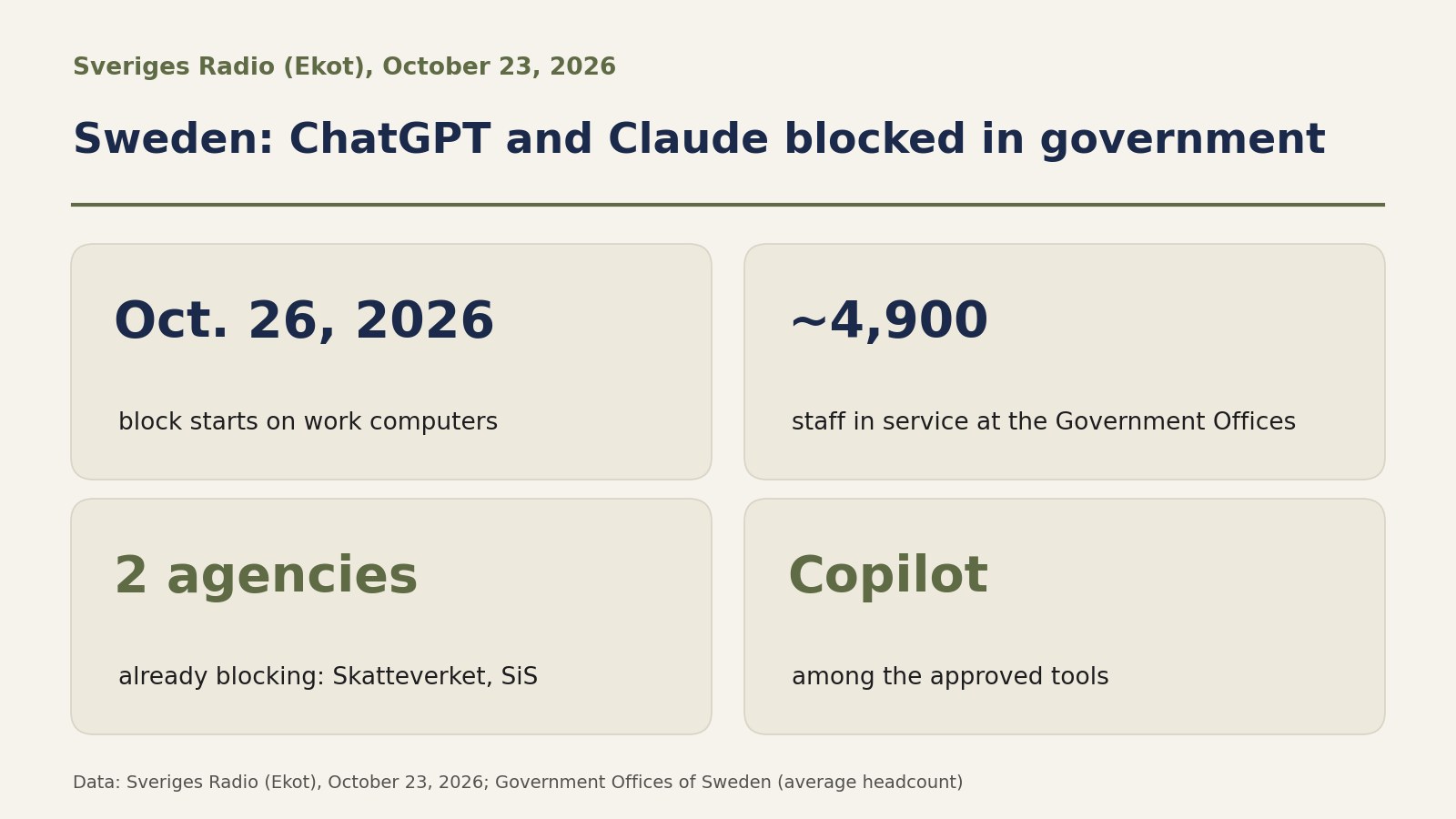

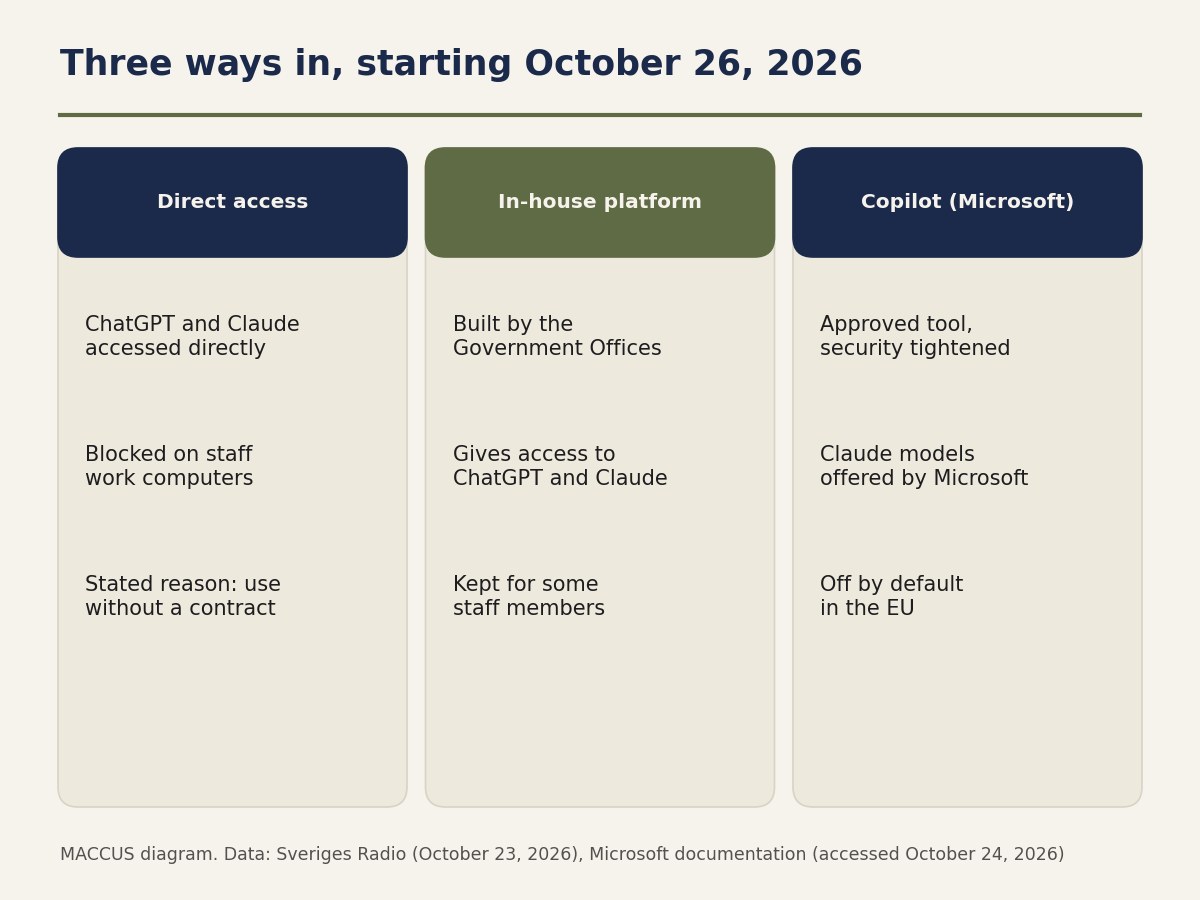
Starting Monday, October 26, 2026, staff at Sweden’s Government Offices (Regeringskansliet), which includes the prime minister’s office and the ministries, will no longer be able to open ChatGPT or Claude on their work computers. Public broadcaster Sveriges Radio reported the move on Friday, October 23, on its Ekot news program. The goal is to steer employees toward approved services, including Microsoft’s Copilot.
The Government Offices employs about 5,100 people on average, roughly 4,900 of them in active service, according to its website. Two other Swedish agencies already block such tools, and a third is still deciding.
A block on work computers
The measure relies on a list of internally approved tools, the approach some companies take in their AI use policies. After a review, officials also tightened Copilot’s security, according to internal information seen by Ekot. The press office declined to give details, citing security reasons. The Government Offices had already restricted use of the Chinese assistant DeepSeek.
In a message on the staff intranet, Mikael Wettercrantz, the director of digitalization, wrote that using AI services without a contract can have “consequences for our information security.” He turned down Ekot’s interview request.
Some employees will keep access to both assistants. According to the press office, they will continue to use an AI assistant platform the Government Offices developed itself, which gives access to ChatGPT and Claude. Ekot does not say how many people that includes.
The trade publication Computer Sweden and the tech news site Breakit picked up the story the same day, citing Ekot.
Sweden’s tax agency already took similar steps
According to Ekot’s survey of government agencies, the Swedish Tax Agency (Skatteverket) and the National Board of Institutional Care (Statens institutionsstyrelse, SiS) have already put similar blocks in place. The Swedish Enforcement Authority (Kronofogden) is still working out its position.
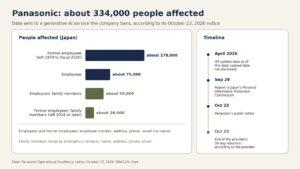
Ekot also points to the Swedish Transport Administration, Trafikverket, whose internal audit found widespread and risky use of about 10 AI services earlier this year. The auditors wrote that they had seen “several examples of problematic use of publicly available AI services.” The examples concerned “both the sensitivity of the information entered and how the AI-generated answers were handled.” The same day in Japan, a Panasonic group company disclosed that a project member had put data on about 334,000 people into an AI service the company bans.
Copilot can run Claude too
According to Microsoft’s documentation, Anthropic is now a Microsoft subprocessor, and its Claude models can run in Copilot, in the Researcher tool, in Copilot Studio and in the Microsoft 365 apps. In that setup, Microsoft’s product terms and its data protection addendum apply.
In the European Union, the European Free Trade Association (EFTA) countries and the UK, these models are off by default, and an administrator has to switch them on. Microsoft says they are currently excluded from the EU Data Boundary, the area within which the company commits to store and process data for its EU and EFTA customers. For some advanced models, such as Claude Fable 5 and Claude Mythos 5, Anthropic also keeps most prompts and responses for up to 30 days, outside Microsoft’s contract. That period can reach two years when content is flagged for a possible violation of Anthropic’s rules.
Ekot does not say whether Anthropic’s models are enabled in the Government Offices’ Copilot. On October 19, Microsoft itself described AI agents as insider risks to monitor, much like an employee with too many permissions.
A prime minister who said he used ChatGPT and Le Chat
In August 2025, Prime Minister Ulf Kristersson told the business daily Dagens industri that he used AI “quite often,” if only “for a second opinion,” The Guardian reported. The British paper names ChatGPT and Le Chat, the assistant made by France’s Mistral AI, among the tools he used.
His spokesperson, Tom Samuelsson, said at the time that no security-sensitive information went into them. Ekot’s report does not revisit those statements.
France is betting on its own assistant
France has taken a different route to the same problem. Dinum, the government’s interministerial digital agency, is developing L’Assistant, an AI assistant for civil servants, with Mistral AI. Its official page describes it as a reliable alternative to consumer chatbots built on language models.
The same page cites a 2025 internal survey of 2,000 staff at the economy and finance ministries, which found that covert use of unsecured AI tools had become widespread. In May 2026, Prime Minister Sébastien Lecornu decided to consolidate the ministries’ assistants into two shared solutions.
L’Assistant was opened to all central government staff in June and grew from 10,000 to 43,000 users between June and August, Dinum told the French public-sector outlet Acteurs publics. The project page does not mention any block on consumer tools.
The open questions
The list of approved services has not been made public, and Ekot names only one, Copilot. It is also unclear what the Copilot security upgrade involves.
The report says nothing about work phones or personal devices. It relies on an internal message and the press office’s answers, since the director of digitalization declined an interview. It carries no comment from OpenAI or Anthropic.
The decision to keep the in-house platform suggests the two assistants are not banned outright. Ekot does not say which contract covers that platform, or where the data passing through it is processed.
What it means
The Government Offices sorts access to AI assistants according to the framework that covers each route. Claude shows how this works: Anthropic’s assistant is blocked for direct use on work computers, stays available to some staff through the in-house platform, and can run inside Copilot if an administrator turns it on. In his intranet message, Wettercrantz justifies the move by pointing to the risks of using AI services without a contract.
For AI vendors, winning public-sector business also comes down to contract terms. OpenAI offers data storage in Europe for ChatGPT Enterprise and ChatGPT Edu, and in-region processing for its API. In January 2026, it extended in-region processing to some ChatGPT Enterprise, Edu and Healthcare customers.
Anthropic publishes its own commercial terms and a data processing addendum for its business plans. Copilot, already approved, can host most Claude models under Microsoft’s contract.
Trafikverket’s finding echoes France’s 2025 survey: civil servants are already using publicly available AI services without rules set by their employer. Stockholm is responding with a block plus approved tools, Paris with an in-house assistant and no block mentioned on the project page. In both countries, the response centers on the information staff type into these tools.
Three things to watch: Kronofogden’s decision, whether the Government Offices publishes its list of approved tools, and what happens to the Claude models in its Copilot, which are off by default in Europe.
Sources
- Regeringskansliet spärrar AI-tjänsterna Chat GPT och Claude, Sveriges Radio (Ekot), October 23, 2026
- Regeringskansliets anställda, Government Offices of Sweden, accessed October 24, 2026
- Anthropic models in Microsoft Online Services, Microsoft Learn, accessed October 24, 2026
- Regeringskansliet spärrar Chat GPT och Claude, Computer Sweden, October 23, 2026
- ‘We didn’t vote for ChatGPT’: Swedish PM under fire for using AI in role, The Guardian, August 5, 2025
- L’Assistant, beta.gouv.fr (Dinum), accessed October 24, 2026
- 43 000 agents de l’État ont utilisé l’Assistant IA en août 2026, Acteurs publics, September 15, 2026
- Introducing data residency in Europe, OpenAI, updated January 16, 2026
Header image: MACCUS chart, data from Sveriges Radio (Ekot, October 23, 2026) and the Government Offices of Sweden (average headcount)