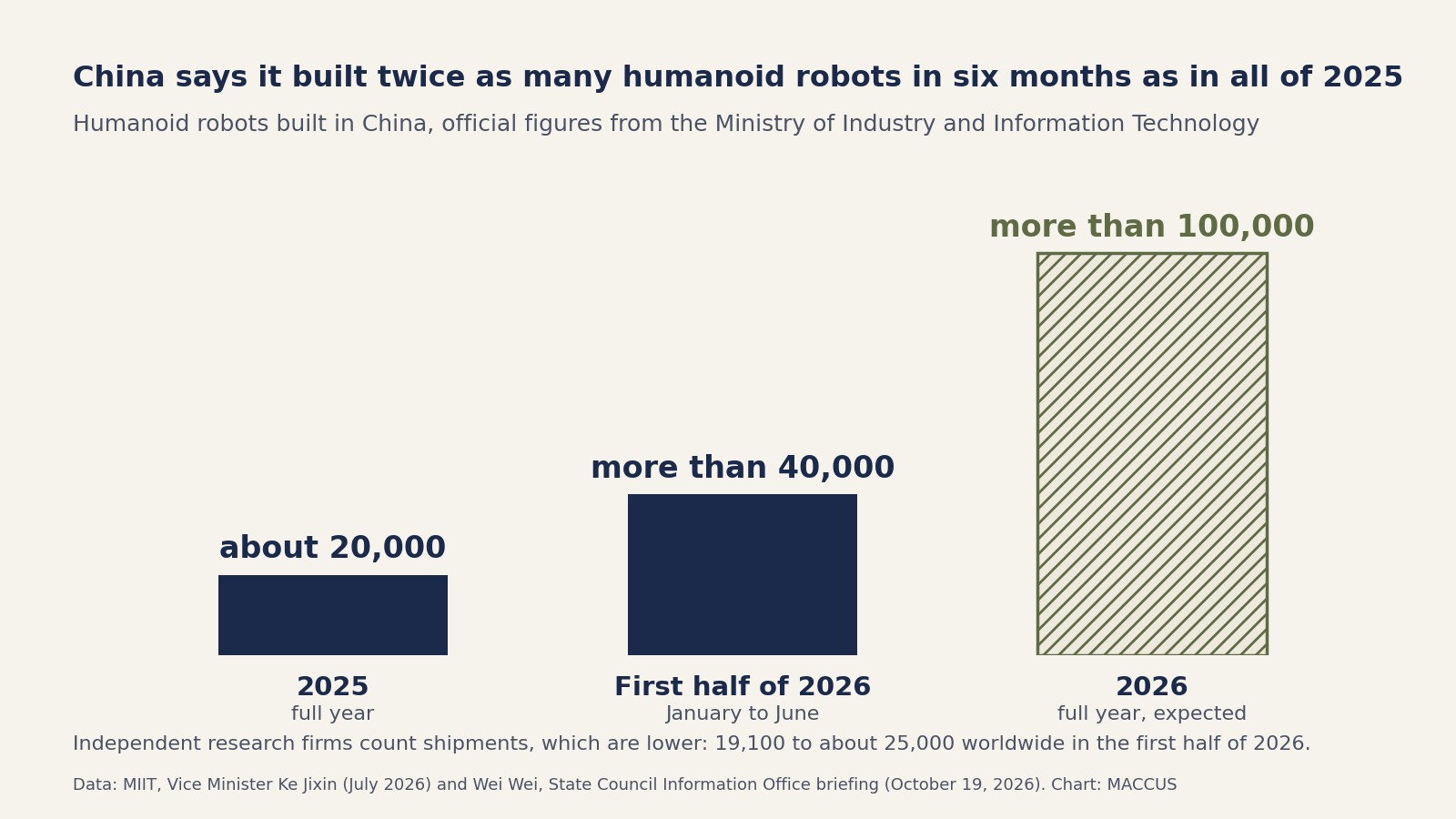

China’s industry ministry says the country’s factories built more than 40,000 humanoid robots in the first half of 2026, about twice the roughly 20,000 it estimates for 2025. Wei Wei, director general of science and technology at the Ministry of Industry and Information Technology (MIIT), repeated the first-half figure at a State Council Information Office briefing in Beijing on October 19, along with a forecast of more than 100,000 for the full year. These are China’s own production numbers. Independent research firms, which count robots shipped to customers, put first-half shipments worldwide lower, at 19,100 to about 25,000.
The ministry’s figures
The briefing presented new government guidelines on technology-driven commerce. Wei said Chinese makers had released more than 400 humanoid models by the end of June, according to China.org.cn, the information office’s English-language portal. The robots are being tested and deployed in more than 300 use cases, which the ministry calls priority scenarios, among them warehousing, logistics, catering, retail and household services. The ministry will also set up a system to monitor the industry and step up testing of product quality, cybersecurity and data security, he said.
The ministry had already given the output figures three months earlier. At an industry standards meeting held July 15 to 17 in Shangyu, in Zhejiang province, MIIT Vice Minister Ke Jixin said China produced about 20,000 humanoid robots in 2025 and more than 40,000 in the first half of 2026, according to the trade outlet C114. He also forecast more than 100,000 for the full year, and said the next two or three years could be a key moment for an industry that C114 described as moving from one-off prototypes and stage shows to batch deliveries.
To pass 100,000, Chinese factories would need to build close to 60,000 humanoids between July and December, about one and a half times the first-half figure. The ministry has not said how it counts a unit or which companies it includes.
Three counts of shipments
The three research firms cited here all count shipments, meaning robots that leave a maker and reach a buyer. In figures released on September 29, IDC counted close to 25,000 humanoid robots shipped worldwide in the first half, just over 19,000 of them in China. Counterpoint Research counted more than 22,000. Smart Analytics Global (SAG) counted about 19,100, with Chinese makers responsible for more than 97%, TechNode reported.
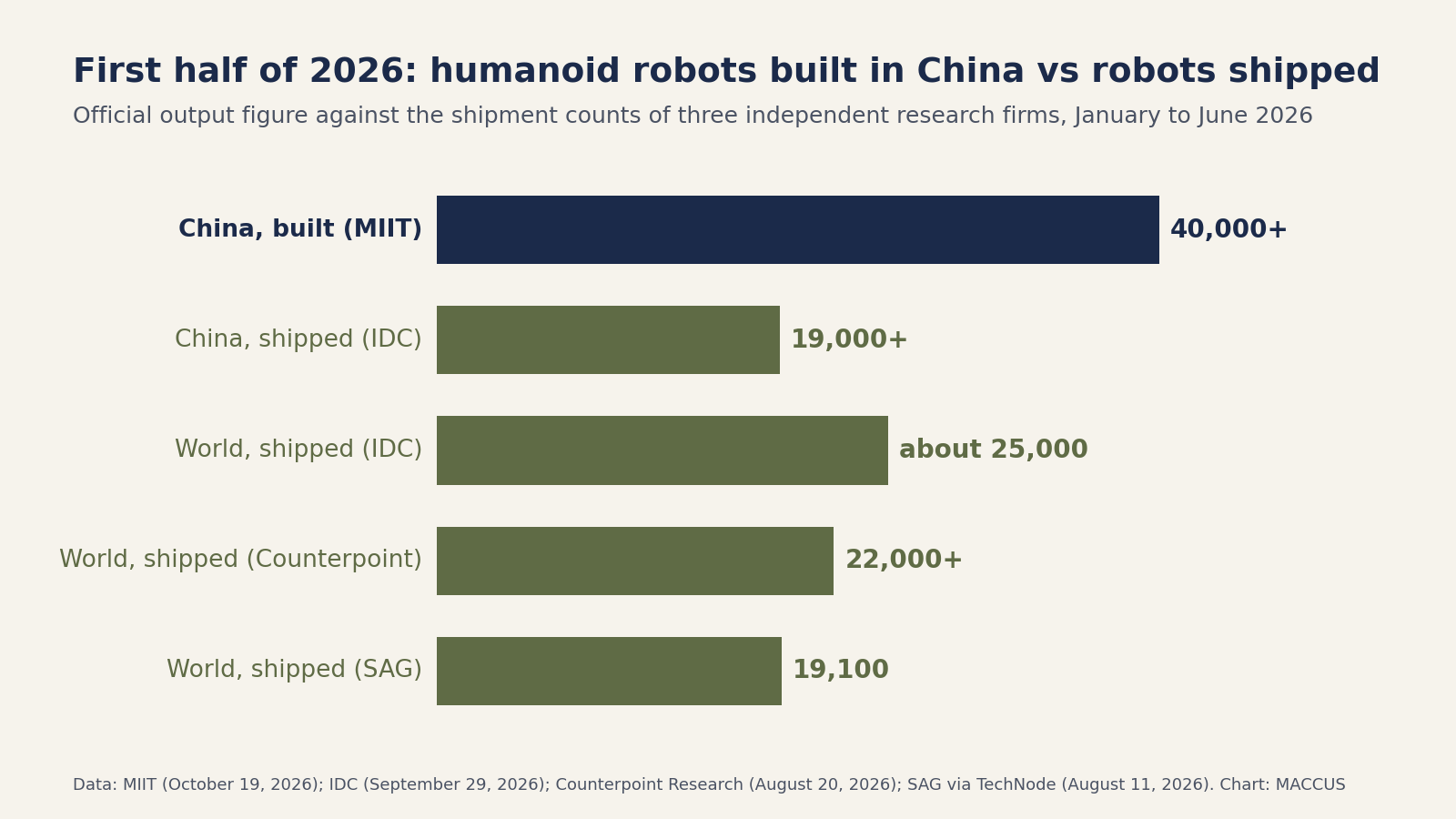
All three put shipments at roughly four to five times their level of a year earlier: up 432% for IDC, up nearly 300% for Counterpoint, and from 5,100 to about 19,100 for SAG. Counterpoint and SAG rank the same two Chinese companies first. Counterpoint puts AgiBot at about 9,700 units and Unitree at more than 7,000; SAG puts them at about 8,400 and 5,900.
None of the three comes close to 40,000 for China alone. The ministry’s count of robots built is about twice IDC’s count of robots shipped in China over the same six months. IDC also says Chinese makers shipped more than 95% of the robots it counted worldwide, about 24,000 by our arithmetic, still well short of the ministry’s 40,000.
Neither the ministry nor the research firms have explained the gap, and the two measures can differ for ordinary reasons. A robot built in June and delivered in August, a unit a maker keeps for its own testing, or a company too small to appear in a research firm’s panel would show up in one count and not the other. We found no independent count of production to set against the ministry’s figure.
Who is buying
A Reuters investigation published on August 27 found that much of the demand so far comes from the state. National, provincial and local governments spent at least $230 million on humanoids and related equipment in the first half of 2026, according to nearly 1,000 public tenders Reuters reviewed. That compares with $62 million a year earlier and $6 million in the same period of 2024.
On the supply side, China’s top economic planner, the National Development and Reform Commission, counts more than 150 humanoid robot companies, more than China has electric vehicle brands. Reuters described a market in which “manufacturing capacity outpaces commercial demand” and prices are falling. The average price of Leju Robotics’ full-size Kuavo fell 26% in 2025, to about $46,000. Dancing robots that companies rent for events now go for $440 to $600 a day, down from about $1,500 last year, a rental platform executive told Reuters.
Counterpoint says most first-half shipments went to stages and labs: entertainment and performances, together with data production and research, took more than 60%. SAG reads the market differently and puts industrial and commercial uses above 70%, according to TechNode.
The robots at work
At a government-funded training center in Liuzhou, in southern China, Reuters watched human trainers wearing headsets guide humanoids through tasks such as sorting crates and packing noodles. A novice trainer might get one usable movement out of 300 attempts, and an experienced trainer one out of 50. One staffer said the robots completed simple tasks at about 20% of a human’s speed or output, and might catch up in two to three years.
The center aims to sell the robot-training data it records to factories. Outside such centers, hundreds of thousands of workers are paid to film their own hands at work so that robot makers get footage of real tasks.
Some commercial uses exist already. Galbot runs humanoids on wheeled bases in pharmacies in more than two dozen Chinese cities, where they pick a product off the shelf in about a minute. The company says they succeed more than 95% of the time.
Gaps in the official count
None of the published accounts of the July meeting or the October briefing defines a humanoid robot or lists the makers counted. Chinese state media have also blurred the two measures. A report released at the World Robot Conference in Beijing in August said China shipped more than 40,000 humanoids in the first half, CGTN reported. None of the three research firms’ shipment counts comes close to that figure.
For 2025, the two kinds of numbers roughly agreed. The ministry’s output estimate of about 20,000 is in line with Bank of America’s count, cited by Reuters: about 20,000 humanoids shipped worldwide that year, 95% of them by Chinese makers.
What it means
Reuters describes Beijing’s approach as the one it used for electric vehicles and solar panels: subsidize a strategic sector, build capacity early and let competition push costs down. In cars, plug-in models took a record 67% of China’s retail car sales in September. Humanoids are at the start of that path: output is running ahead of buyers, and state money fills part of the gap. In July the United States banned imports of new Chinese humanoids, Reuters reported, which leaves Chinese makers to sell in China and other markets.
Shipment forecasts for 2030 run from 500,000 (SAG, as reported by TechNode) through more than 750,000 (IDC) to 1.2 million a year (Bank of America, cited by Reuters). Volumes like those would take robots far more capable than the ones Reuters saw in Liuzhou, which worked at about 20% of a human’s pace. Self-driving cars give a sense of the timescale: they spent years in test fleets before Waymo could report 95% fewer serious crashes than human drivers. Reuters notes that robots able to handle labor-intensive work could one day meet a real need, since China’s population is aging and shrinking.
The next test is the full-year count. The ministry’s 2026 output figure can then be set against its own forecast of more than 100,000, and the research firms’ full-year shipments against their own forecasts: more than 50,000 worldwide for Counterpoint and about 60,000 for SAG. An open question is whether the industry monitoring system Wei announced will come with a definition of a humanoid robot and a list of the makers it counts.
Sources
- China expects humanoid robot production to exceed 100,000 units this year, China.org.cn, October 20, 2026
- 今年我国人形机器人整机产品产量预计将突破10万台!工信部:将深挖民生等领域重点场景需求,形成一批标杆应用, National Business Daily, October 19, 2026
- 工信部:我国人形机器人今年产量或将超过10万台, C114 via Sina Tech, July 17, 2026
- 半年出货 2.5 万台,同比增长432.1%:全球人形机器人商业化探索持续升温, IDC, September 29, 2026
- Global humanoid robot shipments soar nearly 300 percent YoY in H1 2026, Counterpoint Research, August 20, 2026
- Chinese makers accounted for more than 97% of global humanoid robot shipments in H1 2026, TechNode, August 11, 2026
- China’s humanoid robots aren’t smart enough to take your job, yet, Reuters (via Insurance Journal), August 27, 2026
- Report finds China’s humanoid robot industry growing at full speed, CGTN, August 20, 2026
Header image: chart by MACCUS, data from MIIT (Ke Jixin, July 2026; Wei Wei, October 19, 2026)