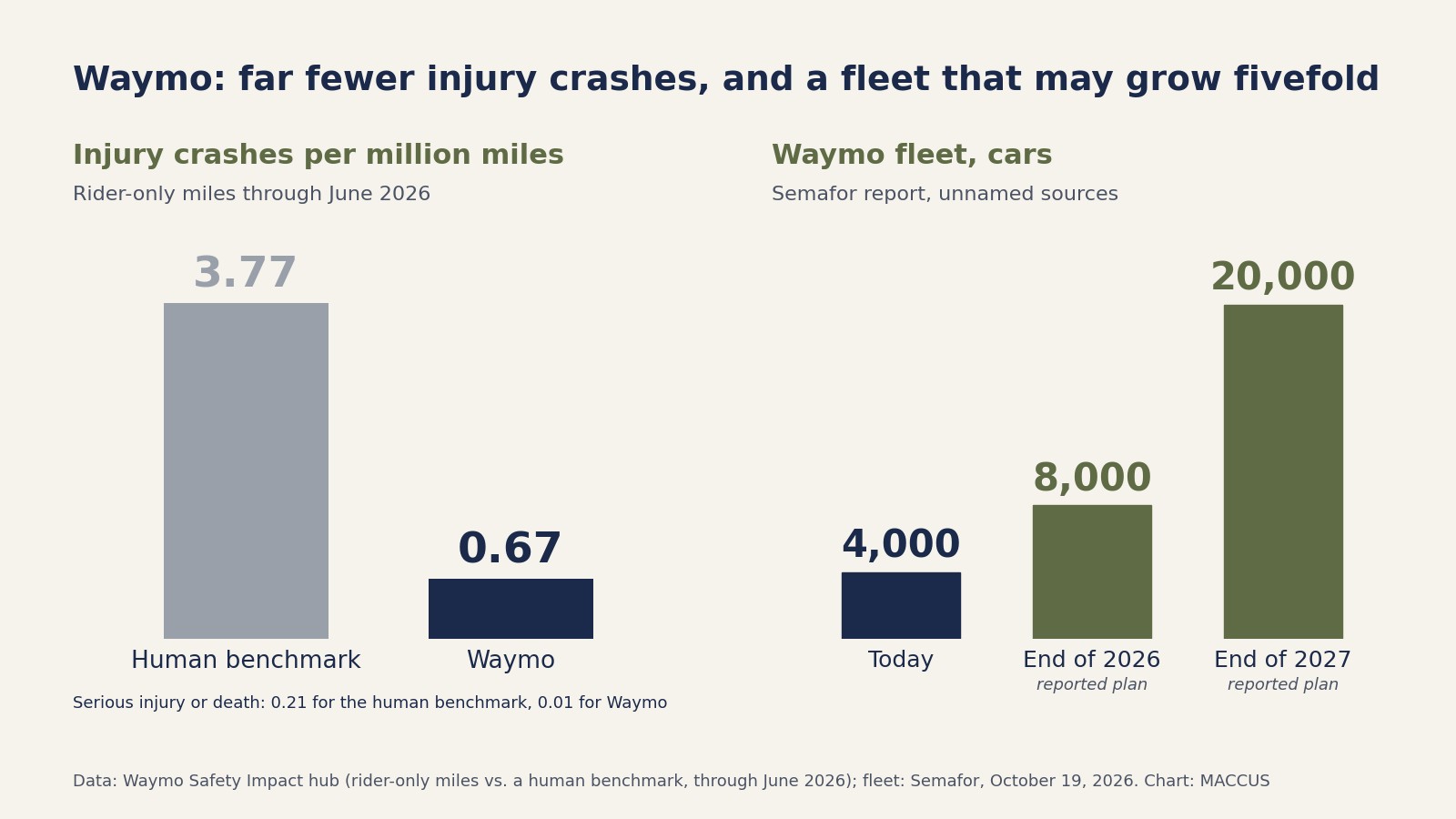

Over 271 million miles with nobody in the driver’s seat, Waymo’s robotaxis were in 95% fewer crashes that seriously injured or killed someone than human drivers would have had over the same distance. That is Waymo’s own data, measured against a human benchmark. An independent study by the Insurance Institute for Highway Safety (IIHS), on older and smaller data, found 81% fewer injury crashes.
On October 19, 2026, Semafor reported that Waymo plans to grow its fleet from about 4,000 cars today to 8,000 by the end of this year and 20,000 by the end of 2027, citing people familiar with the matter. Waymo declined to comment to Semafor.
271 million miles, measured against human drivers
Waymo publishes its crash record on a public safety hub, now updated with data through June 2026. It counts crashes in rider-only miles, the miles driven with no human driver aboard, and compares them with what an average human driver would be expected to have over the same distance in the same areas. The human benchmark comes from police-reported crashes in the counties where Waymo operates. Waymo counts every crash, whoever was at fault.
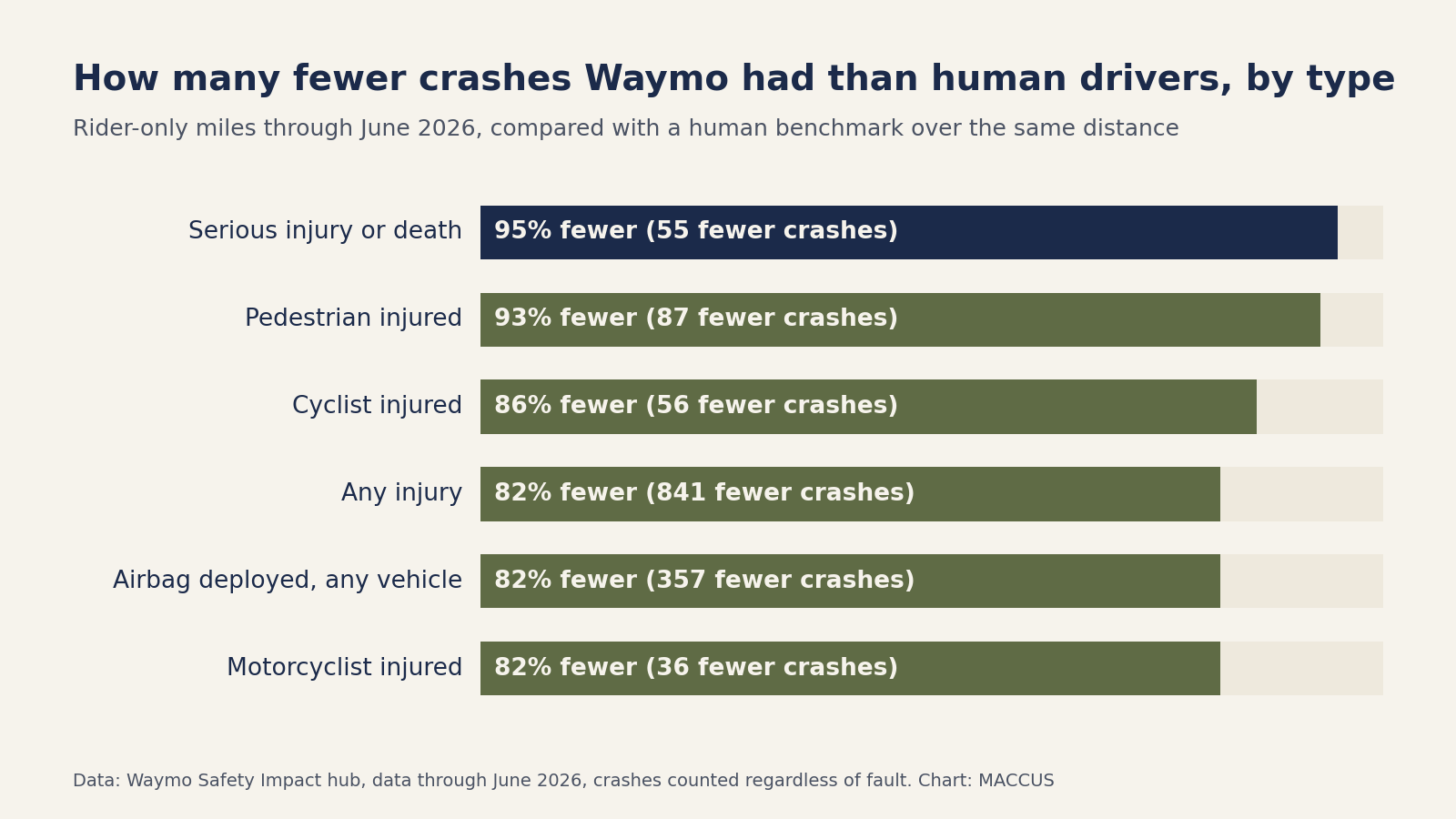
Over 271.3 million rider-only miles, Waymo reports 55 fewer crashes with serious injuries or deaths than the benchmark, 841 fewer crashes with any injury and 357 fewer crashes in which an airbag went off in any vehicle involved. Per million miles, the human benchmark has 0.21 serious-injury crashes and 3.77 injury crashes. Waymo’s rates are 0.01 and 0.67.
Waymo’s count also covers people outside the car: 87 fewer crashes that injured a pedestrian (93% fewer), 56 fewer that injured a cyclist (86% fewer) and 36 fewer that injured a motorcyclist (82% fewer).
The gap changes with the city. In San Francisco, the benchmark has 6.71 injury crashes per million miles against 0.67 for Waymo. Phoenix drivers start from a lower base: 1.95 for the benchmark, 0.56 for Waymo.
An independent study points the same way
Those are Waymo’s figures and Waymo’s method. On July 23, 2026, the IIHS published its own comparison, led by Eric Teoh, its director of statistical services. The researchers started from the crash reports that federal rules have required from automated-vehicle companies since 2021.
They removed duplicates and incidents in which the automation was not engaged, the vehicle was off public roads or no real crash took place: about a quarter of the reports. Of what remained, they kept only the crashes a typical person would report to the police. Human drivers, the institute notes, leave about half of all crashes unreported.
Waymo’s cars drove about 50 million miles without a driver in the 2021 to 2024 period studied, against about 222 billion miles by human drivers in the same places and years. Waymo’s rate of police-reportable crashes came out 68% lower, with 81% fewer injury crashes and 85% fewer single-vehicle crashes. The gap was 76% in Phoenix, 71% in Los Angeles and 35% in San Francisco. In Austin, where the sample was small, Waymo’s rate was 4% higher.
IIHS President David Harkey said the results show that “on a limited scale, these driverless cars are safer than human drivers.” The Governors Highway Safety Association backed the findings. Its CEO, Jonathan Adkins, said Americans have long expected autonomous vehicles to be flawless while accepting a human driving record that “kills more than 36,000 people on our roads every year.” The National Highway Traffic Safety Administration’s early estimate for 2025 is 36,640 deaths.
From 4,000 cars to a reported 20,000
Semafor’s scoop, by business reporter Ellen DiMauro, says Waymo “currently has 4,000 cars” and plans to pay for the growth with the $5 billion it just borrowed. The loan itself is official. On October 8, Waymo CFO Steve Fieler announced the company’s first debt financing, a $5 billion term loan led by PIMCO, Blackstone and Sixth Street, to “accelerate the continued expansion” of its service in the US and abroad. According to Semafor, the debt came without guarantees from Alphabet, Waymo’s parent, and lets the company borrow more later against its fleet.
The New York Post reported on October 19 that Waymo is on pace to import about 5,100 “Ojai” vans by the end of this year, “more than doubling its current fleet” of mostly Jaguar I-Pace SUVs, according to tracking data from research firm MoffettNathanson.
Waymo began taking its first public riders in Denver, San Diego and Tampa on September 1, and in Las Vegas on September 14, its fifteenth US city, where over 100,000 people had expressed interest in riding. According to Semafor, Waymo is also bringing its rides to places such as Toronto.
In Waymo’s launch post for Denver, San Diego and Tampa, Julia Cardenas, president of the National Federation of the Blind’s San Diego chapter, said she usually gets anxious using rideshare because she never knows “if I’ll get a driver who will turn away my dog.”
The jobs in the driver’s seat
The Bureau of Labor Statistics counted 455,700 jobs for taxi drivers (ride-hailing included), shuttle drivers and chauffeurs in 2025, at a median pay of $37,960 a year. Some 86% of them are self-employed. The agency still projects 9% job growth from 2025 to 2035, much of it from demand for ride-hailing drivers.
Waymo’s cars compete with those drivers for fares in every city where they run. In office work, AI already shows up in hiring numbers: Anthropic’s own data showed juniors falling from 27% to 9% of its technical hires.
Where the numbers stop
Waymo’s benchmark is a modeled estimate of what human drivers would have done in those areas, and the 55 fewer serious crashes are measured against it. Serious crashes are rare for both sides. The hub shows zero serious-injury crashes for Waymo in Los Angeles, Austin and the Atlanta area, listed as 100% reductions.
The IIHS data stops at 2024 and covers about 50 million driverless miles in four cities. The institute also warned that the federal system is not ready for what comes next. Companies must report crashes, but mileage reporting is voluntary and only Waymo releases its driverless miles. “The present data collection system isn’t good enough to allow continuous monitoring of a large-scale expansion,” Harkey said.
The Ojai vans are built by Zeekr, part of China’s Geely group. The Commerce Department bans connected-vehicle and self-driving software made in China from model year 2027, and Waymo says it adds its own sensors and software in Arizona and shares no rider data with carmakers. Missy Cummings, an outspoken Waymo critic who directs George Mason University’s Autonomy and Robotics Center and was once a senior safety adviser at NHTSA, told the Post: “It’s very possible that the Chinese have layered in other sensors that are recording data and sending it back to China.” A bipartisan Senate bill from Bernie Moreno and Elissa Slotkin would ban the import of any China-built vehicle, with a grace period that gives Waymo until 2030 to comply.
What it means
On safety, two different methods now agree: Waymo’s 271 million miles and the IIHS reading of the federal crash reports both show far fewer injury crashes than human drivers in the same cities. If Semafor’s numbers hold, the next test is five times the fleet, new vans and new cities, measured by a reporting system the IIHS itself calls inadequate for that scale.
Pedestrians, cyclists and riders like Julia Cardenas stand to gain first, in the cities where Waymo drives. The drivers whose fares those cars take stand to lose. Other fields show how quickly AI can reorganize work once it gets good enough: on October 15, a fan hub that tracked years-long game decompilation projects said it was winding down because AI sped the work up so much. Who pays for that kind of disruption is now an open question in AI: Anthropic’s new public benefit fund names AI’s effect on jobs as its one example.
Waymo has not confirmed the 8,000 or the 20,000. Its safety hub will show whether the rates hold as Ojai miles pile up in Denver, Las Vegas and San Diego, and Congress has a bill on the table that could take those vans off the road by 2030.
Sources
- Safety Impact, Waymo, data through June 2026
- Exclusive: Waymo plans to quintuple its fleet, Semafor, October 19, 2026
- Waymo’s driverless cars crash less often than people, IIHS, July 23, 2026
- Rise of the machines: crash experiences of highly automated vehicles and human drivers, IIHS (Teoh, Kidd, Riexinger), July 2026
- Waymo Closes $5 Billion Debt Financing to Accelerate Business Expansion, Waymo, October 8, 2026
- Waymo has ordered thousands of Chinese-made cars to expand its US robotaxi fleet, New York Post, October 19, 2026
- New IIHS Research Finds Waymo Driverless Vehicles Crash Less Often Than Human Drivers, Governors Highway Safety Association, July 23, 2026
- Vegas, Deal Us In! We’re welcoming riders today, Waymo, September 14, 2026
Header image: chart by MACCUS, data from Waymo (through June 2026) and Semafor (October 19, 2026)