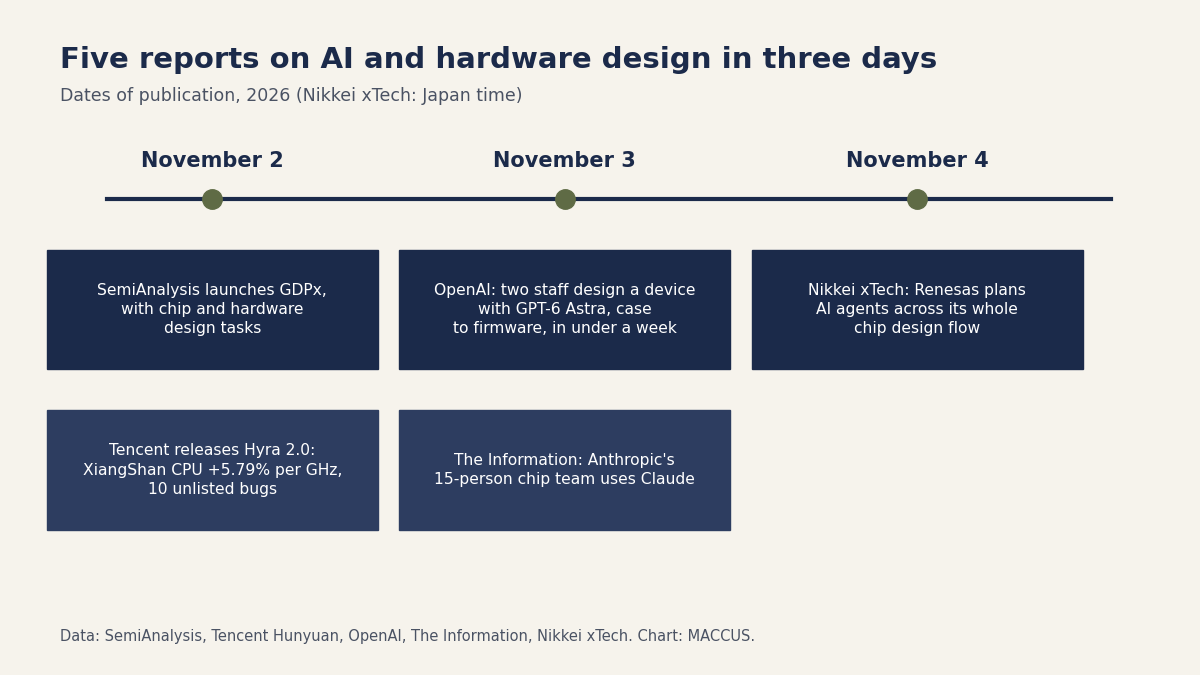
On November 3, OpenAI said that two of its employees used GPT-6 Astra to design a test device for talking to Codex, from the enclosure and the printed circuit board to the firmware, in under a week of side-project time. A contract manufacturer then built a small batch of prototypes in under a month.
The post came a day after Tencent’s Hunyuan team said its Hyra 2.0 research agent had raised the per-GHz benchmark score of XiangShan, an open-source RISC-V processor, by 5.79% and found 10 bugs missing from the project’s issue list. Later on November 3, The Information reported that Anthropic has told prospective IPO investors that its 15-person chip team uses Claude for engineering and design work on the custom silicon meant to train and run Claude. The three reports cover a device, an open-source processor and the chips meant to train and run Claude.
A device for talking to Codex
OpenAI presents the device as a test of Astra’s multimodal and computer-use skills, with a stated goal that the post later qualifies: to “create a device without any direct human edits.” Astra wrote the functional requirements and developed the device’s look, drawing on OpenAI’s past collaboration with Work Louder and on games and toys. It designed the enclosure and the internal structures, selected the electrical components and laid out the circuit board to fit the case. It also designed the user interface and generated the firmware (the low-level code that runs on the board) and the software that connects the device to Codex.
“Getting the device ready for manufacturing still required several rounds of review and iteration,” OpenAI wrote, because Astra “did not consistently account for the manufacturer’s production limits, tolerances, or details required for assembly.” The post does not say how long that review took.
OpenAI’s hardware and infrastructure teams, whose work spans robotics and compute infrastructure, use Codex and ChatGPT for CAD models, manufacturing drawings, simulations and design reviews. Measured in tokens, model usage across OpenAI’s hardware teams “has grown 23-fold” since February. On BenchCAD 2.0, a third-party benchmark of rebuilding 3D parts and assemblies and tracing circuit-board connections, OpenAI reports that a newer internal model averaged 0.875, against 0.594 for GPT-6 Astra at its highest reasoning setting. The post announces research work with Mazda’s aerodynamics and crash-safety engineers.
Tencent’s agent and an open-source CPU
Tencent’s Hunyuan team released Hyra 2.0 on November 2, with a long post in Chinese, dated November 1 on the page, and a GitHub repository. Tencent pitches the agent as a builder of research tools, and one of the projects it worked on is XiangShan, a fully open-source processor built on RISC-V, a royalty-free instruction set.
According to Tencent, Hyra 2.0 fixed several problems that the SPEC CPU2006 benchmark suite had exposed in the design and, with other tuning, raised XiangShan’s geometric-mean score per GHz, a measure of performance at a given clock speed, by 5.79%. Single-core frequency stayed the same and chip area grew 0.3%. Tencent estimates the gain at roughly 2 to 3 months of the official team’s work, judging by the pace on the project’s performance dashboard.
Fuzz tests that Hyra 2.0 designed, which throw random inputs at the design, found 7 bugs. With 3 more found separately, Tencent counts 10, none of them on the project’s official issue list. A formal check written in TLA+, a specification language whose tools search a design’s behaviors for errors, turned up a counterexample in multi-core cache coherence, the rules that keep each core’s copy of shared data consistent. The fix was contributed to OpenLLC, an open-source last-level cache (the cache level just before main memory).
Hyra also designed a five-finger robot hand with its fingers arranged like a spiral staircase. In the DR5 simulation test, after the same fine-tuning, it rotated objects 28.6% faster than the best five-finger design in the paper it was compared with. Tencent says the hand has only been tested in simulation.
The GitHub repository holds files for the protein, force-field and math results, among others, but nothing for XiangShan or the robot hand, so those numbers rest on Tencent’s post alone. Pandaily, which covered the release on November 3, notes that all the results are Tencent’s own and have not been independently reviewed.
Anthropic’s chip team and Renesas
The Information, in a paywalled story relayed by AI Weekly, cited four people familiar with the discussions. According to the report, Anthropic told prospective IPO investors in recent meetings that its new chip design team is already using Claude for engineering and design work on its custom chips, and the engineers claim Claude cuts design time compared with their estimates of Nvidia and AMD workflows. Anthropic also told investors it will keep a “multi-chip approach,” with Nvidia and AMD GPUs, AWS Trainium and Google TPUs at the center of its compute. The relay gives no percentage and names no chip.
Anthropic’s amended IPO filing of November 2, which we covered on November 3, includes a related sentence: based on its expectations “regarding future models, rather than our current models,” Anthropic says it “may imminently meet” its own threshold for “dramatically accelerated progress attributable to AI.”
On November 4, Nikkei xTech reported that Renesas is laying the groundwork for AI agents across its whole chip design flow and aims to design all its products with AI. The Japanese chipmaker expects large efficiency gains on complex systems-on-chip built from digital and analog chiplets. The free part of the paywalled article gives no figures.
The loop Tencent describes
Tencent’s post frames the work as recursive self-improvement: better tools make a stronger system, which can then build better tools. Tencent says Hyra 2.0 already works on the next Hy models, tuning training infrastructure, building data-synthesis pipelines and optimizing the inference stack, and hopes the next model will in turn become one of Hyra’s tools.
SemiAnalysis, which launched its GDPx benchmark on November 2 with chip design the only domain backed by three task partners, expects AI spending on chip design to “start ramping meaningfully in 2027” and calls it “the next ‘killer app’ after coding we have the most confidence in.”
On the software side, MIT researchers showed GPT-6 Astra on November 2 editing a small model’s weights directly, with no training, and in October Anthropic reported that Claude designed quantum circuits up to 39 times cheaper than the best published ones, checked by an automated verifier.
Where the designs still fall short
OpenAI’s note on tolerances matches the results of an outside benchmark published the day before. In GDPx, a public task from Beautiful Machines asks an agent to design an injection-molded housing (formed by forcing molten material into a mold) around an existing compressor, delivered as an editable SolidWorks assembly with native drawings and a manufacturing plan. Across 12 runs of GPT-6 Astra, Claude Opus 5.5, Grok 4.7 and GLM 5.3, none achieved a verified full pass, and SemiAnalysis writes that “the critical failures fall in manufacturability and design intent preservation.” Five of the six Opus and Astra submissions passed the full-cycle clearance checks and every edit sequence.
In chip verification, on a cache-coherence task from Arcverex, each of Astra’s three submissions accepted all four correct designs but missed some faulty ones. On RWE-bench, a set of 20 real mechanical, electrical and aerospace design tasks, GPT-6 Astra led the October 28 leaderboard by passing 37% of its runs.
The headline claims differ in weight: OpenAI reports the BenchCAD 2.0 score for its own unreleased model, Tencent’s processor and robot-hand results are self-reported, and Anthropic’s is an investor pitch known only through a press report.
What it means
In OpenAI’s account, a first complete device design, from requirements to firmware, took two people and a model less than a week. Sign-off has not moved at the same speed: production tolerances and manufacturability are where OpenAI needed review rounds and where no model passed the GDPx housing task, and Astra’s chip testbenches let faulty designs through.
The acceleration case rests on where the work is aimed. OpenAI’s hardware teams, whose work includes compute infrastructure, use 23 times more model tokens than in February. At Anthropic, according to The Information, Claude is used in engineering and design work on Claude’s own silicon, and at Tencent the agent works on the next Hy models, which Tencent hopes Hyra will then use as tools. None of the three has yet shown a finished chip or a speedup measured by an outside party.
XiangShan’s maintainers can confirm or reject the 10 bugs on their issue tracker and the 5.79% on their performance dashboard. If OpenAI releases its newer internal model, outside runs will show whether its BenchCAD score holds up. Neither the free part of The Information’s report nor AI Weekly’s relay gives a date for a first chip.
Sources
- Accelerating engineering for the physical world, OpenAI, November 3, 2026
- Hyra 2.0:自动化科研的下一步, Tencent Hunyuan, November 1, 2026
- Tencent-Hunyuan/Hyra-results, Tencent Hunyuan, GitHub, November 2, 2026
- Tencent Hunyuan’s Hyra 2.0 Research Agent Builds Its Own Tools for Proteins, Proofs and Chips, Pandaily, November 3, 2026
- Anthropic Touts Claude’s Chip Design Skills to IPO Investors, The Information, November 3, 2026
- ルネサス、半導体設計全体をAIエージェント化 全製品に適用へ, Nikkei xTech, November 4, 2026
- GDPx: Measuring Frontier Model Capabilities Across the Most Valuable Domains, SemiAnalysis, November 2, 2026
Header image: chart by MACCUS, data from OpenAI (November 3, 2026) and Tencent Hunyuan (November 2, 2026)