
This summer, for four straight months, the European Union's biggest source of electricity was solar. Since the record begins, in 2016, that spot had gone to nuclear almost every month. The EU grid now has a biggest supplier that changes with the season, and that is what I would keep an eye on.
I took Ember's monthly electricity data, the figures that track generation country by country, and looked at which source came first each month in the Union since January 2016. The question was simple: of solar, wind, nuclear, gas, coal, hydro and bioenergy, which one generated the most kilowatt-hours.
Nuclear on top almost every month since 2016
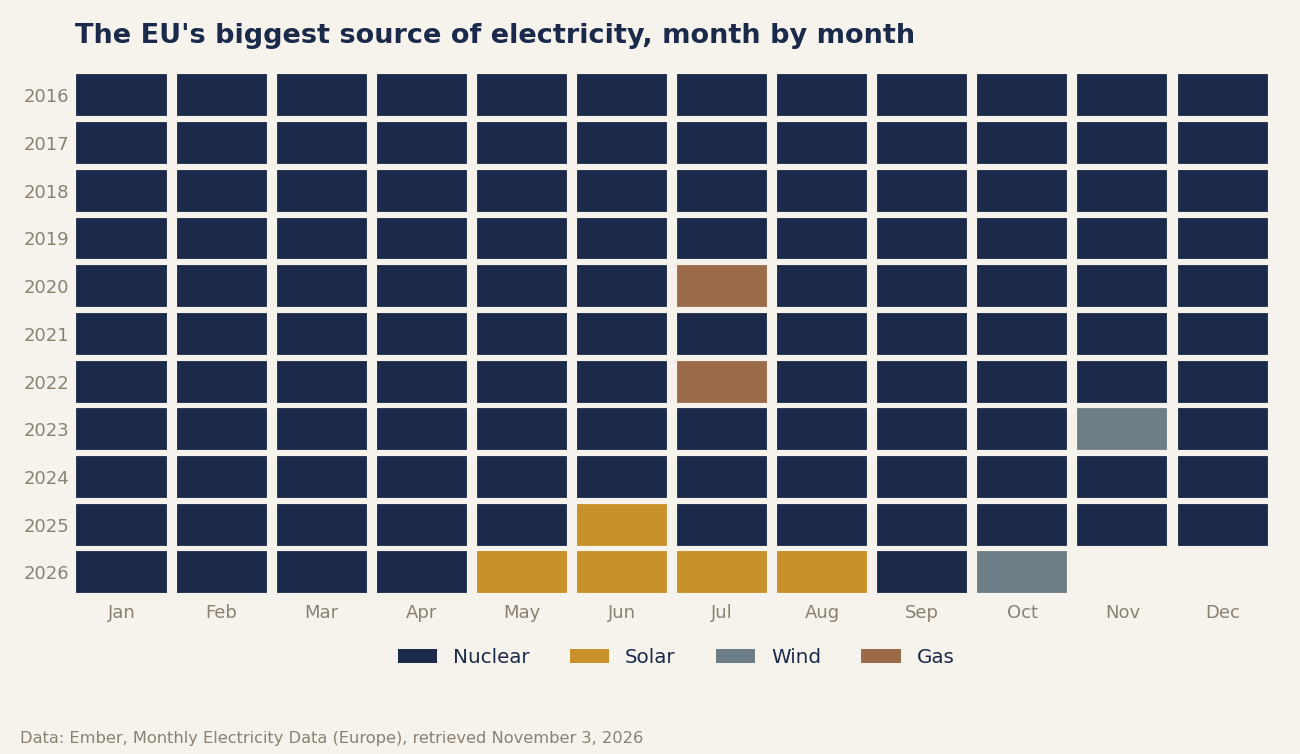
Over ten years, the count is clean. Nuclear was the EU's biggest source of electricity in every month but nine. For almost the whole decade it led without a rival, winter and summer, whatever gas prices or the weather did.
The few exceptions before 2025 came down to accidents of timing. Gas pulled ahead during summers when France's reactor fleet, by far the continent's largest, was running low; wind won one unusually blustery November. The chart at the top shows that long wall of nuclear, a dark column month after month, then the gap that opens in 2026.
The summer of 2026, four months led by solar
The first time solar came first was in June of last year, a single month. The trade press made much of it, as a symbol.
What came next drew less notice, and it is the part that counts. In 2026 solar held first place from May through August, without a break, and its lead over nuclear widened from one summer to the next. More panels go up every spring, and the summer brought a lot of sun across much of the continent. The middle chart follows solar and nuclear through the year: nuclear almost flat, solar swelling each spring, cresting in June and sinking back in the fall.
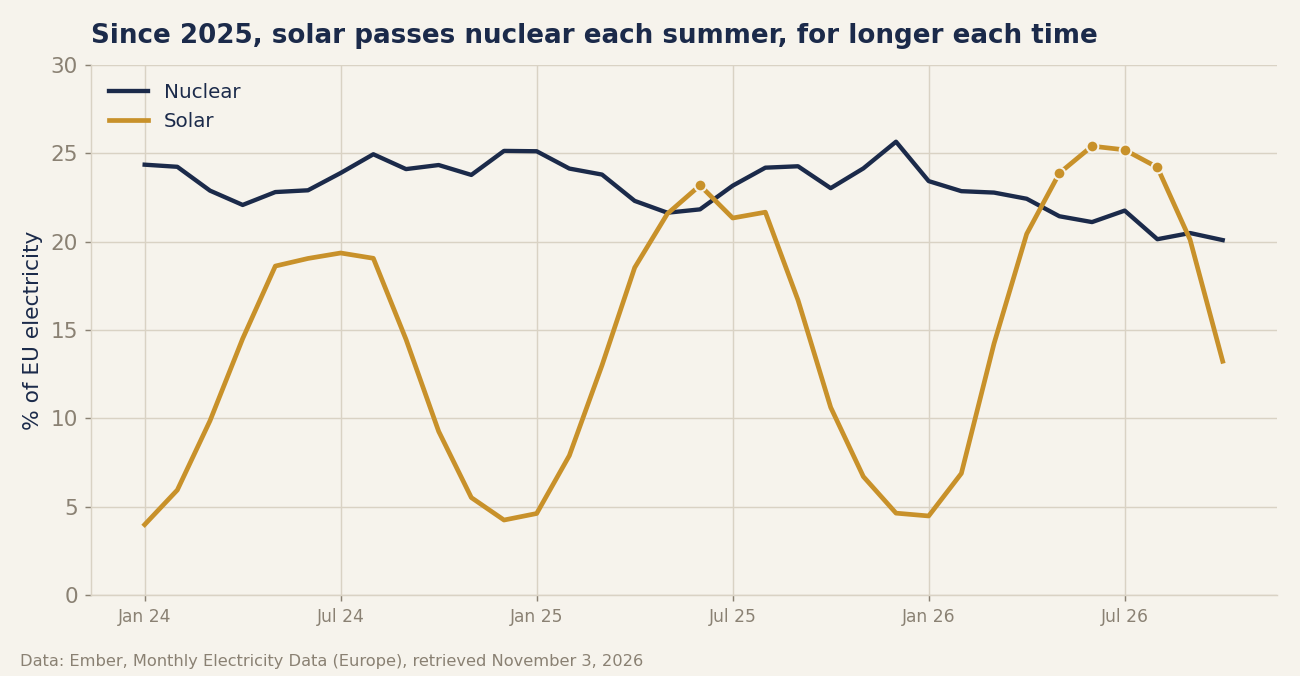
Across the full year, nuclear has led only half the months. In September it edged back in front by a whisker; in October, wind took the lead. The EU grid's biggest source has rarely changed names this often in so short a time.
Thirteen countries, Germany among them
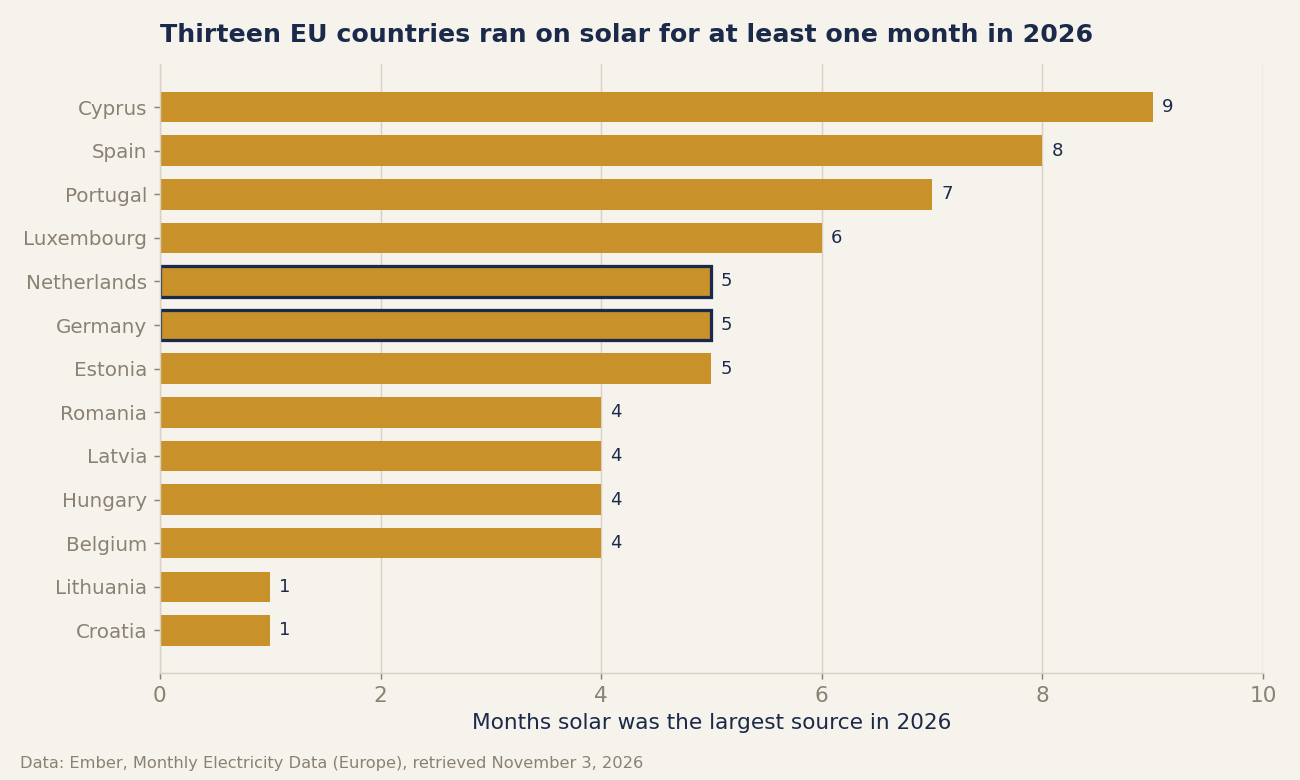
This is not a bloc average papering over frozen national pictures. In 2026, thirteen EU countries had solar as their biggest source for at least one month. The southern regulars are there, Cyprus, Spain and Portugal, which spend a large share of the year that way.
Germany is there above all, the continent's largest economy and biggest power consumer, where solar was the leading source for much of the summer. Estonia, Hungary, the Netherlands and Belgium join the list in the warm months. Southern Europe was already leading; the new part is the north. That Germany, an industrial country under often-gray skies, can run on solar for a whole summer shows how many panels are now in place. The last chart ranks these countries by the number of months they ran on solar.
A grid that turns with the seasons
One caveat comes first, because it frames everything else. Across the full year, solar is still only about an eighth of EU electricity, and nuclear is still the biggest annual source. The shift is monthly and seasonal: long summer days lift solar to the top. Its installed base, by contrast, is still modest next to the reactors.
Nobody decided this. Each panel went up for a local reason, a regional subsidy, a spare roof, a watt that gets cheaper every year. Added together, these unrelated choices make a grid whose biggest supplier depends on the calendar.
So here is my read. The Union has stopped having one dominant source of electricity all year; it has one per season, nuclear in winter, solar in summer, wind in the months between. A grid built around steady output now has to work around a biggest supplier that arrives with the daylight and leaves with it. One large caveat rides with that. This is about kilowatt-hours generated, not price: gas still often sets the wholesale price, even in the hours solar generates most. "Biggest source" says how much electricity, not who the market pays.
I write this from Belgium, where solar was also the biggest source for several months this year. For a northern country, with its thin winter light, that is the clearest sign of how fast the continent has covered its roofs and fields with panels. The same shift is underway on the demand side: Europe now buys more electric cars than gas and diesel ones combined, and even in China gasoline car sales are falling. An increasingly solar supply of electricity is feeding a demand that is itself going electric.
A prediction, so I can be proven wrong. If the trend holds, 2027 has solar on top for five months or more, and nuclear leading fewer than half the months of the year for the second year running.
Two limits, to close. This count is about share of generation, not installed capacity or price. And 2026 stops at October: the most recent months may still be revised, though no revision has yet changed the winner of a single month.
Method and numbers
I used Ember's Monthly Electricity Data (Europe, CC BY 4.0), the "EU" aggregate, retrieved November 3, 2026. For each month, the biggest source is the one generating the most terawatt-hours among solar, wind, nuclear, gas, coal, hydro and bioenergy; the ranking is the same by volume and by share of generation. Across the 130 months from January 2016 to October 2026, nuclear came first 121 times. The other nine: gas in July 2020 and July 2022, wind in November 2023, solar in June 2025, solar from May through August 2026, wind in October 2026. Solar's shares in those four summer months: 23.9, 25.4, 25.2 and 24.2 percent. In June 2025, solar reached 23.2 percent against nuclear's 21.8 percent; the generation lead grows from about 3 TWh in June 2025 to 9 TWh in June 2026. Across 2026, nuclear led 5 months, solar 4, wind 1. Thirteen EU states had solar on top for at least one month, counting only clean monthly wins. For the full year 2025, solar was 13.8 percent and nuclear 23.7 percent. The full dataset is available for download below.
Download the full dataset (CSV)
Sources
- Monthly Electricity Data, Ember, retrieved November 3, 2026
- Solar is EU's biggest power source for the first time ever in June 2025, Ember, July 10, 2025
- European Electricity Review 2026, Ember, January 2026
Header image: the EU's biggest source of electricity month by month, 2016 to 2026. Chart: MACCUS, data from Ember, retrieved November 3, 2026.