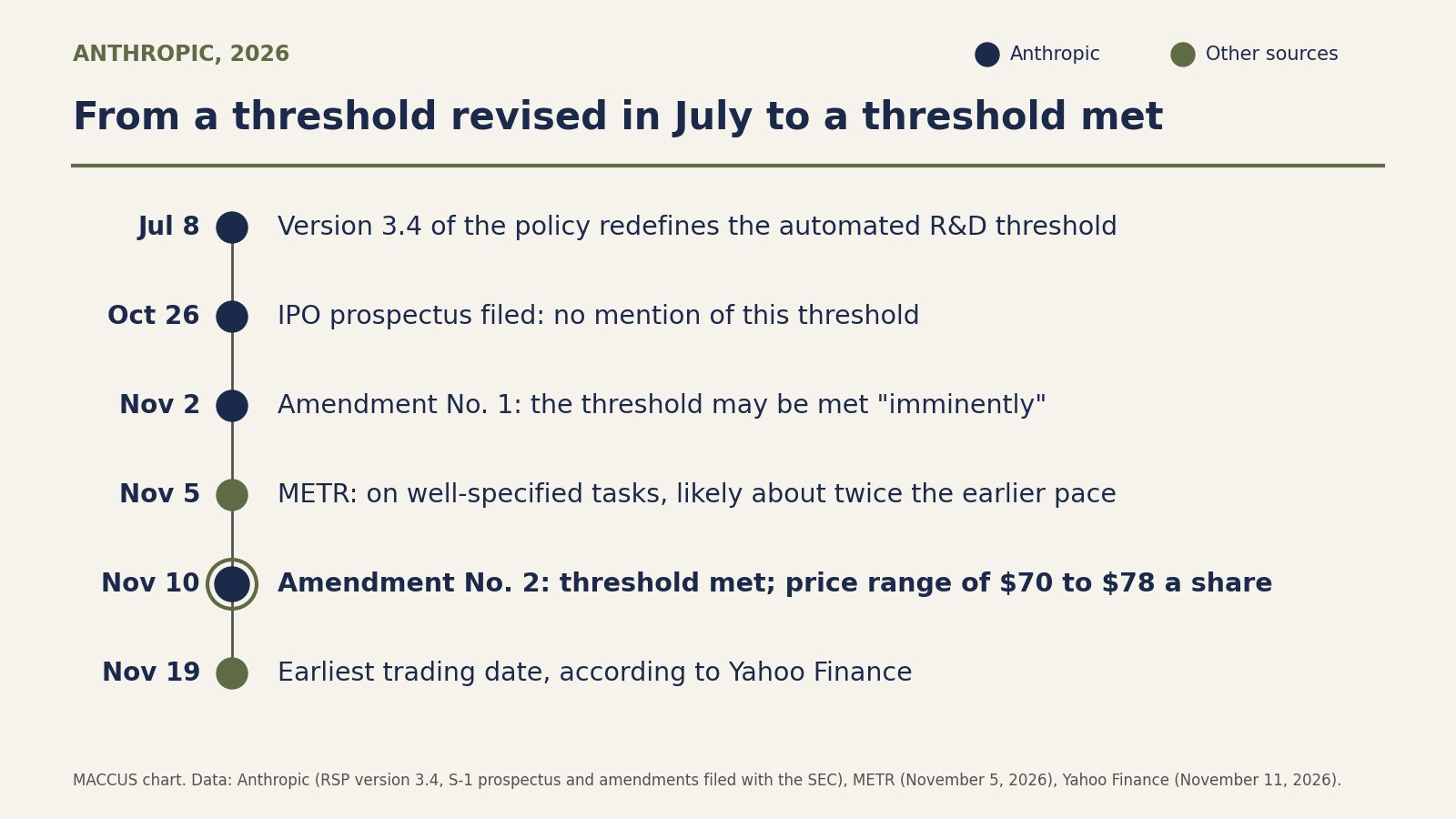

Anthropic, maker of the Claude AI assistant, says it has crossed a threshold in its own safety policy: the one for AI that sharply speeds up research on AI itself. Crossing it commits the company to stronger safeguards and could affect the timing of its next models.
Anthropic made the statement on November 10, 2026, in a filing with the Securities and Exchange Commission (SEC), the US market regulator. The filing is the latest version of the company’s prospectus, the document written for future shareholders before a stock market debut, or initial public offering (IPO). This one sets a price range of $70 to $78 a share.
Eight days earlier, in the November 2 version, Anthropic had only written that it might reach the threshold “imminently.” It based the new finding on what it expects from upcoming models and on its overall pace of progress. It did not base the finding on what it has observed in current models.
One sentence rewritten in eight days
Anthropic’s prospectus is a Form S-1, the standard US filing for an IPO. The first public version, filed on October 26, listed AI that speeds up AI among the risks the safety policy covers. It did not mention the threshold. Two amendments have revised it since.
The first amendment, dated November 2, added the threshold to the list of risks. Anthropic wrote that it “may imminently meet” what its policy calls “dramatically accelerated progress attributable to AI.” It cited its internal estimates and its expectations for future models. The same version said no current model had been classified as exceeding the threshold.
The second amendment, dated November 10, replaces that passage. Anthropic notes that the threshold applies when it can “observe or expect” the degree of acceleration set by its policy. It then writes: “we made a determination that we have met this threshold.”
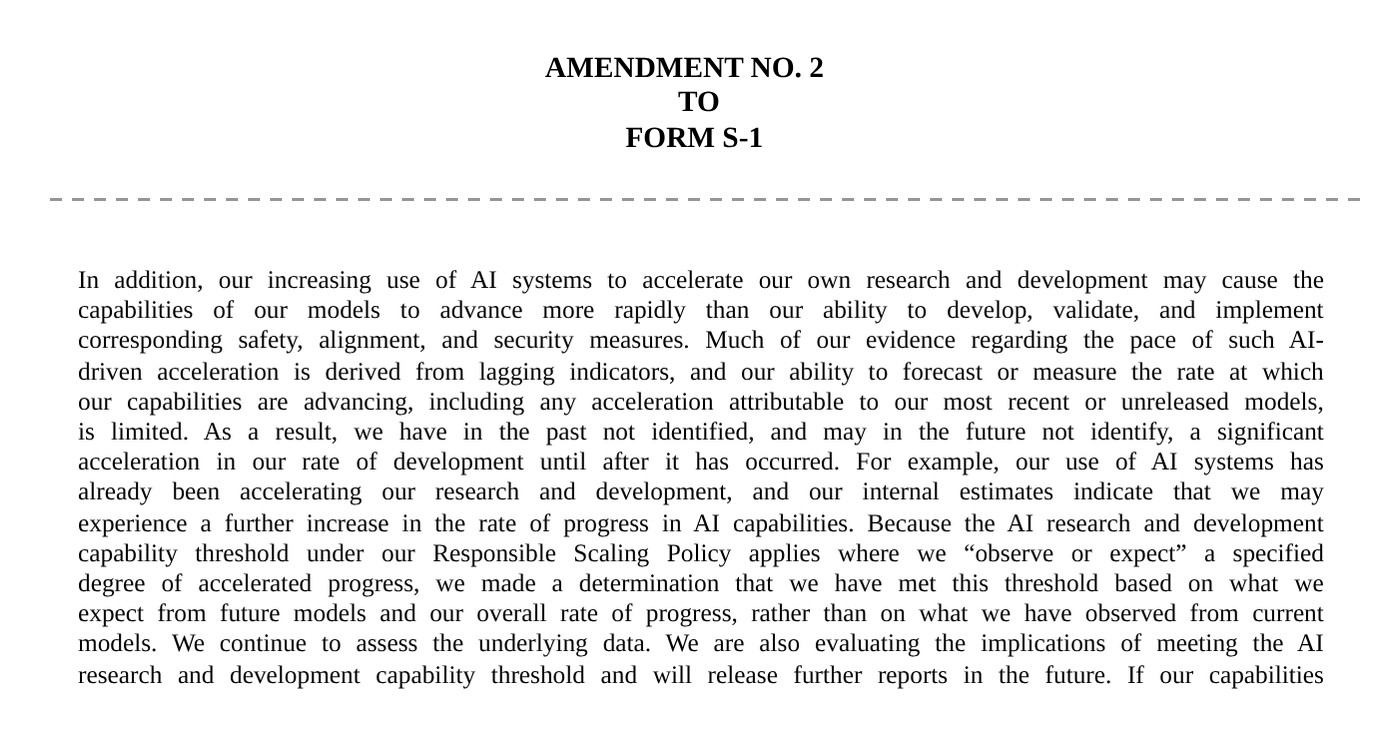
The November 10 text drops the earlier line saying no current model had been classified as exceeding the threshold. The company adds that it continues “to assess the underlying data.” It says it is studying what crossing the threshold implies and promises further reports, with no timetable.
How the policy defines the threshold
The threshold comes from the safety policy Anthropic wrote for itself and publishes, the Responsible Scaling Policy (RSP). It lists the safeguards to add as the company’s models grow more capable. Version 3.4, in effect since July 8, 2026, revised the threshold’s definition.
The threshold’s title is “Automated R&D in key domains” (R&D stands for research and development). It covers systems that can fully automate, or dramatically speed up, the work of large teams of top researchers. For now, Anthropic checks it only for AI research.
The threshold is met in either of two cases. In the first, Anthropic’s models could replace all its research scientists and research engineers, at no more than five times what those teams cost.
In the second, the company observes or expects a doubling of the rate of progress in AI capabilities. The policy defines this as making as much progress in one year as in two years at the baseline rate. It must also be plausible that the doubling comes largely from automating research. The November amendments use the language of this second case.
The safeguards the policy calls for
For this threshold, the policy commits Anthropic to funding ambitious security projects, including unconventional ones, to hold off the world’s best-equipped attackers. The company plans to keep centralized logs of all its critical AI development work. AI models would then scan those logs for threats, such as unusual behavior by an employee or an AI system.
The policy also calls for systematic assessments of Claude’s behavior. Anthropic wants its internal teams that attack its own safeguards to find more flaws than outside researchers paid through bug bounty programs. The company plans to publish risk reports on the status of these measures, reviewed by at least one independent outside expert.
One more commitment applies if Anthropic has, or will soon have, a model past this threshold and clear evidence shows no rival will have one soon. The company would then need a strong argument that the risk of catastrophe is contained. If needed, it would delay developing and releasing its models for as long as it believed it held a significant lead.
In the November 10 prospectus, Anthropic says it is considering policy changes “to keep humans in control of frontier model development.” Frontier models are the most advanced AI models. Anthropic is also weighing a requirement that humans review and approve some research decisions, as its models take on a growing share of that work.
Claude writes a growing share of Anthropic’s code
According to the November 10 prospectus, Anthropic’s models write “a large and growing share” of its code. They also increasingly carry out its research, including its safety research.
The same filing values Anthropic’s own use of Claude at list prices. That value grew more than 250-fold between January and September 2026. In April 2026, the monthly figure exceeded the company’s monthly payroll, excluding stock-based compensation, for the first time.
The filing warns that the organization “may lose visibility across certain processes.” Those processes could then become hard for humans to understand and control. Anthropic adds that it does not expect it could safely let Claude design and build its next models alone, without meaningful human supervision.
METR estimates the pace has probably doubled
On November 5, METR, an independent organization that evaluates the capabilities of AI models, published an assessment of the acceleration at Anthropic. According to METR, Anthropic was likely improving its models about twice as fast in October 2026 as between March 2024 and October 2025. The estimate covers well-specified tasks. METR stresses that it is highly uncertain: the real speedup could be closer to 1.3 times the earlier pace, or to 3 times.
METR also reviewed the automated R&D section of Anthropic’s August 2026 risk report, which covers the period through July 15. That report concluded the threshold had not been crossed. METR calls the report’s argument against a doubling “overstated” and finds it “plausible” that the threshold was crossed by July 15. Even so, most researchers involved at METR and Anthropic leaned toward the view that it had not.
Trading could start as soon as November 19
On November 10, Anthropic started its roadshow, the round of investor meetings held before the final price is set. The offering covers 825 million shares, 801 million of them sold by Anthropic. The company has applied to list them on the Nasdaq, the US stock exchange where most tech companies trade, under the symbol ANT.
According to Yahoo Finance, a price of $78 a share, the top of the range, values the company at about $1.4 trillion. That figure counts every share that could exist. Yahoo Finance reports, without naming its sources, that trading could start as soon as November 19. The October 26 prospectus had already laid out the company’s first-half losses.
What the filing leaves out
The November 10 prospectus does not say which model, which measurement or which figure led Anthropic to conclude that the threshold was crossed. Anthropic’s press release announcing the roadshow that day does not mention the threshold.
The safety policy links this threshold to a label: a “highly capable” model. When a risk report covers such a model and large parts of it are redacted, the report must go through a full outside review. The prospectus does not say whether any model has received that label.
Ray Wang, founder of the firm Constellation Research, was skeptical of IPO risk warnings in October, before the threshold announcement. “As in all S-1 filings, the risks are deliberately overstated,” he said ahead of an appearance on a Yahoo Finance live show.
The November 10 prospectus names another limit. Much of Anthropic’s evidence about its pace of progress comes from lagging indicators, data that trail behind events. As a result, the company writes, it has in the past spotted a significant acceleration only after the fact, and that could happen again.
What it means
A leading AI developer has stated in an SEC filing that it has reached its own threshold for AI that speeds up AI. The timing matters: the statement appears in the version of the prospectus that sets the IPO price range. Under Anthropic’s policy, expected acceleration is enough to make that call. Observations from its current models are not required.
For businesses that use Claude, the practical question is when the next models will arrive. The prospectus warns that future measures could change “whether, how, and when” Anthropic develops or releases new models.
Anthropic has restricted or delayed models before. Its frontier model Mythos, whose version 5.2 was announced on November 9, was first offered only to selected organizations for cybersecurity work. That limited release ran through a program called Project Glasswing.
The October 26 prospectus describes another delay. Anthropic pushed back the pretraining of a new base model by more than a month. Pretraining is the first stage of building a model. The company wanted to strengthen its protections against model theft first.
Several questions remain open. Anthropic has not said which safeguards already apply and which are still to come. It has not said whether a model will be classified as “highly capable,” or when the promised reports will come out.
Next to watch: those reports and the outside review the policy calls for, the next version of the safety policy, and the final IPO price.
Sources
- Anthropic, PBC, Amendment No. 2 to Form S-1, SEC, November 10, 2026
- Anthropic, PBC, Amendment No. 1 to Form S-1, SEC, November 2, 2026
- Anthropic, PBC, Form S-1, SEC, October 26, 2026
- Responsible Scaling Policy, version 3.4, Anthropic, effective July 8, 2026
- Anthropic launches roadshow for proposed initial public offering, Anthropic, November 10, 2026
- Independent Assessment of AI R&D Acceleration at Anthropic in October 2026, METR, November 5, 2026
- Review of the “Risks from automated R&D” section in Anthropic’s Risk Report (August 2026), METR, November 5, 2026
- Anthropic says a key AI safety alarm has been triggered, days before its IPO, Yahoo Finance, November 11, 2026
Header image: MACCUS chart, data from Anthropic (RSP version 3.4, prospectus and amendments filed with the SEC), METR (November 5, 2026) and Yahoo Finance (November 11, 2026)