
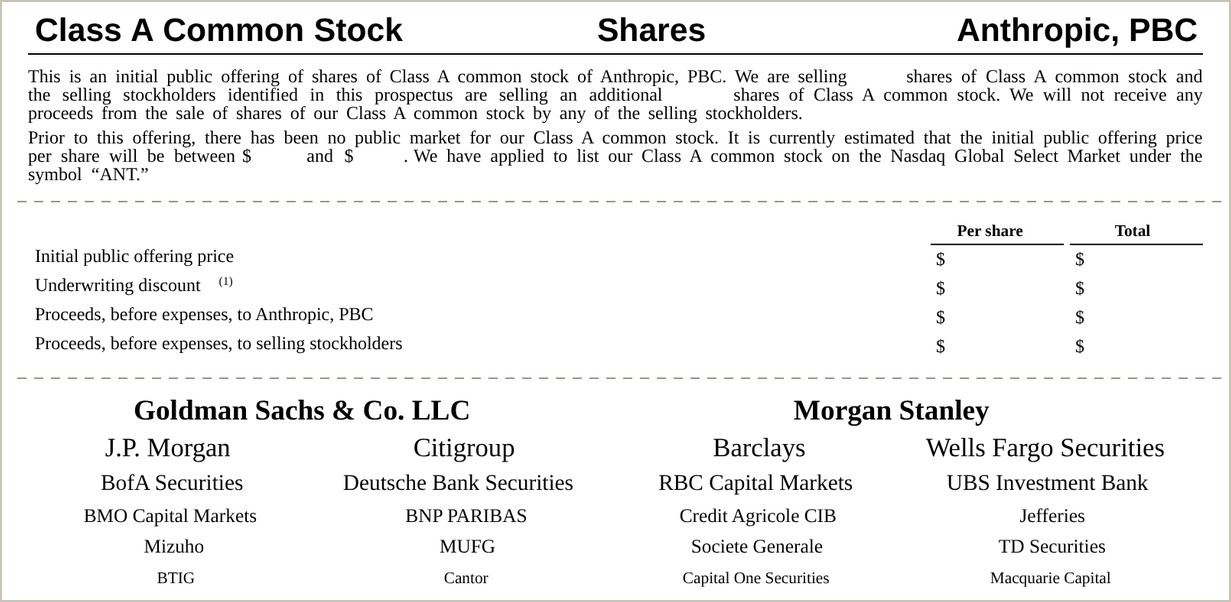
Anthropic, the company behind the Claude assistant, made its Form S-1 public on Monday, October 26, 2026. The registration statement for its initial public offering, filed with the U.S. Securities and Exchange Commission, seeks to list Anthropic’s Class A common stock on the Nasdaq Global Select Market under the symbol “ANT.” Twenty-two banks appear on the cover of the prospectus, led by Goldman Sachs and Morgan Stanley. The price, the number of shares and the size of the deal are all left blank.
The document runs more than 300 pages. It confirms figures known since The Wall Street Journal reviewed a draft, including the losses we broke down on October 21. It adds the rules that will keep the founders and a trust in control after the listing, a quarter of operating profit (the only one of the six it details), counts of large customers and employees, and an offering aimed at European retail investors.
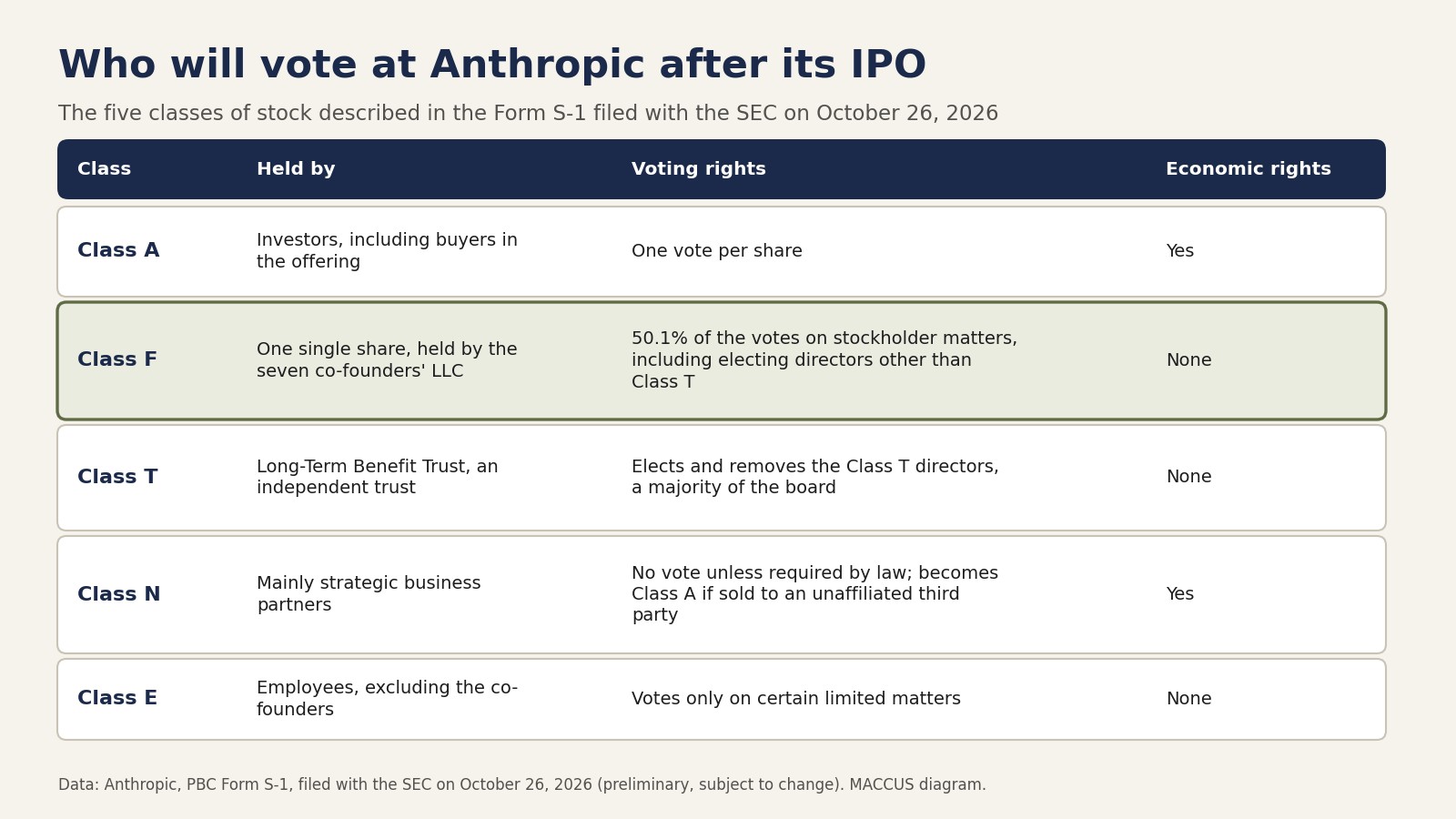
One share, 50.1% of the vote
Immediately before the IPO, Anthropic will issue a single share of Class F common stock to a limited liability company whose only initial members are the seven co-founders: CEO Dario Amodei, President and board chair Daniela Amodei, Tom Brown, Jack Clark, Jared Kaplan, Sam McCandlish and Christopher Olah. That share will carry 50.1% of the voting power on matters submitted to stockholders generally, including the election of directors other than the Class T directors. It will have no economic rights.
The prospectus says that voting power will not be diluted by new share issuances or reduced when the co-founders sell. But a co-founder leaves the LLC in several cases, including resignation, death, or keeping less than 2% of the Class A shares they held at the IPO. If membership falls below three for 90 consecutive days, a 450-day transition period begins. At its end, Anthropic redeems the Class F share without payment, along with the Class E shares issued to employees.
The shares sold in the offering are Class A shares, with one vote each. The risk factors spell out what that means: holders of Class A stock “generally will not be able to affect the outcome of any matter submitted to a vote of our stockholders or the election of our directors, regardless of how they vote.” The filing carves out an exception: if a majority of the co-founders cannot agree on how to vote, the Class F votes are generally cast in proportion to the Class A votes.
A trust elects most of the board
The second source of control is the Long-Term Benefit Trust, created in 2023 and made up of trustees with no financial stake in the company. Through another class of stock, Class T, the trust elects and removes the Class T directors, who will make up a majority of the board. Class T votes on nothing else and has no economic rights. Together with the founders’ LLC, the trust will be able to elect every director.
The trust has five seats, one of them vacant. Neil “Buddy” Shah, CEO of the Clinton Health Access Initiative, has chaired it since June 2023. The other trustees joined later: Richard Fontaine, CEO of the Center for a New American Security, in April 2025; former Federal Reserve Chairman Ben Bernanke in June 2026; and Harvard physics professor Christopher Stubbs in October 2026. Trust policy bars trustees from directly buying or holding Anthropic securities.
Because the trust elects a majority of the board, Anthropic qualifies as a “controlled company” under Nasdaq rules, a status that allows exemptions from some governance requirements. The company says it does not expect to use the exemption except for its nominating and corporate governance committee, which will not be fully independent.
Class N shares, held mainly by strategic business partners, carry no vote and convert into Class A when sold to an unaffiliated third party. Class E shares, issued to employees other than the co-founders, vote only on certain limited matters. Anthropic acknowledges that the structure could make its stock ineligible for some stock indexes, and therefore for the funds that track them.
Operating profit in the second quarter, a loss for the first half
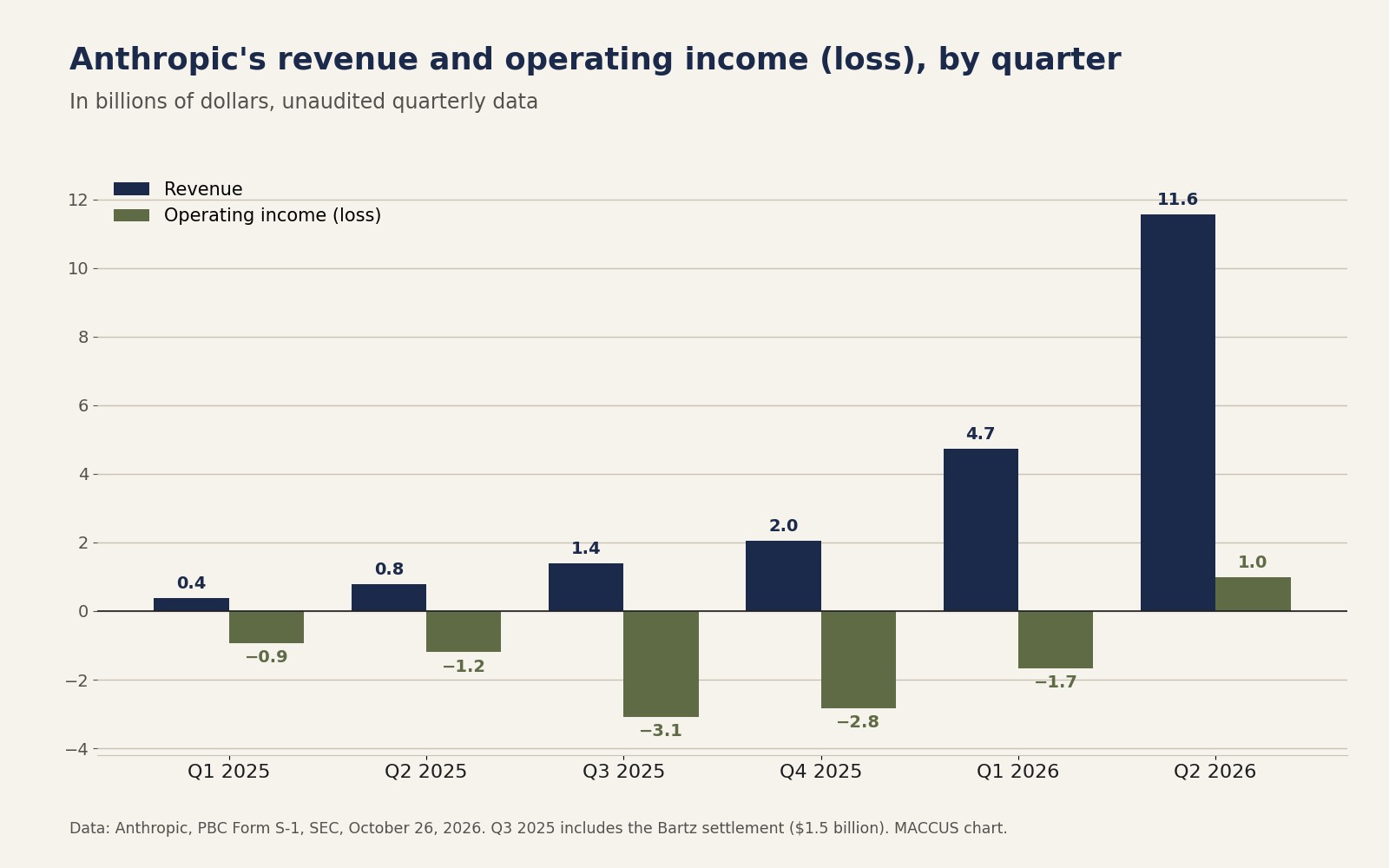
In the second quarter of 2026, Anthropic posted revenue of $11.6 billion, up from $787 million a year earlier. Operating income came in at $974 million (about €870 million at the European Central Bank’s October 23 rate), which the filing rounds to $1.0 billion. Operating margin swung to 8% from negative 152% a year earlier. On the company’s adjusted measure, which excludes stock-based compensation among other items, it reached 19%.
The first half of 2026 was still in the red: on revenue of $16.3 billion, Anthropic booked an operating loss of $693 million and a net loss of $80.7 billion. Of the net loss, $72.4 billion came from remeasuring convertible notes and other financing instruments at fair value, an accounting charge driven mainly by the rise in the company’s valuation. Anthropic warns that its margins will fluctuate from quarter to quarter, especially when new computing capacity is delivered.
As of June 30, 2026, the company had raised $141.1 billion in total and held $112.4 billion in cash and cash equivalents. The prospectus also puts a number on the public benefit fund announced on October 18: 846,840,960 Class N shares, or 5% of fully diluted shares as of that date. The board may add up to 2% more each time the stock price rises 50% above the previous milestone, starting from the IPO price.
Nearly 12,000 customers above $100,000
As of September 30, 2026, more than 11,900 customers had paid Anthropic at least $100,000 over the trailing 12 months, up from about 200 at the end of 2024 and about 1,500 at the end of 2025. More than 1,900 topped $1 million and about 250 topped $10 million. Customers Anthropic already had a year earlier, excluding Pro and Max subscribers, spent about nine times as much in the third quarter of 2026 as in the same quarter of 2025, a net revenue retention rate of about 900%.
No single customer accounted for more than 10% of revenue in the first nine months of 2026. In the third quarter, about 79% of revenue came from customers outside the top five, up from about 64% in the first quarter, even as revenue from each of those five customers hit a record.
Anthropic had about 5,300 employees on September 30, 2026, up from about 940 at the end of 2024. Trailing 12-month revenue per employee topped $6.6 million. According to the filing, Claude wrote more than 90% of the contributions to the company’s codebase in September 2026. On October 16, Anthropic published data on its junior hiring, showing a falling share of juniors on its technical teams.
Shares offered to European retail investors
The deal includes public offerings in Australia, Canada, “certain member states” of the European Economic Area, Japan, Switzerland and the United Kingdom. Anthropic does not currently plan to list its shares in those markets. In the European countries involved, which the filing does not name, Anthropic will offer shares to retail investors through a separate prospectus that will need approval from the securities regulator of one of those countries.
Three French banks are among the 22 firms named on the cover: BNP Paribas, Crédit Agricole CIB and Société Générale. The S-1 does not say whether France or Belgium will be among the countries covered.
The blanks in the filing
The registration statement is not yet effective and may be amended. The price, the share count, the proceeds and the underwriting discount are blank. So is third-quarter 2026 revenue, even though the filing gives customer and employee counts for that quarter.
Citing no source, NBC News reports that the offering is expected in mid-November and could value Anthropic at more than $2 trillion. The filing itself contains neither a date nor a valuation.
What it means
On October 26, numbers that had circulated for a week landed in a public filing, and that filing mostly describes who will decide. Buyers of ANT shares will own a piece of the company but generally will not be able to affect the outcome of votes. In a structure built on multiple-vote shares, founders’ influence depends on how many shares they keep. At Anthropic, the single share keeps its 50.1% of the vote as long as the founders’ LLC has at least three members, then until the end of the 450-day transition.
The numbers show a company that covered its operating costs in the second quarter, with revenue up 1,368% from a year earlier versus a 300% rise in compute and infrastructure spending. They do not yet show a profitable half-year. On October 24, Apollo chief economist Torsten Slok wrote that AI had delivered no financial payoff to U.S. companies outside tech. The S-1 shows the other side of the ledger: a supplier whose customers from a year ago now spend about nine times as much.
The European prospectus will have to name the countries open to retail investors. Later amendments to the U.S. filing will set a price range and a share count. Third-quarter revenue is still unknown, and so is how index providers will treat a company whose Class A shareholders do not control the vote.
Sources
- Anthropic, PBC, Form S-1 Registration Statement, SEC (EDGAR), October 26, 2026
- Anthropic files S-1 with the SEC for proposed initial public offering, Anthropic, October 26, 2026
- Anthropic releases IPO filing ahead of highly-anticipated stock debut, Steve Kopack, NBC News, October 26, 2026
- No Signs of AI Payoff Outside the Tech Sector, Torsten Slok, Apollo (The Daily Spark), October 24, 2026
- ECB euro reference exchange rate, US dollar, European Central Bank, October 23, 2026
Header image: MACCUS diagram. Data: Anthropic, PBC Form S-1, SEC, October 26, 2026