OpenAI launched ChatGPT Wallet on November 13, 2026. The wallet, built into ChatGPT, lets the company’s AI agents pay for online purchases on a user’s behalf without seeing the real card details. OpenAI calls these agents “dots”: assistants that work on their own, around the clock, each on its own computer in the cloud. American Express, Mastercard and Visa helped build the wallet.
At launch, Wallet is open only to people 18 or older who live in the US and subscribe to ChatGPT Pro, a paid plan. OpenAI has given no date for Wallet in Europe. The same day, it published a guide for merchants on what their websites need to check so these purchases go through.
A biometric check before every payment
According to OpenAI’s blog post, users add a card once. The Wallet help page says the card details go into a secure form, outside the chat. After that, the user asks their dot to find a product or book a hotel and to place the order.
Before each payment, ChatGPT shows a summary: the merchant, the items, the total and the selected card, plus any shipping or recurring-payment terms. The user approves with a biometric check on a supported device, such as Face ID or a fingerprint scan. OpenAI says each approval creates a record of what the user authorized.
The card network, such as Visa or Mastercard, then provides a payment token: a stand-in card number with its own security code and expiration date. Neither the agent nor the merchant sees the real card details. The charge still goes to the selected card. That card keeps its rewards and its protections in eligible disputes with the merchant, for example over a defective item.
Under the ChatGPT Wallet terms, in effect since November 12, the merchant is the seller. OpenAI disclaims liability for purchases as far as the law allows. Returns and refunds go through the merchant. Disputed charges go through the bank that issued the card.
Only for Pro subscribers in the US
Users also need a US billing address, the Wallet help page says. Wallet accepts eligible American Express, Chase, Mastercard and Visa credit cards issued in the US. Only the primary cardholder can add a Chase card. OpenAI is rolling Wallet out gradually.
Debit cards and virtual cards are not accepted at launch. The terms do allow a business card if the cardholder’s organization permits it. Wallet works only in conversations with a dot. It is not available in regular chats, in ChatGPT Work or in standalone threads of Codex, OpenAI’s coding agent.
Dots themselves are not yet open to Pro subscribers in Europe. OpenAI introduced them at its developer conference in late September 2026. The dots help page says they are rolling out to Pro users “in markets excluding the European Economic Area, Switzerland, and the UK.” On Business Premium and Enterprise, OpenAI’s business plans, access depends on region and eligibility.
Romain Huet, OpenAI’s head of developer experience, spoke about Europe on October 28 in Berlin, according to The Decoder, an AI news site. He said dots should become more widely available there “in a few weeks,” after talks with regulators. Meta is in the same position with Muse, its agent that shops online. When Muse launched in Japan in October, Meta gave no date for Europe.
No commission at launch
According to CNBC, OpenAI says it is not taking a cut of transactions at launch, though Wallet could later become a source of revenue. Chaya Nayak, who leads product for monetization and payments at OpenAI, described the target audience to CNBC: “Really, who we are speaking to here is the networks and the merchants.”
CNBC also notes that some of OpenAI’s earlier commerce efforts did not take off. OpenAI launched Instant Checkout, a way to buy directly inside ChatGPT, in fall 2025, then quickly set it aside. Luke Gebb, executive vice president and global head of innovation at American Express, told CNBC it makes sense to start “in a contained environment.”
Websites asked to let agents through
According to OpenAI’s guide to accepting payments, merchants need no special integration to accept Wallet, because the token works with existing checkout pages. An identifier called the Payment Account Reference lets the merchant link the token to the customer’s card account. The token is valid only for the approved purchase and must not be reused. The one exception is a subscription the customer agreed to, if the merchant’s checkout supports recurring billing.
OpenAI points to two main obstacles. The first is bot protection, the tools websites use to block automated visitors. A dot uses a web browser running on a remote server, so these defenses can block it. OpenAI signs these visits with Web Bot Auth, a digital signature that proves they come from ChatGPT.
Akamai, Cloudflare, HUMAN and Vercel, companies that host or protect websites, already verify these signatures, according to OpenAI’s page on agent access. In Cloudflare, this traffic appears as “dots, OpenAI” under personal agents. Other firewalls, the filters that screen a website’s traffic, must be set up by hand. Google has issued a similar warning: blocking every bot can push pages out of its search results.
The second obstacle is anti-fraud software. These tools are tuned to spot bots, so they can flag a legitimate purchase made by an agent, then decline or cancel it. OpenAI’s answer is to start passing along information about the user in the Forwarded header, a technical field sent to the website. According to the guide, the header can carry seven signals, including the user’s IP address in full or truncated form, and their estimated country, language and browser.
OpenAI says it is working with fraud prevention companies and payment providers so their systems recognize these purchases. The fraud firms include Forter, Riskified, Sardine and Signifyd. The payment providers include Adyen, Checkout.com and Stripe.
OpenAI’s Wallet announcement also points merchants to business profiles in ChatGPT, which opened in beta on November 10. Once verified, a business can use its profile to publish its catalog with current prices and stock.
Websites that shut agents out
Some websites refuse these agents. On November 12, Business Insider, a US business news site, published a list of them. Amazon’s conditions of use let it limit agent access, “including by technical measures.” eBay’s user agreement bans “buy-for-me agents” without its permission.
Booking.com says it will block anyone it suspects of using an AI assistant. US retailer Target accepts only approved agents, and its list includes “OAI,” Google and Microsoft. On November 11, United Airlines barred unauthorized AI agents from searching, booking or managing trips on its platforms.
On Reddit, one user in the OpenAI forum questioned whether they could trust an agent that pays with their card.
Every purchase approved, for now
OpenAI’s post calls Wallet “the first” wallet to combine two safeguards: the agent pays without access to the real card details, and every purchase requires a security check.
Rival agents already pay with stand-in cards. According to AI company Anthropic, Claude Duet, its agent launched in October, pays with single-use cards through Link, Stripe’s wallet, or Shop Pay, Shopify’s wallet. The Decoder also lists Meta’s Muse and the Grok Bot from AI company xAI among the agents that can already pay, in part with single-use cards from Link. It says OpenAI is catching up.
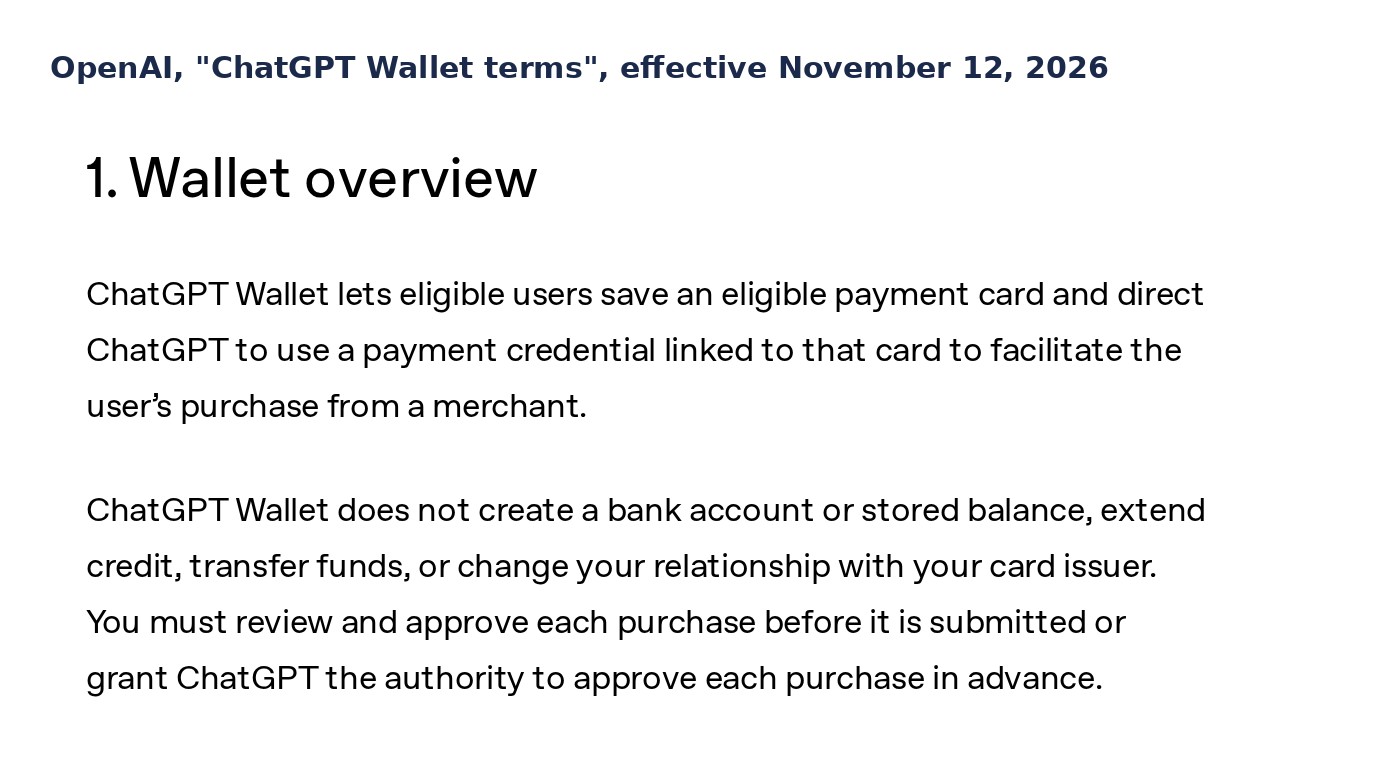
Yet the terms already allow another option: users must review and approve each purchase “or grant ChatGPT the authority to approve each purchase in advance.” Further out, OpenAI’s post says the company expects users to be able to hand purchases off to their agent entirely. Those purchases would run within settings such as spending limits, purchase categories or time periods, along with “enhanced safeguards.”
The dots help page describes custom rules as well. For some actions, users decide what a dot can “share, purchase, or access.” They choose among four behaviors, including “Take action without asking” and “Take action if pre-approved.” Neither the post nor the Wallet help page explains how these rules fit with the biometric check.
The Wallet help page acknowledges that checkout may fail at some stores. The terms warn that “AI systems can make mistakes.”
What it means
With Wallet, OpenAI lets its agents pay without becoming a bank or a seller itself. It relies on the card networks for the token, on banks for disputes and on the user’s own device for the biometric check. Merchants are left to adapt their bot settings, anti-fraud tools and product catalogs.
The audience is still very small: US Pro subscribers, in one type of conversation, with a US credit card. For Europe, OpenAI’s timeline for dots is “a few weeks,” and it has given none for Wallet.
The merchant guide is available now, with no geographic limit. Business profiles, however, remain closed to stores and restaurants outside the US.
OpenAI presents approval of every purchase as the rule, yet its terms already allow purchases authorized in advance. No data has been published on purchase volume, decline rates or fraud.
Still to watch: whether Wallet reaches other plans and countries, when spending limits arrive and whether OpenAI starts taking a commission. The other open question is how big websites respond, from Target’s list of approved agents to Amazon’s limits on agent access.
Sources
- Introducing ChatGPT Wallet, OpenAI, November 13, 2026
- Making purchases with ChatGPT Wallet, OpenAI Help Center, updated November 13, 2026
- ChatGPT Wallet terms, OpenAI, effective November 12, 2026
- Agentic Commerce (Commerce Partner Playbook), OpenAI Developers, November 13, 2026
- Getting started with your dot, OpenAI Help Center, accessed November 14, 2026
- OpenAI launches ChatGPT Wallet, allowing its ‘dots’ AI agents to make purchases for users, CNBC, November 13, 2026
- Not so fast, bot: Companies are banning AI agents. Here’s the list., Business Insider, November 12, 2026
- OpenAI rebuilt AI shopping from scratch with ChatGPT Wallet, The Decoder, November 13, 2026
Header image: MACCUS chart, data from OpenAI’s post and the OpenAI Help Center on ChatGPT Wallet, November 13, 2026