On November 12, 2026, Google began rolling out a new card, a small summary box, in its Google Ads advertising platform. For the first time, it estimates how much advertisers would have paid for the invalid clicks Google filtered out before billing.
The card also shows a second amount: the credits Google issued for invalid clicks it caught after billing. Keerat Sharma, Google’s vice president and general manager for ads privacy and safety, announced the card in a post on Google’s blog.
Invalid traffic means ad clicks and impressions (each time an ad is shown) that don’t reflect genuine interest. Examples include bots, accidental clicks, fraudulent ad placements and competitors who click to run up an advertiser’s bill. Google says it doesn’t charge for this traffic. Before the card, credits for invalid clicks showed up only in the Billing menu and in a separate report.
Two amounts on the Overview page
According to Google’s updated help page, the card is labeled “Invalid traffic.” It sits on the Overview page, the summary screen of the Campaigns menu.
Both amounts cover the date range selected in the account. The first, “Est. savings,” short for estimated savings, estimates the cost of the clicks that Google’s automated filters and manual reviews caught before billing.
The second amount, “Credited cost,” adds up the credits for invalid activity detected after a monthly billing cycle had closed. A “View details” link opens a page with daily charts, a breakdown by campaign and links to the related invoices.
Search Engine Roundtable, a news site about search marketing, quoted Google’s Ads Liaison, the company’s official point of contact for advertisers. According to Ads Liaison, the detailed reports can be downloaded, and the card is “rolling out globally starting this week.” Google’s help page says the rollout is gradual and that some accounts may not see the card yet. As of November 14, the French version of that help page still didn’t mention the card.
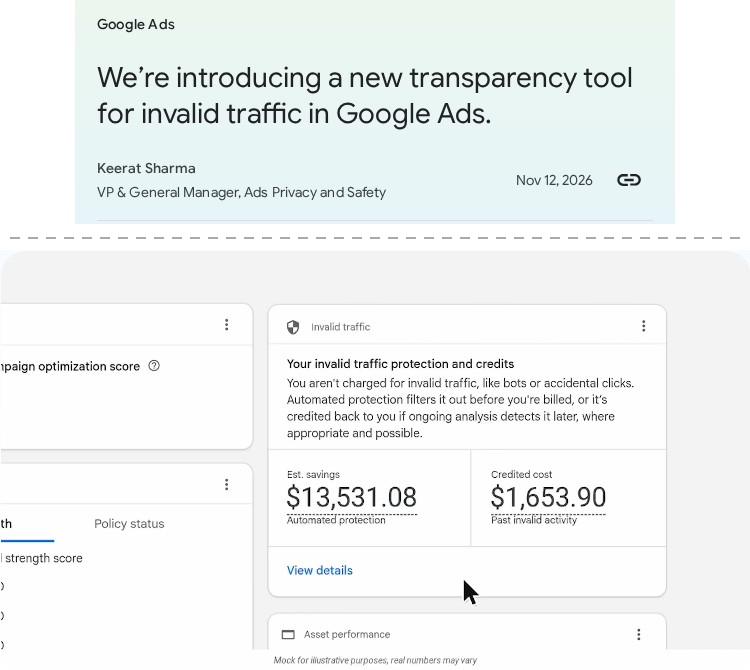
The sample card in Google’s announcement shows estimated savings of about $13,500 and a credited cost of about $1,650. A note under the image says it is a mock-up and that real numbers may vary.
How Google handled invalid clicks before the card
The filtering itself isn’t new. According to Google’s help page, clicks found to be invalid before the end of the month are removed from reports and from the bill. Advertisers have no refund to request. Google says it returns that money to the campaign budget and then tries to spend it on valid traffic.
When invalid traffic turns up after the invoice has gone out, Google issues a credit “where appropriate and possible.” The credit is listed in the Billing menu as an adjustment labeled “Invalid activity.” Campaign metrics such as clicks and cost are a different matter. They are frozen at the end of the month and aren’t adjusted for those credits.
Advertisers already had several tools, but they were scattered. The “Invalid clicks” column shows a count of clicks with no cost attached. Advertisers have to add it to their campaigns table by hand.
A separate report, the Invalid Activity Credit Report, is available as a ready-made template in the Report Editor, Google Ads’ custom report tool. It recalculates campaign performance to account for credits. It covers only Search campaigns, which place ads in Google search results, and Performance Max. Performance Max is the campaign type whose AI splits the budget across Google’s ad channels, Discover included.
Advertisers who suspect a problem can also use a form to ask Google to investigate activity from the past 60 days.
The numbers Google is citing
Sharma writes that ongoing upgrades to Google’s systems have cut advertisers’ exposure to “invalid leads” by an average of 30% so far in 2026. Google didn’t say what period the 30% is measured against or how it was calculated.
Sharma’s post doesn’t define invalid leads either. Leads are potential customers who leave their contact details, usually through a form on the advertiser’s website. Google’s help page describes a related problem: forms submitted by bots and by people who enter fake contact details.
Google has made this kind of claim before. In a Google post on August 12, 2025, Per Bjorke, director of product management for ad traffic quality, described defenses built on large language models. Large language models are the AI technology behind assistants such as ChatGPT. According to Google’s internal data from December 2023 to October 2024, these defenses had cut invalid traffic tied to deceptive or disruptive ad serving by 40%.
Google’s help page also says the Media Rating Council (MRC) accredits Google’s invalid traffic defenses for specific services and metrics. The MRC is an independent US industry body that accredits ad measurement services after an audit.
What the card doesn’t show
According to PPC Land, a trade site that covers online advertising, the card reflects only Google’s own classification. Questionable traffic that Google never flagged, before or after billing, doesn’t show up on it.
PPC Land also points out other limits. The card gives no invalid traffic rate, meaning the share of an account’s traffic found invalid. It doesn’t explain how the savings figure is calculated, and it counts accidental clicks together with fraud.
Google doesn’t say which specific clicks it judged invalid, even after an investigation. Its help page says sharing those details could show fraudsters how its detection works. WeRSM, a social media and marketing news site, notes that the 30% figure is self-reported by Google, with no independent audit behind it.
Fake leads are a separate problem. Google acknowledges that its filters run after an ad is served and can’t block traffic that reaches the advertiser’s website. Bots or people can still fill out forms there.
Google’s help page recommends three safeguards for forms. One is reCAPTCHA, a test that checks whether a visitor is a human or a bot. Another is server-side validation, where the website’s server checks each form before accepting it. The third is double opt-in, which asks people to confirm their address by email.
On November 13, an advertiser on Reddit raised a question the card can’t answer. The advertiser runs campaigns for a small fencing and landscaping business near Paris and posted a week of results. The ads drew 91 clicks and cost €210, but brought in no inquiries.
The Reddit post asked whether the problem was the traffic or the landing page, meaning the page people reach after clicking the ad. The new card doesn’t settle that kind of question: it only puts a figure on what Google filtered out or credited.
What it means
The protections Google describes were already in place before the card. The card puts a cash value on their results and shows it in one place, the account’s Overview page. Until now, those results were spread across a report column, the invoice and a template in the Report Editor. The change applies to every advertiser as the card reaches their account, including small businesses in France and Belgium that run their own ads.
The savings figure is still an estimate made by Google, which also sells the traffic being measured. The 30% drop in invalid leads comes from Google too, and Google has published no method for either figure.
Google’s help page says the MRC accreditation and an annual audit by an independent third party cover Google’s detection and filtering processes. Google doesn’t present either headline figure as audited.
A rising savings figure can be read two ways. On its help page, Google presents a rise in filtered invalid clicks as proof that its defenses are protecting advertisers’ budgets. The same rise can also mean that more of the clicks on the ads didn’t come from genuine interest. Without an invalid traffic rate, the card can’t show which reading is right.
The card arrives as Google removes settings elsewhere in Google Ads, such as language targeting in Search campaigns. A study for the European Commission, the EU’s executive arm, was made public in late October. It found that EU rules had not made online advertising meaningfully more transparent for advertisers.
Several things are worth watching. One is when the card reaches French and Belgian accounts and when the French help page is updated. Another is whether Google publishes how it calculates the estimated savings.
PPC Land notes two more open questions. Google hasn’t said whether the figures will be available through the Google Ads API, the interface that lets other software pull account data automatically. It also hasn’t said whether the card covers every campaign type, including Display campaigns, which place ads on other websites and apps, and video campaigns.
Sources
- We’re introducing a new transparency tool for invalid traffic in Google Ads, Google, November 12, 2026
- About invalid traffic, Google Ads Help, accessed November 14, 2026
- À propos du trafic non valide, Google Ads Help (French), accessed November 14, 2026
- About the Invalid Activity Credit Report, Google Ads Help, accessed November 14, 2026
- How we’re using AI in new ways to fight invalid traffic, Google, August 12, 2025
- Google Ads Invalid Traffic (IVT) Overview Card, Search Engine Roundtable, November 12, 2026
- Google Ads now shows how much invalid traffic advertisers did not pay for, PPC Land, November 12, 2026
- Google Ads Makes Invalid Traffic Visible To Advertisers, WeRSM, November 12, 2026
Header image: MACCUS diagram, data from Google Ads Help and the Google blog (November 2026)