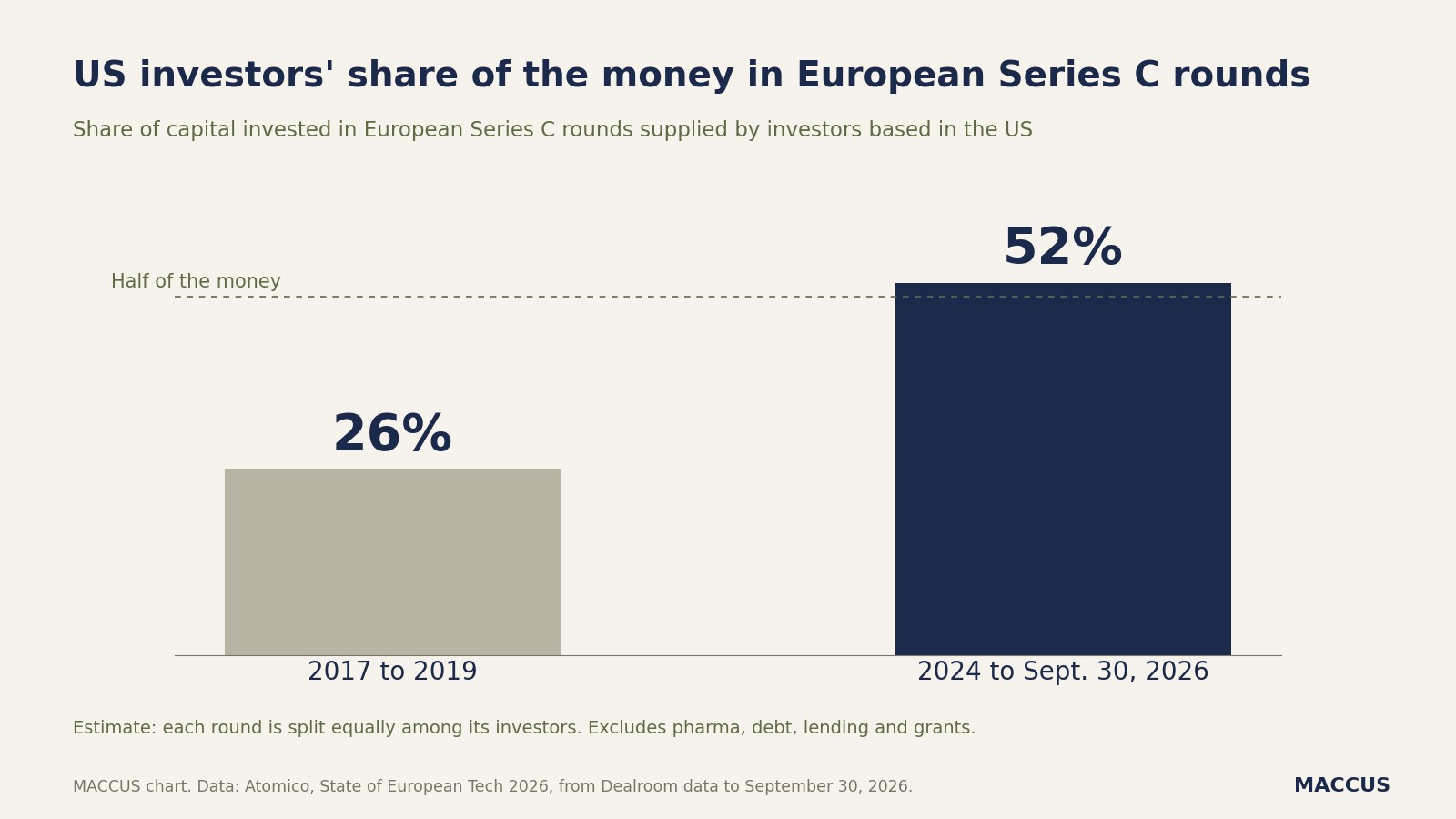

Investors based in the United States now put up more than half of the money in Europe’s Series C startup rounds, an estimated 52%. A Series C is usually a startup’s third large funding round, raised once it already sells at scale and needs money to grow faster. The estimate covers 2024 to September 30, 2026, and the US share has doubled from 26% in 2017 to 2019. Atomico, a British firm that invests in startups, published the estimate on November 18, 2026, in its annual report, State of European Tech 2026.
The 52% measures money put into those rounds. Who owns the companies’ shares is a separate measure that the report does not give here. To get it, Atomico splits each round equally among its investors, then adds up the amounts by the region where each investor is headquartered. The data comes from Dealroom, a company that tracks startup funding, and leaves out pharmaceutical companies, debt, loans and grants.
Atomico says the shift matters because “who funds a company shapes who owns it.” Atomico is also an interested party: as a venture capital firm, it raises money from investors and puts it into startups. Its report argues for steering more European pension money into venture funds, the kind of money that firms like Atomico raise.
The later the round, the less of the money is European
European investors still provide most of the money in early rounds. From 2024 to September 30, 2026, they put up 70% of the capital in European seed rounds, the first round a startup raises from professional investors. Their share falls at each later stage, down to 41% at Series D and beyond, the rounds that come after Series C. “At both Series C and Series D+, US investors now supply more than European investors do, around half of the total,” the report says.
European investors have lost ground over the decade. Their share has fallen at every stage since the 2017 to 2019 period, according to Atomico, while the US share of Series C money doubled.
More European rounds now include investors from abroad. So far in 2026, 36% of all European funding rounds include at least one investor from outside Europe, up from 22% a decade ago. Back then, the figure for US rounds was higher: 24% had an investor from outside the US. That US figure has risen by only four percentage points since.
At Series C, 76% of European rounds now include an investor from outside Europe, up from 31% in 2017. Atomico counts an investor as from outside Europe when it is headquartered outside the company’s region and is investing in that company for the first time.
The report gives the example of two startups that both raised their first funding in 2017. Wayve, a British company that makes self-driving software, passed $250 million and then $500 million in total funding through rounds led by investors from outside Europe. Anduril, an American defense company, raised money only from US investors until its Series F round. In total, Anduril has raised about four times as much as Wayve.
Some large rounds are led by European investors. The report notes that Mistral AI, the French developer of AI models, raised a $1.9 billion Series C in 2025 led by ASML, the Dutch maker of chipmaking machines.
Europe’s pension funds put little into venture capital
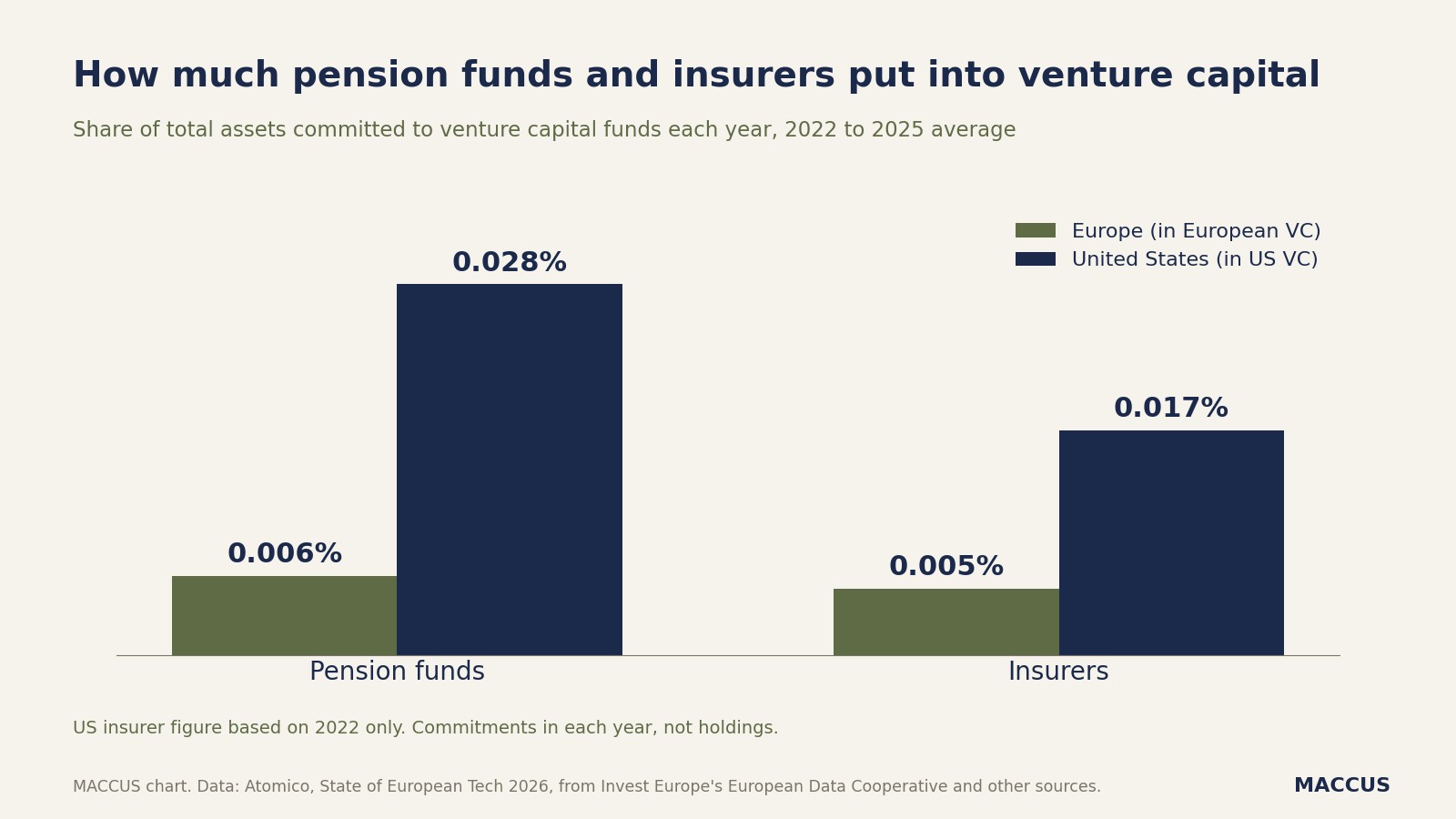
The report traces part of the gap with the US to how Europe’s pension funds and insurers invest people’s savings. European pension funds commit about 0.006% of their assets each year to European venture capital funds, and insurers 0.005%, by Atomico’s average for 2022 to 2025. US pension funds and insurers commit more than four times and three times as much, at 0.028% and 0.017%. The US insurer figure covers 2022 only.
These figures count money committed each year. What pension funds already hold in venture capital is a separate measure. Atomico’s website puts the yearly figure in dollars: European pension funds hold $13 trillion in assets and commit $780 million a year to European venture funds.
Atomico does not blame regulation alone. Pension funds in both regions face limits on risky assets, the report notes. Part of the difference is experience: the US tech sector is older, and US pension managers have been assessing venture funds for longer.
Policymakers who answered Atomico’s survey also rank pension money first. Atomico asked them which single measure would do most to raise European ownership of European tech companies. The top answer, picked by 30%, was pension and insurance funds, ahead of tax incentives at 21%.
European Commission President Ursula von der Leyen described the same problem in her State of the Union address on September 10, 2025. As Europe’s startups grow, she said, “the limited availability of risk capital forces them to turn to foreign investors. This is wealth and jobs going elsewhere. And it jeopardises our tech sovereignty.”
A record number of $1 billion rounds
The rising US share comes in a strong year for European tech. European tech investment is on track to reach $81 billion in 2026, up 62% from $50 billion in 2025, according to the report. That total is a projection: Atomico estimates the full year from data through September 30. It would come close to the 2021 record of $94 billion.
Rounds of $1 billion or more account for much of the total. European startups closed 13 of them in the first nine months of 2026, the most Europe has ever had. Those rounds took 37% of all the capital invested in that period.
Venture funds based in Europe are not keeping pace. They raised $9 billion in new commitments in the first half of 2026. No European fund has closed with more than $1 billion this year. Atomico warns that the $81 billion and the $9 billion are not directly comparable, since startup funding includes money from US and other non-European investors.
What the figures leave out
The 52% depends on Atomico’s method. Splitting each round equally ignores how much each investor actually put in. The real US share of the money could be higher or lower, and the report gives no margin of error.
The report also credits foreign money with benefits. Investors from outside Europe have been “essential” to the growth of European companies, it says. They bring “the scale, speed and conviction that large rounds demand,” the report adds, along with networks and experience in building companies.
Europe has more new tech founders than any other region, by Atomico’s count. In 2026, 29% of the world’s new tech founders were based in Europe, just ahead of the US at 28%. Atomico adds that its data probably undercounts Chinese founders.
What it means for Europe
Europe gains from the inflow: foreign investors fill the gap “where European funds may lack the depth to write big cheques,” the report says, in a region that had 29% of the world’s new tech founders in 2026. The EU’s answer to the shortfall is the €5 billion Scaleup Europe Fund: in May, the board of the European Innovation Council Fund, an EU body that invests in startups, chose the Swedish investment firm EQT to run it. ABP, the Dutch pension fund, and the insurer Allianz were among the founding investors named in May. Brussels also backs technology directly, as with EUROPA, the open AI model it commissioned from the Italian company Domyn.
The gap that remains shows when companies go public or are sold. Between 2024 and October 20, 2026, 53% of the value of European tech IPOs, or stock market debuts, went to US stock exchanges, up from 17% in 2017 to 2020. In 2025 and 2026 so far, US companies made six of the ten acquisitions of venture-backed European tech companies worth $1 billion or more. Control is also at stake in takeovers inside Europe: Italy’s government can block the €2.05 billion bid by the Finnish satellite maker ICEYE for Avio, the company that builds the Vega C rocket.
On August 4, the Commission cleared the last legal steps to launch the Scaleup Europe Fund, whose first investments it had planned in May for fall 2026. By October, the fund had secured €3 billion of its €5 billion, according to Atomico. “The Scaleup Europe Fund is an important first step, but its target €5B alone won’t close the gap,” Victor Englesson, the EQT partner who co-heads the fund, says in the report. Tom Wehmeier, a partner at Atomico, told TechCrunch that “the next few weeks are going to be a really important test, with EU Inc,” the campaign for a single legal form that companies could use across Europe.
Sources
- State of European Tech 2026 (full text), Atomico, November 18, 2026
- State of European Tech 2026, Atomico, November 18, 2026
- Méga-tours, croissance fulgurante, boom entrepreneurial… 5 enseignements sur la tech européenne en 2026, Journal du Net, November 18, 2026
- European Innovation Council selects EQT to lead €5 Billion Scaleup Europe Fund, European Commission, May 18, 2026
- European Commission launches €5 Billion Scaleup Europe Fund to keep growth at home, European Commission (Futurium), August 5, 2026
- 2025 State of the Union Address by President von der Leyen, European Commission, September 10, 2025
- Stripe backer Atomico calls for Europe to own its success stories, TechCrunch, November 17, 2026
Header image: MACCUS chart. Data: Atomico, State of European Tech 2026, from Dealroom data to September 30, 2026.