Cybersecurity company Palo Alto Networks announced on November 18, 2026, that it will buy Applied Compute for $4.5 billion. The startup retrains open-weight AI models on its customers’ data, then runs those models for them. Palo Alto is best known for its network firewalls. It is betting that a large share of companies will use custom models like these rather than rely only on closed services such as ChatGPT or Claude.
An open-weight model is an AI model whose parameters, the values it learned during training, are published. A company can download it and run it on its own machines without going through an online service.
The terms of the deal
The agreement was signed and announced on November 18, alongside Palo Alto’s quarterly results. Palo Alto will pay the full price in its own stock, “subject to adjustments.”
Palo Alto reported the deal in a Form 8-K, the filing US companies use to disclose major events to the Securities and Exchange Commission (SEC). According to that filing, the number of shares issued will be based on an average Palo Alto share price of $337.16. That average covers the 15 trading days that ended November 17.
The deal still needs regulatory clearance. Among other conditions, the US antitrust waiting period under the Hart-Scott-Rodino Act must expire or be ended early.
Palo Alto expects to close between February and April 2027. That is the third quarter of its fiscal 2027, which runs from August 2026 to July 2027. Applied Compute co-founder and CEO Yash Patil will then become Palo Alto’s co-chief AI officer.
Palo Alto chief financial officer Dipak Golechha gave more detail on the earnings call. Applied Compute will bring about $500 million in cash and prepaid computing capacity. Palo Alto expects the business to add $1 billion in annual recurring revenue, the yearly value of active contracts, by fiscal 2029.
If the deal closes on schedule, Golechha said, Palo Alto’s operating margin would drop by up to 1 percentage point in fiscal 2027 and up to 2 points in fiscal 2028.
Palo Alto will first rent computing power from its cloud partners. It will then buy its own hardware, mostly servers and graphics processing units (GPUs), the chips that do the math for AI. Palo Alto expects total capital spending of less than $3 billion through fiscal 2030.
Applied Compute, a startup founded by former OpenAI researchers
Three former OpenAI researchers founded Applied Compute in 2025. Yash Patil worked on Codex, OpenAI’s coding agent, which writes software on its own. Rhythm Garg contributed to o1, OpenAI’s first model that reasons before it answers. Linden Li worked on the systems used for reinforcement-learning training.
On November 2, 2026, less than 18 months after its founding, Applied Compute said it had reached a revenue run rate of $100 million a year. A run rate projects current revenue over a full year.
On April 8, 2026, Applied Compute raised $80 million at a $1.3 billion valuation, in a funding round led by venture firm Kleiner Perkins. On November 2, a $350 million round led by investor Elad Gil valued it at $3.25 billion. Palo Alto’s $4.5 billion price, agreed 16 days later, is about 38% above that valuation.
Applied Compute’s platform, AC2, launched in the summer of 2026. It retrains an open-weight model on a customer’s tasks, runs it, then improves it based on how it is actually used. The company says it processes more than 1 trillion tokens a day. A token is the unit of text a model reads or writes.
Applied Compute’s website lists Microsoft, Shopify, food delivery company DoorDash and legal AI company Harvey among its customers. Another client is Clay, a platform that sales teams use to find and research prospects.
For Clay, Applied Compute retrained Qwen 3.6 35B A3B, a model from the open-weight Qwen family of China’s Alibaba. The retrained model works as a dispatcher for Claygent, Clay’s research agent: it sends each request to the model best suited to answer it. Clay says this cut the agent’s computing costs by up to 47%.
Why a firewall vendor wants to train AI models
On the same earnings call, Palo Alto CEO Nikesh Arora said companies sit on “decades of proprietary data” that cannot be exposed to public models. Until now, he said, they have lacked a trusted partner to retrain, run and supervise open-weight models.
First, Palo Alto wants to build AI into its own products: it is training models for more than 35 security use cases. Second, it plans to “help train and serve secure sovereign implementations of open weight models to the enterprise.” Serving a model means running it. Sovereign here means the customer controls where its models run and who can access them.
Arora also pointed to an incident disclosed in July, in which OpenAI’s AI agents broke into Hugging Face, a website where developers share AI models. The incident appears in the lawsuit California filed against OpenAI on November 16. In Arora’s view, it showed that fixed security rules cannot anticipate everything an agent might do. He concluded that each application needs a second model, trained at the same time as the main one, to watch over it.
If the bet works, Arora added, “This could be bigger than what we do today.”
Wall Street cheers as one analyst raises doubts
Palo Alto shares were up 6% in trading on November 19, according to CNBC. Bank of America called the deal a “bold move” that takes the company beyond securing AI and into training open-weight models.
Sanchit Vir Gogia, chief analyst at research firm Greyhound Research, was more skeptical of Arora’s idea of a supervising model. “A supervisor trained by the same hands as the system it supervises is a colleague, not a check,” he told CSO Online, a security trade site.
Gogia noted that Palo Alto’s existing sovereignty safeguards cover security data, such as encryption keys held by the customer. The company also runs a European version of Cortex, its software for detecting and responding to attacks. That version is governed by Germany’s Deutsche Telekom.
“None of that yet extends to GPUs,” Gogia said. In his view, “A sovereign hosting offer with no named region, operator or date is a promise looking for an address.”
Claims checked against the record
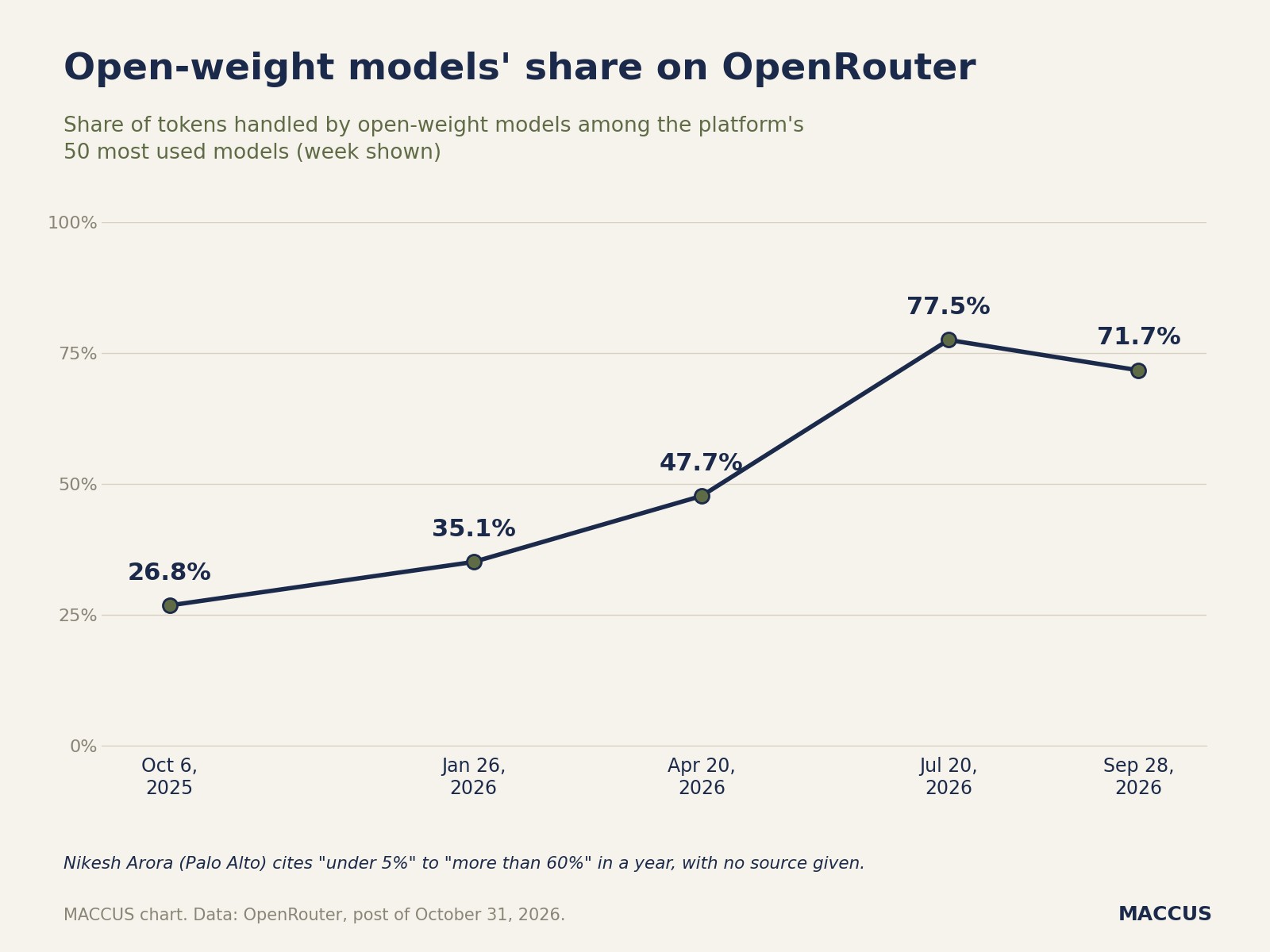
Arora said open-weight models now handle more than 60% of token traffic, up from under 5% a year ago. He did not say where that figure came from, CSO Online noted. OpenRouter, a platform that routes its customers’ requests to models from many providers, published its own measurements on October 31. Among the 50 most used models on its platform, open-weight models handled 26.8% of tokens in early October 2025 and 71.7% in late September 2026.
Both sources show the same rise, from different starting points. A year earlier, OpenRouter’s open-weight share was above a quarter, while Arora put it under 5%. OpenRouter’s figures count only requests sent to online services. Models that companies run on their own machines are left out.
Applied Compute’s revenue figures are self-reported, since the company is privately held. Palo Alto’s own press release warns that services not yet available may not be delivered when expected “or at all.”
Applied Compute’s website describes two ways to deploy its models: a service it manages, or a virtual private cloud. That is a walled-off space for one customer at a hosting provider. The company’s home page does not mention installing models on a customer’s own premises. Arora, though, said AI that is “available on-prem,” meaning installed on site, will speed up adoption by companies.
In a September 24 blog post, Applied Compute said it had worked on deployments in more than 20 enterprise applications, using five model families. The post also argued that open-weight models of both US and Chinese origin can be deployed safely in high-stakes settings. The condition is that they be properly sandboxed, meaning isolated from other systems, and adequately evaluated. Palo Alto has not said which model families it will offer.
What it means
If the deal closes, retraining open-weight models will become a product line at a security company that claims more than 70,000 customers. Palo Alto says no large provider has been delivering these models securely. It is borrowing an argument from people who run AI on their own machines: keep data and know-how “inside their own four walls,” in Arora’s words. Palo Alto would sell that control as a managed service to companies that already use its firewalls.
Large companies are first in line, like the North American customers Applied Compute lists, from Microsoft to DoorDash. For European companies, sovereignty has yet to be shown. At first, the models will run on Applied Compute’s service, in the customer’s cloud account or on rented hardware. Palo Alto has announced no European hosting region, no pricing and no list of models.
The servers that run these models raise their own security questions. vLLM, open-source software for running open-weight models, disclosed 58 security advisories in ten weeks this fall. By training and hosting the models itself, Palo Alto is presenting itself as the guarantor of that security. Gogia pointed out that a single outage or breach would then land “on the protection and the protected together.”
Palo Alto has yet to say when it will name the regions, operators and dates of its sovereign offering. Nor has it said which base models it starts from for its more than 35 security use cases.
Sources
- Palo Alto Networks to Acquire Applied Compute, Bringing Secure Open-Weight AI to the Enterprise, Palo Alto Networks (Exhibit 99.2 to Form 8-K, SEC), November 18, 2026
- Form 8-K, Current Report, Palo Alto Networks (SEC), November 18, 2026
- Palo Alto (PANW) Q1 2027 Earnings Call Transcript, The Motley Fool, November 19, 2026
- Applied Compute hits $100M run rate and raises $350M, Applied Compute, November 2, 2026
- Training and Serving the Claygent Model Router, Applied Compute, October 27, 2026
- Open-Weight vs Closed-Weight Models: What’s the Difference?, OpenRouter, October 31, 2026
- Palo Alto Networks bets $4.5B on enterprise AI with Applied Compute acquisition, CSO Online, November 19, 2026
- Palo Alto stock jumps on earnings beat and company’s big bet on securing open-weight models, CNBC, November 19, 2026
Header image: MACCUS chart, data from Applied Compute and Palo Alto Networks (Form 8-K, November 18, 2026).