
OpenAI’s new usage policies, the rules for using the ChatGPT maker’s artificial intelligence (AI) models, took effect on November 20, 2026. They bar anyone from using those models, or their answers, to build training data for a model meant to replace OpenAI’s. The ban covers preparing, scoring and sorting that data, even for people who never train the rival model themselves. Platforms that give third parties direct access to OpenAI’s models now need OpenAI’s approval.
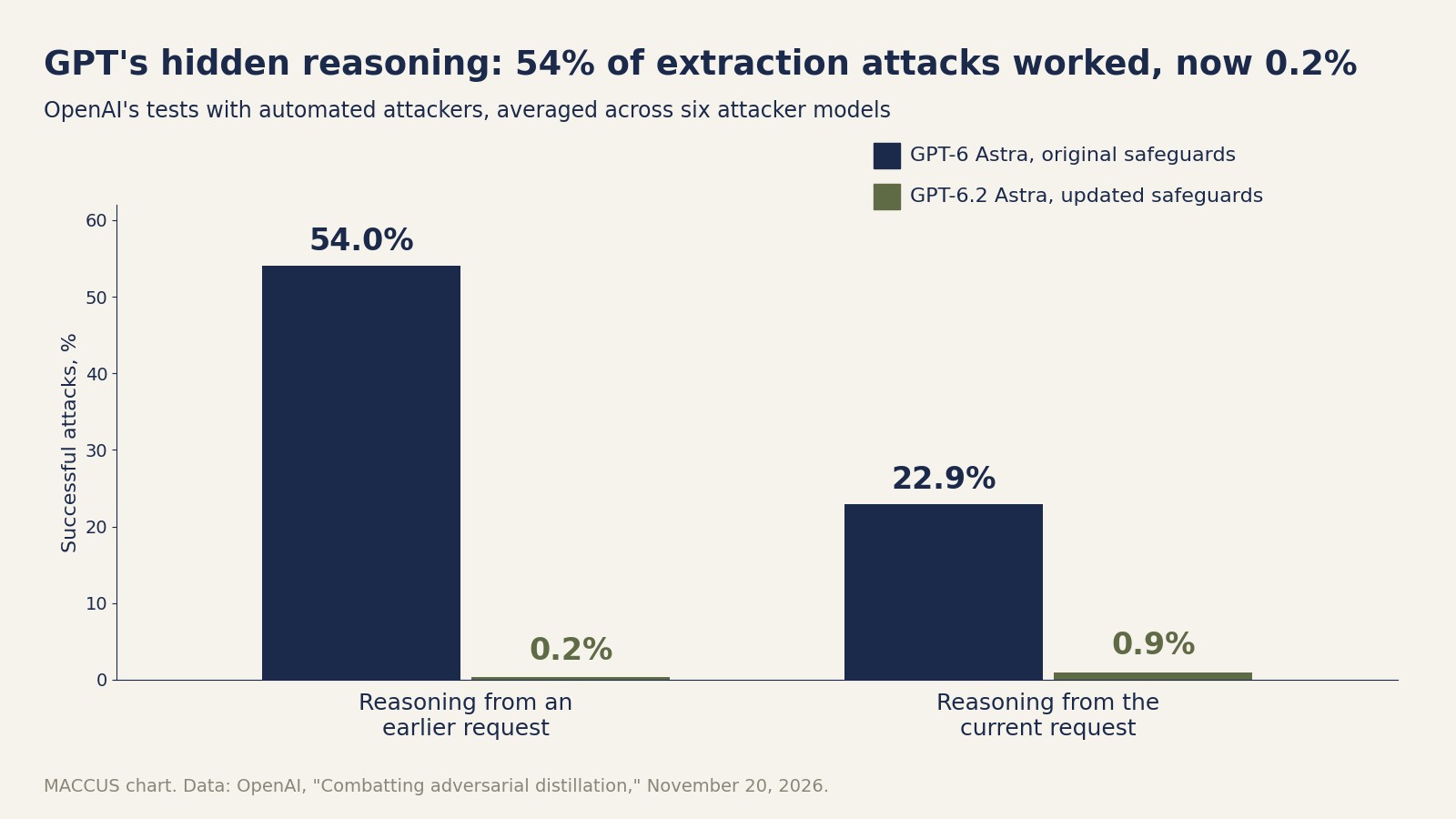
The same day, OpenAI published a post on “adversarial distillation”: copying a model without permission by training another model on its answers. In OpenAI’s own tests, attacks tried to extract its models’ hidden reasoning, the steps a model works through before it answers. One kind of attack worked in 54% of attempts against the older GPT-6 Astra with its original safeguards and in 0.2% against the new GPT-6.2 Astra. OpenAI also says its weekly actions against distillation campaigns have reached tens of thousands of accounts.
A detailed ban on helping train rival models
The previous version of the usage policies, dated October 29, 2025, had no section on training other models. OpenAI’s separate terms of use already had a one-line ban on using its models’ output to develop competing models. OpenAI announced the update on October 21, 2026, in a post titled “Broad access through consistent standards.”
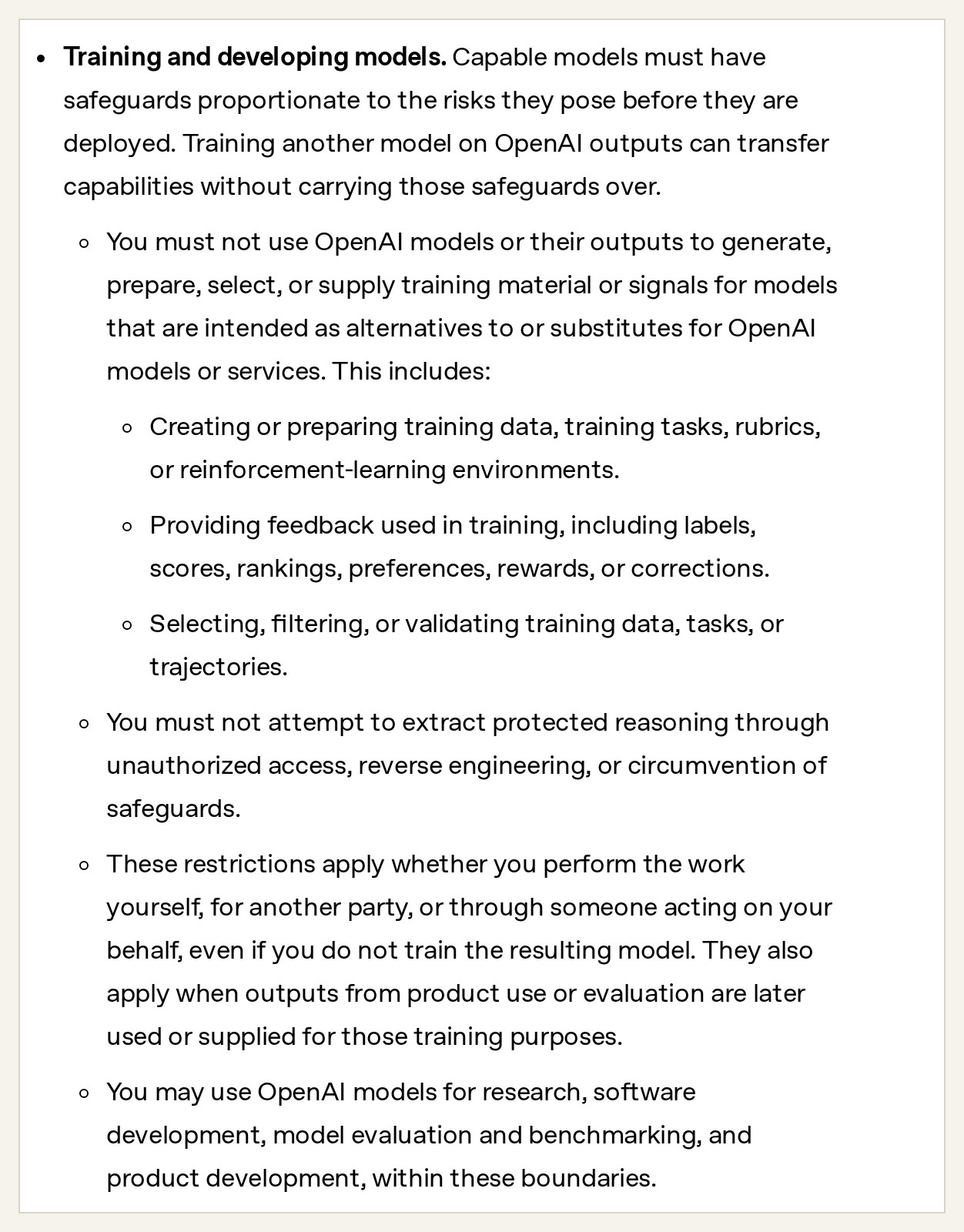
The new section is called “Training and developing models.” It says users “must not use OpenAI models or their outputs to generate, prepare, select, or supply training material or signals.” The ban applies to models “intended as alternatives to or substitutes for OpenAI models or services.”
The section’s list starts with creating training data, grading rubrics (guides for scoring answers) and reinforcement-learning environments, where a model learns from rewards. Labels, scores, rankings and preferences supplied for training are on the list, as are selecting and filtering data.
Two clauses widen the rule. One covers work done for a third party or handed off to someone acting for the user. The other covers the output of ordinary use or of a model evaluation, if that output is later used to train a rival model.
The section allows some work “within these boundaries”: research, software and product development, and model evaluation and benchmarking (comparing models on standard tests). The applicable agreement with OpenAI can also carve out exceptions.
Platforms that offer access to OpenAI models need approval
The new policies add a rule for platforms that sit between OpenAI and the people who use its models. Their operators must “obtain our prior review and approval” before letting third parties access those models directly. The October 21 post names model routers and AI gateways, services that offer many models through a single interface. An app that builds in OpenAI’s models to power its own features is not covered for that reason alone.
As of November 21, OpenAI’s pages gave no list of approved services and no way to apply. The October 21 post says only that these partners must keep safeguards consistent with OpenAI’s own, investigate potential violations, take appropriate action and coordinate enforcement. OpenRouter, one of these routers, listed GPT-6.2 Astra and GPT-6.2 Sol in its public catalog at 1:14 a.m. Paris time on November 21. OpenAI released those two models on November 17.
Anthropic, which makes the Claude AI models, put a similar rule into effect on November 12. Its new usage policy bans reselling or providing access to Claude through unauthorized means, such as services that route requests through consumer subscriptions. The policy also bans training any AI model on Claude’s output without Anthropic’s prior authorization.
The high-stakes ban moves from decisions to actions
OpenAI’s policy update rewrites one more ban. The 2025 version prohibited the “automation of high-stakes decisions in sensitive areas without human review.” The new text replaces “decisions” with “actions”: it now bans the “automation of high-stakes actions.”
High-stakes actions include decisions, transactions, submissions and other steps that materially affect a person’s rights, safety, access to essential services or other consequential interests. The list of sensitive areas is nearly unchanged. It still includes employment, housing, credit and insurance, along with legal and medical matters.
OpenAI’s distillation post centers on hidden reasoning
OpenAI’s November 20 post is about distillation, a common technique in which one model learns from another’s answers. OpenAI calls it “adversarial” when it is unauthorized and aims to reproduce a model stripped of its safeguards. Its example comes from cybersecurity: a copied model could help with an attack that the original would have refused.
OpenAI says it puts particular emphasis on protecting its models’ reasoning, which users do not see in full. According to OpenAI, these reasoning traces can contain information the final answer leaves out, which makes them valuable training data. The new usage policies ban attempts “to extract protected reasoning” through unauthorized access, reverse engineering or getting around safeguards.
In an internal OpenAI study on cybersecurity, a model trained on the exact traces generally beat one that saw only what a user sees. After a round of reinforcement learning, that edge held only when the model could use the most computing power tested for an answer. With less computing power, the model trained without the traces did better.
OpenAI tested its safeguards with six attacker AI models that adapt their approach and see only what an outside user sees. Against GPT-6 Astra with its original safeguards, attempts to extract the reasoning behind an earlier request succeeded 54.0% of the time on average. Against GPT-6.2 Astra, the rate was 0.2%.
For the reasoning behind the current request, the success rate fell from 22.9% to 0.9%. OpenAI says it is applying some of these safeguards to GPT-6 Astra as well.
OpenAI’s safeguards include automated filters, called classifiers, that flag extraction attempts. Other classifiers can block suspected reasoning leaks in the model’s replies and in its tool calls, the requests it makes to other software. OpenAI says it closed a pathway that let someone holding another user’s encrypted reasoning read it.
Editing an earlier message drops later reasoning
Several of these safeguards affect developers who use the API, the interface that lets software send requests to OpenAI’s models. With GPT-6.2 Astra and Sol, a model’s reasoning stays tied to the conversation history that produced it. If an earlier message is rewritten, the API drops the reasoning that followed it. OpenAI’s older model families, which have weaker safeguards, can no longer read GPT-6.2’s protected reasoning.
OpenAI’s documentation lists other edits that change the conversation history. They include shortening an old tool result, rewriting a developer message (the app’s own instructions to the model) and replacing older exchanges with a summary.
After such an edit, the model may have to redo some of its reasoning. That can raise token use (tokens are the units of text OpenAI bills for), cost and response time, and sometimes lower answer quality. OpenAI’s own context compaction feature, which condenses long conversations, keeps the reasoning.
Distillation campaigns and the accounts behind them
OpenAI says it has seen several unauthorized distillation campaigns on its platform this year. Each week it has acted against thousands to tens of thousands of accounts, a rate that rose significantly over the summer. In February, OpenAI briefed the U.S. Congress on activity indicating that DeepSeek, a Chinese AI developer, was trying to distill American models.
In a September 30 post, OpenAI described one campaign that began on July 1. Over two days, July 24 and 25, more than 4,000 users sent 16,000 requests. OpenAI shut the campaign down by July 28, after tying the activity to a cluster of more than 15,000 users.
OpenAI attributes a core part of the activity to people associated with Moonshot AI, the developer of the Kimi AI models. It notes that the campaign figures count attempts, whether or not they succeeded.
Gaps in the figures and the rules
The attack success rates come from OpenAI’s internal tests. OpenAI does not publish the attacks it used or any results from outside researchers. Its results table has no figures for GPT-6.2 Sol, the other new model. The count of accounts OpenAI acted against comes only as a weekly range, with no total and no breakdown by country.
The claim that people associated with Moonshot AI were behind a core part of that campaign rests on OpenAI’s own investigation. The September post does not publish the technical evidence. The same post says it is unclear whether all the operators OpenAI saw came from a single actor.
The new usage policies leave one question open. They cover models “intended as alternatives to or substitutes for OpenAI models or services,” but do not say when a model counts as a substitute.
What it means
The training rule mostly turns a one-line ban in the terms of use into a list of specific tasks. Scoring answers, ranking them or sorting data with OpenAI’s models stays allowed for evaluating or comparing models. The same work is banned when it feeds the training of a model meant to replace OpenAI’s, unless an agreement with OpenAI carves out an exception.
Companies that reach GPT models through a router now depend on OpenAI approving that service. For developers on GPT-6.2, rewriting a conversation’s history can raise costs and lead to slower, sometimes weaker answers. Still to watch: an application process or list of approved platforms, and the first enforcement actions under the new section.
On distillation, the sharp drop in successful attacks rests on OpenAI’s own tests, and its evidence on Moonshot AI is not public. OpenAI says it will share details on recent campaigns “soon.”
Sources
- Usage policies, OpenAI, November 20, 2026
- Usage policies (October 29, 2025 version), OpenAI, October 29, 2025
- Broad access through consistent standards, OpenAI, October 21, 2026
- Combatting adversarial distillation, OpenAI, November 20, 2026
- Keep the prefix unchanged, OpenAI (API documentation), accessed November 21, 2026
- Disrupting a coordinated model-distillation campaign, OpenAI, September 30, 2026
- Usage Policy, Anthropic, November 12, 2026
Header image: MACCUS chart, data from OpenAI (“Combatting adversarial distillation,” November 20, 2026)