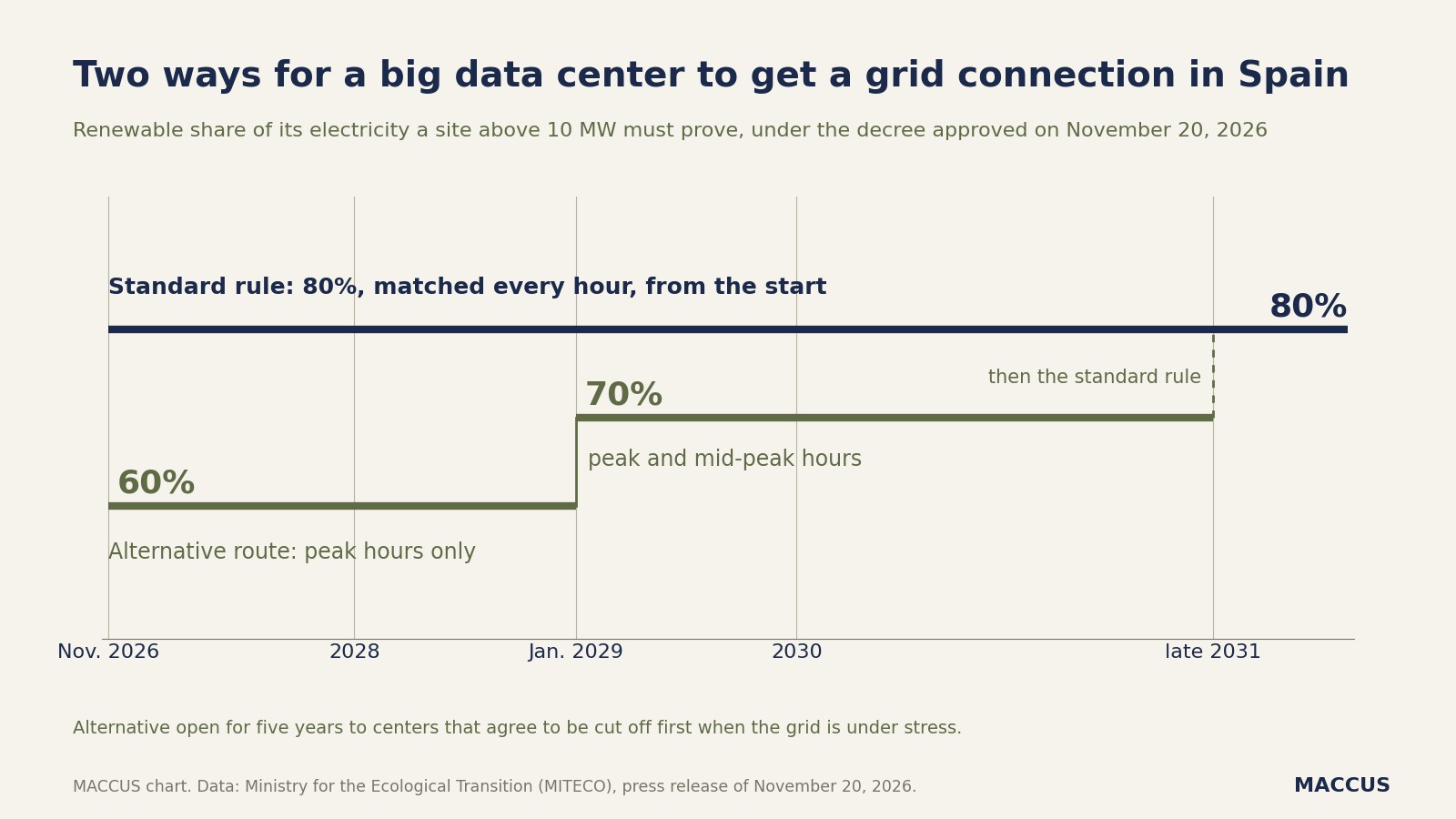

Large data centers in Spain will have to prove that 80% of the electricity they use is renewable, matched hour by hour, to get the right to connect to the power grid. The rule, a royal decree approved by the cabinet on November 20, 2026, covers sites whose electrical capacity is above 10 megawatts (MW). Matching hour by hour means a yearly total of green power is not enough: the share is computed for every hour the site runs.
For five years after approval, a center can take another route. It must join the grid’s automatic power reduction scheme and agree to be among the first sites cut off when the grid is under stress. It can then show 60% renewable power from new plants in peak hours, when demand is highest, until December 31, 2028. After that, it must show 70% in peak and mid-peak hours, the next-busiest period, until the five years end.
The government says the rule protects consumers’ power bills. SpainDC, the Spanish data center association, said on November 20 that it will challenge the decree in court and ask judges to suspend it. The decree applies once it is published in the Boletín Oficial del Estado (BOE), Spain’s official gazette. It had not appeared there by the early hours of November 21.
The 80% rule lasts until renewables supply more than 90% of Spain’s electricity, according to the press release of the Ministry for the Ecological Transition (MITECO). The ministry proposed the decree with the economy and digital ministries.
How the 80% is counted
In the ministry’s words, the rule requires that data centers “justifiquen el consumo de un 80% de energía renovable con correlación horaria”, meaning they must show that 80% of the energy they consume is renewable, with hourly correlation. The release adds: “se computará hora a hora” (it will be computed hour by hour). The ministry notes that the same hourly principle already applies to renewable hydrogen production.
The 80% must also come from new renewable plants, ones that joined the grid no more than 36 months before the data center starts operating. The release lists three exceptions, without detail: photovoltaic (solar panel) plants, some biomass plants and repowered (re-equipped) plants. Power produced on site, storage and supply contracts longer than six years count toward the share.
A center that fails either test faces two kinds of cost. Sanctions can go as far as a three-year suspension of its grid access rights. The decree also adds automatic charges to the center’s power bills, in proportion to the shortfall, so that other consumers do not bear the cost. That money goes to Spain’s capacity mechanisms, which pay power plants to stay available as backup.
Projects already in the approval process get six months to comply, or three months if they are waiting for a grid-access tender. They can instead give up their access rights without losing the financial guarantees they posted.
Sensitive public data and efficiency limits
The decree’s data rules cover data centers that host public information systems rated “high” under Spain’s National Security Framework (Esquema Nacional de Seguridad), the security standard for public-sector IT. These are systems whose failure could cause very serious harm, such as those holding health, tax, energy or transport data.
For these systems, the most sensitive data must stay in the European Economic Area (EEA): the 27 EU countries plus Iceland, Liechtenstein and Norway. The operator must have the staff and equipment for the service in the EU or the EEA. It must effectively control access from countries outside the EEA during administration, support or maintenance.
Unlike the 80% rule, the data rules apply “con independencia de la potencia del centro”, whatever the center’s power rating. The ministry says this is “because the risk does not depend on its size but on how critical the public systems hosted are.”
The decree also sets efficiency limits until an EU rating scheme and a Spanish method based on climate zones are ready. Water usage effectiveness (WUE), the water used per unit of electricity the computers consume, must be 0.1 or less. Power usage effectiveness (PUE) must be 1.25 or less. PUE divides a site’s total power use by what its computers use, so 1.25 means 25% extra for cooling and other loads.
The government’s case
The ministry argues that a data center’s demand is “essentially flat” and cannot adjust to a growing share of renewables. That, it says, would mean more power from gas plants and higher prices for consumers. Data from Ember, an energy think tank, show the mismatch. Solar was Spain’s largest source of electricity in eight of the first ten months of 2026, but a data center draws the same power at night.
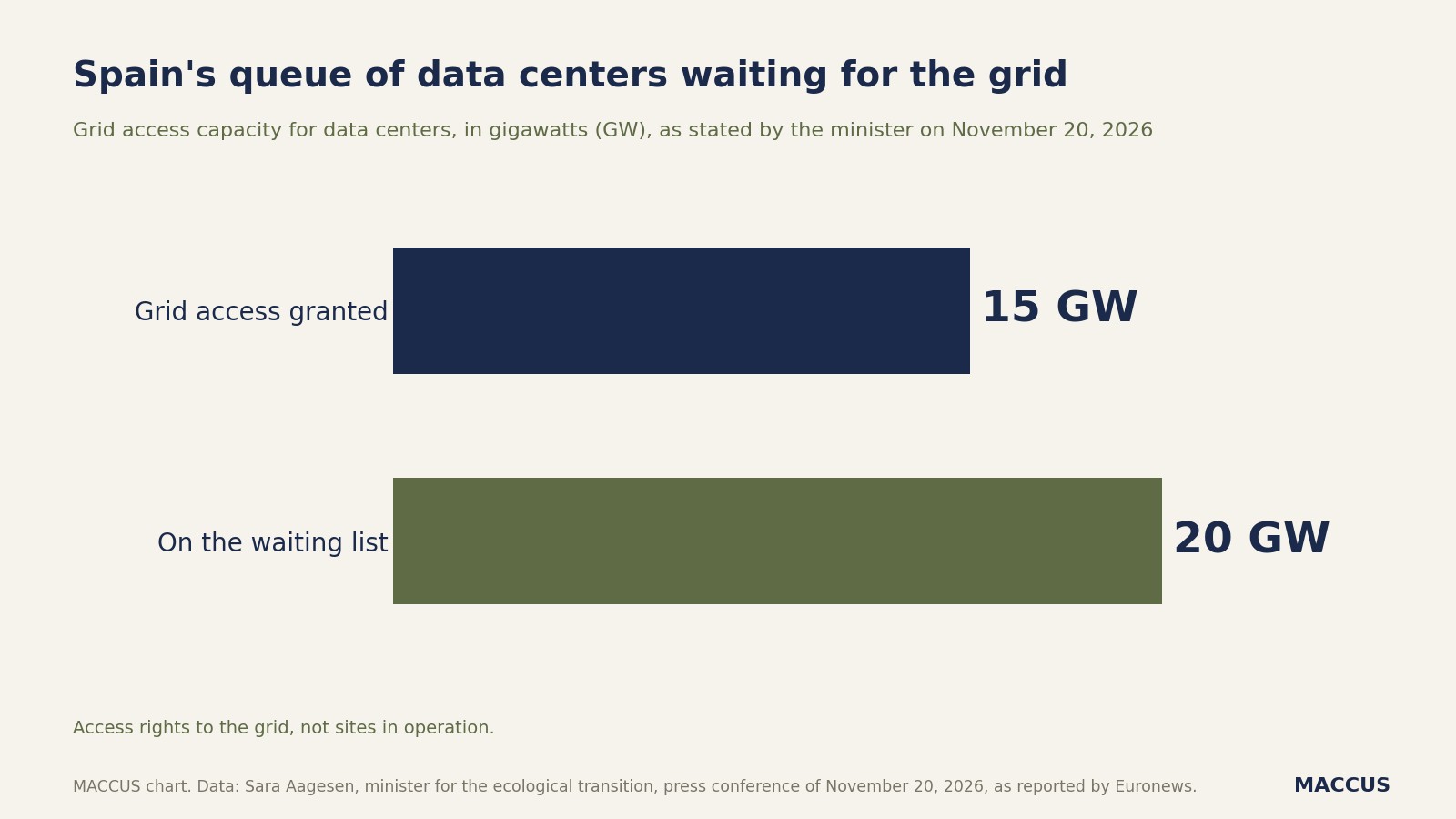
Sara Aagesen, the third deputy prime minister and minister for the ecological transition, spoke after the cabinet meeting. She said data centers already hold 15 gigawatts (GW), or 15,000 MW, of granted grid access, Euronews reported. Another 20 GW are on the waiting list, she said.
“In the absence of this royal decree, we would have an impact of 5,000 million euros on our bills,” Aagesen said, adding that industrial consumers could pay 25% more for their power. Asked for detail, she said the €5 billion figure was yearly, the news agency EFE reported. She attributed €4 billion to higher wholesale prices driven by more gas use and €1 billion to the cost of the capacity market. She said the rule makes Spain a “pionera”, a pioneer.
The industry’s answer
SpainDC calls the conditions impossible to meet and “un veto de facto”, a de facto ban on new data centers in Spain. Its members include Amazon, Google and Microsoft, according to the Spanish daily El Español. In its statement, the association says operators must choose between unworkable tests and being first in line for power cuts, which sites built to run nonstop cannot accept.
SpainDC says €66.9 billion of planned investment through 2030 is at risk. “We will challenge the decree and ask the courts to suspend its application,” said its president, Emilio Díaz.
The association rejects the €5 billion figure, saying the government has not explained where it comes from. It cites a Wood Mackenzie study, sent to the ministry, which estimates that 3 GW of extra data centers would raise the average final power price by 1.3% in 2030. SpainDC also says data centers use 0.8% of Spain’s electricity, against 23% in Ireland.
Multinacionales con España, a group of more than 50 foreign-owned companies, welcomed changes to the draft, EFE reported. It said the 80% hourly rule could still cause technical and economic problems for sites that run without interruption. The opposition People’s Party has said it will repeal the decree; Spain holds a general election on November 29.
Forecasts and a legal challenge
Both money figures in the dispute are forecasts. Euronews describes the €5 billion a year as a government forecast for a hypothetical scenario without the rule. The €66.9 billion is SpainDC’s estimate of planned investment at risk. The 15 GW count grid access rights, which do not show how much capacity is running.
SpainDC has already announced its court challenge, although the decree has not been published yet. Until the BOE text appears, the press release is the only official account of the details.
What it means for Europe
Spain attaches its renewable condition to the grid connection itself. Germany’s Energy Efficiency Act also sets a renewable share for data centers: 50% since January 2024 and 100% from January 2027. The German law counts that share as an accounting total (“bilanziell”, on balance), with no hourly test and no new-plant rule. In the US, resistance has come through local votes: voters sided against data centers in 40 of 41 ballot measures this month.
The rule also lands as data center power use grows far more slowly in Europe than in the US and China. The International Energy Agency projects growth from 2024 to 2030 of about 240 terawatt-hours (TWh, billions of kilowatt-hours) in the US, 175 TWh in China and more than 45 TWh in Europe. Data centers used 5% of Dutch electricity in 2025, Statistics Netherlands reported on November 18. Aragon, the northeastern region at the center of Spain’s boom, is set to receive more than €60 billion of data center and digital infrastructure investment over the next decade, CNBC reported on November 17.
If Spain’s rule holds, each large new site will have to bring new renewable output that matches its hours, which the government says would avoid €5 billion a year in extra costs. The BOE text will show whether the details match the press release. SpainDC’s planned request for a suspension will go to the courts. Projects already in the approval process have six months to comply or give up their grid rights.
Sources
- El Gobierno aprueba el Real Decreto para la sostenibilidad energética, medioambiental y de resiliencia y soberanía digital de los centros de datos, Ministry for the Ecological Transition (MITECO), November 20, 2026
- SpainDC solicitará la suspensión cautelar del Real Decreto y acusa al Gobierno de expulsar a España de la carrera digital, SpainDC, November 20, 2026
- El Gobierno aprueba el decreto ley de los centros de datos y la patronal lo recurrirá, EFE (via Infobae), November 20, 2026
- Spain requires data centres to draw 80% of their electricity from renewables, Euronews, November 20, 2026
- El PP derogará el decreto de centros de datos y la patronal del sector recurrirá la norma ante los tribunales, El Español, November 20, 2026
- Data center policy dominated the midterms. The ‘Virginia of Europe’ is the latest battleground, CNBC, November 17, 2026
- § 11 EnEfG, Klimaneutrale Rechenzentren, German Federal Ministry of Justice (Gesetze im Internet), consulted November 21, 2026
- Energy demand from AI (Energy and AI), International Energy Agency, April 10, 2025
Header image: MACCUS chart. Data: Ministry for the Ecological Transition (MITECO), press release of November 20, 2026.