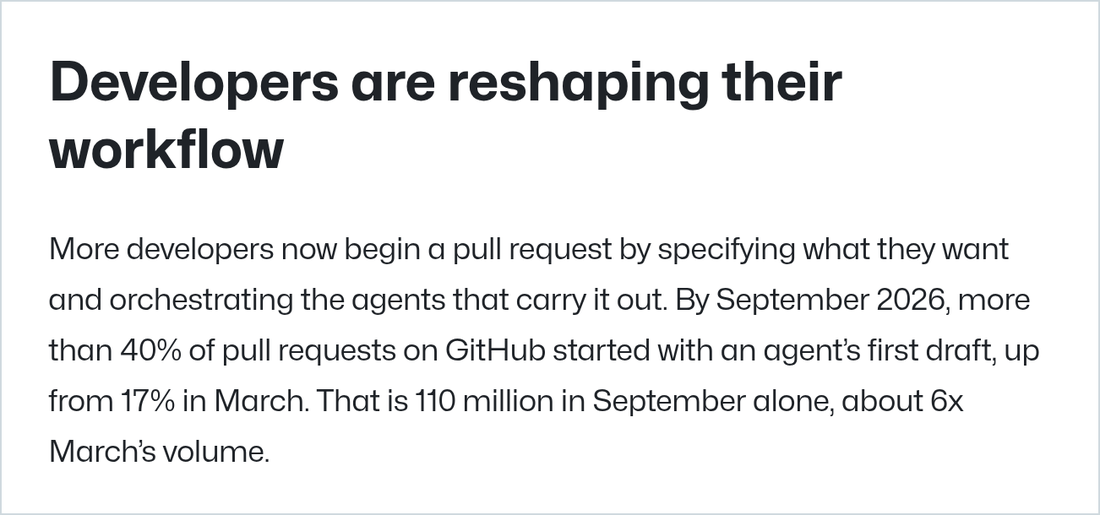
More than 40% of the pull requests opened on GitHub in September started from an AI agent’s first draft, up from 17% in March, GitHub said in its annual Octoverse report on October 28, 2026. A pull request is the change a developer proposes for review before it is merged into a project. In September alone, agents started 110 million of them, about six times March’s volume.
The figures come from GitHub’s own telemetry on public and private repositories. GitHub belongs to Microsoft, which sells GitHub Copilot, and the count covers any coding agent GitHub can detect.
The same day, Google’s chief executive said AI is already speeding up how Google builds its own models. “We’re at the point where AI is helping us increase our training and launch velocity,” Sundar Pichai said in his remarks for Alphabet’s third-quarter earnings call. “I would expect the next 12 months to see continued acceleration because of RSI.” RSI is the industry’s shorthand for recursive self-improvement: AI that helps build better AI.
What GitHub counted
GitHub defines an agent-started pull request as one “whose first draft came from a coding agent that we can detect.” The report calls that kind of signal “a floor, since not all agent use may be detected.” Its year runs from October 1, 2025, to September 30, 2026.
Agent-started pull requests more often change several files: about 87% of them, against 79% of pull requests without detected agent involvement. In February, 83% of agent-involved pull requests were merged within two weeks, slightly behind the roughly 86% for the rest. By September the agent figure had reached 90%, while the comparison group held at about 86%.
GitHub’s telemetry shows activity “climbing steadily from January, then surging around June.” The report notes that better models, the tools built around them and the agents running on both arrived right around then, and that agents began running in the cloud as well as on developers’ own machines. Copilot cloud agent, where a developer assigns a task and the agent works on it alone, grew fastest: 230% year over year, against 85% for agent chat.
Across the platform, developers made 34.3 billion commits over the year, more than three times the level of two years earlier. Merged pull requests more than tripled over the same two years, to 1.3 billion, or 3.5 million a day.
Microsoft’s version: more than a third
Microsoft chief executive Satya Nadella described the trend in his own words on Microsoft’s earnings call the same day. “All major coding agents have showed up to work on GitHub,” he said. “Agent generated PRs have increased 6X over the past six months. And agents now open more than a third of all PRs on the platform.”
The two sources use different verbs. The report counts pull requests that “started with an agent’s first draft,” Nadella’s script counts those that agents “open,” and neither explains how the two figures relate.
Nadella tied the growth to reliability work. “We are very hard at work on reliability as agentic activity on GitHub soars,” he said, adding that GitHub had announced that morning, at its Universe conference, that it was “expanding capacity and rebuilding the core Git architecture for the agentic wave.” Git is the version-control system underneath every GitHub repository.
Simon Willison, a developer and blogger who attended Universe on a free ticket from GitHub, called the numbers that Microsoft executive Jay Parikh highlighted on stage “a pretty stark representation of the impact of agentic engineering on GitHub.”
The labs point AI at their own work
Earlier in the same remarks, Pichai said that “just in the last few weeks,” teams across Chrome, Ads and Search “have used Argon to write and optimize code much faster, shipping 35% more code with 30% fewer errors.” Argon is the Gemini 4 model Google launched two weeks before the call. Google also announced a stronger model that day, Gemini 4 Carbon, which Pichai said ranks first on the Artificial Analysis Intelligence Index.
On Cheeky Pint, a podcast hosted by Stripe co-founder John Collison, OpenAI chief executive Sam Altman was asked how AI-driven AI research works in practice. The episode was published October 29. “We know today how to say, ‘Find me a 5% compute efficiency win,'” Altman said. He does not think anyone knows yet how to say: “Go discover a new architecture that is as big of a single leap forward as the transformer was.”
One thing people at OpenAI talk about a lot, Altman said, is “What are the questions that you’re supposed to ask of GPT-7?” He added: “Probably, it’s not enough to just say: ‘Make me RSI.’ Also, it’s probably not enough to say: ‘Buy me a 5% compute efficiency win.'” He did say that applying “the same pipeline that we applied to get our models to be so good at math” to AI research “will probably work.”
OpenAI’s latest batch of claimed results, released October 26, included a math proof and a paper it says refutes the Exponential Time Hypothesis, a 1999 computing assumption. The Navier-Stokes proof OpenAI has claimed cost “order $10 million,” Altman estimated, and “I bet we could redo Navier-Stokes at 1/100th of the cost a year from when it was done.”
What the numbers leave out
The 40% describes who produced the first draft. It says nothing about how much of the final code came from an agent, and the report gives no revert, defect or review-time figures for agent pull requests. The 90% figure is the share of agent pull requests that projects merged within two weeks, and the report does not tie it to how the code held up afterward.
GitHub’s own wording keeps people at the end of the chain: “review is how developers shape what comes back,” and “someone still has to decide whether it works, whether it belongs, and whether it’s good.” “Code is being written three times faster than anyone can review it,” Dwayne McDaniel wrote on the blog of GitGuardian, a security company that sells tools to catch passwords and keys leaked in code.
Our own count, published October 20, looked only at public code: Claude Code alone signed more than ten million public commits in September, almost all of them in small projects hardly anyone watches. GitHub’s report also covers private repositories and every agent it can detect.
Google’s 35% more code and 30% fewer errors cover teams in three products over “the last few weeks,” and Pichai did not say how either number was measured. His remarks contain no claim that Google’s models now improve themselves without engineers.
What it means
In six months the way changes start on the largest code-hosting platform shifted. Fewer than one pull request in five began with an agent’s draft in March, more than two in five by September, and agent pull requests were by then merged within two weeks more often than the rest. GitHub is rebuilding the core of its service for that traffic.
Two of the companies that build the models described AI at work on their own development. Google says AI already raises the speed at which it trains and launches models, and its CEO expects the acceleration to continue over the next 12 months. OpenAI says it can hand a model a narrow target, such as a 5% compute saving, and that the larger request, a new architecture, is still out of reach.
The loop behind the RSI idea, software that writes the software used to build AI, now shows up in a platform’s telemetry and in what three chief executives said in public within two days. So far it is measured in speed and volume. The one quality figure, Google’s 30% fewer errors, comes without a stated method.
The next markers are whether GitHub publishes review times or revert rates for agent pull requests, whether the share keeps climbing once the June surge is a year old, whether the rebuilt Git core holds up under agent traffic, and whether Google puts a number on “training and launch velocity.”
Sources
- Octoverse: Commits, pushes, reach new highs in 2026 as developers build with agents, GitHub, October 28, 2026
- Microsoft Fiscal Year 2027 First Quarter Earnings Conference Call, Microsoft, October 28, 2026
- Q3 2026 earnings call: Remarks from our CEO, Sundar Pichai, Google, October 28, 2026
- Transcript: Why Sam Altman is against a single superintelligence, Cheeky Pint (John Collison), October 29, 2026
- GitHub Octoverse 2026, Simon Willison, October 28, 2026
- GitHub Octoverse 2026: AI Agents, Citizen Developers, and the New Security Reality, Dwayne McDaniel, GitGuardian, October 29, 2026
Header image: chart by MACCUS, data from GitHub Octoverse 2026 (October 28, 2026)