
Researchers at Harvard Kennedy School’s Shorenstein Center made up two names, Susan Millner and Craig Dalton, and slipped them into a survey alongside 12 people who build AI. Among the men surveyed, 53% said they knew who Susan Millner is, and 53% said they knew who Craig Dalton is. Mira Murati, OpenAI’s former chief technology officer, got exactly the same share from men. Among women, the figure was 40%.
The report, released on October 14, 2026, runs 47 pages on the gender gap in artificial intelligence and doesn’t call it lying. It suggests that part of the measured knowledge gap may reflect “greater confidence, or potentially over-confidence” among men.
Two made-up names tied with Mira Murati
The numbers come from CHIP50, which polled 5,403 American adults online from July 10 to 16, 2026, and weighted the responses to match the US population. Nancy Gibbs, a former editor-in-chief of Time, and Matthew Baum, a professor at Harvard Kennedy School, led the study. Pivotal, the group of organizations founded by Melinda French Gates, funded it.
For each name, respondents said whether they knew who the person was. The list mixed tech executives famous well beyond AI, like Elon Musk and Tim Cook, with heads of AI labs and the two made-up names. The report’s chart flags them with an asterisk and a note: “Susan Millner and Craig Dalton are fabricated names.”
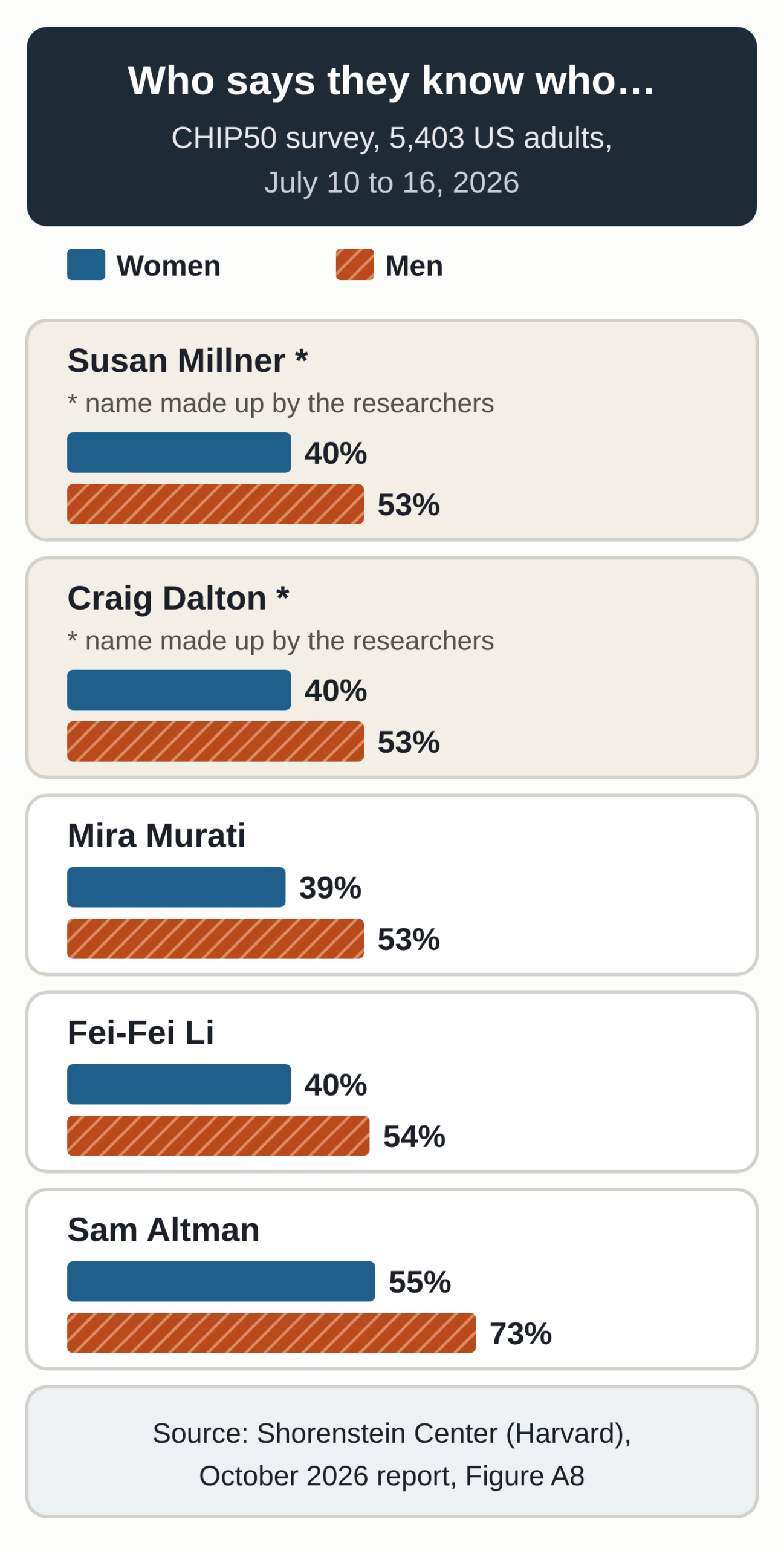
Among all respondents, Fei-Fei Li and Mira Murati each got 46%, “the same share” as the two made-up names, the report notes. Anthropic CEO Dario Amodei and Nvidia CEO Jensen Huang topped out at 50%. Sam Altman, the best known of the executives whose names are tied mainly to AI, reached 64%.
The women surveyed don’t sort real from fake any better: 40% said they knew the two fictional people, one point more than for Mira Murati (39%). The gap between men and women shows up on every name, from 2 points for Elon Musk to 18 for Sam Altman and Tim Cook, and the report finds each difference statistically significant.
More right answers, fewer “not sure” replies
The report doesn’t conclude that men know less. On a quiz of 12 factual questions about AI, men averaged 7.1 correct answers, compared with 6.3 for women. They also got slightly more wrong, 2.0 on average versus 1.6. Women picked “not sure” on 4.0 questions on average, while men did so on 2.9.
The authors tread carefully. These patterns suggest more uncertainty among women, they write, but some of the apparent gap may reflect “greater confidence, or potentially over-confidence, among men rather than greater knowledge alone.” Laura Manley, the center’s executive director and a coauthor of the report, told Wired that this confidence sometimes “veers into overconfidence,” as when people end up “claiming to recognize fictional AI executives.”
A training gap at work
The least funny part of the report is about work. Among employed respondents, 64% of women say they get no AI training at work, compared with 49% of men. Nearly half of working women, 46%, never use AI on the job, compared with 36% of men.
Employer training, mentoring and encouragement go hand in hand with more frequent AI use, the authors find, among women and men alike. Workers who get that support also feel more confident with AI and find it more useful.
The study also counted whom American news outlets name and quote when they cover AI. Across 78,542 articles published between July 2025 and June 2026, men were named in headlines 14.6 times as often as women and cited as experts 4.3 times as often in the body of the stories.
In Europe, the law also covers AI skills at work. In the version that took effect on July 27, 2026, Article 4 of the EU AI Act requires companies that deploy AI systems to take measures to promote AI literacy among their staff.
The survey’s limits
The sample is American. Nothing in the report says how people in France, Belgium or elsewhere in Europe would answer, and it would be a stretch to draw a European figure from it.
Respondents were a nonprobability online sample, recruited by the firm PureSpectrum and then weighted. Nobody had to prove they knew a name, and a hasty answer counts as a “yes.” The two names also sound ordinary (“common-sounding,” in the report’s words), so some respondents may have been thinking of someone else with the same name.
The trap caught women too: 40% said they knew the two strangers. The finding that matters is the gap between men and women, 13 points on the two made-up names and a gap in the same direction on all 14 names. The authors call for tracking these gaps over time. That would show whether self-reported confidence grows as fast as actual use.