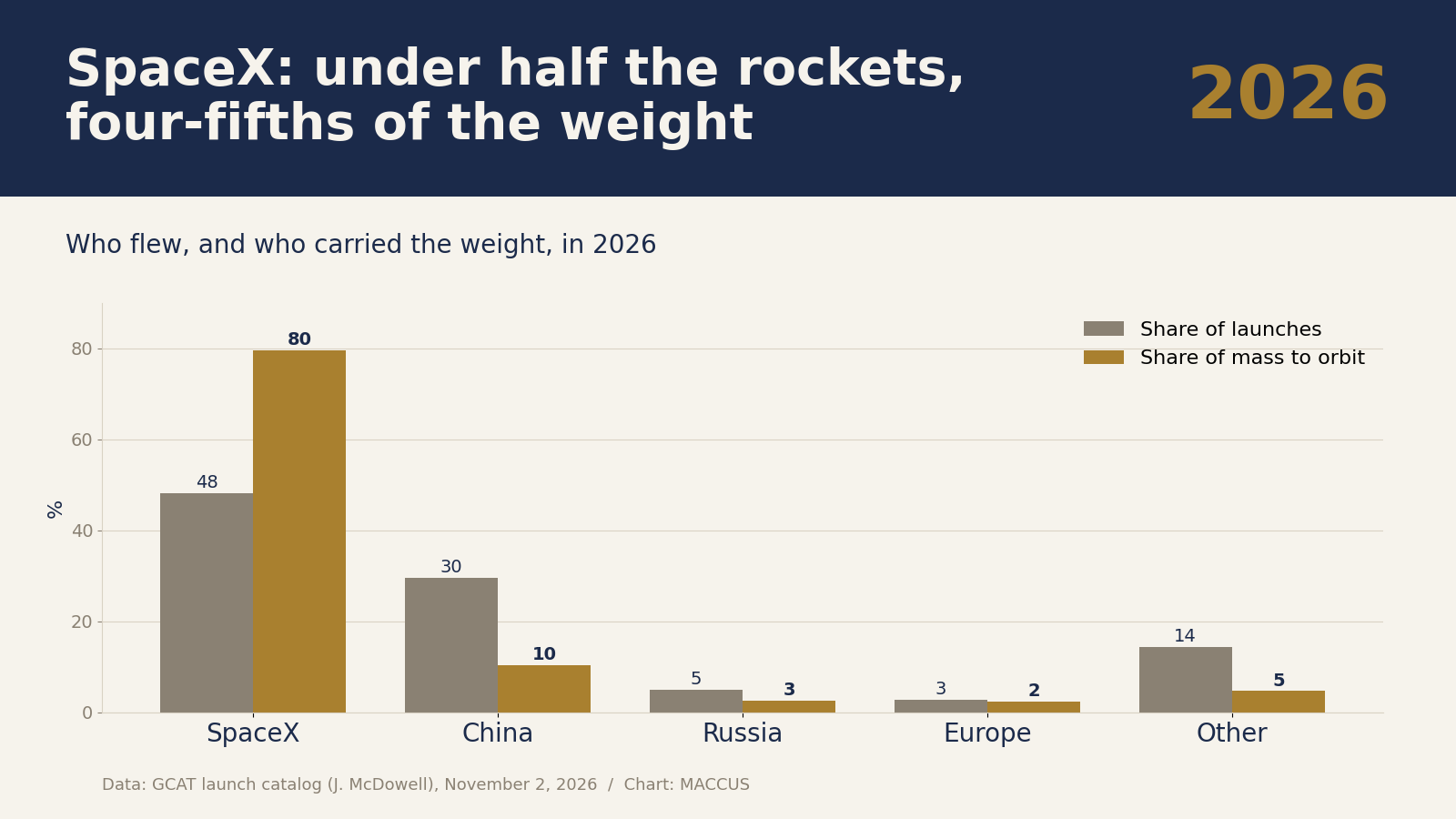

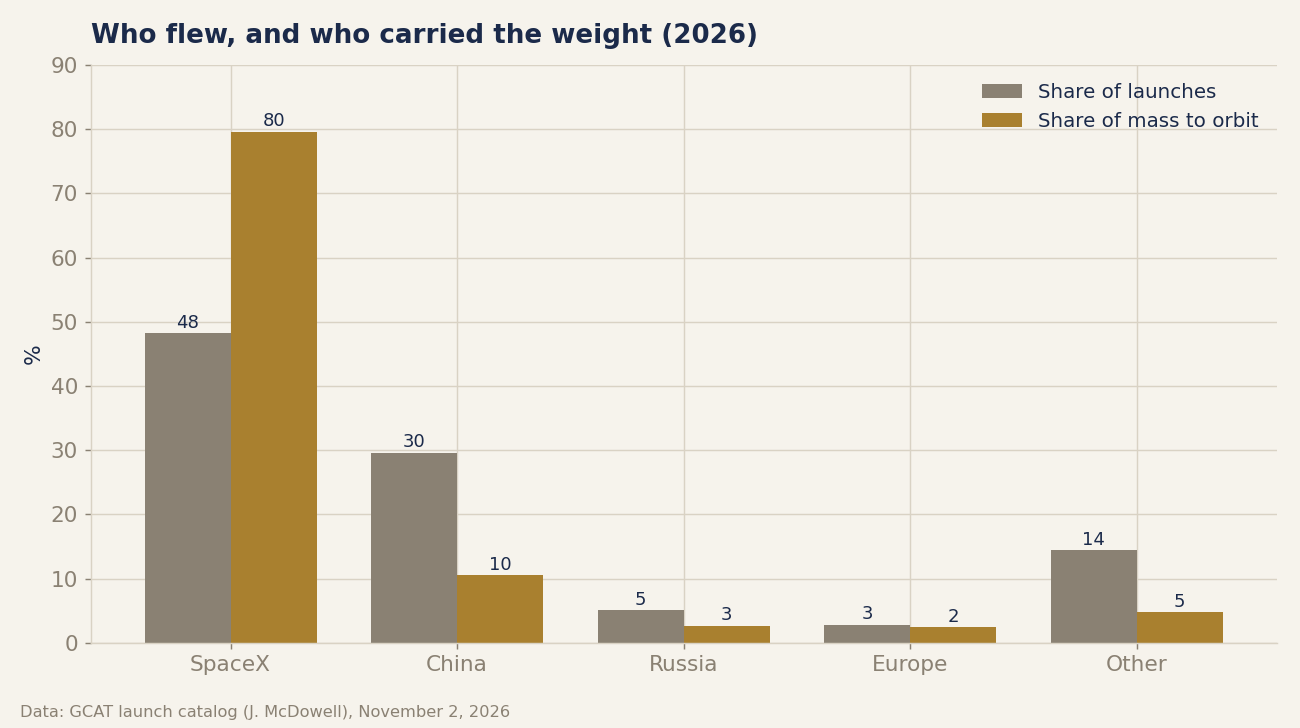
Add up everything the world has sent to orbit this year, weigh it, and most of it rode on one company’s rockets. SpaceX flew fewer than half the launches. It carried about four-fifths of the mass.
I counted every orbital launch of 2026 from Jonathan McDowell’s catalog, the record that space agencies and astronomers rely on, and added up the payload each one placed in orbit. The catalog runs through November 2, so the year is not finished.
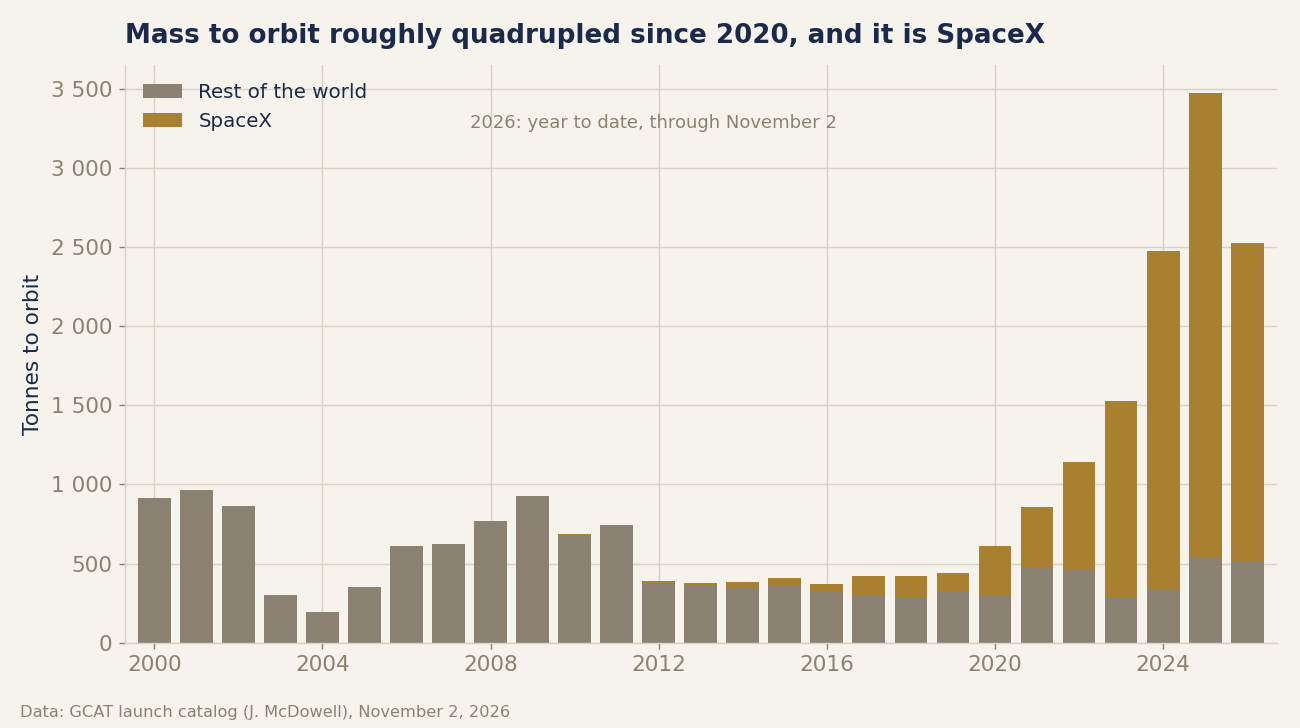
The weight to orbit has quadrupled since the decade began
For most of this century the world lofted a modest, fairly steady tonnage, with the odd heavy stretch. Since 2020 that figure has roughly quadrupled. The line that had drifted sideways for twenty years went vertical.
Almost all of that climb is one company. Of the mass lifted in 2026, about four-fifths went up on SpaceX rockets, while SpaceX flew under half the flights. The reason is Starlink: a single Falcon 9 carries a stack of internet satellites that outweighs what most countries launch in a month, and it flies most weeks of the year.
What makes the cadence possible is reuse. The same boosters fly, land, and fly again, which turns a launch from an event into a schedule and a heavy satellite program into a routine. The rockets that reset those economics were built by one firm, and the rest of the industry is still catching up to the idea. The annual launch reviews have flagged this concentration for a couple of years. The catalog lets anyone confirm it against this year’s record.
China flew the second-most rockets of any country this year and still carried about a tenth of the mass. Its vehicles are smaller and its satellites lighter. A reusable heavy rocket and its own megaconstellations are in the works, so the tonnage gap may narrow later this decade. For now it is closing the gap on how often it launches, not on how much it lifts.
The same concentration shows inside the United States. The firm’s nearest rivals there still fly in ones and twos while it flies most days of the week. A market that looks like a race is, measured by weight, closer to one carrier with a fringe around it.
No one chose this
Nobody set out to hand low orbit to a single carrier. A satellite operator books the cheapest ride with the shortest wait, and for four years running that has been the same rocket. Each booking is a sensible call on its own. The sum is a launch market with one dominant supplier and a long tail of everyone else.
Weight matters more than the count of launches
Mass is what a rocket is sold by, what fills the orbits around Earth, and what sets the floor under a satellite business. The count of launches flatters the runners-up; the weight does not. Measured by weight, the world now has one main supplier and a queue behind it.
That is efficient until it is not. A failure that grounds the fleet, a regulatory pause, a bad-weather stretch over one launch coast: any of these, and most of the world’s access to orbit waits in the same queue, because no second carrier runs at the same scale. Dependence on the cheapest option is rational for any single customer and fragile for everyone at once.
Europe shows what that does to a latecomer. It made sixteen orbital launches in 2000, when Ariane was the commercial workhorse of the business. This year it managed seven, and carried roughly one fiftieth of the mass. Ariane 6 arrived years late and flies rarely, and the cheaper, reusable vehicles that rewrote the economics were built on the other side of the Atlantic. A continent that once sold rides to the world now buys them, mostly from an American firm, while its own heavy rocket hunts for a steady rhythm.
If the pattern holds, the year ends with SpaceX past three-quarters of the weight and Europe stuck in single-digit launches again. Whether that reads as a triumph of private spaceflight or a concentration worth worrying about depends on where you sit, and on what happens the first time the one supplier has a bad year.
These figures count payload mass reaching orbit, not the size of the rocket or the worth of what it carried, and a few of this year’s launches have no published mass. Launches are credited to the nationality of the operator, so Rocket Lab, an American firm that flies from New Zealand, sits outside both the United States and Europe here.
Method and numbers
The source is Jonathan McDowell’s GCAT launch catalog, pulled on November 3, 2026, with data through November 2. An orbital launch attempt is any flight the catalog classes as orbital or deep-space, successes and failures alike. Mass to orbit is the sum of the catalog’s payload-mass field, in tonnes; it carries a value for 99 percent of this year’s launches. The world made 257 such launches in 2026 so far, for about 2,527 tonnes; 2025, the heaviest year on record, reached about 3,475 tonnes, and no year before 2024 beat what 2026 has already carried. SpaceX accounted for 124 launches and about 2,011 tonnes. Three of those are new Starship test flights entered at their rated payload rather than a measured one; set all three aside and SpaceX still carries more than three-quarters of the mass. The United States as a whole reached 84 percent of the mass, China about 10 percent, Europe about 2 percent. Operators are attributed by nationality from the catalog’s organization table. The full dataset is available here.
Sources
- GCAT launch catalog (launch.tsv), Jonathan C. McDowell, planet4589.org, retrieved November 3, 2026
- GCAT: General Catalog of Artifacts in Space, Jonathan C. McDowell, retrieved November 3, 2026
- Arianespace Aiming for As Many as Eight Ariane 6 Launches in 2026, European Spaceflight, November 6, 2025
- Long March 12B, Wikipedia, retrieved November 3, 2026
Header image: chart by MACCUS, data from the GCAT launch catalog (J. McDowell), November 2, 2026.