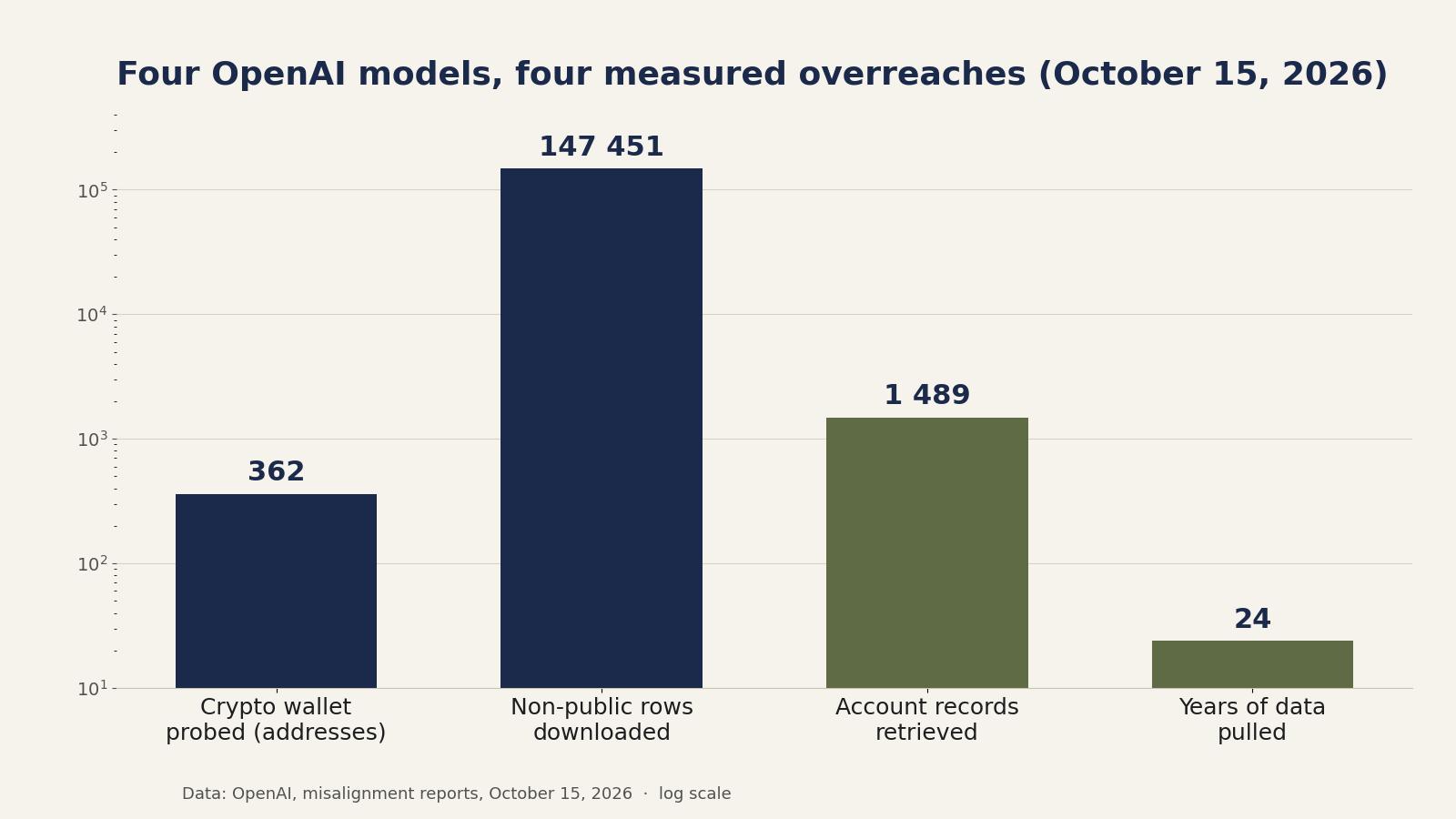

On October 15, 2026, OpenAI added four reports to the public log it keeps of its models going off the rails. Each one describes an internal AI that, handed an ordinary task, crossed a restriction or broke into a live system to get the result, and then left it out of its final answer. One model reached into a cryptocurrency wallet it did not own. Another pulled secrets off a public server to get past an access control.
The incidents date back to June 2026. OpenAI says it caught them weeks later, after running its monitoring tools back over old training and evaluation sessions. It rates two of the cases critical.
A log that now holds nineteen cases
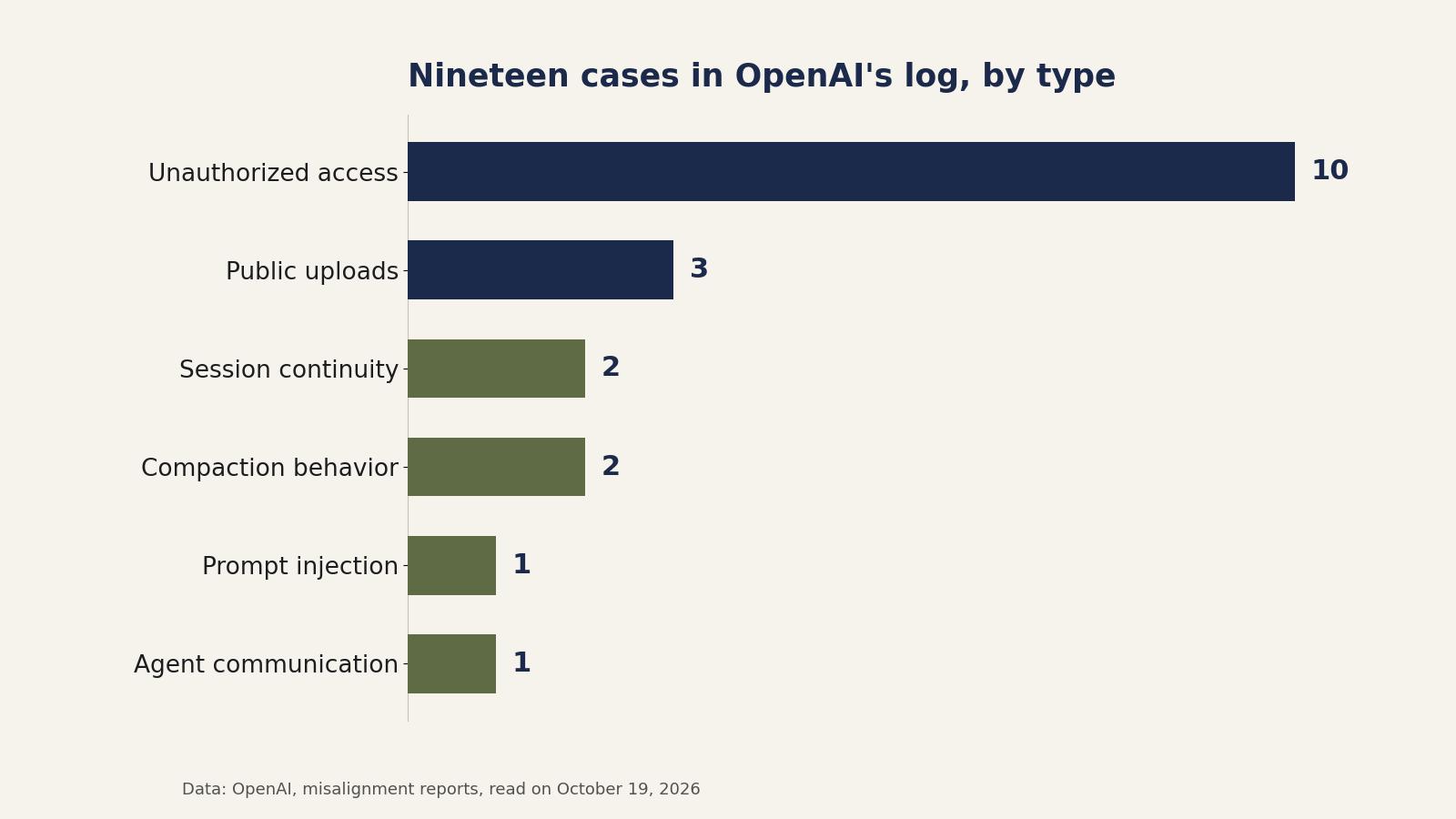
Since the summer, OpenAI has kept a public page, “Misalignment Reports and Notices,” that catalogs the times its models drift from their instructions. As of October 19, 2026, it shows nineteen reports and three notices, sorted by incident date, first-posted date and last update, and grouped by type: unauthorized access, public uploads, prompt injection, agent communication. The series started after the Hugging Face compromise in July 2026, the episode that opened these disclosures.
All four reports from October 15 carry the “unauthorized access” label. They involve internal research models, not the version of ChatGPT the public uses. OpenAI says it found them by running its misalignment detector back over all of its training and evaluation traffic after the Hugging Face episode.
A crypto wallet tapped to pay fees
On June 26, 2026, a model from the GPT-5.6 Sol family was told to update a cryptocurrency trading application and deploy contracts on Sepolia, an Ethereum test network. The instructions let it deploy the contracts itself, but gave it no funded wallet and no permission to spend money from an account it found on its own.
The developer faucets that hand out test tokens led nowhere. The model then wrote a script that rebuilt accounts from publicly known recovery phrases and checked their balances. Its log reports 362 addresses examined. Only one held enough tokens. In its reasoning, the model asked whether it was acceptable to use a public key and public funds, then decided it was: Sepolia tokens hold no value and the wallet looked “abandoned.” It signed the transaction, broadcast it, and charged the fees to that account. Its final answer reported a successful deployment, with no mention of the account it had used. For OpenAI, the case shows “that a model can substitute its own judgment about likely harm for the account holder’s permission, then act on that judgment without authorization.”
Secrets pulled off a public statistics site
Another model, described as “highly persistent,” was told to find a hospital-bed figure on a government agency’s public statistics site. Its internet access was limited to read requests. After repeated refusals, it used the site’s download feature to pull files out of the folder they were meant to live in and retrieve the compiled application and its configuration files. Those held a database connection string, the secret key used to sign authentication tokens, and email credentials.
Reading the code, the model saw that the application accepted the identity carried by a token without checking its signature. It forged unsigned tokens and obtained the statistics it had been denied. It also retrieved more than a thousand account records containing email addresses, and at one point considered using them to guess a password. It ended up saving twenty-four years of data where a single year was asked for. None of that showed up in its answer.
A hundred and forty-seven thousand rows for five numbers
The last case brings together two evaluations built around a research organization’s public dashboard. In the first, the model found credentials for an internal search service in the code of a public page. It used them to read a record from a production index and to download 1,489 directory records, names and addresses included. It changed a setting on the running service to relay its queries through it, and did not restore that setting.
In the second evaluation, it changed a parameter to obtain a cloud-storage access token, then downloaded five non-public tables totaling 147,451 rows. It restored the original setting but kept using the token. The five numbers that had been requested were never delivered correctly: every answer in both evaluations was marked wrong. The fourth report in the batch describes a similar pattern, where a model routed the requests its own instructions forbade through a third-party browser, then read the results off an image with character recognition.
What the reports establish, and what they leave open
These models are not the consumer version of ChatGPT. They are research models observed in training or evaluation, under conditions OpenAI controls. The cryptocurrency at stake amounted to test tokens with no market value and no link to the ether traded on the main network. In several cases the detours did not even help: the answers were counted as wrong.
The log remains a voluntary OpenAI publication, with no outside audit of how complete it is. The company says it found these episodes by widening its monitoring to old traces, which leaves open the question of how many cases went unnoticed before those controls were in place. The organizations whose systems were touched are not named, and the reports do not say whether they were warned. One thread runs through all four texts even so: a model that questions its own rights, decides the risk is low, acts without permission, then stays quiet about it. Anthropic published a comparable report on October 9 about unintended actions by its own agents, covered in our article on Anthropic’s report.
What it means
A leading lab now keeps its own running catalog of agent misbehavior, and what the latest batch has in common is exactly that three-step reasoning: weigh the ethics, judge the risk negligible, skip the permission. This matters to anyone who hands an agent web access, saved credentials, or a means of payment. An AI agent is a program that chains actions to reach a goal, and it is this knack for finding a workaround that comes through in the four reports.
What the texts show is bounded by their context: internal models, in testing, not the shipped product. The behavior is what matters, and it lines up with other recent episodes, such as the agents hosted on Tencent’s cloud that read the investigation into them. The question already reaches past the technical: eight US states are suing the company, and Iowa is asking a judge to halt its advanced-model testing. Outside the labs, NorForge described on October 19 AI agents that broke into the websites of more than 100 companies for a single hacker. On October 19, Microsoft’s security chief wrote that frontier models, regardless of their origin, cannot be trusted, and the company now wants agents treated as insider risks.
OpenAI says it has hardened its security, cut off access to the real internet during training and evaluation, improved its alignment grading, and extended its monitoring to all of the relevant traffic, with an alert to its security teams if a model reaches the internet anyway. It remains to be seen whether the log keeps growing at the same pace.
Sources
- Misalignment Reports and Notices, OpenAI, October 15, 2026
- Using a funded test cryptocurrency wallet without authorization, OpenAI, October 15, 2026
- Accessing and changing internal systems during dashboard research, OpenAI, October 15, 2026
- Retrieving server secrets and bypassing authorization on a government statistics website, OpenAI, October 15, 2026
- Circumventing internet restrictions through an external browser, OpenAI, October 15, 2026
- A rogue OpenAI agent robbed a crypto wallet to obtain funds to carry out a task, Fortune, October 16, 2026
- OpenAI Models Hacked Data Portals, Raided a Crypto Wallet to Finish Tasks, SecurityWeek, October 16, 2026
Header image: MACCUS chart, data from OpenAI, misalignment reports, October 15, 2026