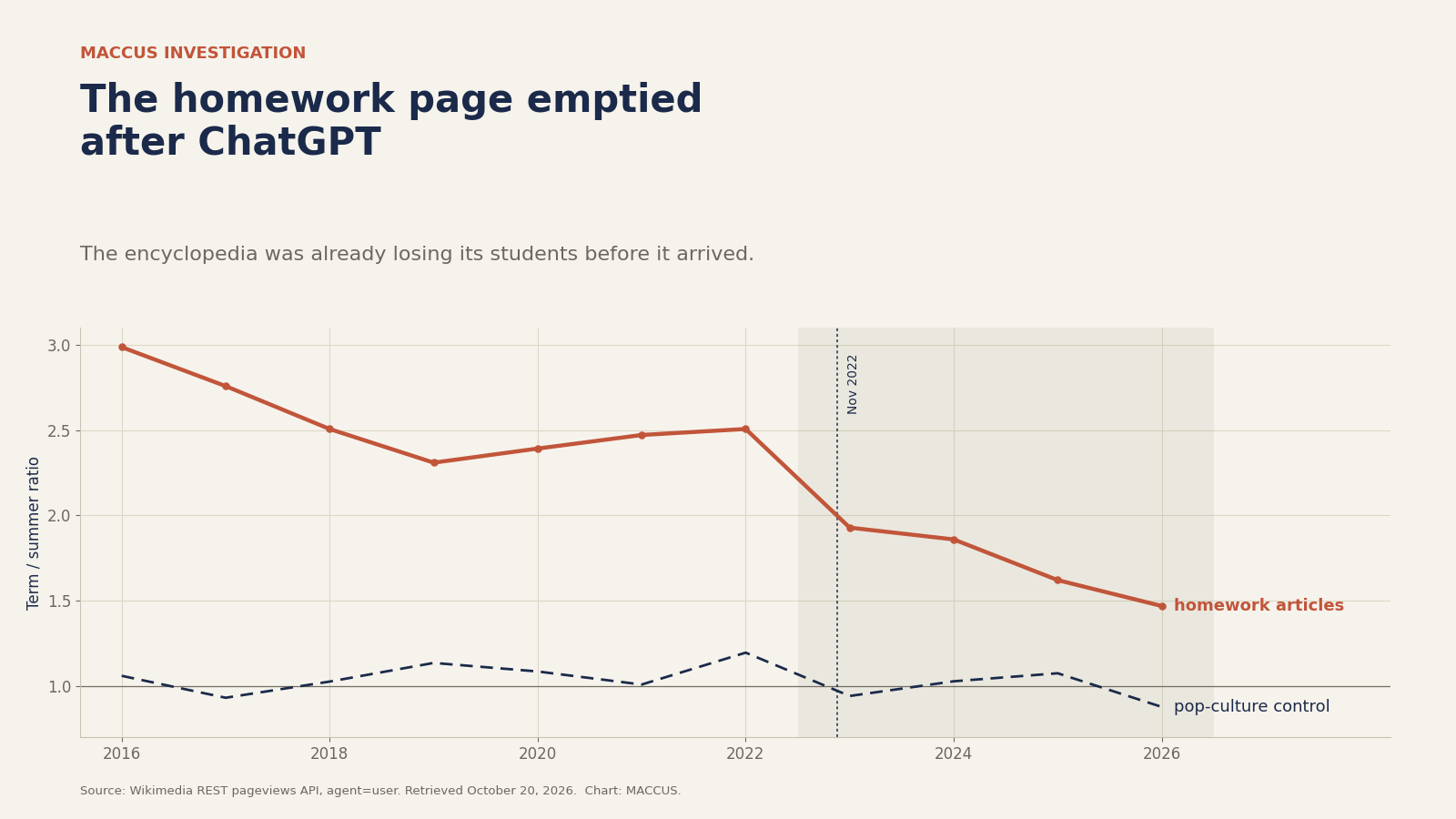

The Wikipedia pages that French teenagers open for their homework have lost a large part of their back-to-school surge, and the break dates to the school year in which ChatGPT arrived. The rest of the encyclopedia had been losing its school-year rhythm for much longer, for other reasons; what changed with ChatGPT is that one specific reader, the student doing homework, started leaving, and I think that loss matters more than the lost visits. On a school day these pages used to get far more visits than on a summer-vacation day; that ratio has fallen by more than a third since ChatGPT arrived, while the pop-culture pages I tracked alongside them did not move.
I pulled ten years of daily pageviews from Wikimedia’s public API for articles on the French middle- and high-school curriculum, such as Photosynthesis, the Pythagorean theorem and the French Revolution, for a comparable set of pop-culture pages, and for all of French Wikipedia. I then labeled every day as a school day or a summer-vacation day using the French Education Ministry’s official calendar, and ran the same exercise for Germany with the calendar of each of its states, and for English Wikipedia.
The broad decline is older than ChatGPT
The ready-made headline is that ChatGPT is killing Wikipedia, and the dates do not fit. Across all French pages, a school day once brought noticeably more visits than a summer day; that gap has been closing little by little over the whole period, with no kink in November 2022, the month ChatGPT launched. The closing has not sped up since; if anything it has slowed. For the site as a whole, a Monday in October now gets about as many visits as a Tuesday in August.
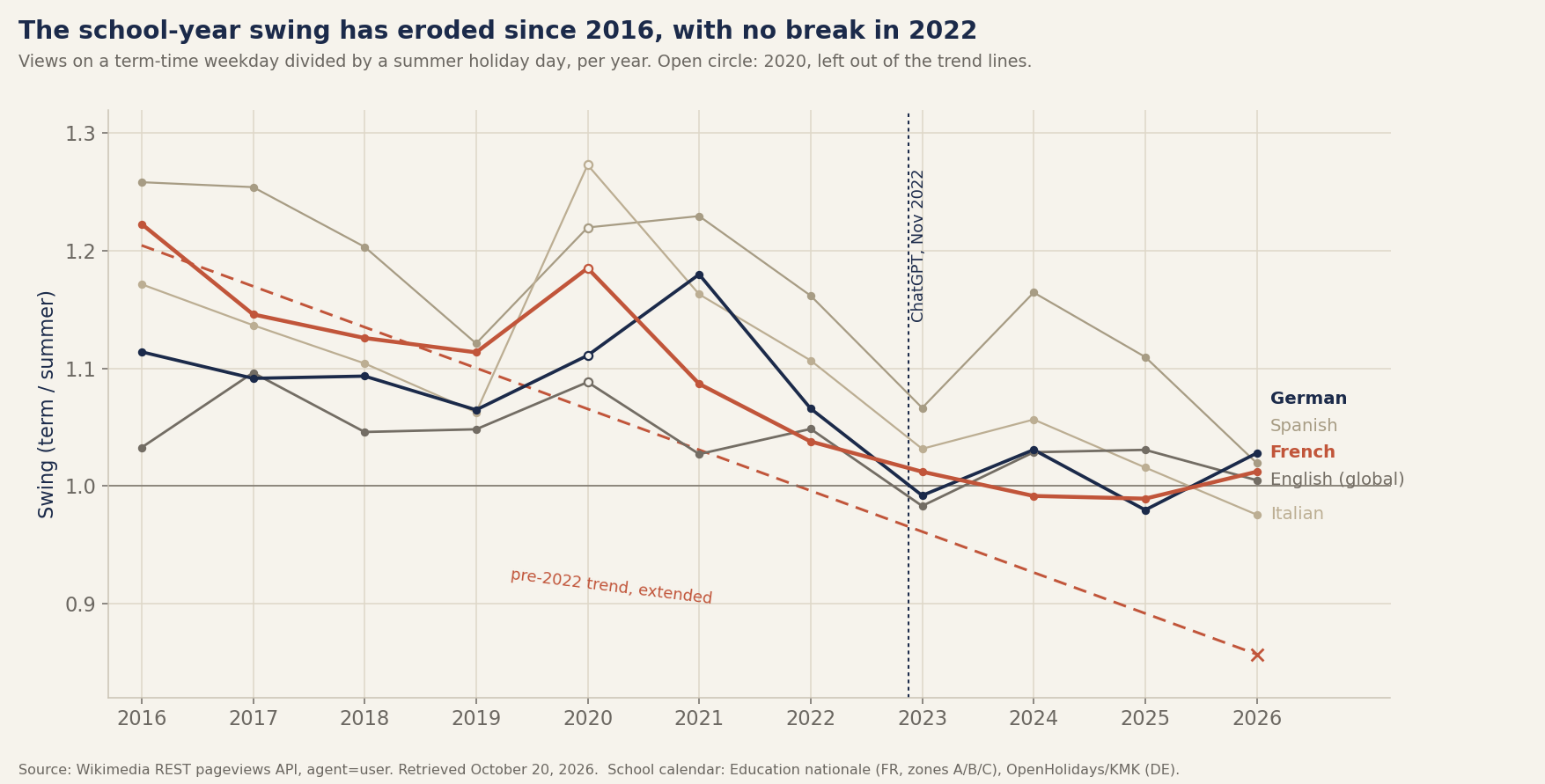
That slide has older and duller causes. Google has shown the answer right on its results page for years, its automatic summaries, the AI Overviews, now sit on top of results in France too, and on a phone few people look past that screen. The Wikimedia Foundation described the drop in its human readers last fall, and independent researchers broke it down by language this spring.
The homework pages dropped off in 2023
Narrow the view to the homework pages and the shape changes. In the years just before ChatGPT, a school day brought them about two and a half times the visits of a summer day, and that level held. It dropped in the 2022-2023 school year, the largest one-year fall in the whole series, and it is still sliding.
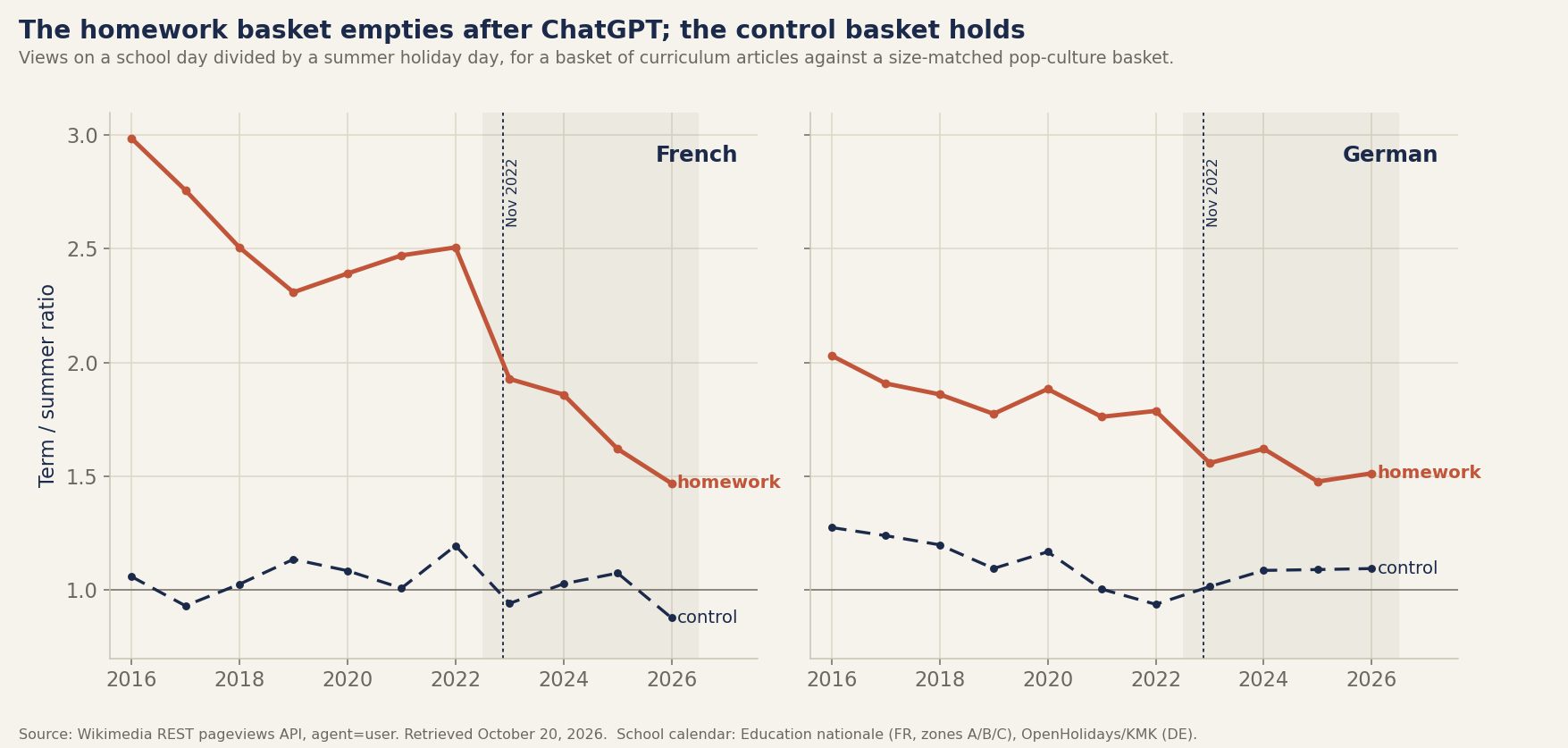
The pop-culture pages, chosen to get about as many visits as the homework pages, stayed flat the whole time. The total number of human readers on French Wikipedia also barely moved between the year before the break and the year after. A general ebb in traffic does not produce this shape: what is shrinking is school-shaped demand, the kind that rises in September and falls in July.
Germany shows the same break in the same year, about half the size. English shows no clear break, which is expected: English Wikipedia mixes the school calendars of the United States, the United Kingdom, India and Australia, and they blur one another.
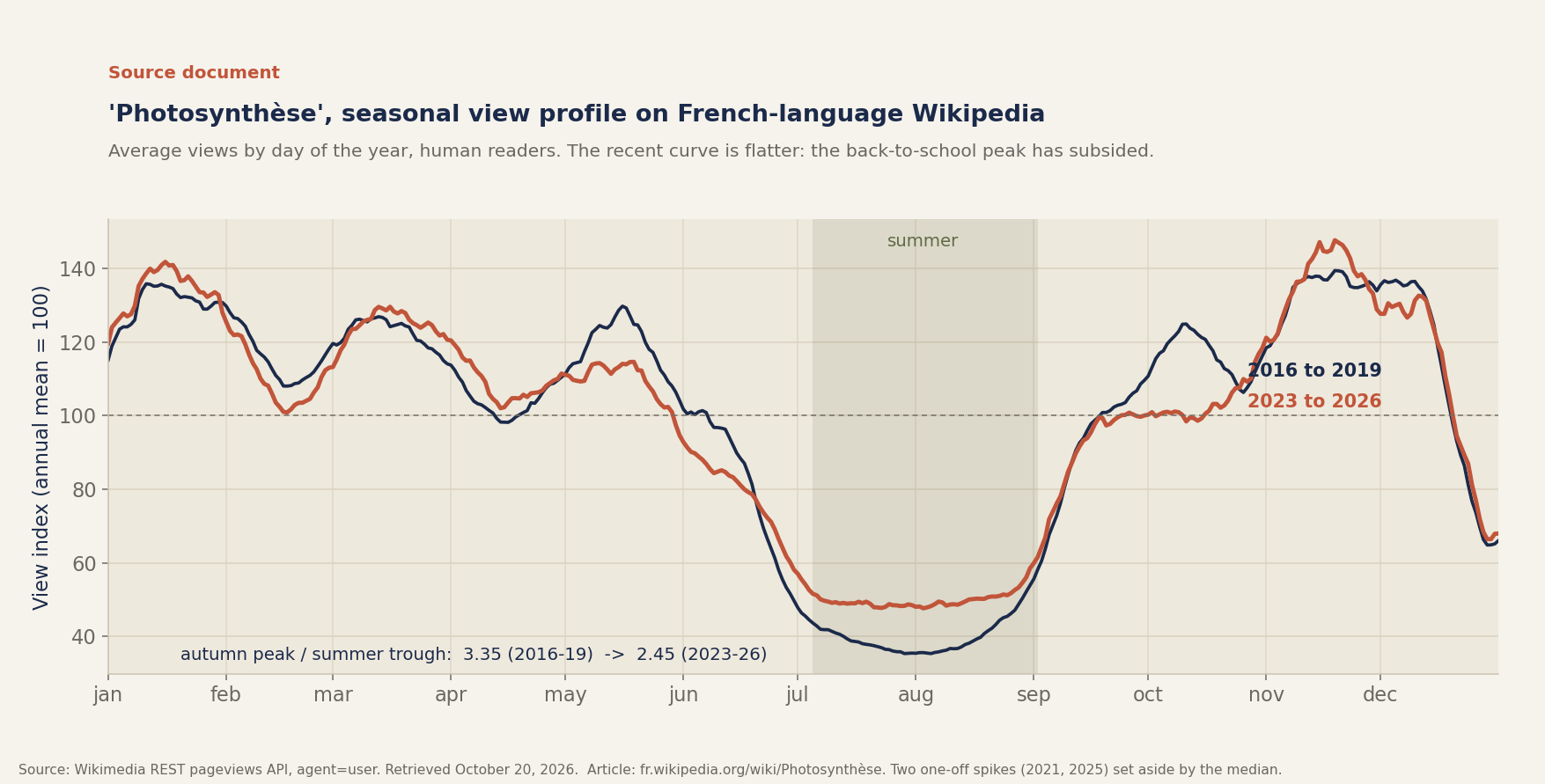
One page is enough to see it. Photosynthesis is a staple of the French science curriculum; its visits climb every time school starts and fall back over the summer break. That bump is still there. Since ChatGPT, it is noticeably lower.
Checking a source matters more than traffic
A ninth-grader has a question the night before a science test. For years the shortest path ran through Google and then Wikipedia, the first result; since ChatGPT, the shortest path is a chat window that writes the answer itself. The teachers changed nothing: same syllabus, same test. Nobody decided that students should close the encyclopedia, and it took one generation of students taking that shortcut for the homework pages to fill up less each September.
Wikipedia is where a generation learned to check a source. The footnotes sit at the bottom, the edit history is one tab over, the disputes are on the talk page; even the student who never read the footnotes could see they were there. An assistant delivers the conclusion and keeps the path to it to itself, and the student reads a smooth paragraph that says nothing about how its answer was put together.
That reflex, asking where a claim comes from, is exactly the step a ready-made answer skips. I think losing it matters more than losing visits, and I say so from Belgium, where an American tool is changing how students learn without the schools having decided anything.
A prediction anyone can check
If the post-ChatGPT slope holds, the back-to-school bump disappears from the homework pages around 2029. The threshold I expect for next June is in the box below; anyone can check it next summer from the same public API, with the article lists and calendars I am publishing, and prove me wrong.
Pageviews are not students: these figures date a break on the homework pages, they do not prove that any given student traded the encyclopedia for ChatGPT, and search engines and phones were pulling the same way over the same years. The homework pages’ ratio was already easing slowly before it leveled off in the years just before ChatGPT, so part of the recent fall continues an old trend; what still sets the ChatGPT year apart is the size of the step, the largest in the series, against pop-culture pages that did not move.
Sources
- Page view analytics, Wikimedia Analytics API, retrieved October 20, 2026 (archive)
- Le calendrier scolaire, French Ministry of Education (data.education.gouv.fr), retrieved October 20, 2026 (archive)
- OpenHolidays API, OpenHolidays, retrieved October 20, 2026 (archive)
- Schulen, Federal Statistical Office of Germany (Destatis), retrieved October 20, 2026 (archive)
- New User Trends on Wikipedia, Wikimedia Foundation (Diff), October 17, 2025 (archive)
- Wikipedia’s traffic drop: more on languages and freshness, Luis Villa (lu.is), April 2026 (archive)
- wikipedia-decline-llm, Martin Monperrus (GitHub), April 2026 (archive)
Header image: chart by MACCUS, data from Wikimedia / French Ministry of Education