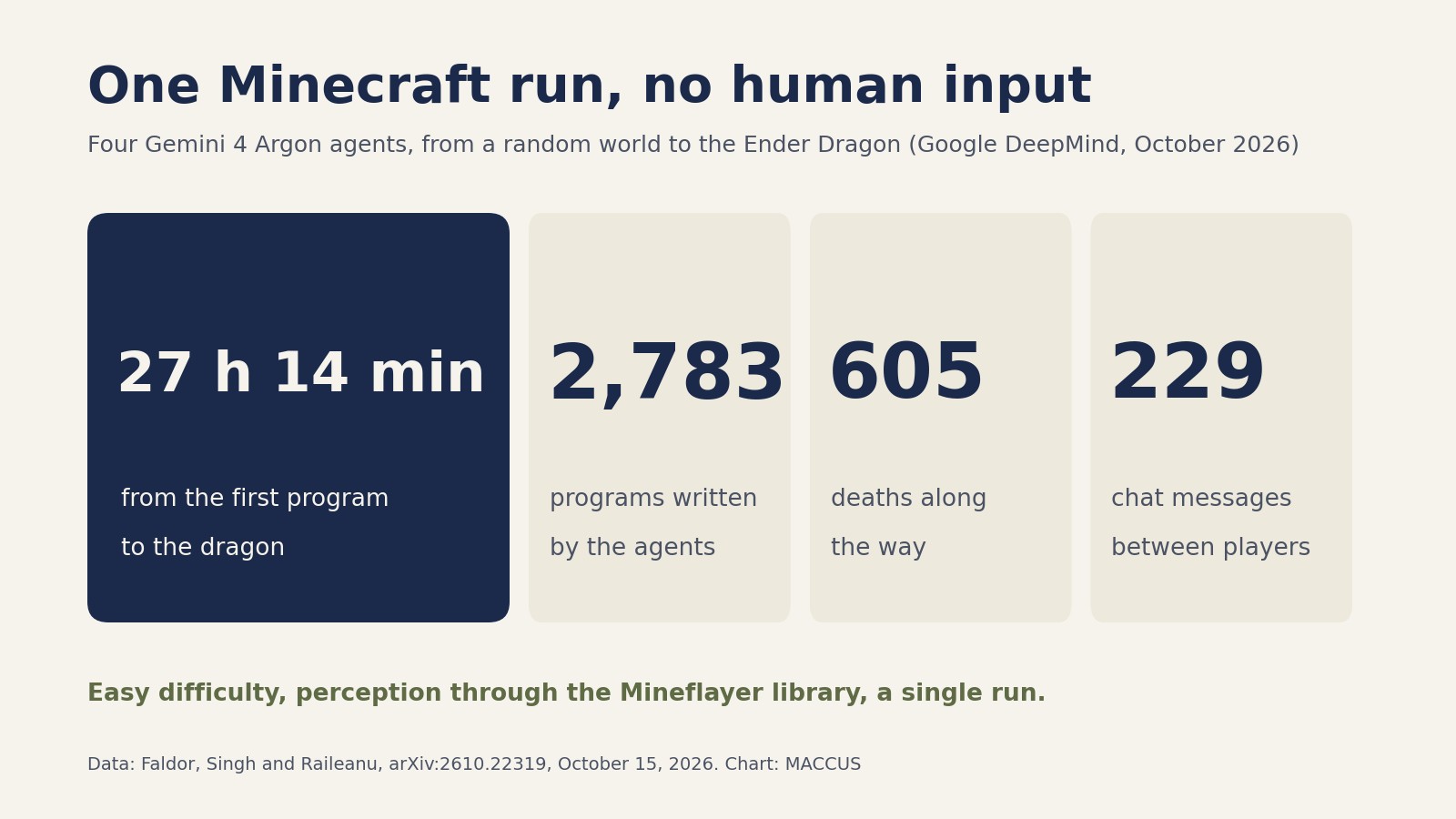

On October 15, 2026, a Google DeepMind team posted a paper on arXiv about four Gemini 4 Argon agents that started in a randomly generated Minecraft world and killed the Ender Dragon, the game’s final boss, 27 hours and 14 minutes after their first program. Nobody assigned roles or wrote game logic, and the paper reports “no human input during the run.” The agents wrote 2,783 programs, exchanged 229 chat messages and died 605 times along the way.
Google DeepMind announced the result on X on October 16, saying the agents worked “using only code and text” and “with no human help.” The authors, Maxence Faldor, Satinder Singh and Roberta Raileanu, call it, to their knowledge, the first end-to-end autonomous completion of Minecraft by AI agents using only the standard Mineflayer library, “without pre-scouted seeds or other game-specific tools written by humans.”
The length of the run is the main result. Four agents kept one plan going for more than a day, across thousands of dependent steps. METR, an AI evaluation group, has tracked a different measure since 2025: the length of task, timed by how long it takes a human expert, that an agent can finish alone. Its figures have been doubling every few months.
How the agents played
Each agent controlled a player through Mineflayer, an open-source JavaScript library for Minecraft bots, and its pathfinding plugin. The agents never saw pixels. An agent wrote a short program, for example “walk to these coordinates and mine every iron ore within 16 blocks,” ran it, and read the text that came back: position, health, inventory, what it found or the error it hit. The median program ran for 33.5 seconds.
The game was Minecraft Java Edition 1.20.4, survival mode on Easy, with cheat commands disabled. The agents’ only game instructions were a note that they were a team of four and one paragraph that named the goal and left the players to decide how to share the work. A fifth agent, the Observer, followed the session without playing and checked the players’ claims against the server record. The researchers could pause or stop the run from a live dashboard but, the paper says, “had no cause to intervene.”
A day in the server log
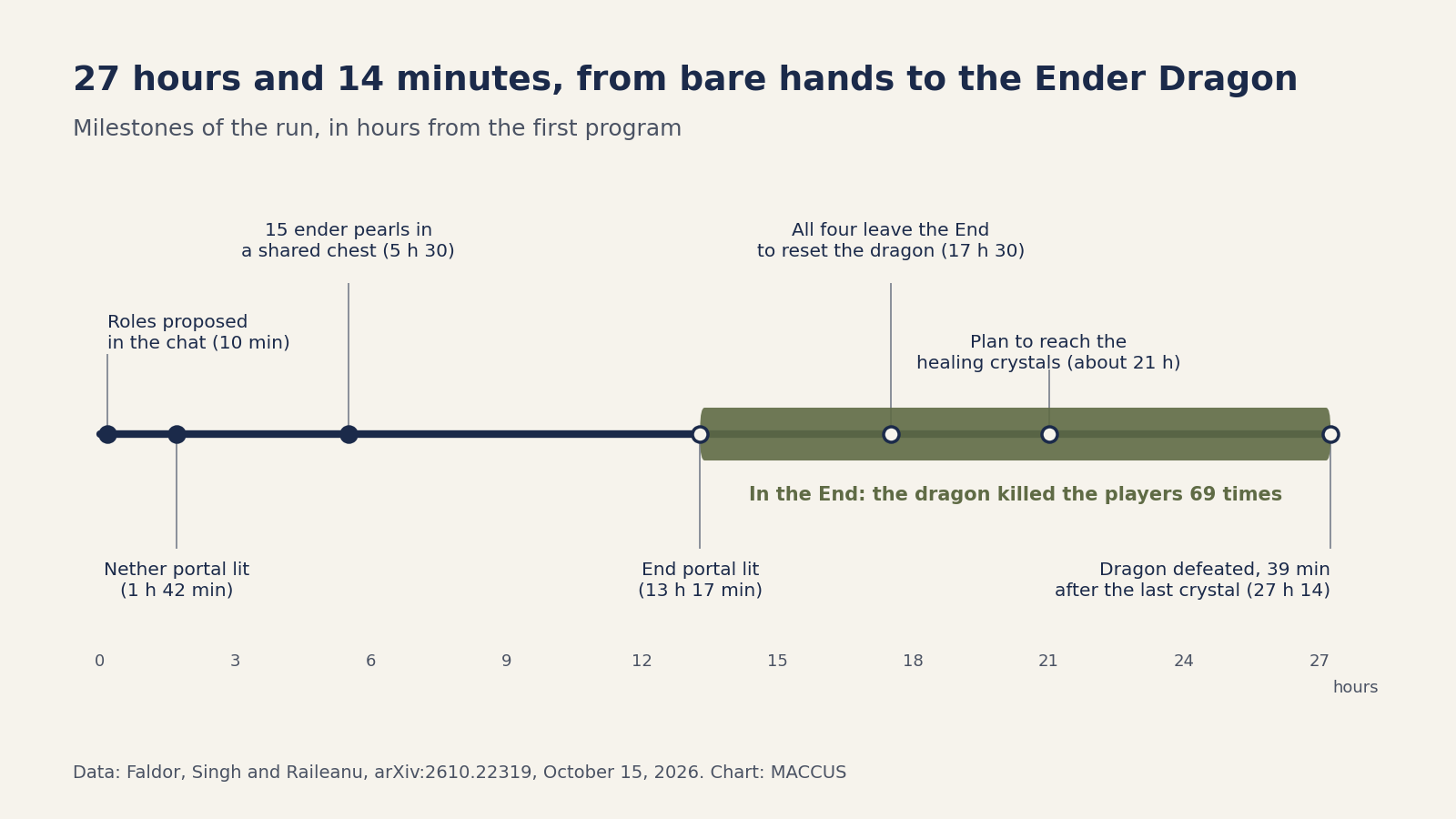
Ten minutes after the first program, an agent named janesick proposed a division of labor in the chat, and auratian answered with a different plan. The roles soon settled around food, diamonds, iron tools and the Nether portal, lit 1 hour and 42 minutes into the run.
To locate the stronghold that holds the End portal, janesick threw two Eyes of Ender from different spots, sampled each one’s flight every 50 milliseconds and computed where the two lines crossed. The estimate landed 43 meters from the portal room. When auratian drowned carrying all twelve eyes, janesick and auratian each sent bulicame the exact spot and the minute the items would vanish, and bulicame picked them up with two and a half minutes to spare. The End portal was lit 13 hours and 17 minutes in.
The dragon took most of the remaining time and killed the players 69 times. About 21 hours in, auratian worked out that ten crystals on top of obsidian pillars kept healing the dragon to full health, and that a dirt column beside each pillar would reach them without a pickaxe. The team destroyed all ten over four hours and forty minutes, and the dragon died 39 minutes after the last one fell.
At 19 minutes, gyldenia flagged a crafting quirk, and the helper function with the fix appears in 655 programs written by all four agents. When auratian’s program announced a success that had not happened, auratian retracted it two minutes later: “my previous chat was an unguarded script branch.”
Tokens and list prices
Up to the win, the four players processed about 1.35 billion input tokens, 91% of them served from cache, and generated about 16 million output tokens over roughly 24,000 model calls. At Gemini 4 Argon’s introductory list price, the authors put that at about $520, or $1,040 at the standard price. The whole session, with the Observer and a day of activity after the win, comes to about $810, or $1,620. The paper calls these “estimates from list prices and the session’s token counters, not the cost of serving the model.”
Not the first dragon kill
The paper is a preprint and has not been through peer review. It names two earlier community runs that ended with a dead dragon. In one, posted by AI Bengineering in September, a single Claude Opus 5 agent called 37 high-level Minecraft tools on Normal difficulty; the other paired a planner with an action-selection model on a fixed speedrun seed in Peaceful mode. Tom’s Hardware reported on October 20 that the Claude run took 3 hours and 56 minutes, with one death, for about $93 at API-equivalent rates.
The Gemini paper makes a narrower claim. Its agents got the standard Mineflayer library, its pathfinding plugin and a one-paragraph objective, and “every program they ran, they wrote themselves.”
The authors list the limits themselves. Mineflayer told the agents exactly which blocks and creatures surrounded them, including blocks behind solid rock and the dragon’s internal state, which a human player cannot see. On Easy, hunger cannot kill a player.
Gemini 4 Argon already knew a lot about Minecraft and Mineflayer from its training data. More than one program in five (22%) ended in an error, the fight in the End took nearly 14 hours, and the world server restarted six times. The paper describes a single run, “the first launch we tried, which cannot show how reliably the setup succeeds.”
METR’s long-task measure
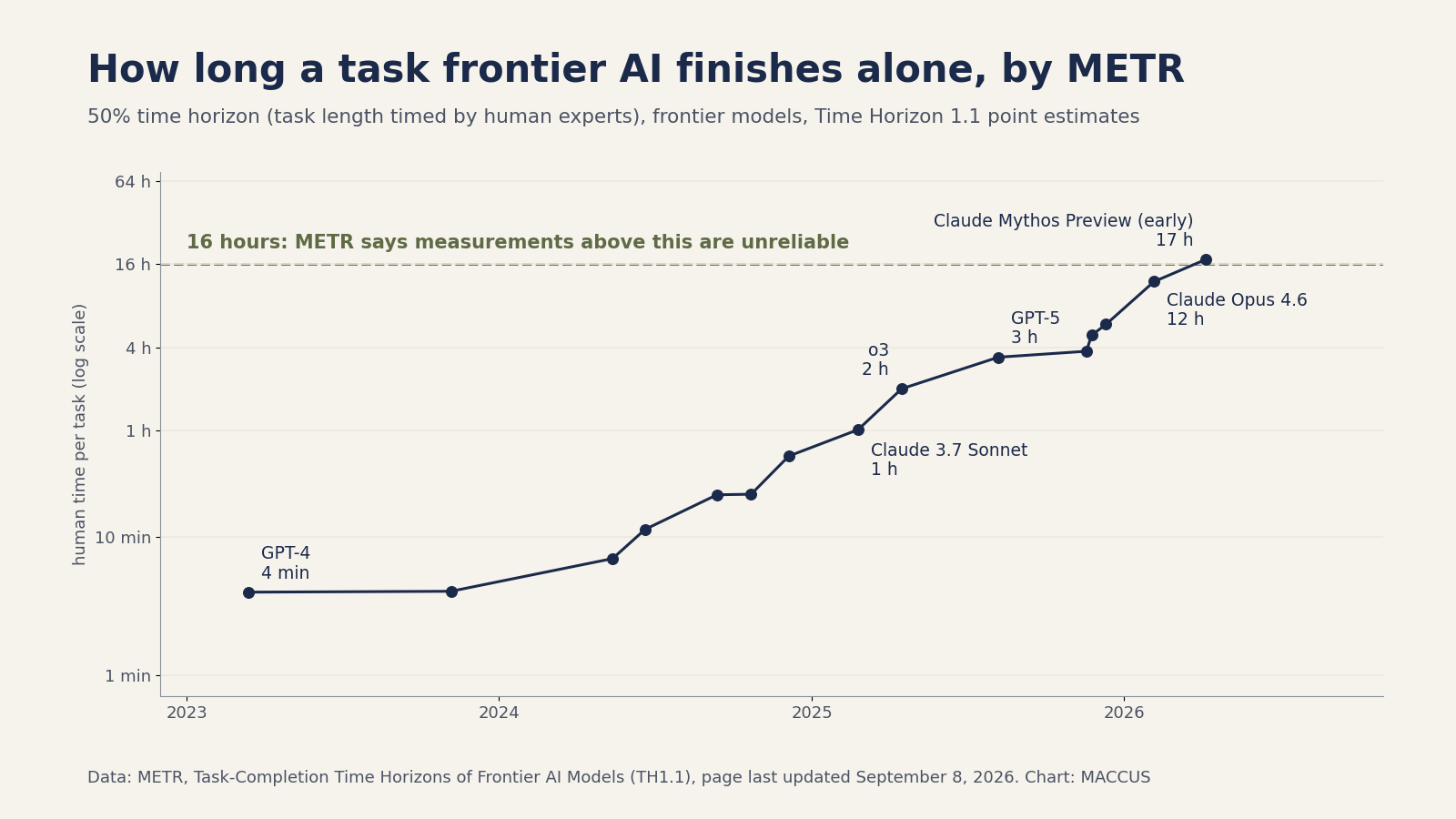
METR’s March 19, 2025 study found that the length of tasks frontier agents complete autonomously with 50% reliability, timed by how long the tasks take human professionals, had doubled about every seven months for six years. Its Time Horizon 1.1 update of January 29, 2026, built on a larger task suite, put the doubling time at 131 days since 2023 and 89 days since 2024.
On METR’s chart, GPT-4 had a 50% horizon of about four minutes in March 2023, and an early version of Claude Mythos Preview reached about 17 hours in April 2026. When METR posted that last point on May 8, it attached a warning: “Measurements above 16 hrs are unreliable with our current task suite.” At 80% reliability, the same Mythos Preview measurement is about three hours.
The Minecraft run is not a METR measurement, and the two figures sit on different axes. METR times each task by how long a human expert needs, runs every task six times, and counts a thousand separate one-hour problems as a one-hour task done a thousand times. The 27 hours are the agents’ own wall-clock time in one attempt.
The run does match METR’s idea of a long task in one respect. Its thirteen steps from bare hands to the dragon each built on the one before. The paper also gives two human benchmarks: HowLongToBeat’s median of 45 hours for a human player to finish Minecraft’s main story, and a random-seed speedrun record under seven minutes.
What it means
The run tested how long general-purpose agents can work toward one goal without human intervention. Each player was an instance of a coding agent, run with the tools it uses for software work. The authors make the link to real-world work, writing that complex software engineering and enterprise tasks “demand the same long-horizon coding and multi-agent coordination.”
Other recent results involve large amounts of code written by AI, including OpenAI’s 87% score at rewriting COBOL programs, free Office-style apps whose code was mostly written with Claude Opus 5.5, and fan projects that rebuild games’ source code, which AI models have sped up so much that the decomp.dev hub is winding down.
The paper shows sustained autonomy in one run, and the authors cannot say how often the same setup would win again. Reliability is also the open question in METR’s data: its 80% horizons sit far below its 50% ones. The authors add that playing from pixels with a keyboard and mouse, as the SIMA 2 agent does, “remains much harder.”
The next things to watch are repeated runs that report a success rate, attempts on Normal or Hard difficulty or from pixels, a long-task benchmark that measures past the 16 hours where METR’s suite stops being reliable, and the end of Gemini 4 Argon’s introductory price, which doubles the run’s estimated cost.
Sources
- A team of Gemini 4 Argon agents beats Minecraft, M. Faldor, S. Singh and R. Raileanu, arXiv, October 15, 2026
- Four Gemini 4 Argon agents beat Minecraft from scratch in 27 hours, Google DeepMind on X, October 16, 2026
- Google DeepMind says four AI agents beat Minecraft in 27 hours by writing 2,783 programs of their own, Tom’s Hardware, October 20, 2026
- Measuring AI Ability to Complete Long Software Tasks, METR, March 19, 2025
- Time Horizon 1.1, METR, January 29, 2026
- Task-Completion Time Horizons of Frontier AI Models, METR, last updated September 8, 2026
Header image: chart by MACCUS, data from Faldor, Singh and Raileanu, arXiv:2610.22319 (October 15, 2026)