
On October 15, 2026, decomp.dev, the website that tracked hundreds of fan projects rebuilding the source code of video games, said it is winding down. For a mid-sized game, that work used to take a team years. AI models now speed it up so much that, in the words of the site’s admin, “the community aspect of decompilation has been broken.”
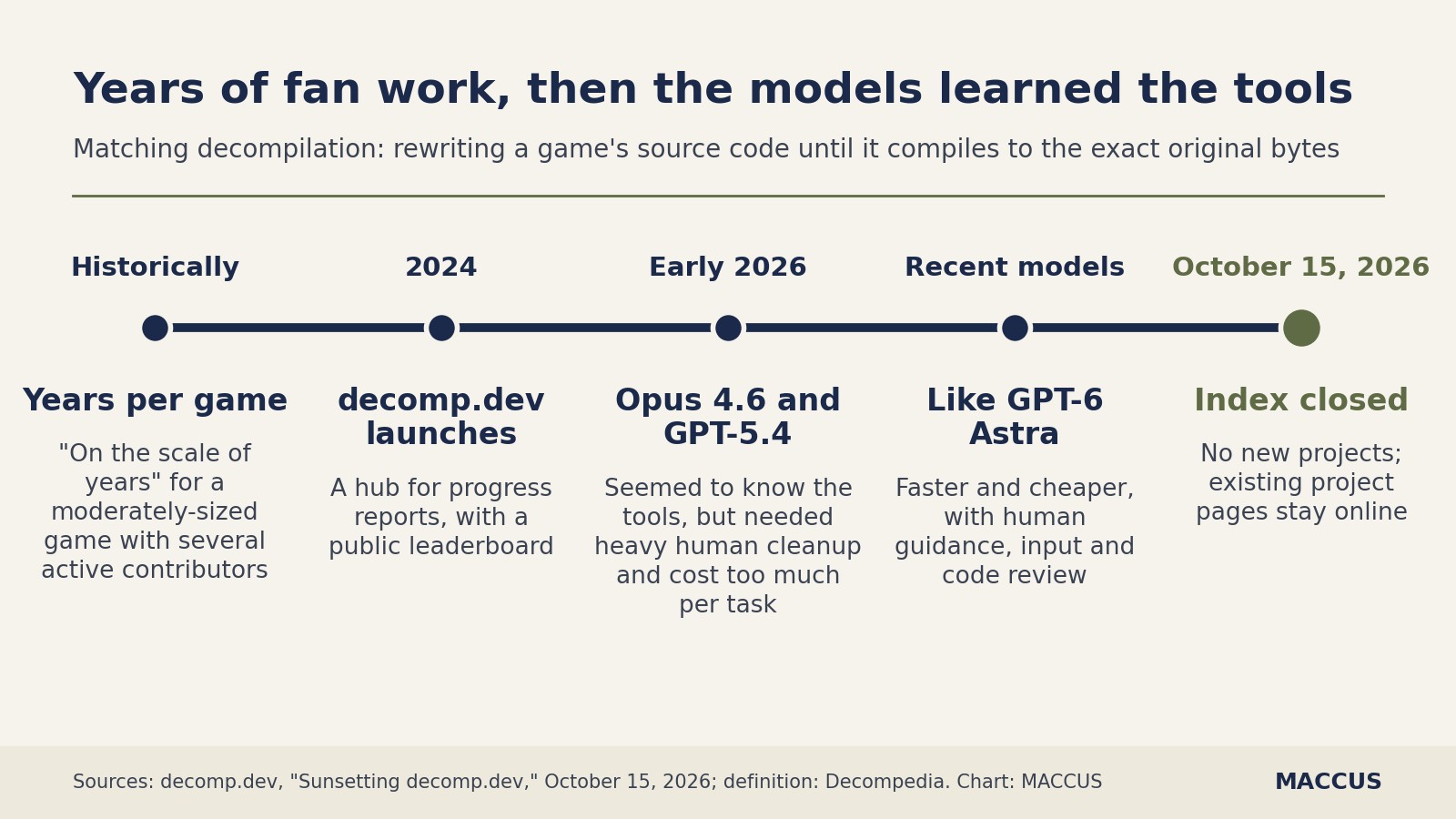
The admin, who goes by Encounter, posted the notice “Sunsetting decomp.dev” on the home page, and the tech news site 404 Media reported it the same day. The main index and new project submissions are now disabled; existing project pages and their historical data stay online.
A hobby measured in years
A console game ships as machine code, the raw instructions a processor runs, without the source code its developers wrote. Matching decompilation, as the community wiki Decompedia defines it, is “the process of writing source code (typically C or C++) that compiles to the same exact binary as the original.” It usually requires the game’s original compiler, the program that turns source code into machine code, and every line is written from scratch. A function, one small piece of the program, counts as done only when it compiles back into the exact bytes of the shipped game.
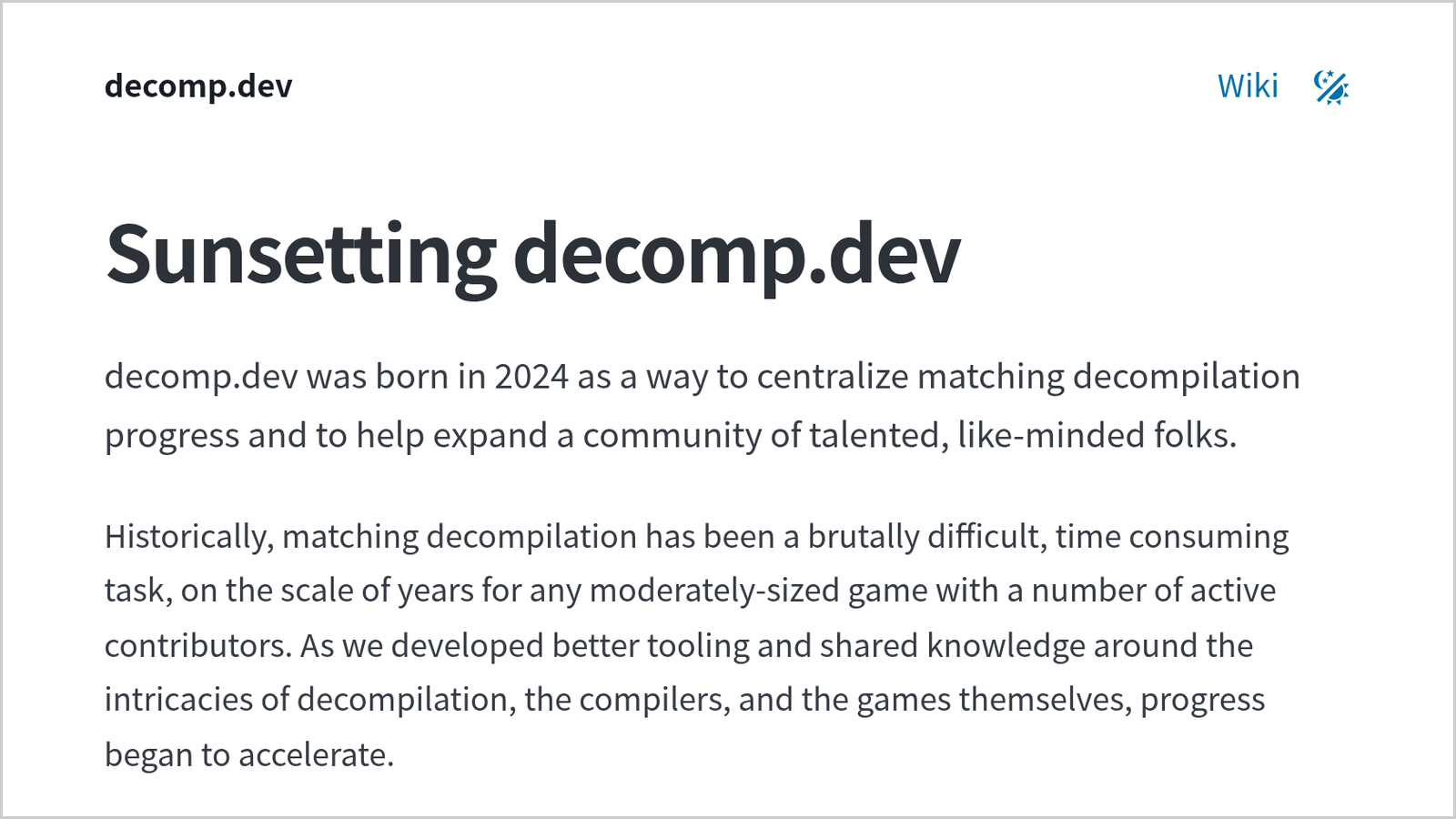
The notice calls the work “a brutally difficult, time consuming task, on the scale of years for any moderately-sized game with a number of active contributors.” Decompilation communities have long said it is “primarily for research,” Encounter writes: “we love these games and want to understand how they work.”
The site launched in 2024 to collect progress reports from those projects in one place. Its leaderboard showed how much of each game had been matched, which kept people motivated “when every fraction of a percent took real human effort.”
What the models learned in 2026
People had tried AI on decompilation “for years, with mixed results,” according to the notice, which dates a first shift to early 2026, with the release of Anthropic’s Claude Opus 4.6 and OpenAI’s GPT-5.4. Those models “appeared to know our specific tools and how to use them without explicit guidance,” the admin writes, and could produce decent results in a clean codebase with exhaustive documentation.
Their output still needed a lot of human cleanup, including fixes for “cheating”: code that compiles to the same machine code but could not pass for what the original developers wrote. The cost per task was “prohibitively expensive relative to the results.” (Our guide to the Claude models covers the lineup that followed Opus 4.6.)
Recent models, “like GPT-6-Astra,” went further. They follow complex directions, cross-reference symbols (function and variable names) and debug information, and write natural code “with enough guidance.” They are “exceptionally good permuters,” writing small scripts that try many versions of the same source code, across files and headers, until one compiles to a match. They stay coherent on long tasks, working continuously “without going off the rails,” and they do all this “faster and cheaper than earlier models could.”
The admin concludes that “with the right guidance, human input, and code reviews, AI can expedite the decompilation process in a significant way.”
Why the hub is closing
The complaint in the notice is about people. Because the projects are open source, outsiders have forked, or copied, existing decompilations to “finish” them with AI. They have also raced to release ports (versions rebuilt to run on other machines, such as PCs) built on work they never contributed to. Some projects may not want AI “for legal or ethical reasons,” the admin writes; others accept it but do not want drive-by contributions from people who never checked their own output.
The leaderboard idea, Encounter writes, has warped decompilation into “a hollow numbers game,” fed by people who “just want to burn tokens to make number go up” (tokens are the units AI services bill by). 404 Media reports that the admin said it had become impossible to keep track of which projects are primarily human-led and which are done by AI. The notice’s verdict: “decomp.dev serving as a public index and leaderboard is now causing more harm than good.”
The notice also asks why the site does not simply ban AI-assisted projects, and answers: “AI is not the issue by itself, and we now know it can help tremendously when used correctly.” As “a sole hobbyist” facing hundreds of projects, Encounter has neither the energy nor the desire to define what makes a good decompilation and enforce it.
Elsewhere in software
On October 7, Ars Technica reported on developer Brandon Thomas, who said he had used Claude Opus 5.5 to build open-source clones of seven Adobe apps, from Photoshop to Acrobat Pro. Ars described him as “the latest in a long line of coders using AI tools to speed up the long-standing but labor-intensive practice of reverse engineering,” and its subhead called the apps “nowhere near finished.” Earlier this month we covered the same team’s free Word, Excel and PowerPoint alternative, also built with Claude.
On October 17, Epic Games CEO Tim Sweeney wrote on X that “the games we’ve long wanted, which didn’t exist because they’d cost several times more to make than they’d earn back, will soon become possible,” and predicted “a new golden age of gaming.”
Linux has its own AI numbers. In August, Jonathan Corbet, editor of the news site LWN, counted 1,111 changes in Linux 7.2 that carried “Assisted-by” tags, which disclose help from an AI model, up from 301 in 7.1. He added that the real number of AI-assisted patches “must surely be far higher.”
On October 18, Linus Torvalds released Linux 7.3, which LWN calls “a record-breaker on all fronts”: 18,765 individual code changes (non-merge commits) from 3,021 developers, 807 of them first-timers. LWN has not yet published the AI-tag count for 7.3, and its release note does not link the record to AI.
Limits of the notice
The “scale of years” is Encounter’s estimate for a moderately-sized game with several contributors. The notice gives no measured speed-up for AI-assisted projects, and we found none published. It credits AI only “with the right guidance, human input, and code reviews,” and names GPT-6 Astra as one example of recent models. The early-2026 output needed heavy cleanup, and the admin calls the rushed ports “half-baked” and “barely-functional.”
404 Media’s headline says AI “has made it too easy.” Encounter’s text is narrower and describes a tool that “can help tremendously when used correctly.” The closure is partial, too: existing project pages stay online, served by code the admin calls “entirely human written.”
What it means
Matching decompilation has a built-in referee: a function either compiles to the original bytes or it does not. The permuter scripts the admin describes rely on that check, so a model can keep trying variants across files and headers for as long as the budget lasts. Claude’s cheaper quantum circuits, which we covered on October 18, came out of the same kind of loop, with an automated evaluator scoring every candidate. The AI-found counterexamples to a 1967 fusion conjecture, by contrast, had to be confirmed by hand.
For years, the bottleneck in this hobby was skilled volunteer hours. As the admin describes it, the human part of the work is now guidance and review, and the progress bars that once measured human effort also measure token spending. Tracking who did the work got harder too. According to 404 Media, the admin said it had become impossible to tell human-led projects from AI-led ones, and in August Corbet wrote that accurately tracking AI-assisted kernel commits “may turn out not to be possible.”
The next things to watch are whether the projects decomp.dev still tracks now finish faster, and whether LWN’s statistics for Linux 7.3 show the Assisted-by count climbing again.
Sources
- Sunsetting decomp.dev, decomp.dev, October 15, 2026
- Video Game Reverse Engineering Community Shuts Down Because AI Has Made It Too Easy, 404 Media, October 15, 2026
- “Software is over”: Bold AI developer takes aim at Adobe with open source clones, Ars Technica, October 7, 2026
- Post by Tim Sweeney, X, October 17, 2026
- Development statistics for the 7.2 kernel, LWN.net, August 17, 2026
- The 7.3 kernel has been released, LWN.net, October 18, 2026
Header image: chart by MACCUS, sources decomp.dev (“Sunsetting decomp.dev,” October 15, 2026) and Decompedia