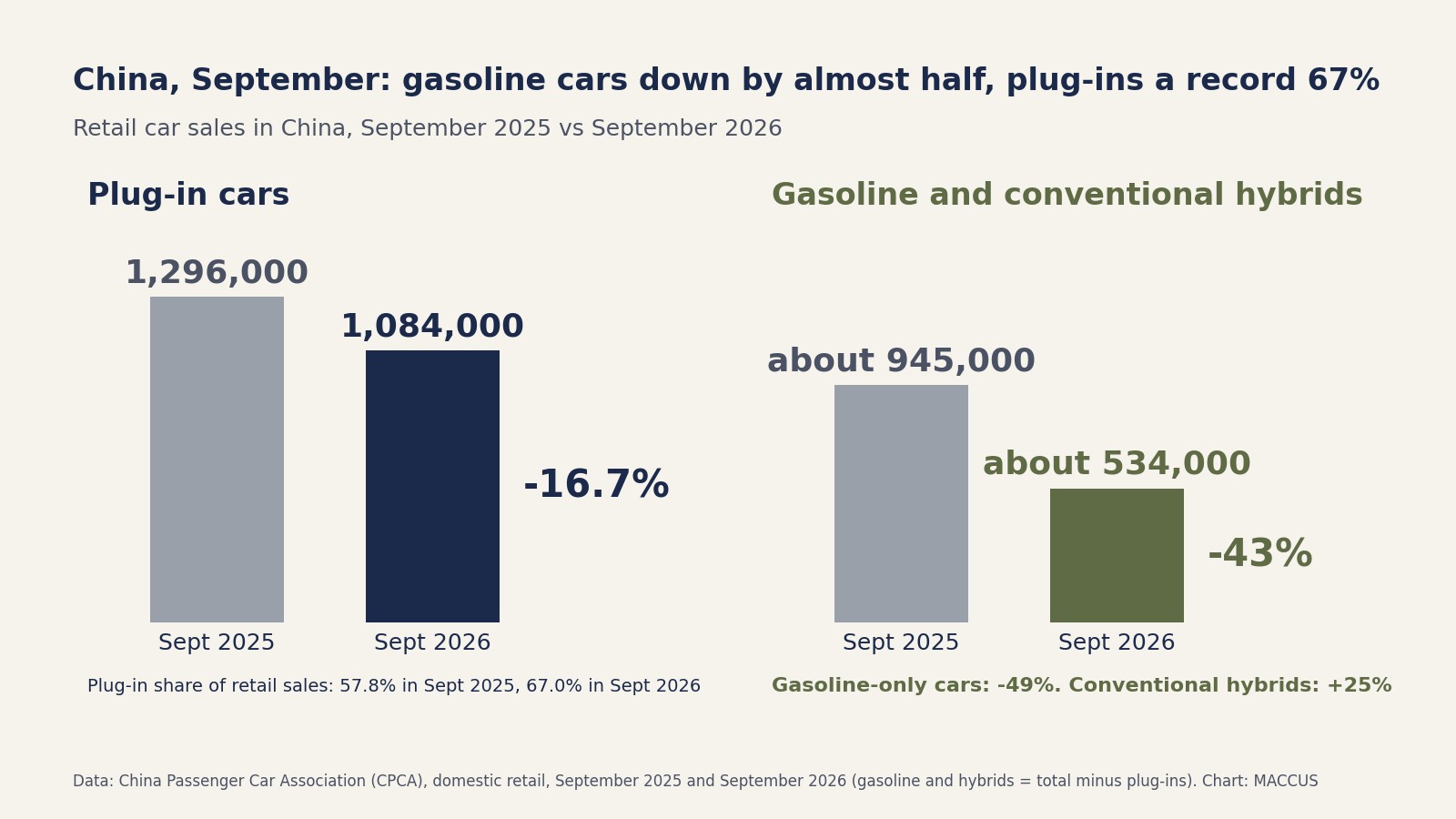

For every two gasoline-only cars that Chinese dealers sold in September 2025, they sold about one this September. On October 12, the China Passenger Car Association (CPCA), the industry body that tracks the country’s car sales, reported a 49% year-over-year drop in retail sales of gasoline-only cars. It said combustion-engine cars at domestic, joint-venture and luxury brands had all been “hit hard by high oil prices.”
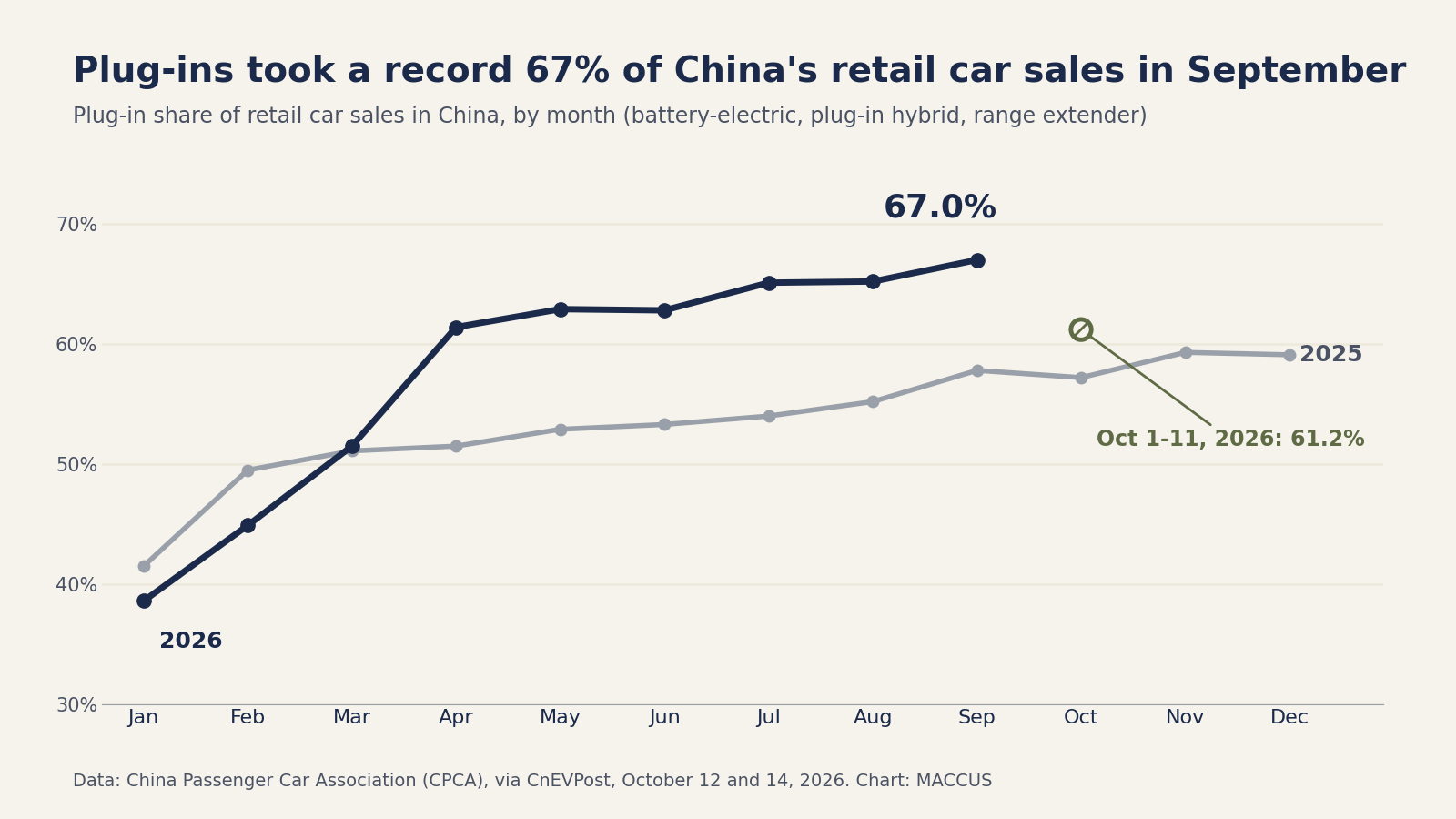
Plug-in cars, a category that covers battery-electric cars, plug-in hybrids and range-extender models, took a record 67.0% of China’s retail car sales in the same month, up from 57.8% a year earlier. The CPCA’s September report says combustion-engine cars are “shrinking faster” and that high oil prices keep speeding up the switch from oil to electricity.
The record came in a shrinking market. Retail sales of all passenger cars fell 28% to 1.618 million, and plug-in sales fell 16.7%. Among the reasons the CPCA gives for the weak month are the Mid-Autumn holiday, which fell in late September this year; a subsidy rush in some provinces that inflated September 2025; and the price of oil.
Half the gasoline cars, a record share of plug-ins
Retail sales of gasoline cars and conventional hybrids, counted together, fell 43%. Within that group, the two moved in opposite directions: gasoline-only cars fell 49%, while conventional hybrids, which carry a battery but never plug in, rose 25%. The CPCA found almost no difference between brands: combustion-engine car sales fell 47% at Chinese brands, 42% at the mainstream joint ventures with foreign automakers and 41% at luxury brands.
Subtracting the plug-in total from the overall total gives roughly 534,000 gasoline and conventional hybrid cars sold in September, compared with about 945,000 a year earlier. Plug-ins fell much less, from 1.296 million to 1.084 million, according to CnEVPost’s tables of the CPCA data. The record share comes from that gap: gasoline-car sales shrank faster than plug-in sales.
Fully electric cars accounted for 765,000 of the 1.618 million cars sold at retail, about 47%, but their sales fell 7.4% from a year earlier. Among plug-ins, plug-in hybrids fell hardest, down 35.6% to 232,000.
Oil, the Strait of Hormuz and the pump
China imported 21.5% less crude oil in September than a year earlier, according to the September snapshot published on October 21 by the Centre for Research on Energy and Clean Air (CREA). CREA ties the fall to “disruptions to shipments through the Strait of Hormuz.” Crude imports are down 15.3% over nine months, and Chinese refineries processed 8.4% less crude in September. CREA’s analysts write that “electric vehicles and rail travel displaced oil in transport.”
At the pump, the National Development and Reform Commission (NDRC), which sets China’s retail fuel prices, left gasoline and diesel prices unchanged on October 15. It said crude had dipped briefly and then risen sharply again since its last adjustment on September 24, with the situation in the Middle East “complex and volatile.”
The CPCA reports that high oil prices clearly hurt gasoline-car sales, that dealers grew more cautious about ordering new stock, and that most of them found the usual September and October peak season noticeably weaker than in past years.
The drop in oil use showed up earlier in the crisis. In a Carbon Brief analysis published on September 3, CREA lead analyst Lauri Myllyvirta found that China’s oil use fell 9% in the second quarter of 2026, and 16% in transport. He wrote that the rise in fuel prices “only accelerated the structural shifts in transportation that were already underway.” Sinopec, the state-owned refiner, had forecast a 5% fall in gasoline consumption and a 6% fall in diesel for 2026 before the war on Iran began.
The energy think tank Ember estimates that electric cars in oil-importing countries displaced about 200 million barrels of crude worth $20 billion from March to August, the six months since the start of the US-Israel war with Iran. Ember puts China’s share at $14 billion.
The factories keep building, for export
Chinese plants are slowing far less than Chinese showrooms. Figures compiled by CREA show plug-in production up 16.9% in September, to 61% of all vehicles built, while total vehicle production fell 5.7%.
According to the CPCA, China exported 917,000 passenger cars in September, including kits for local assembly, up 73.7% from September 2025. Exports made up 36% of automakers’ passenger car sales, compared with 19% a year earlier, and plug-ins accounted for 558,000 of the cars shipped abroad, up 163.5%. The second-largest plug-in seller in China in September was Geely, with 119,682 cars; its Zeekr brand builds the Ojai vans that Waymo is importing for its US robotaxi fleet.
Where the numbers stop
Oil explains only part of the 49%. September 2025 was a high bar, lifted by buyers rushing to use provincial subsidies before they expired, and this year’s holiday week took selling days out of the month. Both explanations come from the CPCA itself.
Early October looks less dramatic. In the first 11 days, plug-ins took 61.2% of retail sales, below September’s record and below the 70.3% recorded in the first 13 days of September, CnEVPost reported from CPCA weekly data. The CPCA said automakers chasing sales targets even without order backlogs slightly lifted their direct retail sales and pushed the plug-in share unusually high. At the factory end, the shift went further: plug-ins were 78.1% of wholesale sales, which include exports, and gasoline-car production fell 51% in the first two weeks of October.
On the oil side, CREA links September’s fall in crude imports to Hormuz. For the second quarter, when China’s oil imports fell 32%, Myllyvirta found that drawing down stockpiles covered about 60% of the fall. In the same analysis, he wrote that electric vehicles and the other structural factors “are not sufficient to account for the size of the fall in oil consumption,” which leaves changes in behavior as the other explanation. Ember’s barrels and dollars are model estimates.
The CPCA calls the slump a temporary result of short-term policy changes and a high comparison base. It says first-time demand still has room to grow in county towns, where car ownership remains low compared with big cities, and it expects trade-in subsidies to increase later this year.
What it means
The plug-in share of China’s September car sales has gone from 53.3% in 2024 to 57.8% in 2025 and 67.0% this year. The CPCA expects the monthly share to stay above 65% in October. New cars are a small part of China’s car fleet, so oil demand moves more slowly than showroom shares, but September alone added 765,000 fully electric cars to that fleet.
Of the 56 countries Ember tracks, 49 now have a higher share of fully electric car sales than the United States, where they made up 6% of light-duty vehicle sales from January to August after federal support was rolled back in 2025. Fifteen countries overtook the US this year, including India and Brazil. Worldwide, fully electric cars were 18% of new car sales in the first eight months, up from 16% a year earlier, while sales of combustion-engine cars fell 6%. “The countries that invested in electric vehicles before this crisis are now better protected and a growing number are following,” said Euan Graham, a senior energy analyst at Ember.
Over the next five to twenty years, the test comes when oil gets cheaper. If Chinese buyers stay with plug-ins once prices ease, the September split points to falling gasoline demand in the world’s largest crude importer, a decline Sinopec was already forecasting for 2026 before the war. If they drift back, September 2026 will look like a wartime spike against a strong September 2025. The CPCA’s October figures, due in November, and its weekly data before then will show which way buyers are leaning.
Sources
- 乘联分会:9 月全国乘用车市场零售 161.8 万辆同比下降 28%,新能源渗透率 67% 创新高 (CPCA September 2026 market report, full text), IT Home, October 12, 2026
- 乘联分会:9月新能源乘用车零售渗透率达67.0%,创历史新高, China News Service, October 12, 2026
- China September NEV retail sales fall 16.7% as penetration hits record 67%, CPCA data shows, CnEVPost, October 12, 2026
- China NEV retail sales fall 13% in October 1-11 as penetration slips to 61.2%, CnEVPost, October 14, 2026
- China Energy and Emissions Trends: September 2026 snapshot, Centre for Research on Energy and Clean Air (CREA), October 21, 2026
- Analysis: China’s CO2 emissions fall in Q2 2026 due to plummeting oil use, Carbon Brief (Lauri Myllyvirta, CREA), September 3, 2026
- Electric cars have saved oil-importing countries $20bn since the start of the Hormuz energy crisis, Ember, October 14, 2026
- 2026年10月15日国内成品油价格不作调整, National Development and Reform Commission (NDRC), October 15, 2026
Header image: chart by MACCUS, data from the China Passenger Car Association (CPCA), September 2025 and September 2026