
On October 21, 2026, SEO consultant Marie Haynes published 12 months of Google Analytics 4 (GA4) data from 100 websites, more than 145 million sessions in all. ChatGPT sent them the equivalent of 0.62% of the visits they got from Google organic search. Counting every AI assistant, the figure rises to 0.73%. Her post, “GEO is a distraction,” takes aim at GEO (generative engine optimization), the work of getting a site to show up in AI assistants’ answers.
Two other GA4-based studies came out or were updated in the same few weeks. On October 14, The SEO Works, a British agency, updated its benchmark of 95 websites, first published September 7. On October 19, Kevin Indig, who writes the Growth Memo newsletter, described his hunt for hidden AI traffic among the direct visits of 12 sites. Search Engine Roundtable grouped the three on October 22 under the headline “3 New Studies Suggest AI Visibility & Search Not Worth Investing In.”
0.62% of Google organic volume across 100 sites
Haynes, who has practiced SEO since 2008, describes the sites as “of varying sizes” and randomly sampled. She doesn’t give the exact 12-month window, the industries, or how she identified visits from AI assistants.
Only 55 of the 100 sites tracked conversions in GA4. On those sites, ChatGPT visitors converted more than four and a half times as often as Google organic visitors: 13.8% versus 3.02%. Google still drove 96.5% of the conversions across the channels analyzed, 27 times as many as all AI assistants combined.
By her count, the exponential growth in visits from ChatGPT stopped in August 2025, when GPT-5 launched, and the number has been falling since. “We were wrong,” she writes about predictions, her own included, that AI assistants would one day send far more traffic than Google.
Organic search sent 39 times more visits
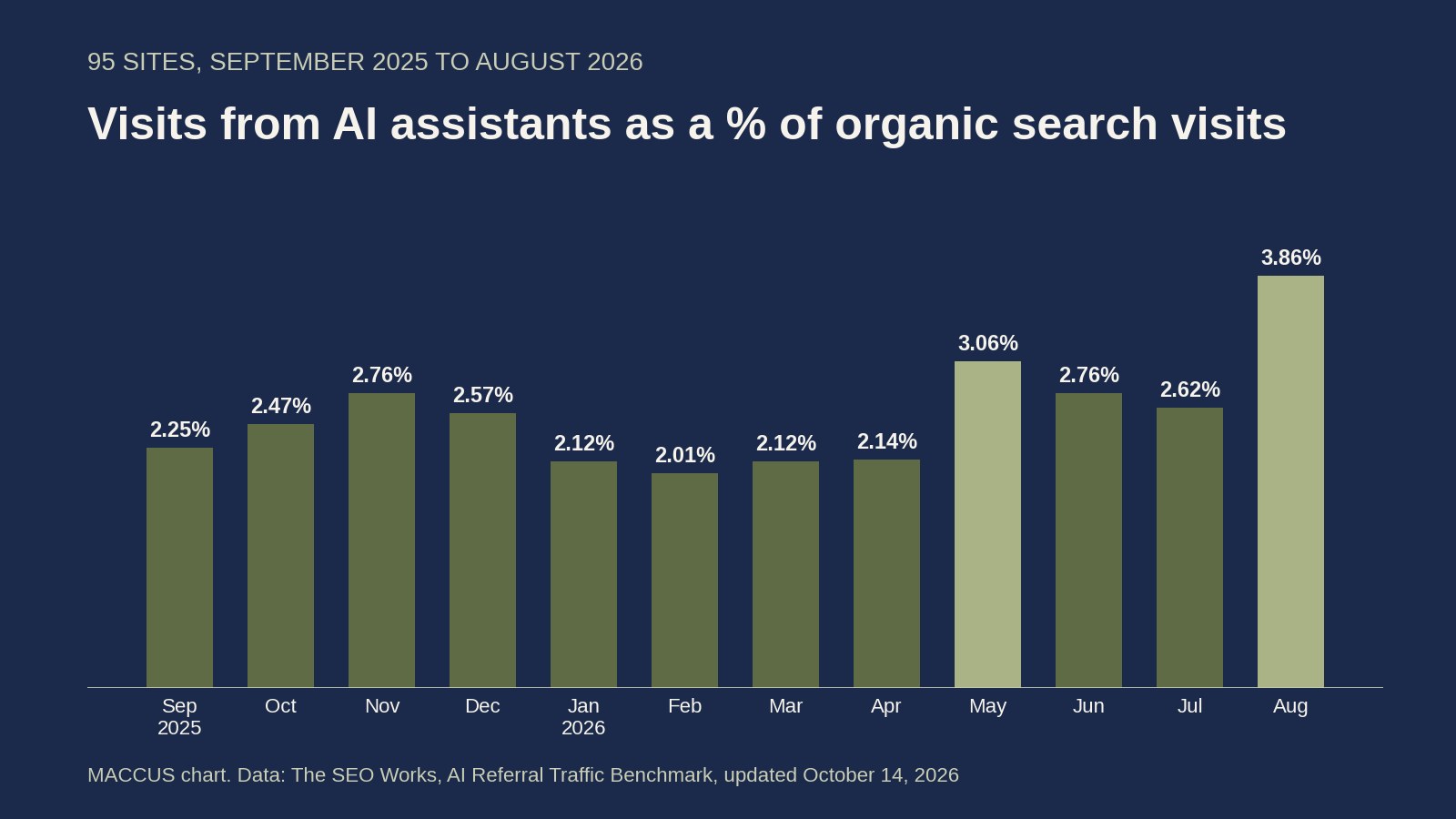
The SEO Works analyzed 95 GA4 properties from September 2025 through August 2026. Organic search brought them 2,825,594 sessions, 39 times the 72,095 that came from AI assistants (2.6% of the organic volume). The agency identifies AI visits by source name (chatgpt, claude, gemini, perplexity, copilot, grok, openai, bard) because the AI Assistant channel in GA4 only goes back to June 2026.
Measured against organic search, AI traffic stayed between 2.0% and 2.8% every month through April 2026. It reached 3.06% in May, dipped to 2.76% in June and 2.62% in July, then climbed to 3.86% in August. According to the agency, ChatGPT started making brand names clickable inside the text of its answers around May 7, 2026. The SEO Works offers that change as a working hypothesis for the rise, without claiming it as an established cause.
Across the 63 sites used to compare conversions, AI traffic converted at 7.18% versus 6.08% for organic search, a ratio of 1.18. It did worse on 23 of those 63 sites. For the 10 sites that sell products to businesses, the ratio drops to 0.62.
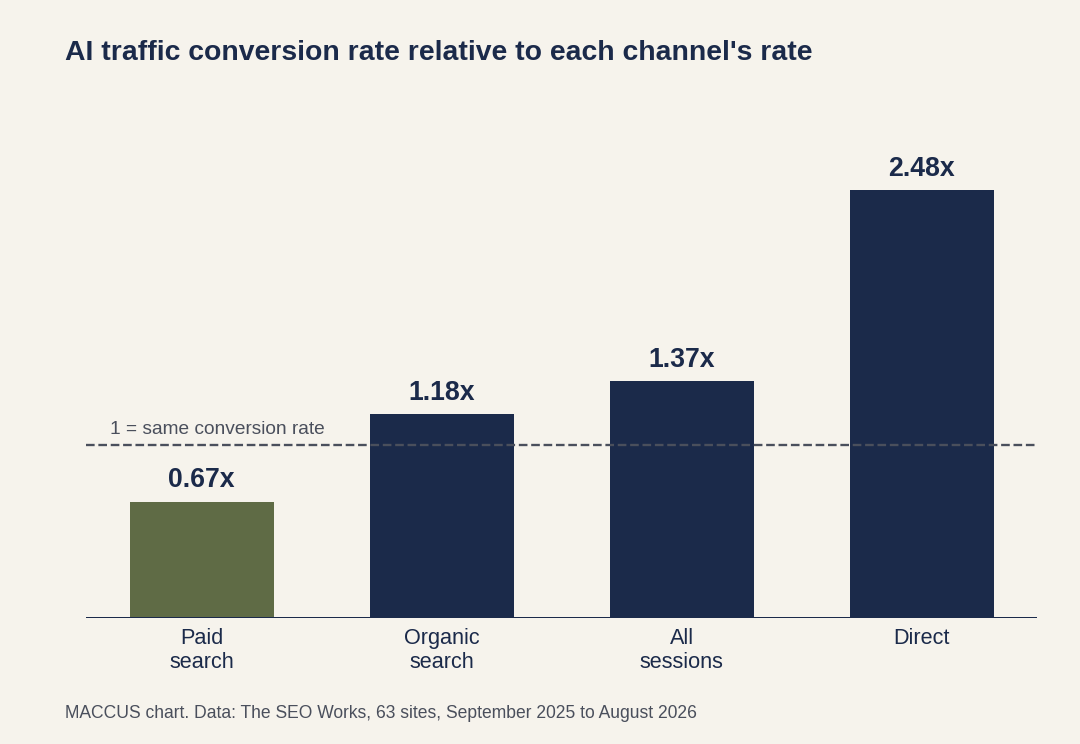
In absolute terms, AI assistants delivered 3.2 conversions for every 100 from organic search (5,001 versus 155,605). The agency calculates that 5% more organic search traffic would have added an average of 10.3 conversions per site per month, compared with 6.6 from doubling AI traffic. Sites that gained AI traffic also tended to gain organic search traffic (a 0.557 correlation across 61 sites).
No clear sign of AI traffic hiding in direct visits
Indig himself had described how invisible AI traffic might work: someone reads an AI answer, then types the site’s address. He looked for that traffic in 12 GA4 properties, 10 of them targeting the US, comparing August with September 2026.
Direct traffic had grown at eight of the sites, much of it from bots. On one site, GA4 recorded 409,000 direct sessions, only 198 of them engaged. From January through September, direct traffic jumped 140.9% in his filtered sample, while engaged direct sessions fell 1.0%. On average across the 12 sites, direct sessions with an identifiable AI trace made up 0.003% of direct traffic.
He then ran 632 tests on four brands, comparing their weekly visibility in AI answers with their branded searches and direct traffic. One brand showed a 0.72 correlation, but several deliberately misaligned series produced correlations just as strong or stronger. “An effect could still exist. I just couldn’t isolate it,” he concludes.
The SEO Works tested the same idea. Once it controlled for the sites’ overall growth, it found no evidence that rising AI traffic drives direct traffic.
Indig does cite a counterexample: Ramp attributes 30% to 40% of its direct traffic to answer engines. Eric Wu, who shared that figure on the Siege Media podcast, walked Indig through the method. His team isolated direct visits to long blog URLs that people rarely type, compared those visitors with visitors from search, and then confirmed where they came from by asking users how they had heard about Ramp.
Numbers that don’t line up
In June 2025, Ahrefs reported that visitors from AI search made up 0.5% of its traffic but 12.1% of its signups, converting at 23 times the rate of organic search visitors. The SEO Works says multiples like these aren’t comparable to its own: they come from single companies measuring their own websites, or from studies of publisher and news sites that count newsletter signups against very little search traffic.
Haynes and The SEO Works also disagree on the trend. She finds that ChatGPT traffic has been falling since August 2025. In the agency’s data, sessions from all AI assistants ranged from 4,588 to 6,328 a month from September 2025 through April 2026, then rose to 8,351 in August. The samples differ, and Haynes counts ChatGPT alone. The agency is the only one to publish its dataset for download.
The limits of measuring AI traffic in GA4
Google’s GA4 help page says the AI Assistant channel “excludes Google’s AI Overviews and AI Mode.” The SEO Works treats its AI traffic figure as a floor: clicks from AI Overviews show up in GA4 as ordinary organic search sessions and can’t be separated out. Google gave no click figures in its October 15 announcements about links in AI Mode.
The agency lists other visits it misses: in-app browsers, stripped referrers, and people who read an AI answer and then search for the brand by name. From October 8 to 16, 2026, a bug in ChatGPT caused GA4 to log some of its referrals as direct traffic. Since Haynes doesn’t date her 12 months, it’s unclear whether her sample covers that period.
GA4 records key events, so a form submitted twice by the same person registers as two conversions. The SEO Works therefore treats its conversion totals as an upper bound and says the double counting doesn’t skew the ratio between channels.
What it means
Two of these studies cover about 100 sites each, whereas several of the multiples quoted in 2025 came from a single site, such as Ahrefs’s own. Over their full periods, both count fewer than three visits from AI assistants for every 100 from organic search. They disagree on the trend and on how much better AI traffic converts, from 1.18 times to more than four and a half times depending on the sample and the scope (all assistants at The SEO Works, ChatGPT alone for Haynes).
The findings bear most directly on companies that sell brand-mention tracking for AI assistants: Haynes says it boggles her mind how much money they have raised and earned. For sites that depend on Google traffic, AI assistants remain a real but still marginal source of visits in 2026.
Two unknowns remain: the effect of Google’s AI Overviews and AI Mode, which GA4 can’t see, and AI traffic that arrives untagged as direct visits, which Indig couldn’t isolate and Ramp says it found by asking its users.
Because GA4’s AI Assistant channel has no history before June 2026, sites won’t have a full year of Google-classified data until summer 2027. The open questions are whether the rise seen since May 2026 holds, and whether any study will look at French-language sites.
Sources
- GEO is a distraction, Marie Haynes, October 21, 2026
- How Much Traffic Do AI Assistants Actually Send, And Does It Convert Better?, The SEO Works, September 7, 2026, updated October 14, 2026
- Does AI drive more direct traffic?, Kevin Indig (Growth Memo), October 19, 2026
- 3 New Studies Suggest AI Visibility & Search Not Worth Investing In, Search Engine Roundtable, October 22, 2026
- Does AI Search Traffic Convert Better Than Traditional Search? For Ahrefs, Yes: 0.5% of Visitors Drove 12.1% of Signups, Ahrefs, June 16, 2025
- Default channel group, Analytics Help (Google), accessed October 23, 2026
Header image: MACCUS chart, data from The SEO Works (AI Referral Traffic Benchmark, updated October 14, 2026)