
On October 15, 2026, Google announced five changes to how AI Mode and AI Overviews show links to websites. Links inside the answer text are moving higher, Google will test a box reserved for official sites, and news article carousels are reaching new countries. Google names none of those countries, gives no timeline and shares no click figures. On October 28, Alphabet acknowledged that AI Mode earns less, without putting a number on the gap.
French and Belgian sites may feel this directly. AI Mode and AI Overviews have been live in France since July 22, 2026, on mobile, on desktop and in the Google app. Google does not say which countries get each change. Connecting Gmail and Google Photos to AI Mode is not offered there; since October 16, Google’s Privacy Policy has said that data can also be used to personalize ads. On the ads side, Google opened ads in AI Mode to ten more countries on October 28, 2026, in English only and with no EU country.
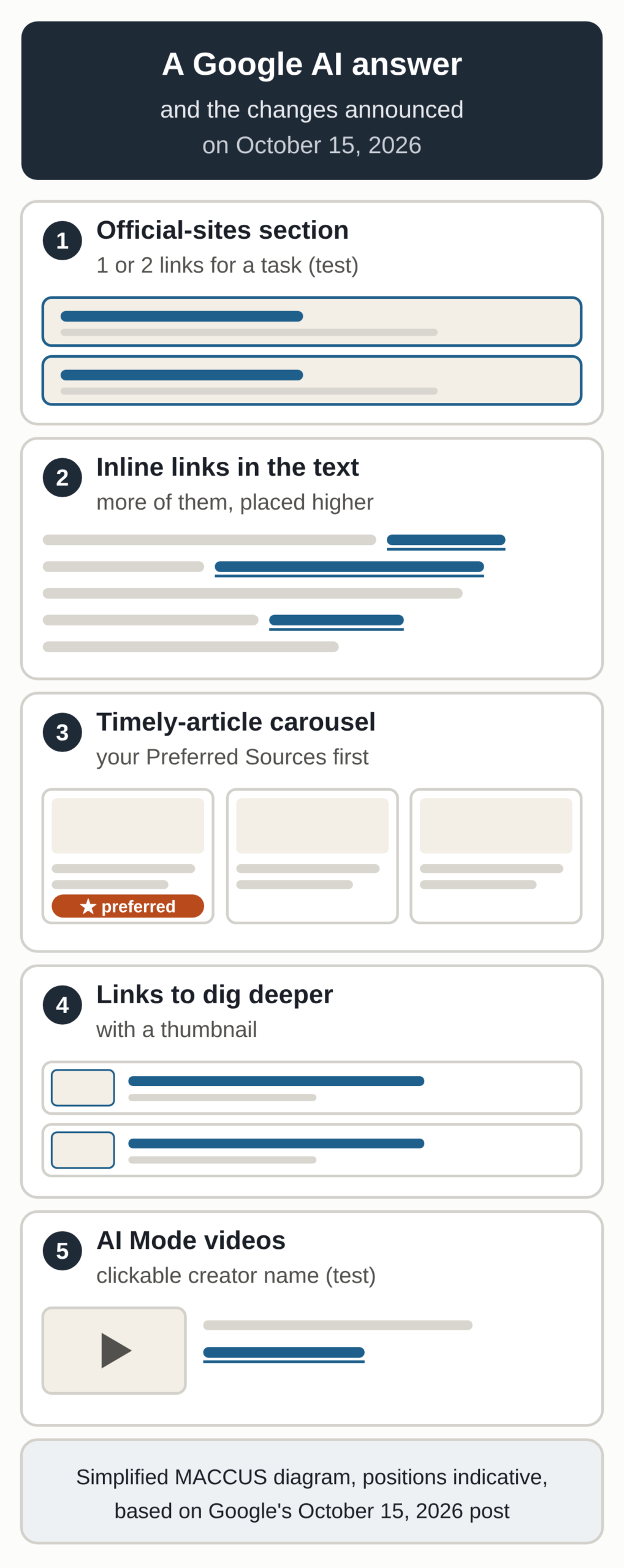
Google’s five announcements
The post, by Hema Budaraju, VP of Product Management at Google, went live at 6 p.m. Brussels time on Google’s official blog. It lists five changes, two of which are only tests.
| Change | Announced status | Countries named |
|---|---|---|
| Inline links in the answer text, shown higher and more often | Launching | None |
| A box at the top of the answer for one or two official sites | Test announced | None |
| Carousels of timely articles that highlight the user’s Preferred Sources | Starting to roll out | More countries and languages, no list |
| Links at the end of the answer, with thumbnails | Announced, no date | None |
| Clickable creator and publisher names on AI Mode video results | Testing | Profiles open in Canada, India and the U.S. |
Inline links are links placed on a word or phrase in the answer. Google says it has made “continued and substantial increases” to their presence but doesn’t put a number on it. It is also launching an update that shows them higher up in the answer, and more often. Which pages get cited remains fragile: according to a Fudan University study posted on October 8, eight of ten AI search engines cited a made-up concept within a week, Google’s AI among them.
The official-sites box targets searches where only one or two official sites let you complete a task or find a specific piece of information. Google will test a dedicated section at the top of the answer, with context on why each link is useful. The company doesn’t say how it decides that a site is official. Six days later, observers spotted another test: source descriptions written by Google’s AI in AI Overviews.
The carousels for timely articles, launched in May, are starting to roll out to more countries and languages. They highlight the user’s Preferred Sources and are meant to show up on a wider range of queries. The post doesn’t name a single country. On X, Nick Fox, Google’s SVP of Knowledge and Information, described them as “available globally.”
The clickable names lead to Search profiles, Google pages that collect a creator’s or publisher’s work. According to Google’s help page, checked on October 16, 2026, those profiles are available only in Canada, India and the United States, and only to creators with at least 10,000 followers on YouTube, Instagram, X or TikTok. For now, the test doesn’t reach French or Belgian creators.
Seven times more users, with no baseline
Google says the number of people who use Preferred Sources has grown by more than 7x since the start of the year. The post gives neither a user count nor a method, as Search Engine Journal pointed out the same day. The figure measures users, and it comes with no click data.
For a click figure on Preferred Sources, you have to go back to a Google post from May 27, 2026. It said people were twice as likely to click through to a Preferred Source, and that more than 345,000 unique sources had already been selected. On October 29, Reddit’s CEO said that AI Mode “does not drive traffic” as he announced that reading Reddit will soon require an account.
Search Console still doesn’t break out clicks from AI answers
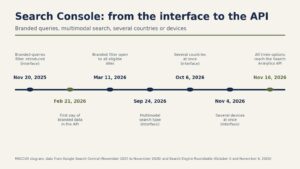
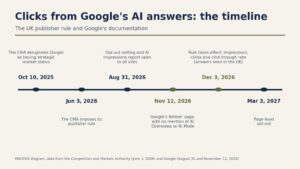
The generative AI performance report, rolled out to all sites on August 31, 2026, shows your site’s impressions in AI Overviews and AI Mode by page, country and device. It has no clicks column. A logging error lowered its impressions from November 9 to 11, 2026, just before AI Mode switched to Gemini 4 Hydrogen.
The clicks are in Search Console, though. According to Search Console’s help page, a click on a link in an AI Overview counts as a click in the regular Performance report, mixed in with the rest of the web results. Analytics tools can’t single them out either: the page Google published on November 12 on spotting its search traffic lists no Referer value specific to AI answers.
An AI Overview takes up a single position on the results page, and all of its links get that same position. A link that moves up inside an AI Overview doesn’t change the position Search Console reports. In AI Mode, position follows the rules of a regular results page.
When Barry Schwartz of Search Engine Roundtable asked, Google said it is continuing to work with site owners and will introduce additional metrics over time. It gave no date.
The rules for Preferred Sources
The carousel change ties into Preferred Sources, a documented feature that is available from France or Belgium. Google Search Central’s page on the feature, last updated September 18, 2026, lays out three rules.
The feature works in all languages for Top Stories, and in AI Mode and AI Overviews wherever those are available. To get the “preferred” badge in those answers, a site has to be included in Search generative AI features in Search Console. Only domains and subdomains are eligible, so a blog in a subfolder such as example.com/blog is not.
Google offers an “Add to preferred sources” button that takes two lines of HTML, or a deep link in the format https://www.google.com/preferences/source?q=yoursite.com for newsletters and social posts. The page notes that neither is required to appear as a preferred source.
Carousels, tests and metrics to watch
The first thing to watch for is the carousels arriving in France and Belgium. As of the morning of October 16, we could not confirm whether they show in France yet.
Google has set no date for expanding its two tests, the official-sites box and the creator names. Then there are the “additional metrics” it mentioned to Search Engine Roundtable, with no date and no list. Google hasn’t said whether a clicks column will be among them. That column is what would show the real effect of these changes. On October 28, Google also opened a preview console that lets developers publish their apps inside AI Mode, starting in the US.
An Agence France-Presse dispatch carried by Le Temps and Le Devoir reports that the announcement comes as news publishers worry about falling traffic. According to the same dispatch, Apig, the group that represents French daily newspapers, raised concerns about Google’s AI summaries with France’s competition authority in August. Wikipedia shows a narrower loss: on a basket of French homework pages, the ratio of term-time views to summer views fell 39 percent from its 2019-2022 plateau to 2026 (see our investigation into Wikipedia’s homework pages).
The traffic effect is still an open question
Google hasn’t published how much inline links increased, which countries get the carousels or the baseline behind its 7x figure. Two of the five changes are still tests and may never go further. More visible links don’t guarantee more visits.