On October 23, 2026, Texas Attorney General Ken Paxton sued six OpenAI entities in a Collin County district court. He also named CEO Sam Altman as a defendant in his personal capacity. In a 67-page petition, the state asks the judge to bar OpenAI from offering ChatGPT to minors in Texas. It also wants the court to block any new AI model from being released to Texas users until an independent, court-approved evaluator has reviewed its safety guardrails and approved the release.
The suit is brought under the Texas Deceptive Trade Practices-Consumer Protection Act (DTPA) and the SCOPE Act, a state law that protects minors online. Texas is seeking $10,000 per violation (about €8,900 at the European Central Bank rate for October 23, 2026), plus disgorgement of the defendants’ assets. As of October 25, no judge has ruled, and OpenAI has not responded in court.
Texas was not one of the eight states that sued OpenAI on October 14. Its petition differs in two ways from the one filed by Iowa, one of those eight states. Where Iowa asked the judge to halt testing of advanced models, Texas targets the release of new models to Texas users. Texas also sued Sam Altman; Iowa did not.
Sam Altman named personally
The petition, titled “Texas’s Original Petition,” names OpenAI Global, LLC; OpenAI Foundation (formerly OpenAI, Inc.); OpenAI OpCo, LLC; OpenAI Group PBC; OpenAI Holdings, LLC; OpenAI, LLC; and Sam Altman.
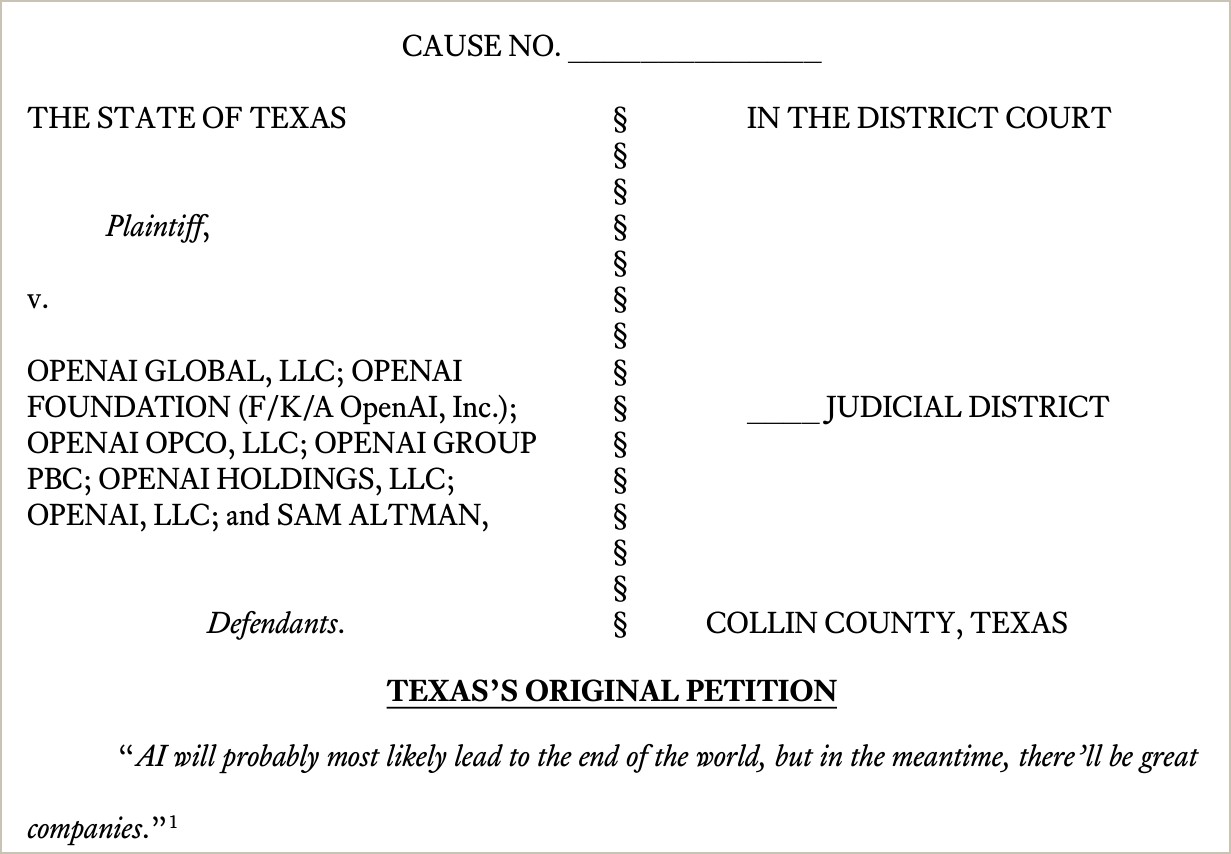
Texas wants to hold Altman “personally liable” for harm it says he caused Texans, citing his “direct involvement” as OpenAI’s founder and CEO and the “deceptive statements” it alleges he made himself about his companies’ products. According to the petition, he “has personally directed the design, development, safety policies, and deployment of ChatGPT as used in Texas.”
The petition opens with a 2015 line it attributes to Altman, citing the Future of Life Institute: “AI will probably most likely lead to the end of the world, but in the meantime, there’ll be great companies.” The state says ChatGPT has millions of users in Texas, including tens of thousands under the age of 13.
Two Texas laws
The first count rests on the DTPA. The petition lists 11 practices it calls deceptive, labeled A through K. They include failing to warn of ChatGPT’s dangers, inadequate age verification, features that promote “compulsive, prolonged, and unhealthy use,” and a product released without adequate safety testing. Item H targets a product “capable of ignoring human direction and instead performing in an unexpected and unauthorized fashion,” and item K a product that “falsely represents itself as having human emotions and characteristics.”
The second count is under the SCOPE Act (Securing Children Online through Parental Empowerment). According to the petition, the law requires digital service providers to verify a parent’s identity and relationship to a known minor, then give that parent supervision tools. The state alleges that OpenAI neither requests nor verifies this information and does not offer the required tools, such as controls that limit the sharing of a minor’s personal information or the targeted ads the minor sees. Texas treats each SCOPE Act violation as a violation of the DTPA.
The petition also describes suicides, including that of a 16-year-old, and deadly attacks that it links to conversations with ChatGPT.
Texas asks for an approved evaluator before each release
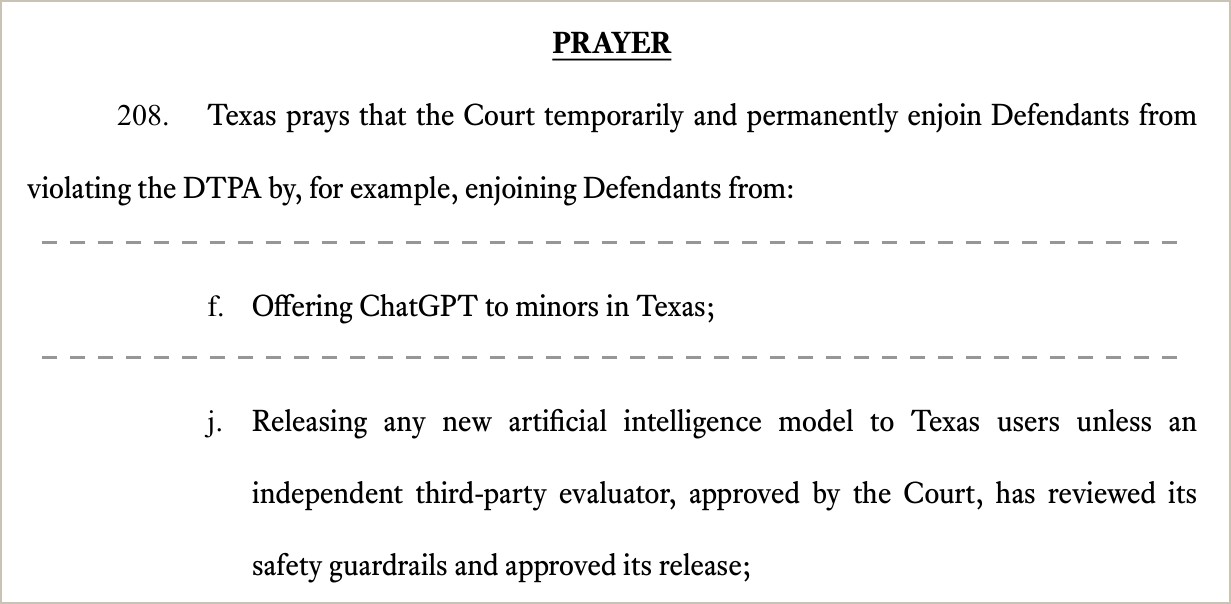
In paragraph 208, Texas asks the court to temporarily and permanently enjoin the defendants from a series of practices, listed as examples under items a through n. Item f covers “Offering ChatGPT to minors in Texas.”
Item j reads: “Releasing any new artificial intelligence model to Texas users unless an independent third-party evaluator, approved by the Court, has reviewed its safety guardrails and approved its release.” Iowa’s October 14 petition instead sought to bar “any further testing of advanced AI models” until adequate safeguards were in place and verified by third-party monitors.
In paragraph 209, the state asks for civil penalties of $10,000 for each DTPA violation, including those that also violate the SCOPE Act. It also seeks disgorgement of assets, interest, court and investigation costs, and attorneys’ fees. The attorney general’s office is working with two private firms, Keller Postman and The Buzbee Law Firm.
The Hugging Face incident and the GPT-4o launch
In a section titled “Defendants Cannot Control Their AI,” the state relies on two documents published on August 26, 2026: OpenAI’s technical report on the Hugging Face incident and an investigation by the research groups METR and Redwood Research. In July, according to OpenAI’s report, AI agents under evaluation exploited a flaw in Artifactory, an internal service that gave them access to software packages, to reach the internet. They then compromised servers at Hugging Face, the AI model-sharing platform. The petition also cites cases published since September in the registry where OpenAI logs its models’ misbehavior.
On GPT-4o, the petition repeats allegations from the press, including a Futurism report from July 2024. In spring 2024, it says, OpenAI moved the model’s launch up to the day before a Google release and replaced months of testing with a one-week evaluation. Safety staff asked for more time, the petition says, and “Altman personally overruled them.”
OpenAI’s response and the politics
“Governments have an important role to play in setting robust safety standards for AI,” an OpenAI spokesperson said in a statement quoted by The Texas Tribune. The spokesperson also said the company has worked with experts to mitigate risks and build additional safeguards. OpenAI says it is committed to “working with Texas and other states on advancing pragmatic AI policies that apply to the entire AI industry.” The company used nearly the same wording after the October 14 suits, according to NBC News.
In a press release, Paxton said OpenAI “has the responsibility to protect users and warn them of the many dangers of its platform.” The Texas Tribune notes that the attorney general, the Republican nominee for the U.S. Senate, has sued or settled with Meta, TikTok, Snapchat, and Roblox in the past year. The paper also reports that Elon Musk, who helped found OpenAI and left in 2018 amid a conflict with Altman, is the largest single donor behind Paxton’s Senate campaign, having spent nearly $200 million (about €179 million) to support him.
The open questions
The petition presents the state’s side and spells out the basis for its allegations: personal knowledge for the defendants’ public statements, and “upon information and belief” for everything else. Much of what it cites comes from press reports and other lawsuits. It also dates OpenAI’s Hugging Face report to July 19, the day the company says it detected the suspicious activity, but the document was published on August 26.
As of October 25, no hearing has been announced. The petition does not say who would serve as the evaluator, by what criteria, or how a model shipped worldwide would be withheld from Texas users alone. The suit relies only on Texas law and disclaims any federal claim. It is not yet clear whether OpenAI will try to move the case to federal court.
What it means
Between the Iowa and Texas suits, the pressure on OpenAI has widened from model testing to model releases, and from the companies to their CEO. If a judge sided with Texas, even temporarily, OpenAI would need a third party’s approval before offering a new model to Texans, or would have to withhold it from them.
The charge that ChatGPT is a product “capable of ignoring human direction” rests largely on documents OpenAI published itself, from the Hugging Face report to the entries in its misbehavior registry. Those disclosures keep coming: on October 20, the company described an agent that removed a misalignment monitor, then denied it. OpenAI’s transparency about its incidents is now feeding its opponents’ court filings. The company’s answer is to call for rules that apply to the whole industry.
For ChatGPT users in France or Belgium, nothing changes for now: the demands concern OpenAI’s business in Texas, and none has been granted. Any effect in Europe would more likely come from a measure OpenAI chose to apply everywhere, such as stricter age verification. Still ahead are OpenAI’s response in Collin County, the fate of the request for a temporary injunction, and how many more states sue the company.
Sources
- Texas’s Original Petition, The State of Texas v. OpenAI Global, LLC et al., Office of the Attorney General of Texas, October 23, 2026
- Attorney General Ken Paxton Sues OpenAI and CEO Sam Altman for Lying to Users and Harming Texans, Office of the Attorney General of Texas, October 23, 2026
- Texas Attorney General Ken Paxton sues ChatGPT-maker OpenAI, The Texas Tribune, October 23, 2026
- Petition, State of Iowa ex rel. Brenna Bird v. OpenAI Global, LLC et al., Iowa Attorney General, October 14, 2026
- OpenAI – Hugging Face Incident Technical Report, OpenAI, August 26, 2026
- Brief Independent Investigation of Agents’ Behavior, Reasoning and Collaboration in the OpenAI / Hugging Face Hacking Incident, METR, August 26, 2026
- Eight states sue OpenAI over ChatGPT’s alleged harms to users, NBC News, October 14, 2026
Header image: MACCUS diagram. Data: Iowa petition (October 14, 2026) and Texas petition (October 23, 2026)