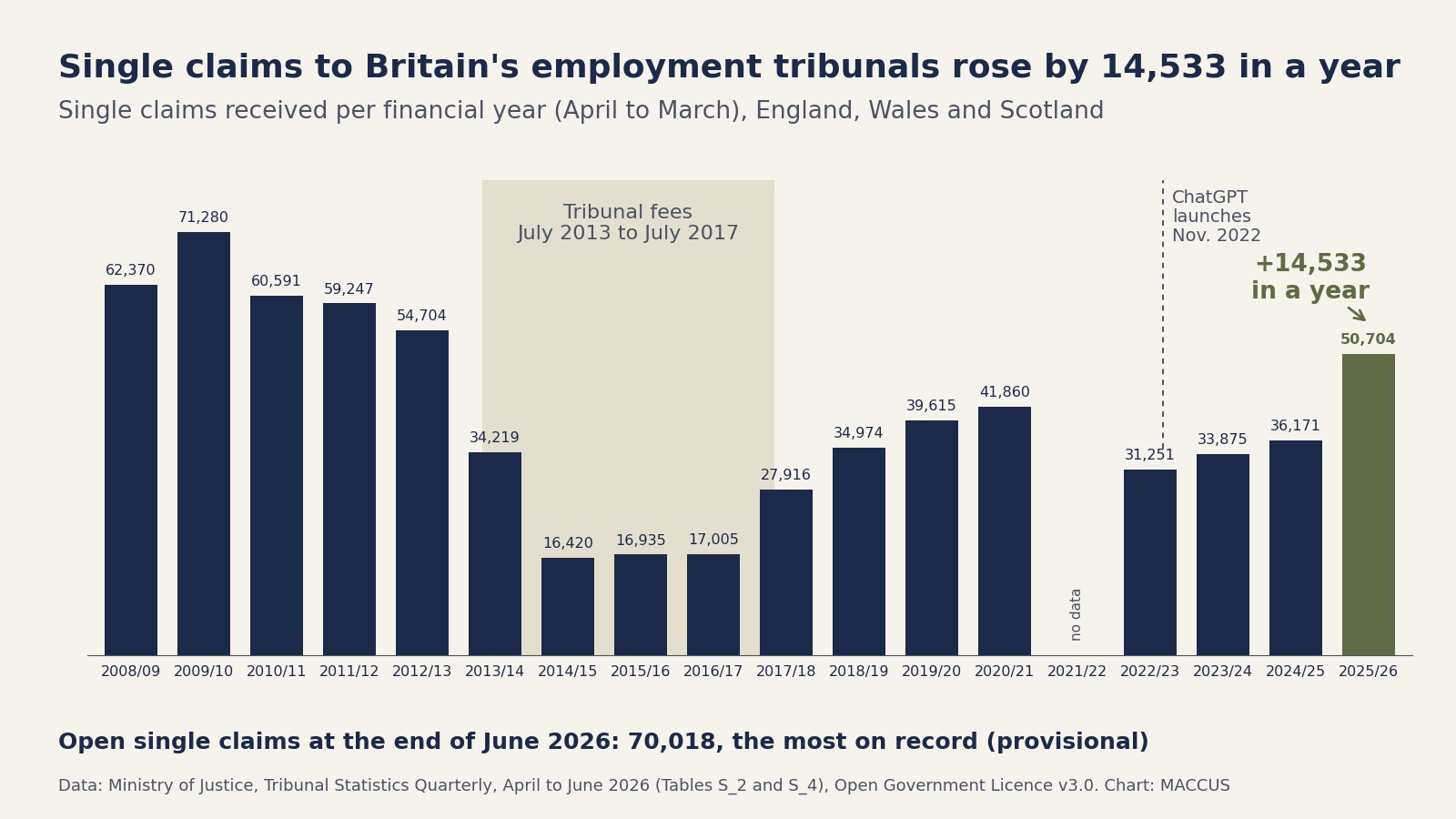

A worker in Britain who takes an employer to an employment tribunal now joins a backlog of 70,000 open claims from individual workers, the largest the Ministry of Justice has recorded, according to figures it published September 10. Individual workers filed about 50,000 claims in the 12 months through March 2026, 39% more than the year before, while the tribunals closed 12% fewer, according to the ministry’s annual figures. The two judges who lead the tribunals say many of the most urgent cases now show signs of being written with AI.
On June 22, 2026, Judge Barry Clarke and Judge Susan Walker, the presidents of the Employment Tribunals for England and Wales and for Scotland, issued guidance on interim relief, an emergency procedure. They wrote that applications had risen sharply, “largely in protected disclosure cases,” the legal term for whistleblowing, “and often indicating use of artificial intelligence.” Tribunals across Great Britain used to receive “perhaps 20 such applications a year,” they wrote. “Now most offices are receiving a similar number each month.”
That remark covers one procedure, and the ministry’s figures do not record how any claim was drafted. Local councils, the information regulator and a Sky News data analysis describe the same shift elsewhere in British public life: more complaints and requests since late 2022, longer ones, many of them drafted by machines.
From 20 applications a year to 20 a month per office
Interim relief is the tribunal’s emergency brake on a dismissal. A worker who says they were fired for whistleblowing, or for union activity, can ask a judge to give them their job back, or their full pay, until the full hearing. The claim must reach the tribunal within seven days of the dismissal. The bar is high, the guidance says, and “most applications therefore do not succeed.”
The presidents also report “a significant increase in the amount of documentation which accompanies such applications.” Because each application is an emergency, it is scheduled quickly, and other hearings are often postponed or delayed to make room. Since few of them succeed, the judges wrote, the result is “unnecessary delay to other users.” The rest of the six-page document explains, in plain terms, what a claimant has to show to win.
A record backlog
The ministry’s April to June 2026 bulletin, published September 10 and updated October 20, shows no slowdown. Single claims, those brought by one worker, rose 28% from a year earlier to 14,000 in the quarter, while the number of claims closed fell 6% to 6,100. The open caseload of single claims reached 70,000 at the end of June, up 51% in a year and “its highest level in the timeseries,” which goes back to 2007/08.
Over three years the rise is steeper. In 2022/23, the fiscal year in which ChatGPT launched, the tribunals received 31,251 single claims. In 2025/26 they received 50,704, an increase of 62% by our count from the ministry’s tables and the same figure Sky News reported on October 20.
Multiple claims, group cases brought by many workers against one employer, went the other way, falling 40% in 2025/26. The ministry also warns that the open caseload may still be overcounted by about 3% after a database change.
Councils, regulators and 200-page complaints
On October 22, the Local Government Chronicle (LGC), a trade publication for British local government, reported that Wiltshire Council attributes a 27% rise in formal complaints and a 40% jump in service requests to residents using AI tools to write to it. Deborah Evans, chief executive of Lawyers in Local Government, told the paper that “some ombudsman report receiving AI-generated complaints running to as many as 200 pages.” A resident can generate a 10-page grievance in seconds, LGC wrote, and council staff often spend hours untangling it.
On May 6, the Information Commissioner’s Office (ICO), Britain’s data protection and information regulator, published guidance for public bodies facing “an increase in the volume and complexity” of AI-generated Freedom of Information (FOI) requests, including requests that “misquote legislation.” The guidance itself warns that such requests may cite “case law that doesn’t exist.” It asks, “Does using AI make a request invalid?” and answers “Not necessarily”: a request drafted with AI must still be answered if it meets the usual legal requirements. Sweden’s government is taking a stricter line with its own staff: its offices block ChatGPT and Claude on work computers starting October 26.
Sky News technology correspondent Rowland Manthorpe put numbers on the wider trend in a report published October 20. Since ChatGPT’s launch, Sky reported, complaints to English local authorities rose 78%, written complaints to family doctors’ practices 71% and household complaints about water companies 144%. Sky also reported that Manthorpe ran 100 recent FOI requests through an AI-text detector, which flagged 89% as fully AI-written. He warned that such detectors are unreliable.
Among the tools that make paperwork at scale easier, the video’s description names AI agents “such as Meta’s Muse,” which Meta launched in Japan on October 23. In a simulation published October 15, one agent told to get a train refund emailed an MP’s office 50 times.
When filing a claim cost £1,200
Britain has already measured what the cost of filing does to the number of claims. On July 29, 2013, the government introduced tribunal fees of up to £1,200 (about $1,600 at October 23 exchange rates) for a single worker’s claim, including unfair dismissal. Single claims fell from 54,704 in 2012/13 to 16,420 in 2014/15, according to the ministry’s tables.
On July 26, 2017, the UK Supreme Court struck down the fees, finding that they prevented access to justice. The evidence before the court, its summary says, showed “a dramatic and persistent fall in the number of claims.” By 2018/19, single claims were back up to 34,974.
What the data does not show
None of these sources measures AI’s share of the rise. The word AI does not appear in either tribunal bulletin. Manthorpe said his figures do not prove that AI caused the increases, and that each service has its own causes; water companies, Sky noted, have had difficult years. The judges’ observation covers interim relief only, and says applications “often” show signs of AI use.
Single claims in 2025/26 were still below the 71,280 recorded in 2009/10, before the fees were introduced, according to the same tables. The 2022/23 starting point was itself low: single claims had reached 41,860 in 2020/21. Claim counts also do not measure merit: in the one procedure where judges described the surge, most applications fail.
What it means
The 2013 fees raised the price of filing a claim. AI lowers another cost, the skill it takes to put a grievance into formal written English. The gain goes to people who had a complaint and no lawyer, and the cost lands on whoever reads the result, whether a judge, a council employee or a complaints handler. Evans, who relayed the ombudsman reports of 200-page complaints, told LGC that “the aim should not be to restrict access to redress, particularly for vulnerable people, but to ensure that genuine complaints are not buried under unnecessary content.”
So far, the responses come from the receiving end. The ICO keeps AI-written requests valid and tells authorities they may politely correct the errors in them. Wiltshire is exploring AI tools to summarize long submissions and draft first replies under human oversight, and Durham County Council is looking at software that groups similar FOI requests. Ruth Hopkinson, a Liberal Democrat member of Wiltshire Council, told a committee meeting that “the thought of AI-generated complaints being responded to by AI-generated responses makes my blood turn cold.”
In December, the ministry publishes its statistics for July to September 2026, the first full quarter since the presidents’ guidance. Its bulletins do not mention interim relief, so the figure to compare against is the open caseload of 70,000 single claims at the end of June.
Sources
- Tribunal Statistics Quarterly: April to June 2026, Ministry of Justice (UK), September 10, 2026, updated October 20, 2026
- Tribunal Statistics Quarterly: January to March 2026, Ministry of Justice (UK), June 11, 2026
- Presidential Guidance: Applications for interim relief, Courts and Tribunals Judiciary, June 22, 2026
- How councils are fighting flood of AI-generated complaints, Local Government Chronicle, October 22, 2026
- New guidance to support public authorities dealing with AI-generated FOI requests, Information Commissioner’s Office, May 6, 2026
- Freedom of Information (FOI) and Artificial Intelligence, Information Commissioner’s Office, accessed October 25, 2026
- Why AI could overwhelm Britain’s public services, Sky News (YouTube), October 20, 2026
- R (on the application of UNISON) (Appellant) v Lord Chancellor (Respondent), UK Supreme Court, July 26, 2017
Header image: chart by MACCUS, data from the Ministry of Justice (Tribunal Statistics Quarterly, April to June 2026, Tables S_2 and S_4, Open Government Licence v3.0)