
Jason Furman, who chaired the White House Council of Economic Advisers under Barack Obama, said in an Axios interview published on October 23, 2026, that if he were running the council today and had to choose between 20 staff members “who had a combination of current Ph.D.s and future Ph.D.s” and “the AI systems that we have today,” he “would somewhat regretfully and sadly choose the AI systems.”
The Harvard professor has work to show for that view. His website lists five economics papers, each written by Claude in what he calls “a single unattended run from a brief prompt.” The day the interview ran, he launched Econvitals, a free economic data site that he says runs on about 500,000 lines of code, none of which he has read.
A paper from a two-sentence request
In August, Furman built the system behind the papers and named it Paperwright. “Someone types a topic, often a single line. From that point nobody touches the work,” he writes on the project page. Claude, Anthropic’s model, finds a question worth asking, reads the literature, gathers the data, runs the analysis and writes the paper. It then puts the draft through simulated peer review and delivers it with a replication package.
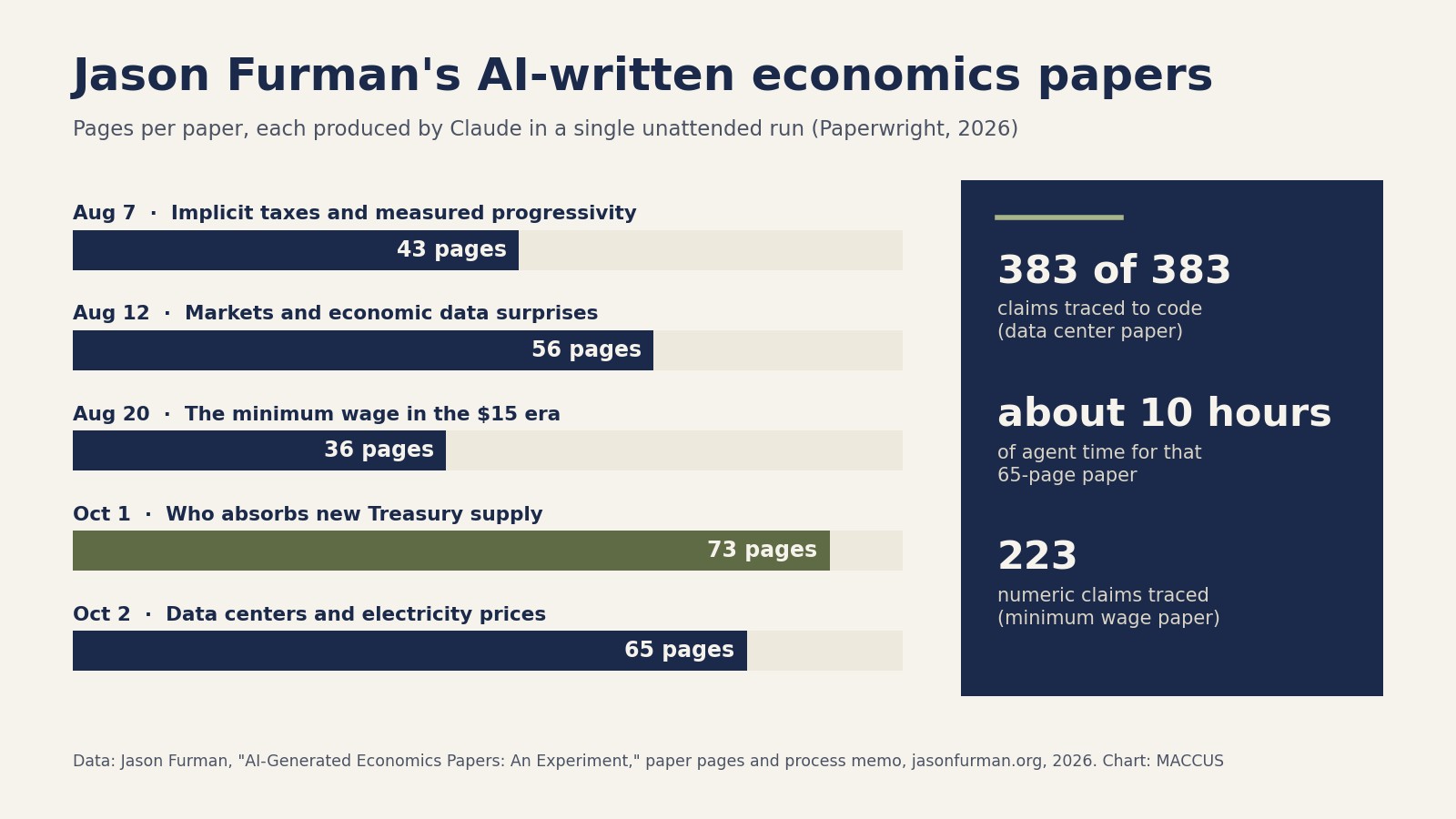
The five papers cover implicit taxes on municipal bondholders (43 pages, August 7), how financial markets react to surprises in economic data (56 pages, August 12), the minimum wage in the $15 era (36 pages, August 20), who absorbs new Treasury debt and at what cost (73 pages, October 1), and data centers and retail electricity prices (65 pages, October 2). Each one lists Claude as its author.
The minimum wage paper shows how little a human supplied. Its entire input was two sentences: “Impact of minimum wage increases on incomes, employment and poverty. Ideally use the SIPP but other data sets also most welcome instead or in addition.” The system built its analysis on 4.0 million person-months of data from SIPP, a federal household survey. The data center paper started from a brief of about 210 words.
Numbers written by code
The method page lists the safeguards. For a short request, Paperwright brainstorms eight to twelve possible papers, has three simulated referees rank them and emails the top three to the requester, who picks one (with no answer, it takes the referees’ first choice). It writes and time-stamps its analysis plan before running the main tests. From then on, one rule applies: “the writer never types a number,” and every figure in the text is a placeholder filled from the code’s output.
Over two rounds, papers in the style of the National Bureau of Economic Research go to five simulated referees who read blind, plus a reader who makes the case for the paper. Nothing goes out until every number traces to the code, every quotation matches its source word for word and every citation has been checked against a real copy.
The audits are public. Every one of the minimum wage paper’s 223 numeric claims “traces to code output.” The data center paper’s process memo reports a clean check of 383 out of 383 claims. It puts the whole job at “about ten hours of agent time, two referee rounds included,” over four attempts, two of them resumed after the system hit a usage limit.
A 484,000-line website he never read
Econvitals went live on Friday, October 23. It tracks U.S. growth, jobs, inflation, financial conditions and the federal budget in charts updated as new data come out, and it sends free email briefings.
Furman built it in his spare time, Axios reported, “with a little help from research assistants and a lot of help from Claude (with some cross-checking by OpenAI’s Codex).” On the About page he writes that there are “about 500,000 lines of code in the full system and I haven’t looked at a single one of them.” It was, he adds, “all vibe coded.”
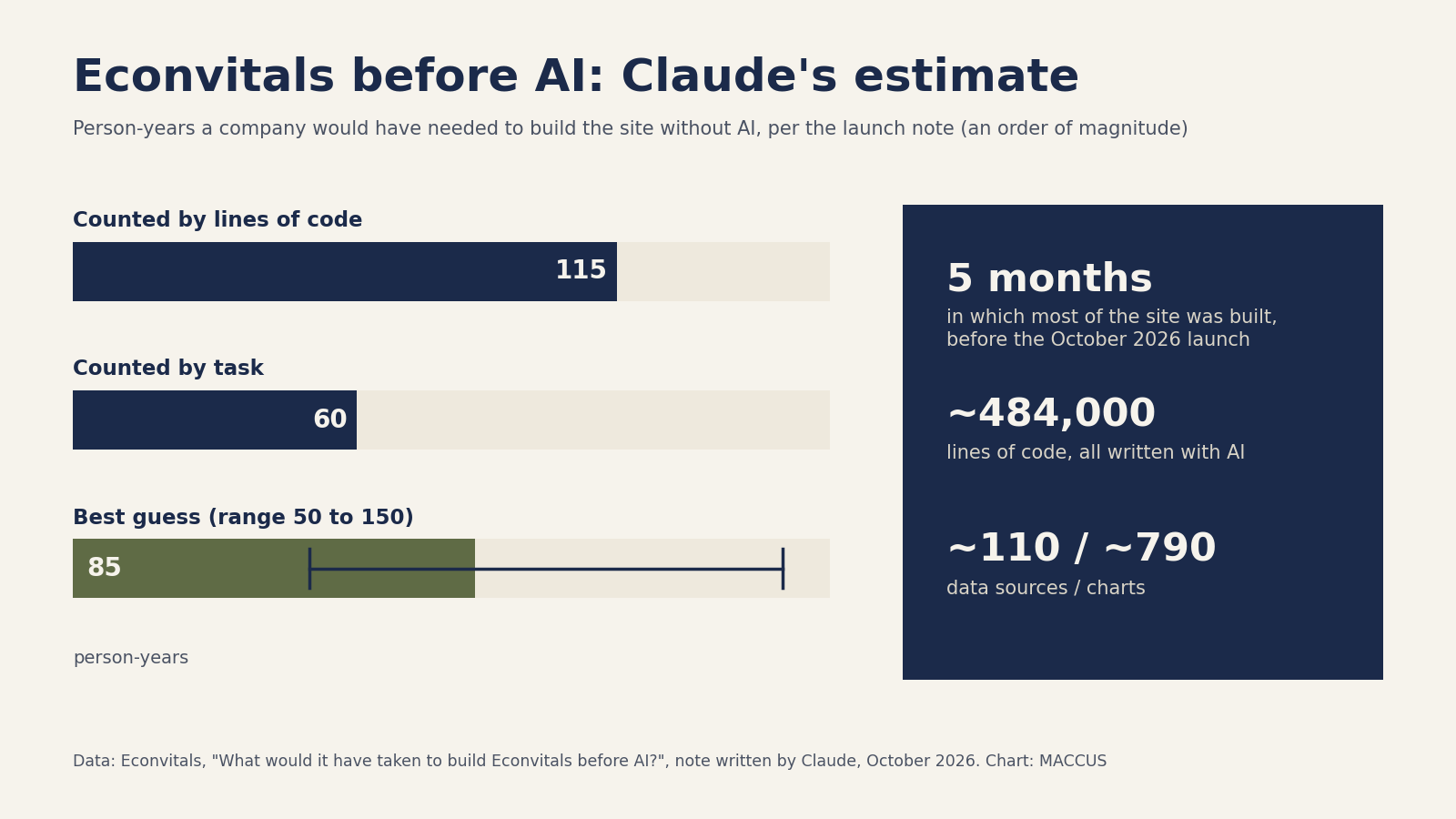
A launch note written by Claude asks what the same build would have cost before AI. It counts about 484,000 lines of code, about 110 data sources and about 790 charts, built “mostly in the five months before launch.” Counting by lines of code gives about 115 person-years; counting by tasks gives about 60.
The note settles on about 85 person-years, within a range of 50 to 150. Spread over three years, that is about 28 engineers, data scientists and analysts, or a company of 45 to 55 people once economists, managers and administrative staff are added. The build labor alone comes to roughly $20 million (range: $12 million to $38 million).
The note tells readers to “treat every number as an order of magnitude.” No outside audit has checked the estimate, which is Claude’s own.
A separate test by a Fed economist
Serafin Grundl, an economist at the Federal Reserve Board, ran a separate test that does not cover Furman’s work. In a paper dated July 9, he gave AI agents the three-stage task that 146 human research teams had completed in an earlier study: estimate how eligibility for the DACA immigration program changed the likelihood of working full time. Codex running GPT-5.4, Codex running GPT-5.3-Codex and Claude Code running Opus 4.6 each did every task 100 times.
The agents reached average estimates close to the humans’, and the human estimates had wider tails. Four AI reviewer models then compared the submissions side by side and produced the same ranking: GPT-5.4 first, GPT-5.3-Codex second, Opus 4.6 third and the human teams last. Grundl writes that he cannot rule out that the AI reviewers are biased against human work, and the paper states that it does not speak for the Board.
The limits Furman draws himself
Furman’s papers page sets out those limits plainly: “They are not verified, were not edited or reviewed by anyone, have not been submitted or published anywhere, and may contain mistakes. They are not my views.” The referees are simulated, and no journal has seen the work.
On the data center paper, all five simulated referees asked for a major revision in both rounds, and their median estimate of its odds of acceptance as it stood was about 30 percent. The memo lists open problems such as the power load of each facility, which no public record carries.
In the interview, Furman said that “in terms of factual reliability,” the systems “are at this stage, if done properly, better than any human,” and that “the hallucination idea is a combination of outdated or incompetent usage.” He added: “It is still not as creative and exciting as the best humans.” Axios called the papers “remarkably competent given how little human effort was involved.” It also wrote that they are “not the kind of output that would get a young economist tenure.”
People still have a role in the council he describes: “You would need people at CEA to interact in meetings, to talk to the press, talk to Congress.” His worry is volume. “Any idiot could write 300 papers a year now, and they’d be fine and factually correct,” he said. “But I’m hoping that people don’t write more papers but write better papers.”
What it means
Other fields saw similar results this month. A Harvard physicist produced 36 manuscripts in three months with Claude, AI found explicit counterexamples to a 1967 fusion conjecture, and former journal editors judging blind preferred AI peer reviews to top human ones. In economics, a former chief White House economist now posts complete papers that no human edited, along with their replication code and, for four of them, a process memo.
The measurable change is cost. A 65-page paper with 383 traced numbers took about ten hours of agent time. A data site that its own launch note prices at roughly 85 person-years of pre-AI work came together mostly in five months, built by one professor with help from research assistants. In Paperwright, a person still types the topic and, for a short request, can pick one of the three pitches the referees rank highest.
The next tests will happen outside his site. Paperwright never submits a paper on its own, and none of the five has gone to a journal, so no real referee has weighed in yet. Each paper is posted with the scripts and data list behind its tables, so other economists can now rerun them.
Sources
- How AI is transforming economic research and analysis, Axios, October 23, 2026
- AI-Generated Economics Papers: An Experiment, Jason Furman, papers dated August 7 to October 2, 2026
- How Paperwright Works, Jason Furman, updated October 4, 2026
- The Impact of Minimum Wage Increases on Incomes, Employment, and Poverty: Monthly Evidence from the $15 Era, Claude (Paperwright), jasonfurman.org, August 20, 2026
- Process memo, Data Centers and Retail Electricity Prices, Claude (Paperwright), jasonfurman.org, October 2, 2026
- About, Jason Furman, Econvitals, site launched October 23, 2026
- What would it have taken to build Econvitals before AI?, note written by Claude, Econvitals, October 2026
- A Comparison of Agentic AI Systems and Human Economists, Serafin Grundl, claude-code-economist.com, July 9, 2026
Header image: chart by MACCUS, data from Jason Furman’s AI-Generated Economics Papers pages and process memo (jasonfurman.org, 2026)