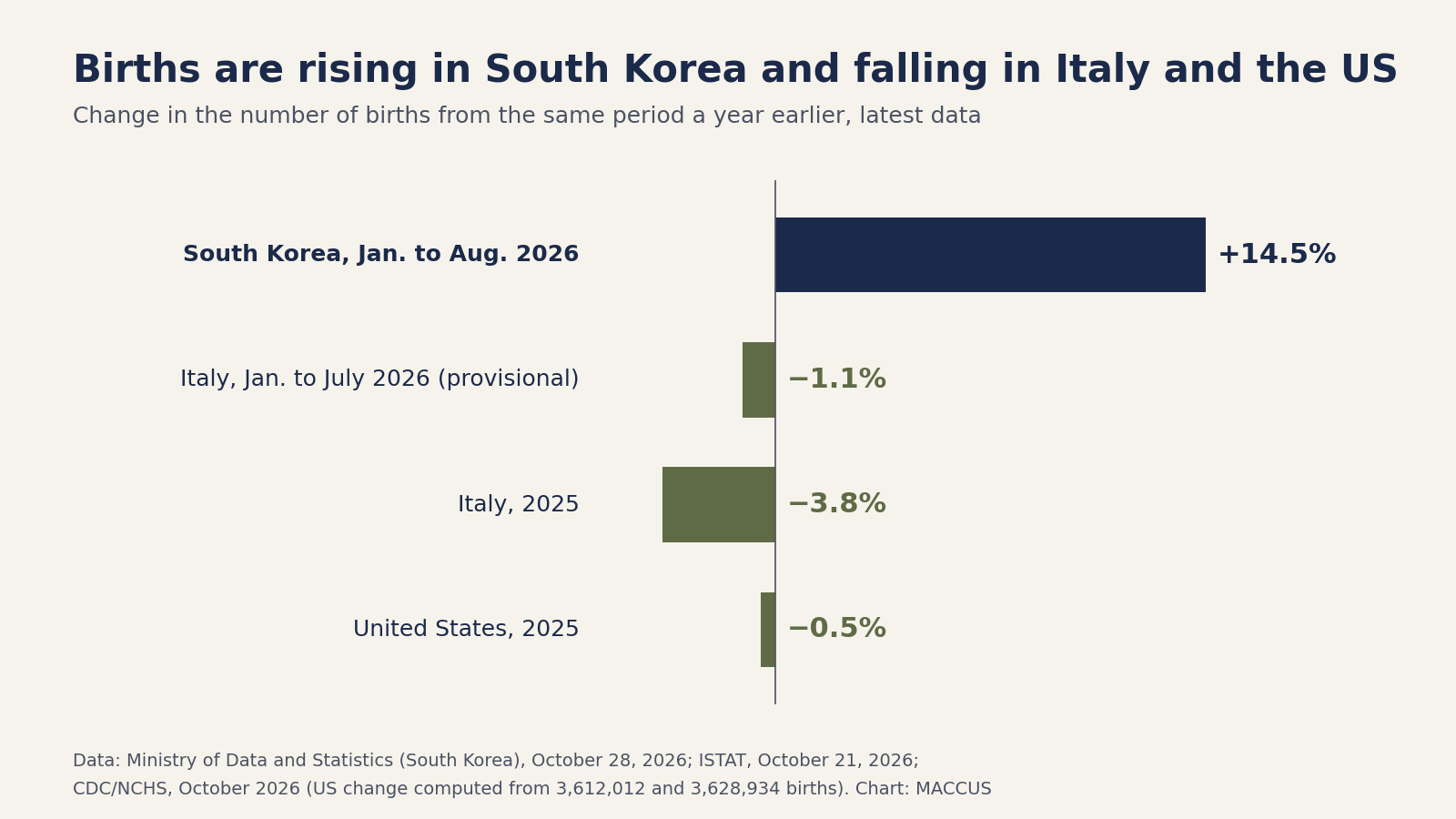
South Korea recorded 193,783 births from January to August 2026, 14.5% more than in the same months of 2025, the Ministry of Data and Statistics reported on October 28. In a country best known for its collapsing birth rate, that is the fastest January-to-August growth since the monthly series began in 1981, according to the Korean daily Segye Ilbo. Deaths still outnumber births: 6,605 more people died than were born in August, when fertility stood at 0.87 children per woman. A week earlier, on October 21, Italy’s statistics institute reported a record-low fertility rate of 1.14 children per woman for 2025, and US health statisticians confirmed a record-low general fertility rate in final 2025 data.
Twenty-six months of growth in South Korea
August alone brought 23,703 births, up 13.0% from 20,983 a year earlier and the most for any August since 2019, Yonhap reported. Births rose in every province and metropolitan city that month, the ministry said. Its monthly table shows births up year over year in every month since July 2024, 26 months in a row. Segye Ilbo notes that the streak beats the previous record of 25 months, from February 2006 to February 2008.
The annual figures show when the turn came. Births fell to 230,028 in 2023, then rose to 238,317 in 2024 and to 254,341 in 2025, up 6.7% from 2024. The total fertility rate, the number of children a woman would have at current rates, went from 0.75 in 2024 to 0.80 in 2025.
Most of the growth comes from women in their 30s. In August, women aged 30 to 34 had 79.5 births per 1,000, up from 70.6 a year earlier, and women aged 35 to 39 had 59.8, up from 51.6. Firstborns made up 63.8% of all births. The government attributes the rise to a larger number of women in their 30s, the recent jump in marriages and more positive views of marriage and children, Segye Ilbo reported.
Italy’s 355,772 births and a new low
ISTAT, Italy’s national statistics institute, counted 355,772 births among residents in 2025, down 3.8% from 2024, or about 14,000 fewer babies. The fertility rate fell from 1.18 to 1.14 children per woman, which ISTAT called “un nuovo minimo storico,” a new record low. Births are down 38.3% from 2008, when Italy recorded more than 576,000.
The decline continued into 2026 at a slower pace. Provisional data for January to July show 196,864 births, 1.1% fewer than a year earlier, and an estimated fertility rate of 1.13.
ISTAT attributes part of the drop to the size of the parents’ generation. Women now aged 30 to 40, who account for more than 65% of births, were born between 1985 and 1995, years when Italian fertility fell from 1.45 to 1.19. The institute also cites longer schooling, insecure jobs for young people, trouble finding housing, the difficulty of combining work and family, and decisions to delay or forgo having children.
Fewer births to American women under 30
The CDC’s National Center for Health Statistics published final 2025 data in October. The United States registered 3,612,012 births, down less than 1% from 3,628,934 in 2024. The general fertility rate fell 1% to 53.2 births per 1,000 women aged 15 to 44, a record low.
Every age group under 30 had a lower birth rate, and the agency puts each of those rates at a record low. The rate fell 7% for teenagers aged 15 to 19, 6% for women aged 20 to 24 and 4% for women aged 25 to 29. It rose 3% for women aged 30 to 34, 2% for those aged 35 to 39 and 1% for those aged 40 to 44.
The same shift in three countries
Read together, the three releases show births moving toward women in their 30s, and in two of the three countries the official sources tie the totals to the size of that age group. In South Korea, the government points to a bigger generation of women in their 30s, who are also having more children on average. In Italy, ISTAT points to a smaller one. In the United States, the only birth rates that rose in 2025 were those of women aged 30 to 44.
The comparison is ours: none of the three agencies mentions the other two countries.
The levels still differ widely. South Korea’s August rate of 0.87 remains well below Italy’s 1.14, and the US total fertility rate was 1.60 in 2024, according to the Congressional Budget Office. All three are below 2.1 children per woman, the level that keeps a population stable without immigration.
The limits of the rebound
South Korea still records more deaths than births. From January to August, 238,052 people died and 193,783 were born, a natural decline of 44,269. August was the 82nd straight month of natural decline, according to Segye Ilbo. Marriages, which the government counts among the drivers of the rebound, fell 1.2% in August to 19,218, though they were up 5.2% over the first eight months.
The comparison also mixes periods and measures. South Korea’s 2026 figures are monthly counts that include estimates of late registrations, and the ministry warns that they can differ from the annual figures it publishes the following year. The Italian and US records are annual rates for 2025.
The CDC adds that the change in its rates from 2024 to 2025 reflects both the number of births and new population estimates. The raw count of US births, 3.6 million, is not a record low.
What it means
South Korea has already beaten its own forecast. In December 2023, Statistics Korea (now the Ministry of Data and Statistics) published a central projection that had the fertility rate falling to 0.65 in 2025 and births to about 220,000. The actual figures for 2025 were 0.80 and 254,341. The same projection had the population dropping from 51.75 million in 2024 to 36.22 million in 2072, with about 160,000 births a year by then.
In Italy, deaths already far outnumber births, and the Congressional Budget Office expects US deaths to exceed births from 2030, after which immigration would be the only source of US population growth. None of the scenarios in ISTAT’s projections of August 31 has Italian births catching up with deaths; in the median one, births stay near 355,000 a year until 2030 and fall to 335,000 in 2050, deaths rise from 652,000 in 2025 to 708,000 in 2030, and the population drops from 58.9 million to 55.0 million by 2050. How smaller generations will fare in the job market is still open. In Japan, 98% of university graduates who looked for work had a job by April 1 this year, according to the labor and education ministries, yet in a Nikkei survey more than one large employer in five said it may take fewer graduates from 2029.
The question South Korea’s numbers raise for the next five to 20 years is whether a rebound carried by women in their 30s lasts once that generation moves past its childbearing years. The next data to watch are the ministry’s monthly releases, including the marriage count, and its provisional figures for all of 2026, due in February.
Sources
- 2026년 8월 인구동향 (출생, 사망, 혼인, 이혼), Ministry of Data and Statistics, South Korea, October 28, 2026
- 8월 출생아 2.4만명, 7년 만에 최다, Segye Ilbo, October 28, 2026
- Births up 13% in Aug. to highest in 7 years, Yonhap via The Korea Herald, October 28, 2026
- Natalità e fecondità della popolazione residente, anno 2025, ISTAT, October 21, 2026
- Births in the United States, 2025 (NCHS Data Brief No. 571), CDC National Center for Health Statistics, October 2026
- 장래인구추계: 2022~2072년, Statistics Korea via Korea.kr, December 14, 2023
- Previsioni della popolazione residente, delle famiglie e delle forze di lavoro, base 1/1/2025, ISTAT, August 31, 2026
- The Demographic Outlook: 2026 to 2056, Congressional Budget Office, January 2026
Header image: chart by MACCUS, data from the Ministry of Data and Statistics (South Korea), monthly births, January to August 2025 and 2026