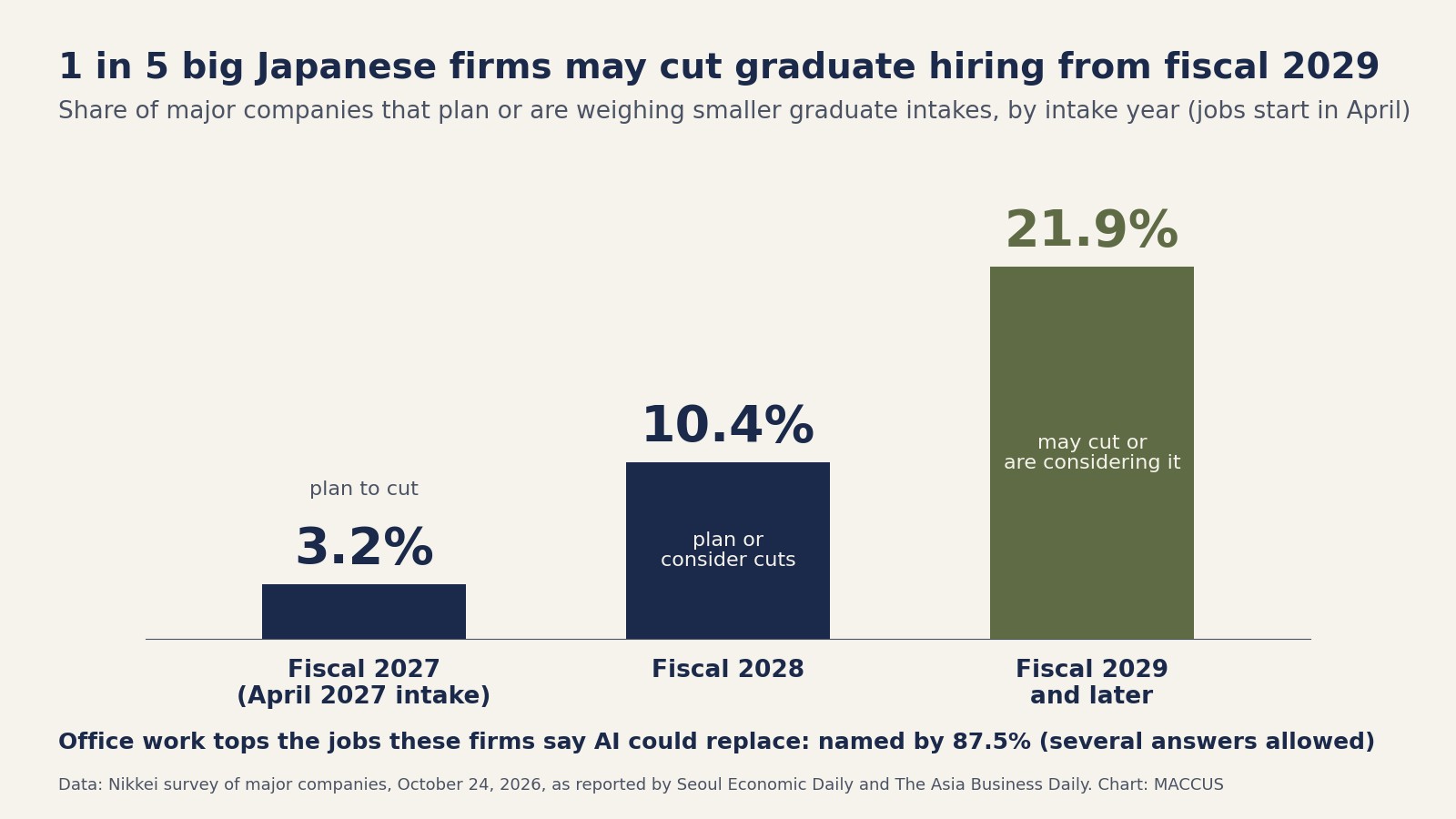

More than one in five big Japanese companies in a Nikkei survey say they may hire fewer university graduates from fiscal 2029, the April 2029 intake that today’s college sophomores would join. Office work tops the list of jobs they say AI could take over.
The figures come from Nikkei’s autumn survey of major companies, reported on October 24. Only 3.2% of the firms plan to cut graduate hiring for April 2027. For fiscal 2028, 10.4% plan cuts or are weighing them. For fiscal 2029 and later, 21.9% say they might hire fewer graduates or are considering it, according to Seoul Economic Daily and The Asia Business Daily, which both relayed Nikkei’s report that day with identical numbers.
Asked which jobs AI could replace, with several answers allowed, respondents put office work first, at 87.5%. Corporate planning and general affairs came next at 25%, level with IT and engineering roles.
Offers already fell in 23 of 42 industries
The same survey asked 1,084 major companies how many job offers they had made to graduates as of October 1, and Nikkei tallied the 931 that could be compared with a year earlier. Its October 23 report found that offers in manufacturing fell below the previous year’s hiring for the first time in six years, with marked declines in materials industries such as steel, oil and chemicals. Nikkei’s headline blames turmoil in the Middle East.
Across all industries, offers for April 2027 rose just 0.7% from the number of graduates hired this spring, and they fell in 23 of 42 industries, Nikkei reported on October 24. Offers to humanities and social science graduates went down for the first time in five years. Mid-career hiring rose 8.6%, the October 23 report added.
Nikkei describes companies moving from filling headcount to picking the people who will drive future growth. Some are hiring more. Kioxia, the flash memory maker whose chips are in demand for AI, plans to take 32.9% more graduates next spring.
Earlier surveys pointed the same way
On April 19, Kyodo News found that 25 of 111 major companies, or 23%, would hire fewer graduates in fiscal 2027 than the year before, up 11 points. It was the first time in five years that “fewer” outnumbered “more,” according to the Kyodo report carried by the Niigata Nippo. Kyodo saw the labor shortage easing and AI starting to take over tasks at some companies.
On April 28, Nikkei’s spring survey of hiring plans found that mid-career recruits made up 50.3% of planned hires for fiscal 2026, the first majority since the survey began. Nikkei called it a turning point for a hiring system built on taking in graduates and training them over many years.
In August, Nikkei reported that three megabanks, MUFG Bank, Sumitomo Mitsui Banking Corporation and Mizuho Financial Group, plan to hire a combined 2,180 graduates for April 2027, 4.8% fewer than this spring. Banks’ graduate hiring is on course for its first fall in five years, and Nikkei named two reasons: efficiency from AI and fewer young employees quitting.
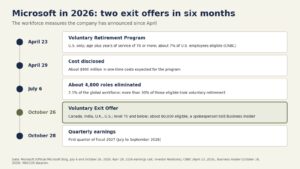
Outside Japan, Microsoft on October 26 opened a voluntary exit offer to about 60,000 employees in Canada, India, the U.K. and the U.S., a move the company does not link to AI.
Short of workers, long on office clerks
These plans come in a tight job market. Of the university students who graduated in March 2026 and looked for work, 98.0% had a job by April 1, the labor and education ministries reported in May. Public employment offices listed 1.18 openings per job seeker in August, seasonally adjusted, the labor ministry said on October 2, although new openings were 3.4% lower than a year earlier.
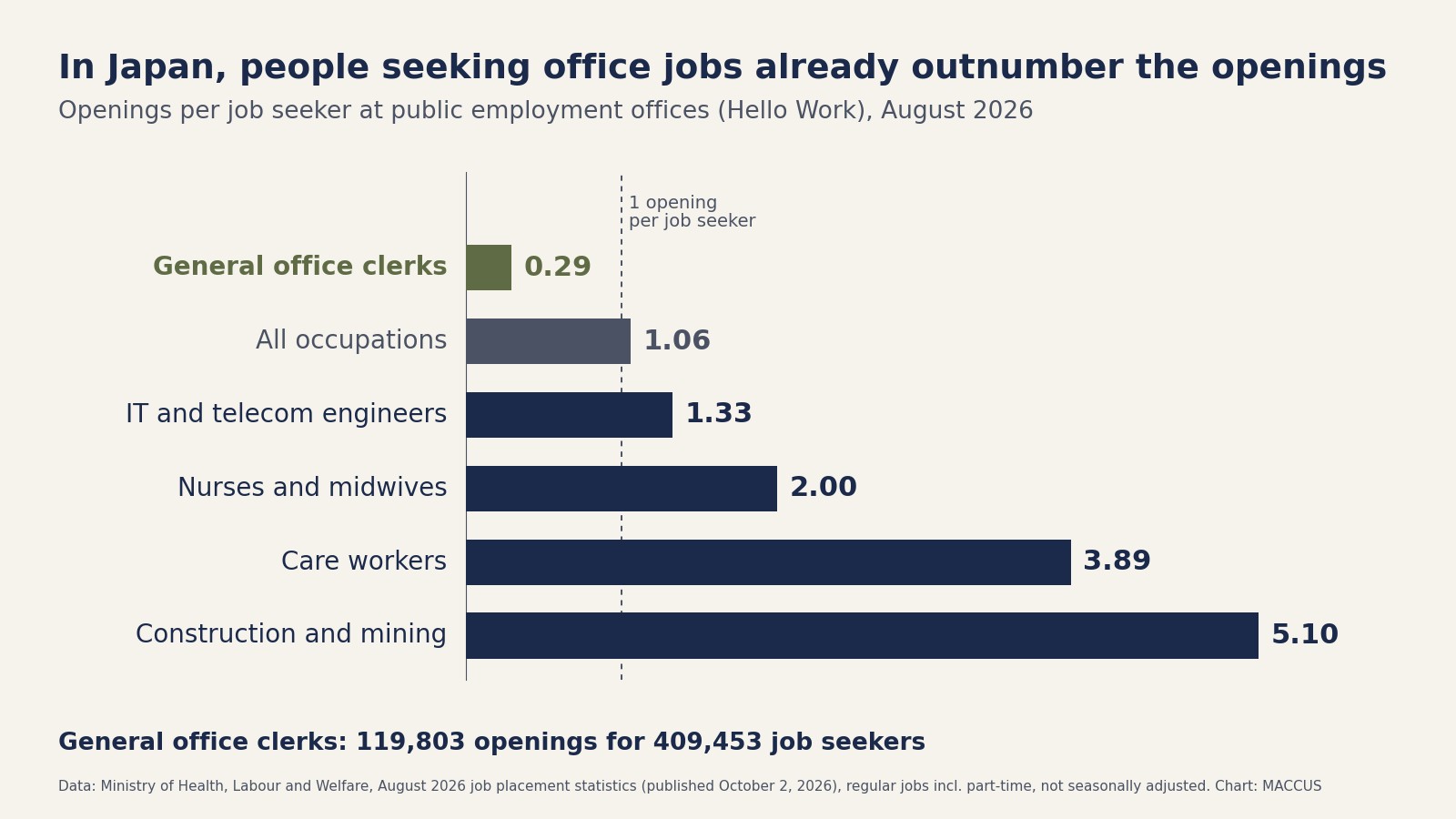
The shortage is uneven. In the ministry’s August table by occupation, construction and mining had 5.10 openings per job seeker and care workers 3.89. General office clerks had 0.29: 119,803 openings for 409,453 people looking for that work.
Office work, the job big companies now say AI could take, is already one where Japan has more candidates than openings. These public-office figures cover job seekers of all ages; graduate recruiting is counted in a separate series.
South Korea shows where the same pressures can lead, with a caveat. On August 18, the Bank of Korea said jobs held by 15- to 29-year-olds fell by 285,000 between June 2022 and June 2026, and 268,000 of them were in sectors highly exposed to AI, such as IT services and publishing, The Korea Times reported. Jobs held by people in their 50s rose by 230,000.
The bank started its count in 2022 because ChatGPT launched late that year. It said the country’s continued population decline “may have contributed significantly” and that AI “may have accelerated the trend.”
The shift shows up at individual companies too. At Anthropic, juniors fell from 27% to 9% of technical hires, and in Britain Barclays named AI among its reasons for cutting 5,000 jobs.
The survey’s limits
The survey measures plans. No layoffs are involved, and the 21.9% are companies that might take fewer graduates two or three years from now. The figure counts firms and says nothing about the number of jobs. For next spring, only 3.2% plan a cut.
The drop in offers has other causes. Nikkei ties the manufacturing fall to the Middle East, and Kyodo noted in April that instability there had made the economic outlook harder to read. Young employees are also staying longer: 31.2% of university graduates who started work in spring 2023 left within three years, down 2.6 points, the labor ministry reported on October 23. Lower turnover reduces the need for replacement hires, a factor Nikkei cited for the banks alongside AI.
Whether AI delivers the savings these firms expect is also unproven. On October 24, Apollo’s chief economist Torsten Slok wrote that AI had delivered “zero financial payoff” to US companies outside tech.
The AI figures come secondhand. Nikkei’s article is paywalled, and the reports that relayed it did not give the exact wording of the AI question or how many firms answered it.
What it means
For a country where 98% of job-seeking graduates still find work, the survey is an early signal. Most big employers have not cut yet. For next spring, 3.2% plan a smaller graduate intake, and total offers are still up 0.7%. The share that may hire fewer graduates climbs to one in five for intakes two or three years out, in a survey that also asked which jobs AI could take over.
The accelerationist reading is that AI is landing where Japan can spare the labor. With 0.29 openings per applicant in office work and 3.89 in care work, software that absorbs paperwork frees people and money for the jobs that stay empty, and for employers like Kioxia that are hiring more. The cost falls on the 22-year-old with a humanities or social science degree whose first job was often the office work now at the top of the AI list. Oh Sam-il, a researcher at the Bank of Korea, described the same pressure as “the diminishing career ladder for young people.”
The next readings are scheduled. Nikkei’s spring hiring-plan survey, which appeared on April 28 this year, will be the next look at graduate intakes. Next October’s offer count will tell whether the 10.4% became real cuts, and the ministries’ graduate employment rate, out each May, will test whether 98% holds. Together they will show whether big employers open other entry routes for graduates or simply hire fewer of them.
Sources
- 新卒内定人数、過半の23業種で減少 大卒文系は5年ぶりマイナス, Nikkei, October 24, 2026
- 製造業の新卒採用6年ぶり減 中東混乱響く、鉄鋼は2割マイナス, Nikkei, October 23, 2026
- AI Pushes Japanese Firms to Cut Graduate Hiring From 2029, Seoul Economic Daily, October 24, 2026
- AI Reshapes Hiring Landscape… One in Five Japanese Companies Considering Cuts to Hiring, The Asia Business Daily, October 24, 2026
- 銀行の27年度新卒採用5年ぶり減 AIで業務効率化、売り手市場に転機, Nikkei, August 24, 2026
- 一般職業紹介状況(令和8年8月分)について, Ministry of Health, Labour and Welfare (Japan), October 2, 2026
- 令和8年3月大学等卒業者の就職状況(4月1日現在)を公表します, Ministry of Health, Labour and Welfare and Ministry of Education (Japan), May 22, 2026
- AI-exposed sectors see sharp drop in youth employment: BOK report, The Korea Times, August 18, 2026
Header image: chart by MACCUS, data from a Nikkei survey of major companies (October 24, 2026) as reported by Seoul Economic Daily and The Asia Business Daily