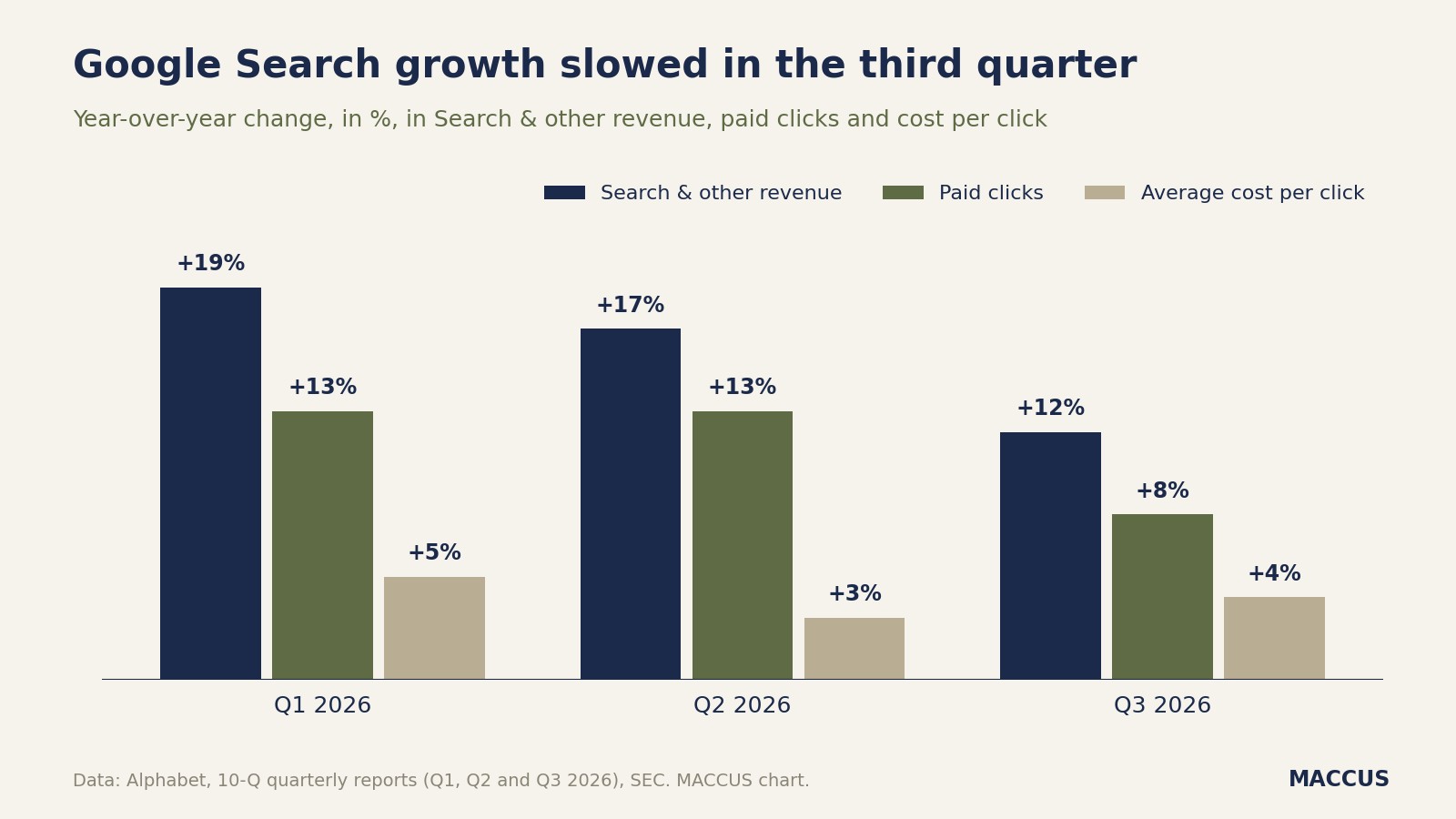

Search growth at Google slowed again in the third quarter. Alphabet, Google’s parent company, reported results on Wednesday, October 28, 2026, for the quarter ended September 30. Revenue from “Google Search & other,” the ads shown on the search engine and on Google’s other services, rose 12% from a year earlier, down from 17% in the second quarter and 19% in the first. It came to $63.35 billion, or about €56.9 billion at the European Central Bank’s October 28 reference rate ($1.1133 per euro).
On the earnings call with analysts, Chief Business Officer Philipp Schindler gave several reasons for the slowdown, led by currency. He also cited AI Mode, Google’s conversational search feature: “the strong growth in AI Mode queries had an impact because of the lower monetization we were seeing in AI Mode.” Alphabet shares fell nearly 13% the next day, their worst one-day drop since Google went public in 2004, CNBC reported.
Paid clicks are slowing
Alphabet’s quarterly 10-Q report, filed with the Securities and Exchange Commission on October 28, breaks out two metrics advertisers watch. Paid clicks on search and Google’s other services, such as Gmail, Maps and Google Play, rose 8% year over year, after rising 13% in each of the first two quarters. Average cost per click, or click revenue divided by the number of clicks, rose 4%, compared with 5% in the first quarter and 3% in the second.
In an analysis published October 29, the trade site PPC Land calculated that roughly two-thirds of the quarter’s growth came from more clicks and one-third from higher prices. It concluded that the slowdown is in click volume. Compared with the second quarter, search revenue barely moved: $63.35 billion versus $63.27 billion.
Cost per click is a worldwide average. The 10-Q says it depends in part on the mix of countries and devices, and on exchange rates. Alphabet doesn’t break these metrics out by country or for Europe; its geographic figures, for the U.S. and the EMEA region, cover total revenue only.
A week earlier, on October 21, Meta said the average price per ad on Facebook and Instagram was up 14% from a year ago, with ad revenue up 26%.
Currency, cheap parcels and the World Cup
JPMorgan analyst Doug Anmuth asked Schindler to explain a disconnect: query growth was the fastest in five years, yet search growth was slowing. Schindler first pointed to currency, calling it “the single largest driver of Search deceleration relative to Q2.” He then turned to retail, where “some of our APAC advertisers were impacted by the EU eliminating its de minimis exemption.” In media and entertainment, he said, spending normalized after a second quarter lifted by the FIFA World Cup, which had more matches, and therefore more ad budgets, in June than in July.
The exemption let parcels worth less than €150 enter the European Union free of customs duty. Council Regulation (EU) 2026/382, adopted on February 11, 2026, removed it. According to the law firm Andersen in Belgium, a temporary flat duty of €3 per item applies in some cases from July 1, 2026, to July 1, 2028, in particular to shipments declared through the IOSS one-stop shop or sent by mail. Alphabet did not quantify the impact on its revenue or name any advertisers.
Schindler mentioned AI Mode last, then added: “To be clear, we feel very good about our trajectory here.” The company’s ad experiments, he said, “have shown promising results.”
Chief Financial Officer Anat Ashkenazi pointed to another factor: tougher comparisons. Starting this quarter, search is measured against the end of 2025, when its growth accelerated. She put that effect at about 3 points of growth in the third quarter and expects it to weigh on the fourth by “a couple of points.”
Longer queries that earn less
CEO Sundar Pichai described a change in how people search: AI Mode queries are on average three times longer than traditional searches, and 1 in 5 AI Mode searches worldwide use voice, images or documents. He also spelled out the order of priorities: “Just like our shift to mobile over a decade ago, we are focused on building the best Search user experience, followed by monetization.”
Schindler described many of these queries as “upper-funnel,” meaning they come early in the buying process, and said the majority are “incremental,” or additional to existing searches. Google’s user research, he said, shows that people are comfortable with ads in these formats. He cited one data point: in AI Mode, click-through rates are already “similar” for sponsored and organic product list items.
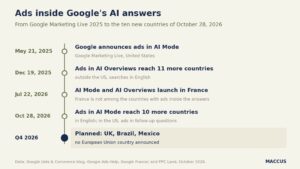
Google is leaning on those results to expand ads in AI Overviews and AI Mode. On the day of the earnings report, it brought ads in AI Mode to 10 more countries, none of them in the EU, and launched them in follow-up questions in the U.S. It plans to add more markets in the fourth quarter, including the U.K., Brazil and Mexico, according to a blog post Google published the same day.
In France, where AI Mode and AI Overviews launched on July 22, 2026, Google’s Ads Help page does not yet list ads inside their answers. A guide to AI Mode and AI Overviews explains how both work.
Fewer impressions on partner sites
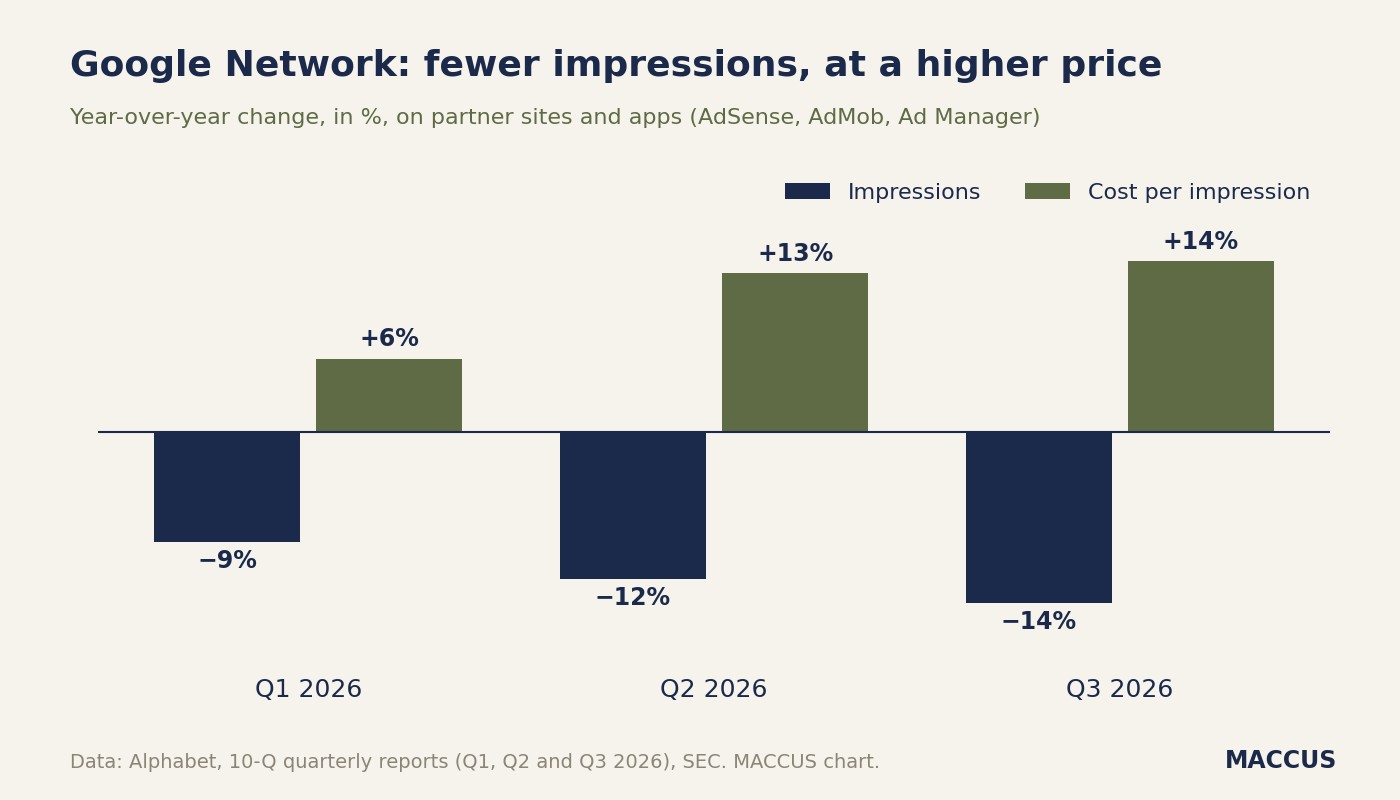
The Google Network, which covers ads placed on partner sites and apps through AdSense, AdMob and Google Ad Manager, brought in $7.46 billion, up 1%. Impressions there fell 14% year over year, while cost per impression rose 14%. The decline in impressions has deepened all year: down 9% in the first quarter and 12% in the second.
According to the 10-Q, the quarter’s small gain came from apps (AdMob), while revenue from AdSense, Google’s ad network for website publishers, declined. Since October 15, Google Ads has let advertisers cap their spending on the Display Network and search partners.
Wall Street’s verdict
The drop on Thursday, October 29, wiped out about $500 billion in market value, according to CNBC. Investors also focused on cash, the network reported: free cash flow for the quarter was negative $9.07 billion, compared with the negative $2.7 billion analysts had expected. Alphabet kept its 2026 capital spending forecast of $195 billion to $205 billion.
On the same network, Rosenblatt Securities analyst Scott Devitt took a calmer view: “I don’t think it’s a sea change.”
The missing numbers
Alphabet doesn’t disclose AI Mode revenue, its share of queries or how many ads it shows. Schindler ranked the causes of the slowdown without sizing them, currency first and AI Mode last. Only the comparison effect got a rough figure, about 3 points, from the CFO.
The click-through comparison covers only product list items in AI Mode, not text ads. Google attached no numbers to it, and its blog post says it is based on U.S. data from August 20 to September 3, 2026.
The 10-Q metrics combine search, Gmail, Maps and Google Play, and say nothing about how click prices are moving for advertisers in France or Belgium. For the fourth quarter, Ashkenazi expects a slightly larger currency headwind to consolidated revenue than in the third.
What it means
Google now publicly ties part of its search slowdown to AI Mode, and its answer is to put more ads in it. Worldwide, the 10-Q shows click volume growing more slowly than in the first half and the average price per click up 4%. That click slowdown could reflect tougher comparisons, Asia-Pacific advertisers hit by the EU customs change, the end of the World Cup boost or AI Mode, and Alphabet doesn’t say how much each one contributed. Currency moves revenue and cost per click as reported in dollars but leaves the number of clicks unchanged, and the company doesn’t publish these metrics for Europe.
Europe is a separate case. In France, AI Mode has been answering in French since July 22, with no ads inside its answers so far, according to Google’s Ads Help page. No EU country is among the announced markets, and Google has given no date for France.
Next to watch are the arrival of AI Mode ads in the U.K., the first European market on the list; any date for France; and the paid-clicks line in Alphabet’s next quarterly report, which will show whether the summer slowdown was temporary.
Sources
- Alphabet Announces Third Quarter 2026 Results, Alphabet (Form 8-K, SEC), October 28, 2026
- Form 10-Q for the quarter ended September 30, 2026, Alphabet (SEC), October 28, 2026
- Form 10-Q for the quarter ended June 30, 2026, Alphabet (SEC), July 22, 2026
- Form 10-Q for the quarter ended March 31, 2026, Alphabet (SEC), April 29, 2026
- Alphabet (GOOGL) Q3 2026 Earnings Call Transcript, The Motley Fool, October 29, 2026
- Alphabet tanks nearly 13% for worst day ever, losing $500 billion in value, CNBC, October 29, 2026
- Google ad clicks gain 8% in Q3, slower than 11% over nine months, PPC Land, October 29, 2026
- La fin de l’exemption douanière de 150 € : l’Union européenne instaure un droit forfaitaire de 3 € sur les petits colis, Andersen in Belgium, July 28, 2026
Header image: MACCUS chart, data from Alphabet (2026 10-Q reports, SEC)