Starting in December, ChatGPT Plus, Pro and Business subscribers will get a single usage allowance, counted in tokens and shared between ChatGPT and Codex, OpenAI’s coding tool. OpenAI announced the change on a help center page updated October 31, 2026. The only exemption it names is Instant chat, the fast-response mode, and it has not given a switchover date or said how much usage each plan will get.
One pool for Chat, Work and Codex
The page, “Understanding ChatGPT and Codex usage limits,” is three paragraphs long. OpenAI writes that the allowance will be shared across ChatGPT and Codex “as we bring the agentic capabilities of Work into the main ChatGPT experience.” OpenAI’s documentation describes Work, ChatGPT’s agent, as built for longer multi-step tasks and finished deliverables: documents, spreadsheets, presentations and reports.
Usage will be measured in tokens, the units of information a model processes and generates. The amount each request uses will depend on the model and the task: more advanced models and complex tasks generally cost more. Subscribers will see their combined remaining usage and reset times in Settings, under Usage. Once they hit the limit, they can wait for the reset, upgrade their plan or buy credits for eligible features.
Part of this is already in place. According to the help center, Work follows the same usage rules as Codex, and the two draw on a dedicated allowance. The new part is regular chat, which has been metered separately until now.
A line spotted on the checkout page
OpenAI has not published a blog post about the change. On October 28, a screenshot of a ChatGPT dialog titled “Chat and Work, all in one place” circulated on X. Thibault Sottiaux, who works on Codex and ChatGPT at OpenAI, quoted the post to say the team was working on it but that it was “not rolling out just yet,” and apologized for the confusion. He added that the plan was to combine the two modes’ capabilities “at some point this year” and that the team would proceed “carefully.”
On the evening of October 29, Tibor Blaho, a Vienna-based engineer who builds the AIPRM extension for ChatGPT and Claude, posted a screenshot of one sentence: “Starting in December, plan usage will have a shared limit across all of ChatGPT and Codex.” He said the line was still hidden in the legal fine print of ChatGPT’s checkout page, for a subscription billed at 23 euros a month including tax. As of November 1, the same sentence appears on the ChatGPT Business pricing page, with a link to the help article.
More usage for Pro and Business Premium on October 29
The same day, the ChatGPT release notes announced an increase in the Work and Codex usage included in Pro plans and Business Premium seats. Pro 100 and Pro 500, two of the three Pro tiers, now get twice their previous allowance. OpenAI also canceled the Pro 200 cut it had announced by email on September 29: Pro 200 subscribers still on the lower allowance now get twice their previous amount. The note says nothing about Plus or Business Standard seats.
On ChatGPT Business, Premium seats already get more Work and Codex usage and have no five-hour limit, according to the plan’s help page. Standard seats remain subject to the five-hour window. Since October 28, eligible Pro and Business subscribers have also been able to activate promotional monthly API credits.
Today’s numbers, model by model
For Work and Codex, OpenAI publishes estimates of local messages per five-hour window. On a Business Standard seat, the estimate is 5 to 45 messages with GPT-6 Astra, the most capable model, and 250 to 2,000 with GPT-5.6 Luna, the most economical one in the table. In between, GPT-6.1 Terra, launched October 26, is rated at 35 to 285 messages. A separate guide to OpenAI’s GPT models explains what each family is for.
For Plus, the Codex pricing page lists the same ranges as for a Business Standard seat: 5 to 45 messages for Astra, 250 to 2,000 for GPT-5.6 Luna, and 350 to 3,000 for GPT-6 Luna, a model missing from the table on the Business help page. The pricing page warns that weekly limits may also apply.
These figures describe the current setup. No table yet says how many ordinary conversations will fit in December’s shared pool. The Business help page itself notes that a fixed number of messages is not a reliable measure of remaining usage.
Subscribers worry about chat counting against the limit
On Reddit, about ten threads went up on October 31, mostly in the evening, in subreddits devoted to ChatGPT, OpenAI and AI in general. A Plus subscriber who uses ChatGPT for fiction writing said they chose the plan for what looked like unlimited use. A developer said they kept general research in ChatGPT so it would not eat into their Codex quota. Others expect image generation to draw on the pool too, a point OpenAI has not addressed.
Several subscribers say they received an email from OpenAI about the change on the evening of October 31. OpenAI has not posted that email on its own pages.
The promises and the gaps
OpenAI says it expects most users won’t have to wait for their usage to reset more often than they do now. The page offers no figures to back that up: no per-plan allowance and no exact date in December.
The page says Instant chat “will not draw from your usage,” but does not call it unlimited. OpenAI’s Business help page describes “virtually unlimited” access to Instant, subject to safeguards against misuse. That page also says ChatGPT can add reasoning on its own while Instant is selected, and that this reasoning may then use the reasoning allowance.
As of November 1, the Business help page still states that Chat allowances are separate from Work and Codex usage. It describes the current setup and does not yet mention the December change.
The scope is unclear. OpenAI’s page on the shared limit names Plus, Pro and Business. It says nothing about the Free and Go plans, Enterprise or Edu, or how files, voice and images will be handled.
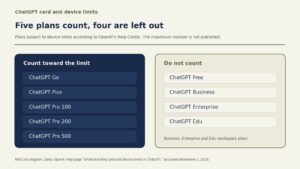
A separate help page, updated October 30, also caps paid ChatGPT subscriptions per payment card and per device.
What it means
ChatGPT currently runs separate meters: reasoning messages and Pro models in chat on one side, Work and Codex on the other. In December, a single token-based pool will replace them. A subscriber who uses both reasoning chat and the Work or Codex agent will see the two compete for the same allowance. Someone who sticks to Instant shouldn’t notice anything if OpenAI’s promise holds, except when ChatGPT adds reasoning on its own.
Anthropic already works this way: according to its help center, the limits on the Claude Pro, Max and Ultra plans are shared across the Claude app and Claude Code. On October 30, Anthropic also removed the five-hour limit for verified Ultra accounts. Both companies are moving toward one shared pool for chat and agent work, although Anthropic keeps a separate weekly Fable limit on Max and Ultra. They set their top tiers apart by the size of that pool and by the absence of a five-hour window, as on verified Ultra accounts and Business Premium seats.
The biggest unknown is volume. A token-based allowance makes the cost of each request variable: the same question will cost more with Astra than with Luna, and a long Work task will use more than a short one, as the Business help page points out. Until OpenAI publishes the allowance for each plan and how many tokens a reasoning chat message is worth, nobody can say whether a Plus subscription will cover as much work in December as it does in November.
The switchover date and the per-plan numbers in Settings, under Usage, are the next things to watch. Another open question is whether Plus and Business Standard will get an increase like the one Pro plans and Business Premium seats received on October 29. OpenAI also has yet to update the Business help page, which still describes two separate pools.
Sources
- Understanding ChatGPT and Codex usage limits, OpenAI (Help Center), updated October 31, 2026
- ChatGPT Business pricing, OpenAI, accessed November 1, 2026
- ChatGPT release notes, OpenAI (Help Center), October 29, 2026 entry
- ChatGPT Business models and limits, OpenAI (Help Center), accessed November 1, 2026
- Codex Pricing, OpenAI, accessed November 1, 2026
- Thibault Sottiaux’s post on merging Chat and Work, Thibault Sottiaux on X, October 28, 2026
- Screenshot of the ChatGPT checkout notice, Tibor Blaho on X, October 29, 2026
- Use Claude Code with your Pro, Max, or Ultra plan, Anthropic (Help Center), accessed November 1, 2026
Header image: MACCUS chart, data from OpenAI (help page “ChatGPT Business models and limits,” accessed November 1, 2026).