
OpenAI now limits how many paid ChatGPT subscriptions can be tied to the same payment card or the same device. On a Help Center page updated October 30, 2026, the company files both caps under its “privacy and security protections.” The device limits cover the Go, Plus and Pro plans. OpenAI has not published how many subscriptions are allowed or when the caps take effect.
Two caps, two error messages
The first cap applies at checkout. If too many subscriptions are already associated with the card or device, ChatGPT may block the purchase with the message “Too many subscriptions associated with this card or device. We can’t complete this purchase.” According to OpenAI, that message does not mean the bank declined the payment.
The second cap limits how many paid accounts can be used on one device. Past that point, the user sees “Device limit reached” and can no longer use that paid account on that device. The warning can appear at sign-in, or after a later check that signs the account out, even if the purchase went through and the account worked at first.
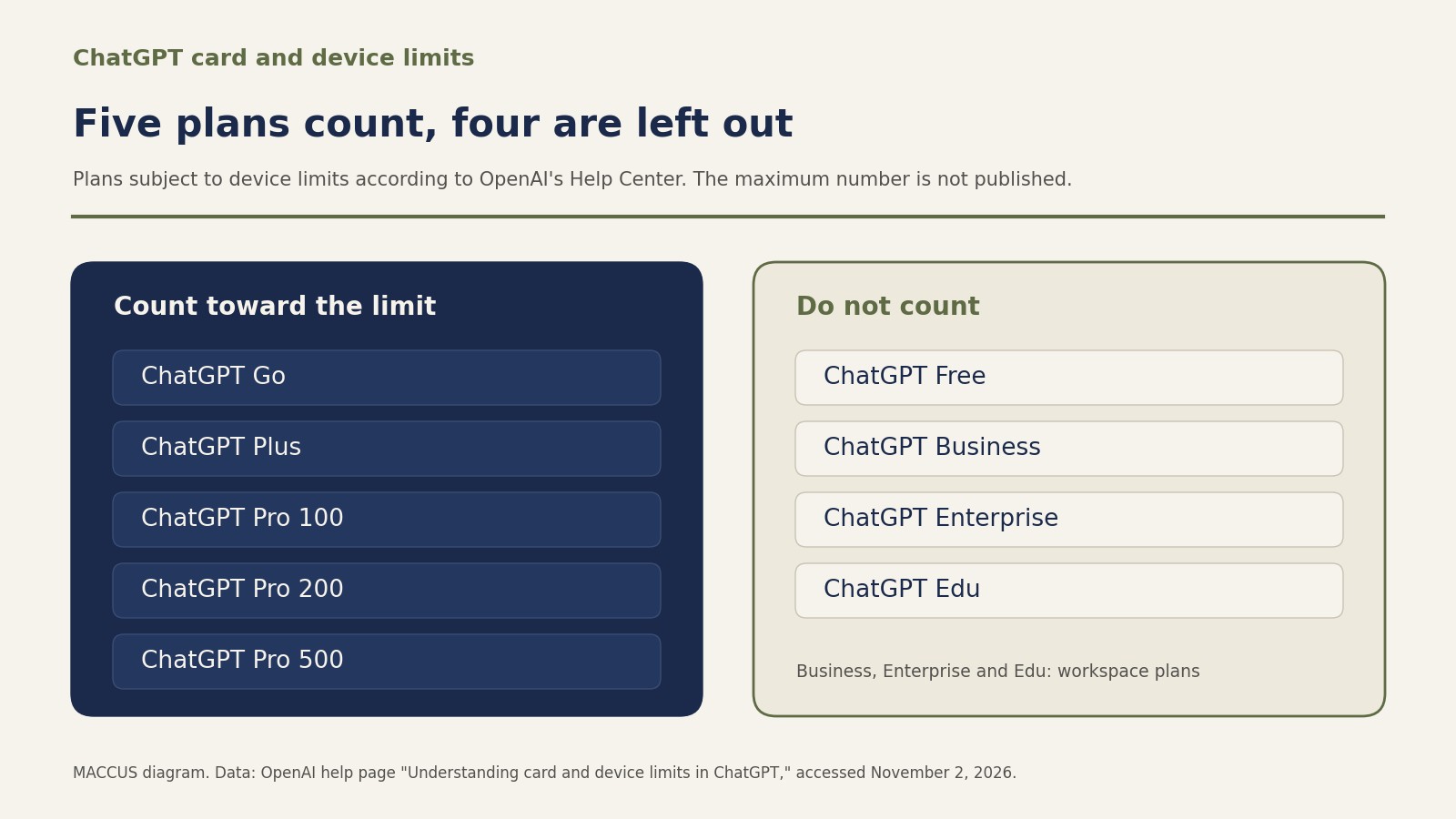
Five plans count toward the limit
The device limits apply to ChatGPT Go, Plus, Pro 100, Pro 200 and Pro 500. The free tier and the Business, Enterprise and Edu workspace plans do not count toward the limit.
The page distinguishes this cap from the number of accounts signed in at once. OpenAI’s account switcher, available on the web and rolling out on iOS and Android, lets people stay signed in to as many as two ChatGPT accounts and switch between them. Signing out of one account does not guarantee that another paid account becomes usable on the device.
Subscriptions bought before the restrictions apply can continue under an exception. OpenAI warns that a canceled subscription may not be replaceable.
Shared cards and shared devices
The page also covers unexpected restrictions. When several people pay with the same card, the card can hit the checkout limit even if each of them uses a different device. A device shared by a household, or one in a public place, can likewise hit the device limit when each person signs in to a separate account.
In those cases, OpenAI asks users to request a review from Support. The request should say that the card or device is shared and include only the details of the user’s own account. According to the company, a blocked purchase or a device warning does not on its own mean that someone else accessed the account.
When an account is blocked after payment, the page offers two ways out: sign in to another permitted account, or request cancellation and a refund. For subscriptions billed through ChatGPT or Google Play, paid access ends as soon as the cancellation goes through, and the request can affect several subscriptions on the account. Apple purchases are canceled and refunded through Apple.
OpenAI points to credits and resets
For subscribers who need more usage, OpenAI suggests looking at the options on the account they already use: buying credits or paying for a usage reset. Credits cover usage beyond the included limits on features such as ChatGPT Work, Codex (OpenAI’s coding tool) and the Word, Excel and PowerPoint add-ins. According to the page, they do not unlock models outside the plan, combine subscriptions or move usage between accounts. These usage credits are separate from the monthly API credits that eligible Pro and Business subscribers have received since October 28.
The paid reset, open only to Plus and Pro personal accounts, immediately restores Work and Codex usage for both the five-hour window and the week. OpenAI says it pulls the normal weekly allowance forward rather than adding a new one. Neither credits nor resets lift a card or device restriction. The help pages list no prices and say that amounts vary by account, region and plan.
A rule that seems aimed at account stacking
OpenAI does not say what behavior the rule targets. Matthias Bastian of the tech news site The Decoder covered the page on November 1. In his view, the rule will likely hit users who switch between several paid accounts on one device to squeeze more usage out of cheap flat-rate subscriptions. He argues that the alternatives OpenAI promotes, credits and resets, generally cost more than an extra subscription.
At least one multi-account manager has already been asked to adapt. The request was opened on October 31 in the GitHub repository of Cockpit Tools (about 19,600 stars), an account manager for Codex and other coding tools. The author wants the tool to flag the “Device limit reached” message clearly. It also asks that the tool make clear, if no official method exists, that deleting an account locally is no guarantee the slot is freed on OpenAI’s side.
No thresholds on the page
The page gives neither the number of subscriptions a card can carry nor the number of paid accounts a device can use. It gives no start date for the restrictions, even though it mentions an exception for subscriptions bought before them. Nor does it explain how ChatGPT identifies a device.
The stated rationale is general. OpenAI ties the limits to its privacy and security protections without naming the risk they address. In the same document, the company points users to its paid options for more usage.
What it means
Until now, OpenAI mostly capped how much usage each subscription included. It now also caps how many subscriptions one card or one device can hold. The practice The Decoder describes, stacking several paid accounts on one device to stretch the limits, becomes unreliable: a paid account can be signed out after the fact, and the way out runs through cancellation.
The rule also reaches two cases the page itself names: a card shared by several people and a shared device. A team that pays for several individual Plus subscriptions with the same company card fits the first case, even when each person works on a separate device. Business, Enterprise and Edu workspaces stay outside the count, so the device limit applies only to personal plans.
Timing matters. The page came out about a month before the shared, token-based ChatGPT and Codex allowance planned for December. Both changes should narrow the room for people who stacked flat-rate subscriptions, and both steer extra demand toward credits. On October 30, the day the page was updated, Anthropic moved the other way on its most expensive individual plan by removing the five-hour limit for verified Ultra accounts.
Still unknown: the numbers behind both caps, when they start applying to new subscriptions, and how Support will handle shared cards. Another open question is whether OpenAI will show these thresholds under Settings > Usage, where the December shared allowance is due to appear.
Sources
- Understanding card and device limits in ChatGPT, OpenAI Help Center, updated October 30, 2026
- Using multiple ChatGPT accounts on web and mobile, OpenAI Help Center, accessed November 2, 2026
- Using Credits for Flexible Usage in ChatGPT (Personal plans), OpenAI Help Center, accessed November 2, 2026
- Paid weekly Work and Codex rate limit resets, OpenAI Help Center, accessed November 2, 2026
- OpenAI is steering ChatGPT users toward more paid usage, The Decoder, November 1, 2026
- [Feature Request][Codex] 适配 ChatGPT 付费账号设备数量限制:占位状态识别与账号清理, Cockpit Tools on GitHub, October 31, 2026
Header image: MACCUS diagram, data from OpenAI (help page “Understanding card and device limits in ChatGPT,” accessed November 2, 2026).