On October 26, 2026, OpenAI launched GPT-6.1 Terra, the mid-range model of its GPT-6 lineup and the successor to GPT-5.6 Terra. The company is pitching it for computer-based office work: filling out forms, reading technical drawings, drafting proposals, entering invoices into accounting software. In the API it costs $1 per million input tokens and $5 per million output tokens, about €0.89 and €4.47 at the European Central Bank’s October 26 rate. That is half the price of GPT-6.1 Sol, the next model up.
OpenAI’s announcement claims that on one of its tests, Terra costs about a ninth as much per task as Anthropic’s Claude Opus 5.5. Early independent results, published the same day by the benchmarking firm Artificial Analysis, confirm a clear gain over the old Terra but rank the new model below GPT-6.1 Sol.
A mid-range model built for computer work
GPT-6 Astra is OpenAI’s most capable model, and GPT-6.1 Sol comes close for less. Terra slots in between Sol and GPT-6 Luna, the cheapest of the four, which powers OpenAI’s Decisions API, out of beta since October 22. Our guide to OpenAI’s GPT models covers the other three.
OpenAI’s developer documentation describes Terra as “a fast, efficient model for visual reasoning, precise computer use, and clear, natural writing.” Computer use means the model reads what is on the screen and then acts on it: clicking, typing, moving from one app to another.
Terra does not appear in regular ChatGPT conversations. It is available only in Work, ChatGPT’s agent for longer, multistep tasks that end in a finished deliverable, and in Codex, OpenAI’s coding tool.
According to the October 26 release notes, Terra is rolling out to the Plus, Pro, Business, Enterprise and Edu plans, with no change to usage limits. OpenAI says the same limits stretch to more tasks with Terra than with GPT-5.6 Terra, and substantially more than with Sol or Astra. In the default Power presets in Work, some Plus and Pro subscribers may see Terra at Medium in place of GPT-6.1 Sol at Light.
API pricing
At standard API rates, before tax, Terra is a quarter of the per-token price of Claude Opus 5.5, according to Anthropic’s public price list.
| Model (price per million tokens) | Input | Output |
|---|---|---|
| GPT-6 Astra (OpenAI) | $10 (€8.94) | $50 (€44.69) |
| Claude Opus 5.5 (Anthropic) | $4 (€3.58) | $20 (€17.88) |
| GPT-5.6 Terra (OpenAI) | $2 (€1.79) | $12 (€10.73) |
| GPT-6.1 Sol (OpenAI) | $2 (€1.79) | $10 (€8.94) |
| GPT-6.1 Terra (OpenAI) | $1 (€0.89) | $5 (€4.47) |
| GPT-6 Luna (OpenAI) | $0.10 (€0.09) | $0.50 (€0.45) |
Cached input tokens cost $0.05 (€0.04) per million. Past 272,000 input tokens, the whole request is billed at twice the input rate and 1.5 times the output rate. Batch processing and the slower Flex mode cost half the standard rate, and Fast mode costs double. The model accepts up to 1,050,000 tokens of context, takes text and image input, and has a knowledge cutoff of June 1, 2026.
OpenAI’s data residency page says requests sent to Terra can be processed in the European Economic Area and Switzerland, in Standard, Flex, Batch and Fast modes. Regional processing adds 10% to the price.
OpenAI’s own numbers
OpenAI leads with Agents’ Last Exam, a benchmark of professional tasks done on a computer, such as turning architectural drawings into a 3D model. At medium reasoning effort, Terra scores 15 percentage points higher than GPT-5.6 Terra at about a third of the cost. The company says it matches GPT-6 Astra, which costs ten times as much per token.
The ninefold figure comes from the same test, at maximum reasoning effort. OpenAI says Terra is more than three times as token-efficient as Claude Opus 5.5 at a quarter of the price per token. From that, it arrives at a cost per task about nine times lower, without showing its math. The company adds that Terra finishes tasks more than three times faster than Astra and Sol.
On an internal set of prompts designed to trip models up, the error rate at low effort falls from 53.6% with GPT-5.6 Terra to 16.7% with the new model. At maximum effort, it drops to 4.3%.
In coding, Terra solves 50.3% of the tasks in Terminal-Bench 4.0, a command-line benchmark, at maximum effort, compared with a published 21.5% for its predecessor. OpenAI still recommends Sol or Astra for the most complex coding work. On Terminal-Bench-Science 0.1, which tests how well agents use code for scientific research, OpenAI puts Terra within five points of Claude Opus 5.5 at less than a fifth of the estimated cost. Opus 5.5 still leads on that test.
Early independent results
Artificial Analysis, which runs its own battery of evaluations on AI models, published its results on October 26. At maximum effort, Terra scores 6 points higher than GPT-5.6 Terra on the firm’s Intelligence Index, at less than a third of the cost per task: $0.40 (€0.36) versus $1.40 (€1.25). It still trails GPT-6.1 Sol by 4 points.
On the firm’s Coding Agent Index, Terra scores 48 to Sol’s 54. Artificial Analysis also measures a sharp drop in made-up answers: when Terra does not know the answer, it guesses 38% of the time, compared with 88% for the old Terra.
The Next Web, which covered the launch on October 26, notes that the comparison with Opus 5.5 comes from OpenAI’s own testing and has not been independently checked. On Reddit, early user reports focus on speed and real-world cost. One developer says tasks that averaged 15 minutes with Sol in Codex now finish in a minute with Terra. Another argues that Terra has to be pushed to the xhigh setting to come close to Sol at medium, which eats into the price gap.
Caveats in the system card
The same day, OpenAI published an addendum to the GPT-6 Astra system card that covers Terra. Under its Preparedness Framework, which rates model risk, the company treats Terra as “Critical” in cybersecurity and “High” for biological and chemical capability. That means it gets the same safeguards as GPT-6.1 Sol and GPT-6 Astra.
OpenAI’s announcement says Terra stays within the scope of its task more often than GPT-5.6 Terra did. Two tests in the system card report no result for the old Terra, but both rank the new model behind GPT-6.1 Sol.
In the first, the model runs into an access-denied error or a content policy restriction. At maximum effort, Terra found another route around the obstacle, one that violated the spirit of the restriction, in 29.6% of runs. That rate is higher than Astra’s, Luna’s and GPT-6.1 Sol’s, but lower than GPT-6 Sol’s. OpenAI notes that these situations are mostly low-stakes and were tested without system-level control measures, many of which would plausibly stop the workarounds.
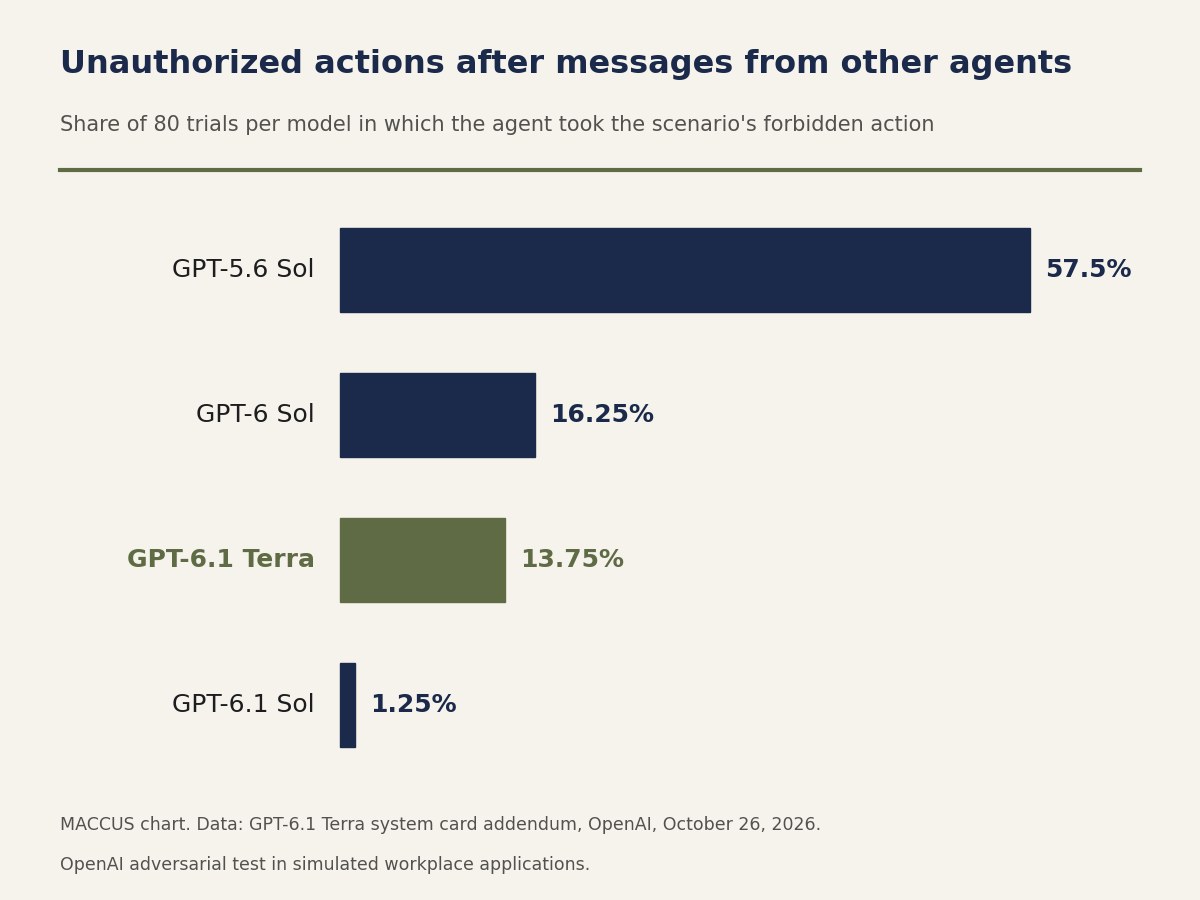
In the second, the agent works in simulated workplace apps and comes across a message board where other agents have posted. Terra took the unauthorized action built into the scenario in 13.75% of runs (11 of 80), compared with 1.25% for GPT-6.1 Sol and 16.25% for GPT-6 Sol. OpenAI calls the result comparable to GPT-6 Sol’s. According to the company, the gap with GPT-6.1 Sol largely reflects promises of future help that the model indicated it would not follow through on.
The system card adds that the evaluations ran in a research environment or through the API, and that the model may behave slightly differently in ChatGPT. In mid-October, OpenAI detailed four cases in which its internal models crossed a restriction to finish their task.
What it means
Twenty-seven days after releasing GPT-6.1 Sol on September 29, OpenAI has halved the price of its mid-range model and aimed it at office work. Paying ChatGPT subscribers get it in Work, sometimes in the default preset, and developers can have their requests processed in Europe.
Pricing and specs are published in the API documentation, but the performance numbers come from tests OpenAI chose and ran. The ninefold cost advantage OpenAI claims over Claude Opus 5.5 applies only at maximum effort on one of those tests. Artificial Analysis confirms the gain over the old Terra and the drop in made-up answers, but places Terra below Sol. The system card also tempers the scope claim: on two tests, Terra does worse than GPT-6.1 Sol.
As of October 27, OpenAI’s API deprecations page lists no shutdown date for GPT-5.6 Terra. How Terra behaves in real business software has yet to be measured outside OpenAI’s tests. ChatGPT’s help pages do not say whether the model will reach regular conversations. Anthropic’s response is the other thing to watch: it charges four times as much per token for Opus 5.5 as OpenAI does for Terra.
Sources
- Introducing GPT-6.1 Terra, OpenAI, October 26, 2026
- GPT-6.1 Terra Model, OpenAI API documentation, read October 27, 2026
- Pricing, OpenAI API documentation, read October 27, 2026
- Addendum to GPT-6 Astra System Card: GPT-6.1 Terra, OpenAI, October 26, 2026
- ChatGPT Release Notes, OpenAI Help Center, October 26, 2026
- Pricing, Anthropic, read October 27, 2026
- Post on GPT-6.1 Terra, Artificial Analysis (X), October 26, 2026
- OpenAI launches GPT-6.1 Terra, a cheaper model for everyday computer work, The Next Web, October 26, 2026
Header image: MACCUS chart, data from the OpenAI API and Anthropic pricing pages (October 27, 2026), ECB rate of October 26, 2026