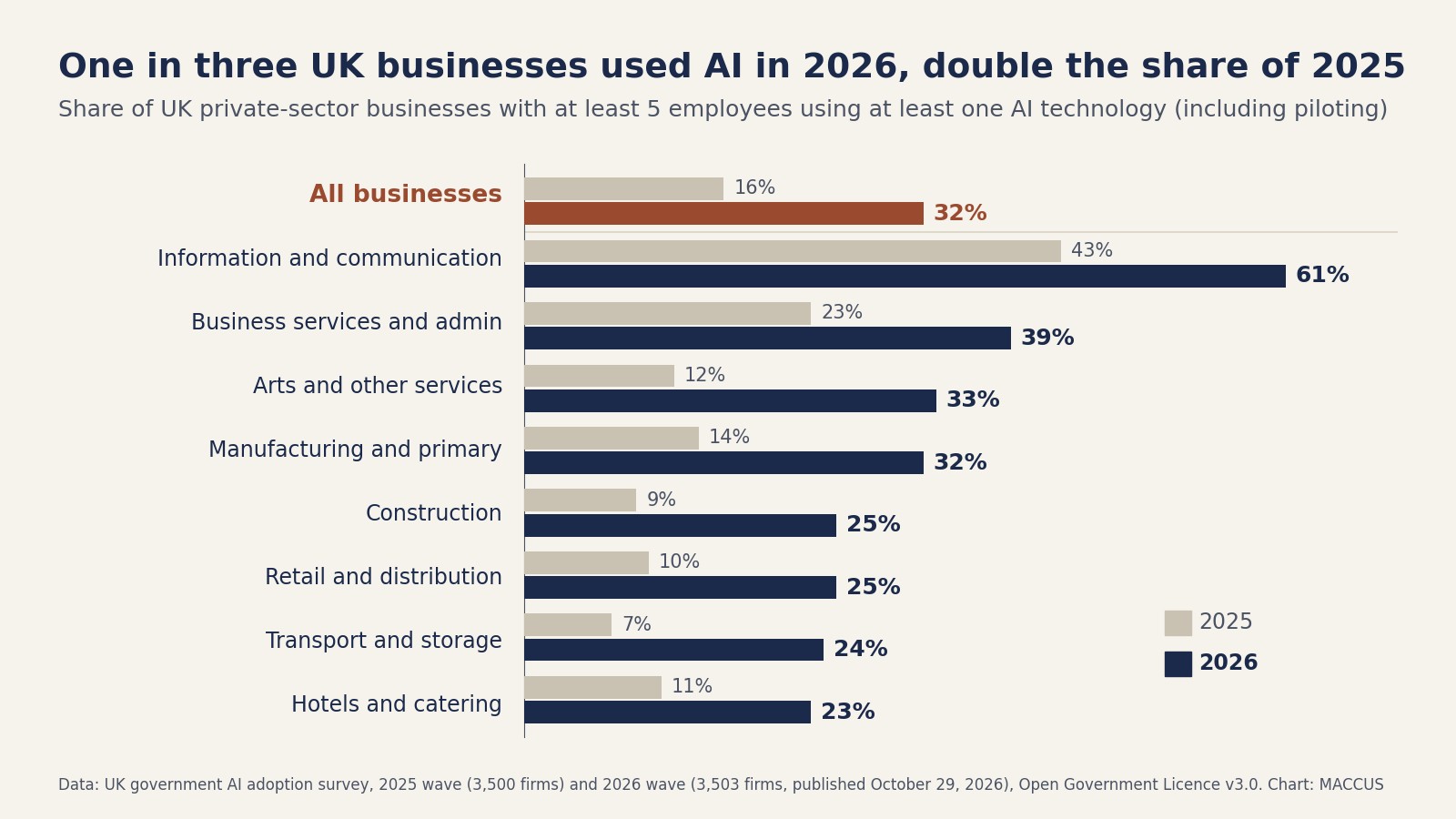

In the first months of 2026, one in three British companies with at least five employees was using some form of AI, almost always a text tool that drafts emails, summarizes documents or does quick research. A year earlier, the figure was one in six. The UK government published the numbers on October 29 in its AI adoption survey 2026, which polled about 3,500 firms in 2025 and again in 2026.
Relative to where they started, use grew fastest in sectors where AI had barely arrived. The share of construction firms using it rose from 9% to 25%, retailers and wholesalers went from 10% to 25%, and transport companies from 7% to 24%. Among the smallest firms in the survey, with five to nine staff, it rose from 14% to 27%.
Adopters report productivity gains more often than savings. Half say their staff became more productive, while 64% say their operating costs have not changed. On October 30, the day after the survey came out, the government said an AI assistant built with Google DeepMind had cut the time spent on key tasks for routine home extension requests by 58% in a three-council pilot, and that it is extending the tool to 15 councils.
Two surveys built to compare
The Department for Science, Innovation and Technology commissioned the first wave from IFF Research and Technopolis, which interviewed 3,500 businesses by telephone between February 12 and May 2, 2025. For the second wave, which the report says was “designed to allow comparisons with the previous wave,” BMG Research reached 3,503 businesses by phone between January 7 and April 21, 2026, with a questionnaire adapted from the first. The 2026 report is published under the name of the Department for Business, Innovation, Science and Trade.
Both samples, weighted by size and sector, cover UK private-sector firms with at least five employees. Firms with fewer than five staff, public administration, schools and health services are excluded.
In 2026, 32% of those firms said they used at least one AI technology, pilots included, against 16% in 2025. The share calling AI irrelevant to their organization fell from 51% to 38%. Use was highest in information and communication (61%) and real estate (45%), and among large companies with 250 or more staff (52%).
Text tools carried most of the rise. Natural language processing and text generation, which covers chatbots built on large language models, was in use at 30% of all businesses, up from 13%. Computer vision (9%) and machine learning (6%) stayed far behind. Administration is the most common use, and 57% of adopters say they use AI constantly.
Builders, retailers and hotels join in
Sectors where almost nine in ten firms neither used nor planned to use AI a year ago more than doubled their rates. The share of construction firms in that position fell from 88% to 69%, and in retail and distribution from 86% to 69%. Hotels and catering went from 11% of firms using AI to 23%. All three still trail the average, and the report counts them among the sectors with lower engagement.
By size, the share also rose from 16% to 34% at firms with 10 to 49 staff, from 23% to 47% at 50 to 249 and from 36% to 52% at 250 or more.
Most of this costs little. The report says businesses tend to start with “free tools or AI features embedded within existing software” and test on a small scale first. Of the AI users able to estimate their spending, 43% said they spent nothing on AI in 2025.
According to the executive summary, “AI was functioning primarily as a support tool, augmenting existing activities rather than redefining business models.” Custom installation work is a different business: in the US, job ads for engineers who install AI inside client companies passed 7,300 in the first nine months of 2026.
A planning office test
On October 30, the Ministry of Housing, Communities and Local Government announced that PlanAssist, a tool developed with Google DeepMind, Google Cloud, the AI company Faculty and local councils, would move from three pilot councils (Camden, Barnet and Dorset) to 15 for a 12-month beta on live applications. The government plans to offer it to every council in England by the end of 2027, and DeepMind says that national rollout depends on “successful testing.”
The tool gathers an application, the local rules and the site’s constraints in one place and drafts an initial assessment for an officer to review. In a post on October 31, Google DeepMind said that during the pilot, which began in June, the tool showed it could bring the average time an officer spent on householder assessment tasks down by 58%, and that officers approved more than 70% of the tool’s reports with no edits. Householder applications (requests to add an extension, convert a loft or build a conservatory) account for up to 70% of planning officers’ workloads, DeepMind says.
The ministry adds that the tool is “helping us halve processing times for routine householder applications from eight weeks to four.” Neither page gives a method or a sample size for these figures, and an officer still decides every application. The same release brought a rule change from Saturday, October 31: straightforward applications are now decided by planning officers instead of waiting for a committee slot. “This is what putting AI to work for the public looks like in practice,” AI Minister Kanishka Narayan said.
The Netherlands, by contrast, plans about 25,000 fewer civil service jobs by 2035 and wants AI to help. The British release talks of freeing up officers’ time and cites 420 newly recruited planners.
The limits of the data
Every impact figure in the survey is self-reported. The 2025 report warned that such answers “may not provide a completely accurate picture of real impacts, and should be viewed as estimates.” Both waves interviewed the person in charge of technology, and the 2025 report notes that this misses “shadow AI adoption” by staff using tools on their own.
Among firms using AI, 64% say it has had no effect on operating costs. Another 22% report a slight reduction and 2% a significant one, while 9% say their costs went up, a share that reaches 20% in real estate and 19% in finance. Half report higher employee productivity, down from 56% in 2025, the report notes, and 7% report a gain of 20% or more.
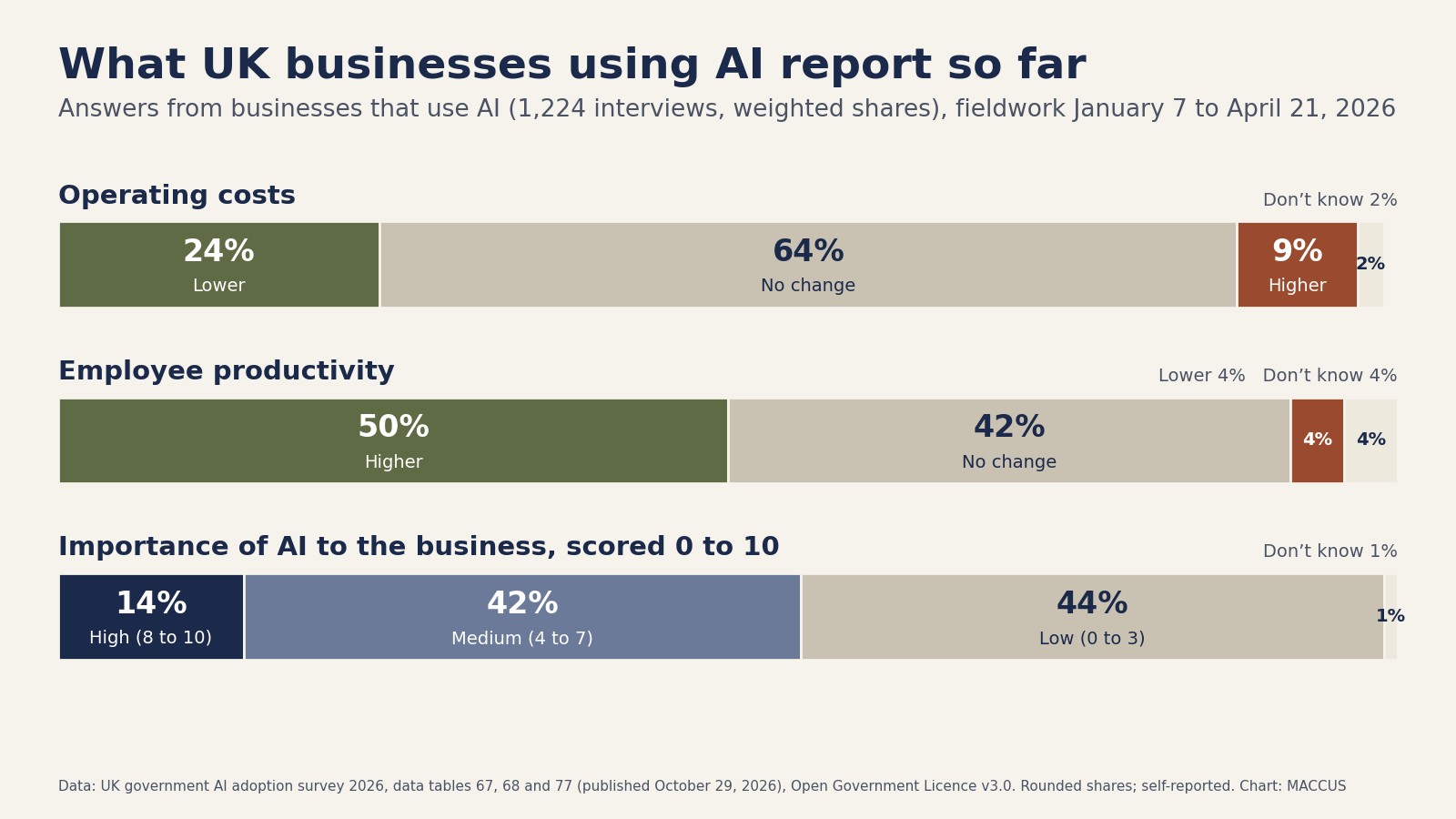
Use inside each firm is still thin. At 38% of adopting firms, one employee in ten or fewer uses AI. Asked to rate the importance of their AI tools from 0 to 10, users gave an average of 4.3; 14% scored 8 or higher and 44% scored 3 or lower.
Few job cuts so far
The UK report found “limited evidence of widespread job displacement.” In follow-up interviews, some firms expected job losses, “but there was little experience of this in reality,” the report says, although some staff moved departments after AI took over their previous workload.
A US Census Bureau working paper published in April, based on a different survey of US firms covering November 2025 to January 2026, found that 18% of firms used AI in a business function, a figure that cannot be compared with the British 32%. Among the US firms using AI, 2.3% reported AI-linked increases in headcount and 2.0% reported decreases. Of the firms that saw any effect on tasks, 66% used AI only to augment them.
In ZipRecruiter’s survey of more than 1,500 US workers, published October 26, 52.6% said AI had made their work more enjoyable and 5.5% less so. The same survey found 25.1% planning to leave their job over the way their employer views or uses AI.
What it means
Britain now has two readings of business AI use, taken a year apart with a comparable method, and the share doubled between them. Much of the growth came from sectors that had mostly stayed out: builders, retailers, transport firms and hotels.
Few adopters call AI critical, and AI-linked job cuts are rare in both countries’ data. Enthusiasts can cite a doubling in a year; skeptics, the 64% of users with no change in costs and the October 24 argument by Apollo’s chief economist that AI has delivered “zero financial payoff” to US companies outside tech.
A third wave, if the government runs one, would show whether the pace holds. A second doubling would put the share near two in three firms (64%, our arithmetic), and the questions on costs and importance would reveal whether wider use starts to show up in the accounts. The PlanAssist beta, a nearer test, will show whether the ministry’s eight-weeks-to-four claim stands up on live applications.
Sources
- AI adoption survey 2026, Department for Business, Innovation, Science and Trade, GOV.UK, October 29, 2026
- Artificial intelligence adoption research 2026, BMG Research for the UK government, GOV.UK (full report, PDF), October 29, 2026
- AI adoption survey 2026: data tables, UK government, GOV.UK (ODS spreadsheet), October 29, 2026
- AI adoption survey report 2025 (web version), Department for Science, Innovation and Technology, GOV.UK, updated February 13, 2026
- Faster planning decisions as new rules and AI tackle delays, Ministry of Housing, Communities and Local Government, GOV.UK, October 30, 2026
- Speeding up planning decisions with AI, Owen Larter and David Thacker, Google DeepMind, October 31, 2026
- The Microstructure of AI Diffusion: Evidence from Firms, Business Functions, and Worker Tasks (CES-WP-26-25), Bonney, Breaux, Dinlersoz, Foster, Haltiwanger and Pande, US Census Bureau, April 2026
- Better Work, More to Learn: The 2026 AI Worker Report, Nicole Bachaud, ZipRecruiter Economic Research, October 26, 2026
Header image: chart by MACCUS, data from the UK government AI adoption survey 2026, with 2025 comparison (published October 29, 2026), Open Government Licence v3.0