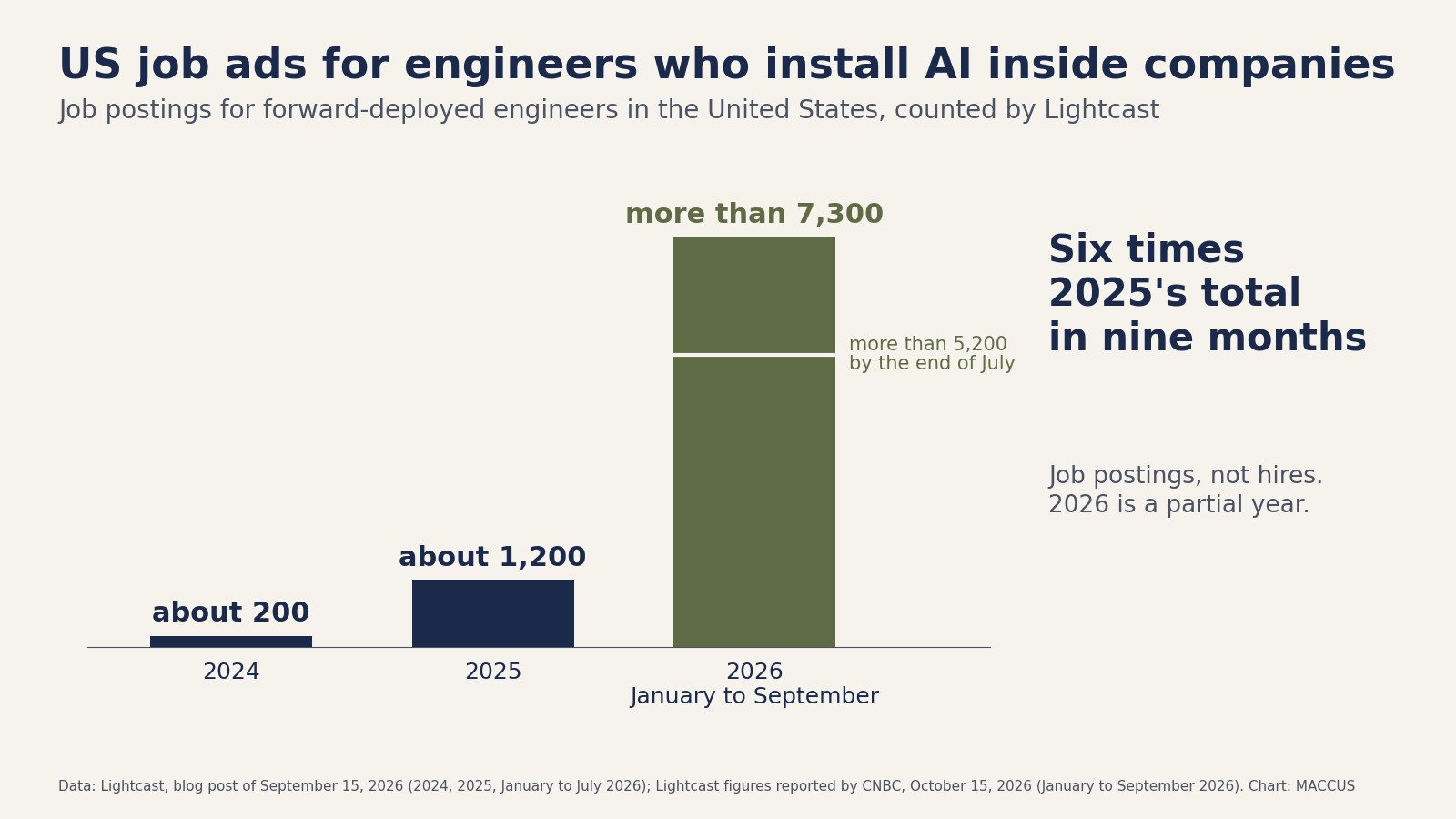

US employers posted more than 7,300 job ads in the first nine months of 2026 for engineers whose work is to make AI run inside other companies, according to data from the labor market analytics firm Lightcast reported by CNBC on October 15. That is about six times the roughly 1,200 ads for the role in all of 2025, and Lightcast calls it the fastest-growing AI job.
The title is forward-deployed engineer, or FDE: an engineer who sits with a client, learns how its business works and turns an AI model into a system that does part of that work. AI companies are paying to hire and train these engineers.
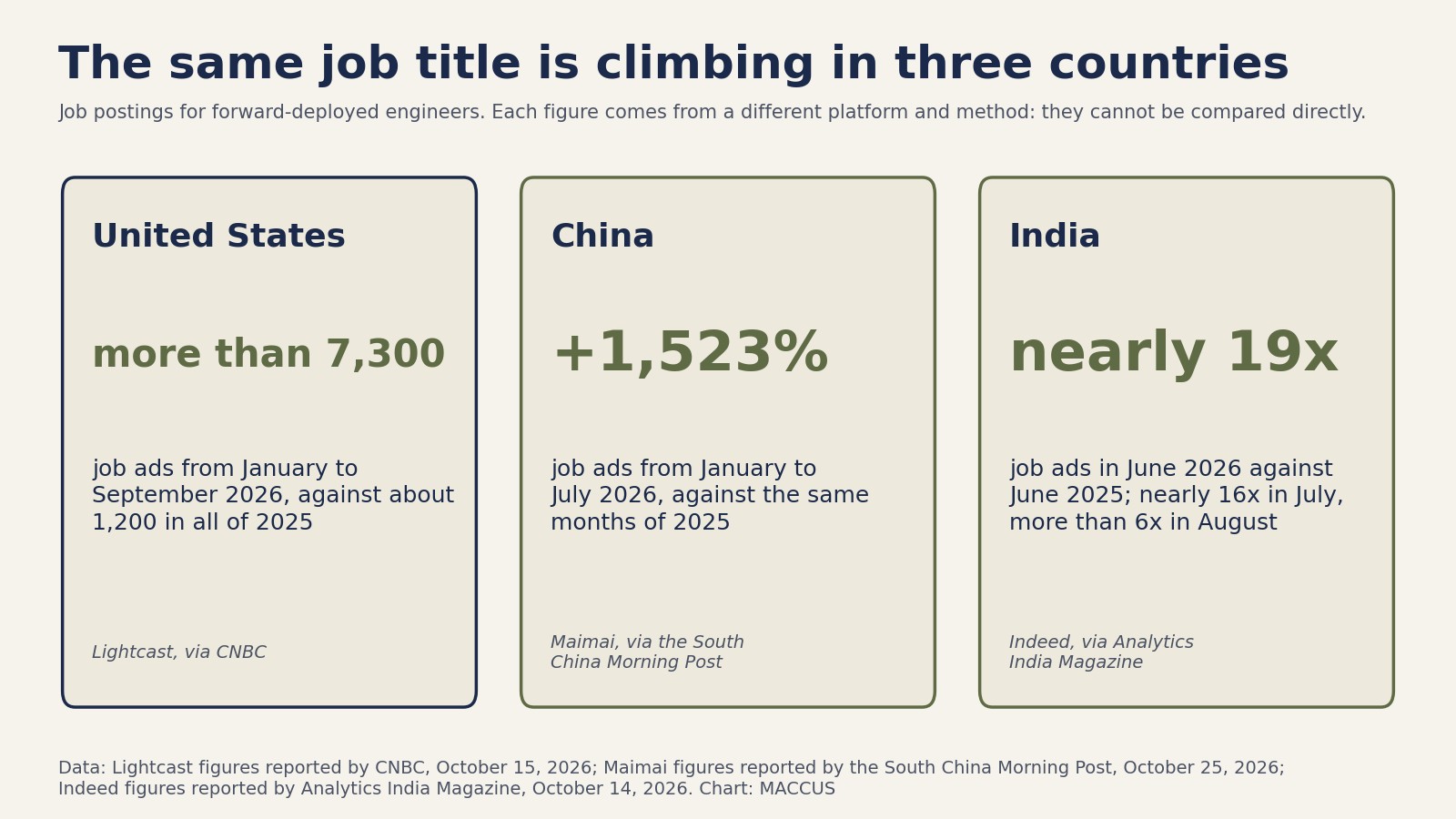
In China, job postings for FDEs rose 1,523% in the first seven months of 2026 from the same months of 2025, according to data from the professional network Maimai reported by the South China Morning Post on October 25. In India, FDE postings on Indeed in June were nearly 19 times their level a year earlier, then nearly 16 times in July and more than 6 times in August, Analytics India Magazine reported on October 14. The counts come from different platforms with their own methods, so they cannot be added up or compared directly.
An engineer at the client’s desk
Palantir says it coined the term in 2007, according to The Register, which described the practice on October 22: vendors send these engineers to a client without a fixed project and expect them to build something valuable with the vendor’s technology, fast. Demand began to accelerate in 2025, Lightcast’s head of global research, Elena Magrini, wrote on September 15, “as employers looked for people who could turn artificial intelligence and software into practical solutions.”
In FDE job ads, artificial intelligence, workflow management and Python rank among the most requested skills, Lightcast found, while AI and workflow management do not make the top 20 in software engineering ads. “FDE is not an entirely new role. It shares roughly half of its skills with software engineering,” Magrini told CNBC.
The ads also call for human skills such as communication and problem solving, according to Lightcast. “The hardest thing to teach is the customer EQ, without question,” Val Henderson, chief executive of Caylent, an AWS consulting partner that places FDEs with clients, told CNBC. In India, Sashi Kumar, managing director of Indeed India, said in a statement that “companies want engineers who can sit with a customer, unpack a real problem and make the technology work in practice.”
The pay in the ads
The median advertised salary for US FDE jobs reached $195,456 over the nine months, up 40% from 2023 and more than three times the median advertised salary across all US job postings, according to the Lightcast figures reported by CNBC. The salary site Levels.fyi puts the median total compensation for the role in the United States at $216,250, The Register reported.
In China, ByteDance has advertised FDE jobs in its AI business at 35,000 to 65,000 yuan a month, according to listings on the recruitment site Boss Zhipin cited by the SCMP. With 15 months of pay a year, that puts potential annual pay at up to 975,000 yuan, about $146,000 at the exchange rate the SCMP used. Ant Digital Technologies, the technology arm of Ant Group, has offered 40,000 to 60,000 yuan a month, Tencent’s FDE-related listings run from 30,000 to 60,000, and Alibaba Cloud has advertised deployment engineering roles at up to 50,000 yuan a month. Ant Group is an affiliate of Alibaba, which owns the SCMP.
“The high salaries advertised for some of these jobs represent only a small part of the market. Most positions do not pay that much,” George Wang, a senior human resources professional at a leading AI company in Beijing, told the SCMP. In India, Indeed said its sample of FDE ads was too small to support a reliable median salary.
Consultants post the most ads, AI vendors fund the teams
Deloitte and Accenture top Lightcast’s list of advertisers, with 872 and 688 unique FDE job postings in the first nine months of 2026, followed by Google with 499 and KPMG with 447, CNBC reported.
The AI vendors are building their own teams. On June 30, Amazon Web Services announced a $1 billion investment in a forward-deployed engineering organization that “will embed thousands of experts with customers” and is designed to leave them “self-sufficient when a deployment ends.” OpenAI has launched a deployment business backed by more than $4 billion in initial investment and agreed to acquire Tomoro, an applied AI consulting and engineering firm expected to bring about 150 experienced FDEs and deployment specialists, according to CNBC. Accenture and Google Cloud are building a 1,000-person FDE workforce.
Anthropic chose to train engineers who already work for its customers and partners. On October 2, it committed $100 million to its Claude Frontier Academy, which aims to train 10,000 “Frontier Deployed Engineers” by the end of 2027. Engineers from Accenture, Bain, Capgemini, Commonwealth Bank of Australia, Deloitte, McKinsey, Morgan Stanley and Novo Nordisk are in the first cohorts.
The program follows the medical model: a graded simulation of an enterprise deployment, then a 12-week residency leading a real project at the engineer’s own company, then a second assessment. The first Claude Frontier Deployed Engineer badges are expected in early 2027.
On August 27, China’s Ministry of Industry and Information Technology signed a notice that aims for more than 2,000 AI application service providers in a national pool by the end of 2026 and at least 3,000 by the end of 2027. It encourages those providers to build forward-deployed engineer teams “rooted at user sites” (our translation) to make sure applications actually get deployed. The ministry’s explanatory note says national and industry standards that will grade FDE capabilities are being drafted.
What the counts leave out
Lightcast itself says demand “remains small compared with established technology occupations, but its rate of growth is striking.” CNBC notes that the figures “represent advertised positions, not completed hires.” The coverage of the Chinese and Indian data gives growth rates without the number of ads behind them.
The Register describes part of the boom as a sales method. It traces the model to Palantir, whose mantra is “land and expand,” and quotes Mukul Saha, a senior director at the research firm Gartner, on two risks for buyers: lock-in, if only the vendor’s engineers understand the systems they built, and leaks of the client’s intellectual property. “If you’re doing an FDE engagement, figure out the exit strategy,” Saha said.
The payoff is not proven. “To date, the available evidence from FDE projects falls short of confirmation,” CNBC wrote; some early deployments show productivity gains but no financial returns, according to case studies reported by the companies themselves. Steve Corfield, Anthropic’s global head of business development and partnerships, told CNBC that it was too early for outcome data on the academy. On October 24, Apollo’s chief economist argued that AI had delivered no financial payoff yet to US companies outside the tech sector.
What it means
Lightcast reads the rise of the role as a sign that businesses are moving “from developing AI technology to applying it.” Maimai’s chief executive, Lin Fan, told Jiemian in September that the models “are already capable enough” and that the bottleneck lies in the layer that gives AI the context and best practices of each type of job (our translation). In the United States and China, employers are advertising high pay for engineers who build that layer at the client’s site.
For workers, the role is mostly open to experienced engineers. Accenture told CNBC that its FDE onboarding can take 30 to 90 days for engineers who already have substantial software experience, and Anthropic trains engineers who are already on its customers’ payrolls. Entry-level hiring is moving in the opposite direction. At Anthropic itself, juniors fell from 27% to 9% of technical hires, and in Japan more than one in five large companies in a Nikkei survey may hire fewer graduates from 2029.
The next test comes when the engineers leave. AWS says its program is designed to leave customers self-sufficient, and Gartner advises buyers to work out their exit strategy. The next data points are the first full Frontier Deployed Engineer badges in early 2027, Anthropic’s tracking of how quickly its residents’ projects reach production, China’s FDE grading standards and Lightcast’s count for the full year.
Sources
- AWS, Anthropic race to deploy army of specialized engineers key to proving AI spending will pay off, Barbara Booth, CNBC, October 15, 2026
- Q: What is a Forward Deployed Engineer? A: The fastest growing AI job., Elena Magrini, Lightcast, September 15, 2026
- China’s tech giants are paying 1 million yuan for a new kind of AI engineer, South China Morning Post, October 25, 2026
- Forward Deployed Engineer Job Postings in India Grew Nearly 19x in a Year: Report, Analytics India Magazine, October 14, 2026
- Anthropic invests $100 million to train 10,000 engineers and tackle the enterprise AI talent gap, Anthropic, October 2, 2026
- 工信部组织开展人工智能应用服务商培育专项行动, Ministry of Industry and Information Technology of China, notice 工信厅科函〔2026〕414号, text reprinted by Secrss, August 27, 2026
- 对话脉脉CEO林凡:明年科技公司将只招AI人才, Jiemian, September 9, 2026
- Vendors asking forward deployed engineers to make good on trillion-dollar AI bet, The Register, October 22, 2026
Header image: chart by MACCUS, data from Lightcast (blog post of September 15, 2026, and figures reported by CNBC on October 15, 2026)