
About 2,000 engineers at Revolut now write code by default with GLM, an open-weight model from the Chinese lab Z.ai that the digital bank hosts itself. Anthropic’s Claude Code and OpenAI’s Codex remain available, but only for exceptions. David Abitbol, who leads AI operations at Revolut, described the switch on October 13, 2026, at the AI Engineer conference in New York. He said the bill is now a tenth of what the company used to spend with Anthropic and OpenAI.
The talk and its full transcript are posted on the organizers’ website. Trending Topics, a European tech news site, and the startup data platform Dealroom covered it on the morning of November 3. The Register followed that evening with a headline about AI coding costs cut tenfold.
From capped budgets to unlimited tokens
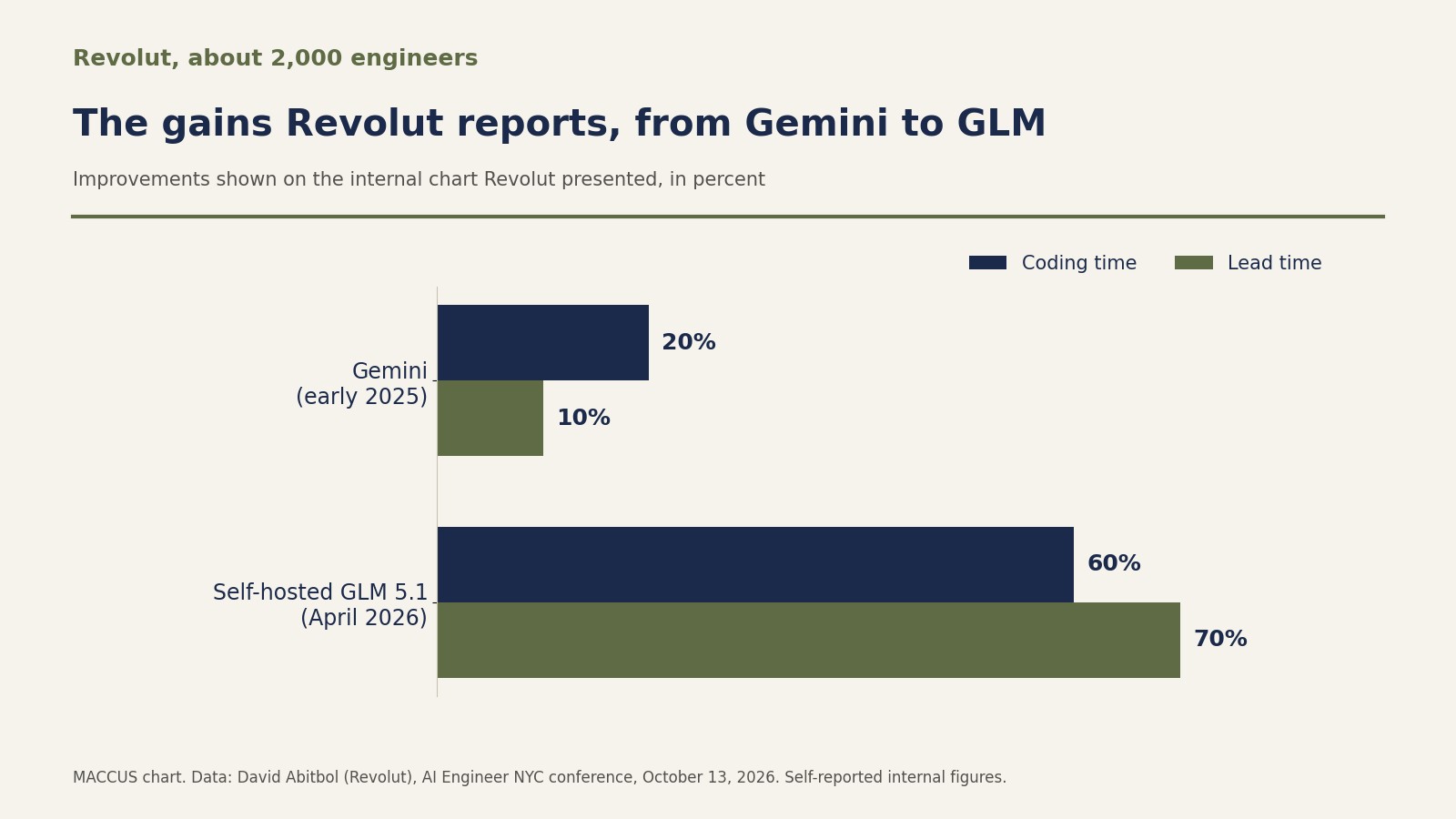
Abitbol walked through three stages, measured on a sample of about 2,000 engineers. Revolut tracks two metrics: coding time, in hours, and lead time, in days, from the moment an engineer picks up a feature to the moment it is merged and ready to deploy.
In early 2025, the company rolled out Gemini. Coding time fell 20% and lead time 10%, according to the chart he showed. Claude Code came next, launched at scale in early 2026 with strict budget caps. At the time, its impact was small.
“We were highly skeptical about the cost of AI,” Abitbol said. “We were seeing engineers spend $1,000 a month, $10,000 a month with not so much ROI.”
In April 2026, Revolut started hosting GLM 5.1 itself. From there, the chart shows a 60% improvement in coding time and a 70% improvement in lead time.
Abitbol’s conclusion is that coding is not necessarily the bottleneck in engineering. Engineers get a lot of time back when they no longer have to dig through their inboxes or wrestle with Jira and Confluence. With unlimited tokens, they stop saving them “for the end of the quarter or the most difficult task.”
56 GPUs for 2,000 engineers
Revolut runs GLM 5.3, the current version, on 56 Nvidia B200 GPUs for about 2,000 engineers. In GPU count, that is equivalent to seven eight-GPU DGX B200 systems, The Register notes. The blended cost works out to about 30 cents per million tokens. “The billing is flat, we don’t have any bill shock at the end of the month, and the frontier is the exception,” Abitbol said.
He sets two targets. The first token has to arrive in under three seconds; past five, his Slack inbox “starts to blow up.” Generation speed matters less. In his view, 200 tokens per second is enough, because engineers run tasks in parallel and check back when they’re done instead of watching the model think in real time.
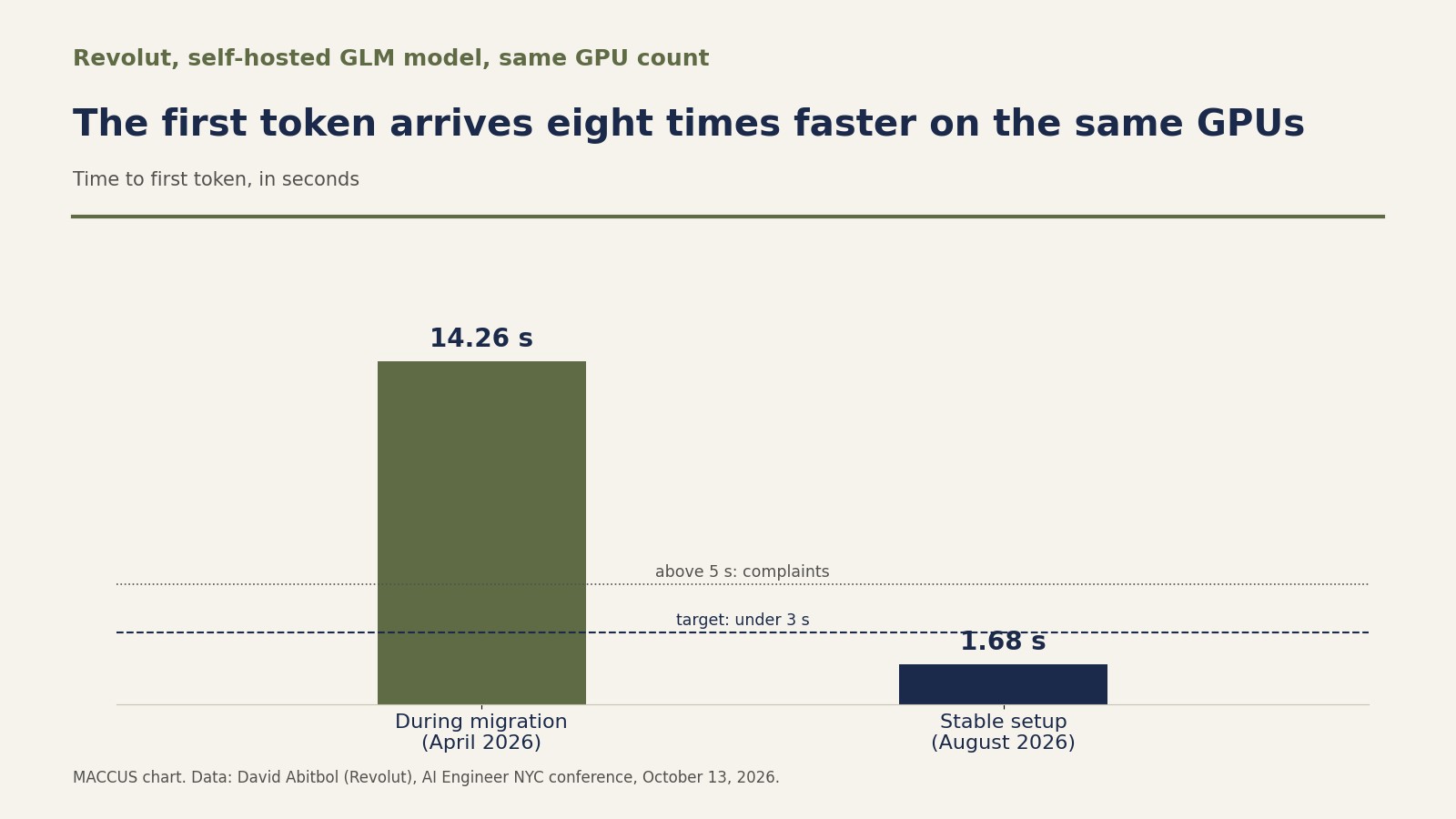
Hitting the three-second target took tuning. According to the slide described on the organizers’ page, time to first token dropped from 14.26 seconds during the migration to 1.68 seconds in the stable setup, on the same number of GPUs, while requests per second rose 76%. Abitbol pointed to FP4 quantization on Blackwell chips and to splitting the model across eight GPUs instead of four, which leaves enough memory for the KV cache. He also advised tracking the cache hit rate, which matters a lot for coding, where the same context keeps coming back.
Long context, in his words, is “a scam”: even if you can serve a million tokens, 256,000 is what this work needs. A guide to running AI locally in a business explains what drives time to first token and how much memory an open model needs.
GLM handles text only, so a router sends requests that include images to other models, such as Gemini or GPT Luna. The internal endpoints follow OpenAI’s API format, which lets engineers keep the coding tools they prefer, including OpenCode and Codex.
A Chinese model inside a regulated bank
Abitbol acknowledged the “stigma” around Chinese models. His answer turns on where the data goes: Revolut downloads the published weights and runs them on infrastructure of its choosing, without going through an inference service based in China. He said the GPUs can sit in the United States, the European Union, the United Kingdom or Israel, with providers that keep no data by default.
Revolut is regulated as a bank in the EU and keeps a human in the loop on all coding tasks, so it doesn’t have to present them to its regulator as autonomous agents.
Each agent runs in a sandbox whose rules set what it can execute without approval: “you can allow grep but not gradle” (grep searches text in files; Gradle is a build tool). The same setup is meant to guard against insider misuse and prompt injection. Detailed logs make it possible to reconstruct an incident.
GLM 5.1 was released under the MIT license. GLM 5.3, released in late August, uses Z.ai’s own license. Commercial use is free, but a company that sells API access to models and brings in more than $10 billion in revenue over 12 months must first pass a Z.ai security review. On October 29, Mistral tightened the license on Large 4 for API resellers.
GLM 5.3 has about 753 billion parameters, with about 40 billion active per token, according to Amazon Bedrock’s model card. Bedrock has offered it to eligible customers since October 5. In European regions, it is available only through global inference, with no guarantee that requests stay in Europe.
Self-reported numbers and an incomplete cost
The productivity gains come from Revolut’s internal comparison. The organizers note on the talk page that it does not isolate the model change from other possible causes. Dealroom names one that happened at the same time: the removal of token limits.
The organizers also point out that the 30-cent figure reflects Revolut’s deployment and utilization and does not transfer as is to other self-hosted models. The talk doesn’t say whether the 56 GPUs are owned or rented, or how much the tuning team and monitoring cost. Dealroom says smaller companies without Revolut’s scale and infrastructure team may not get the same result.
Nor does the talk compare the quality of GLM’s code with Claude’s or GPT’s on the same tasks. Z.ai calls GLM 5.3 the most capable open-weight model for coding. Its own table, though, puts it behind Anthropic’s Fable 5 or OpenAI’s GPT-5.6 Sol on most of the coding tests it lists, including Terminal Bench 3.0, DeepSWE and FrontierSWE. Abitbol himself calls the latest Anthropic and OpenAI models “fantastic,” while reserving them for exceptions.
What it means
A large European digital bank is saying publicly that it now uses Anthropic’s and OpenAI’s coding tools only for exceptions, and it is putting a number on its cost per million tokens. The account comes as both vendors rework their plans. At OpenAI, the Plus, Pro and Business plans will share a token-based usage limit across ChatGPT and Codex starting in December. At Anthropic, the old Max 20x plan became Ultra on October 30 and is losing its five-hour limit for verified accounts.
Revolut’s case is mostly a story about pricing. As long as every token costs money, engineers save AI for hard tasks; once the cost is flat, they also hand it tickets, documentation and debugging. According to the company, the biggest lead-time gains came from that work. An open model is one way to get there, but an expensive one: it takes dozens of current-generation GPUs and a team that can spend months tuning them.
Price pressure already shows up in Anthropic’s numbers. In a November 2 report on the company’s IPO filing, AFP noted that Anthropic’s growth was slowing amid competition from OpenAI and from cheaper models, many of them Chinese.
Several questions remain open: the full cost of Revolut’s infrastructure, the share of work still sent to Claude Code and Codex, how the code compares on quality, and whether other large companies will publish comparable numbers. On the vendor side, the shared ChatGPT and Codex limit due in December and Anthropic’s next financial filings will offer clues to how they respond.
Sources
- Shipping like a startup, regulated like a bank (David Abitbol, Revolut), talk page and transcript, AI Engineer, October 13, 2026
- British fintech Revolut slashes AI coding costs 10x by cutting out Claude and going self-hosted, The Register, November 3, 2026
- Revolut Cuts A.I. Coding Costs 90% With a Chinese Open-Weight Model, Trending Topics, November 3, 2026
- Revolut swaps Claude Code for a Chinese open-weight model, cutting its AI coding bill by 90%, Dealroom, November 3, 2026
- GLM-5.3, model card and license, Z.ai on Hugging Face, accessed November 4, 2026
- GLM 5.3, model card, Amazon Bedrock, accessed November 4, 2026
- Anthropic says revenue surged 1,100 percent ahead of IPO, AFP (on Yahoo Finance), November 2, 2026
Header image: MACCUS chart, data from David Abitbol (Revolut), AI Engineer NYC conference, October 13, 2026.