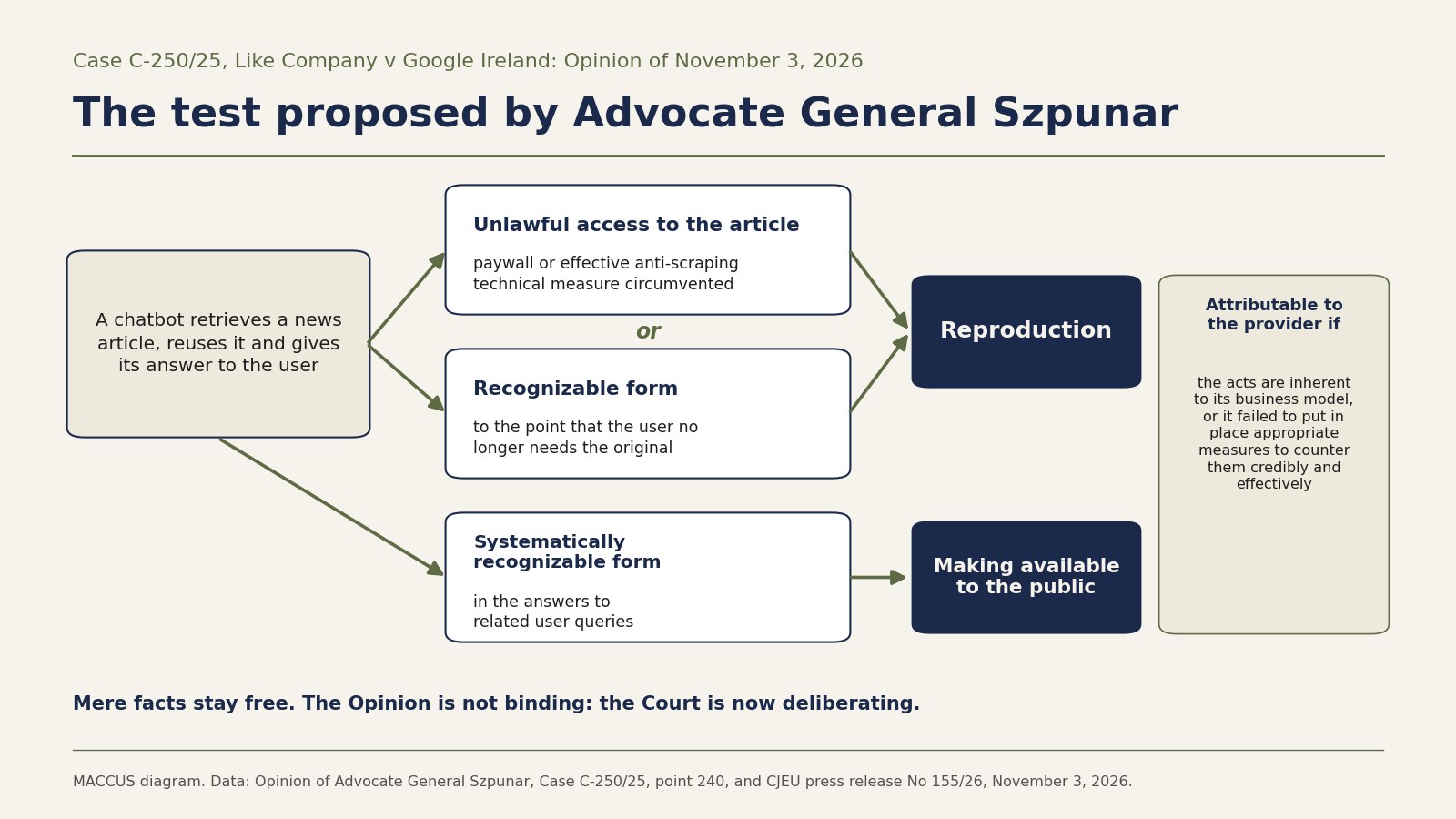

On November 3, 2026, Advocate General Maciej Szpunar advised the Court of Justice of the European Union to find that an AI chatbot such as Gemini may, in certain circumstances, infringe the EU press publishers’ right when it retrieves a news article in real time to answer a user. He identified two cases: the chatbot accessed the article unlawfully, for example by circumventing a paywall, or its answer reuses the article’s form of expression to the point that the reader no longer needs the original. Case C-250/25, which pits Hungarian web portal operator Like Company against Google Ireland, is the first generative AI case to reach the Court.
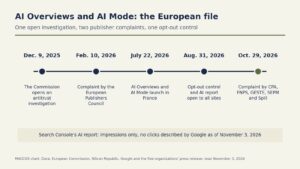
On model training, the Advocate General proposed that the Court declare the two questions inadmissible, while suggesting that such use is, “as a rule,” freely permitted under the text and data mining exception. The Opinion does not bind the Court, whose judges are now beginning their deliberations. It came five days after French publisher groups filed a complaint with the European Commission against Google’s AI Overviews.
A Hungarian portal operator takes on Google
Like Company sued Google in the Budapest Regional Court under the press publishers’ right created by EU Directive 2019/790. It claims that Google used its articles to “train” the Gemini models and repeatedly reproduced them and made them available to the public through the chatbot between June 13, 2023, and May 31, 2024.
To answer questions about the news, Gemini relies on retrieval-augmented generation (RAG), and “the chatbot often retrieves (or ‘scrapes’) press articles available online,” according to the Court’s press release. In a request lodged on April 3, 2025, the Hungarian court referred four questions to the Court of Justice: two on training, two on the chatbot’s answers.
Facts are free, the form of expression is protected
The Advocate General stresses that the press publisher’s right “does not protect the mere facts reported in press publications, but only the specific form of expression of those publications.” The full Opinion defines that form as “the way in which those articles are arranged, structured and phrased” (point 199). An in-depth analysis, he adds, is easier to recognize in an answer than a purely factual report (point 206).
Two routes to a reproduction
According to the press release, whether a chatbot’s use of press publications falls under the publisher’s reproduction right “depends on two factors” in the Advocate General’s view. The first is “whether that chatbot accessed the press publication at issue unlawfully, in particular by circumventing effective technical measures (such as a paywall) designed to restrict access to, or web-scraping of, that publication.” The second is whether the answer “reuses the form of expression of that publication in a recognisable manner, to such an extent that the user, by reading that answer, is entirely dispensed from accessing the original publication.”
The press release does not say whether both must be met. The full Opinion joins them with “or” in the answer it proposes to the Court (point 240), so either one is enough. Rewording does not shield a chatbot if the article’s form remains recognizable: a reproduction right limited to verbatim copying would be too easy to circumvent, as Like Company and several governments, including France’s, argued (point 205).
The right of making available to the public would, in the Advocate General’s view, be infringed “as a rule” where the article’s form is “systematically recognisable” in the chatbot’s answers to related queries. He considers that scenario “rather unlikely,” since answers vary from one query to the next, and says publishers would have to prove it with sufficient examples (point 214).
Who is liable
When a user expressly asks a chatbot to reuse an article, primary liability should generally lie with that user, the Advocate General writes (point 219). The provider would still be liable where such acts are “inherent to the business model of that provider” or where it has failed to put in place appropriate measures to counter them “credibly and effectively.” According to the Opinion, appropriate measures include bots that respect publishers’ access restrictions and output filters that screen out answers too close to the articles retrieved (point 222).
Szpunar rejects Google’s implied-consent argument
Google argued that by leaving their articles freely accessible, with no paywall and no bot blocking, publishers implicitly consent to their reuse by chatbots. The Advocate General rejects that argument (points 224 to 228). A paywall is a commercial choice, he writes, and blocking bots “is not as easy as it sounds”: in Google’s case, “it seems that the same bots serve both functions,” indexing for search and grounding chatbot answers.
A robots.txt block, covered in our guide to AI crawlers, can therefore cost a site search visibility, as Like Company told the Court at the hearing. France’s competition authority, the Autorité de la concurrence, flagged the same problem on March 20, 2024, when it announced a €250 million fine against Google over press publishers’ related rights. Until Google launched Google-Extended on September 28, 2023, a publisher that wanted to keep its content away from Bard, now Gemini, had to block all crawling by Google, including for Search, Discover and Google News.
Google says Google-Extended lets sites block training and grounding for Gemini without affecting their visibility on Google. “That would need to be verified,” the Advocate General writes (footnote 236).
Training is outside the case, the Advocate General says
The training questions are hypothetical, according to the Advocate General: there is no evidence that Like Company’s articles were used to train the Gemini models, and training is not an “online use” of press publications. The text and data mining exception, which he discusses “for the sake of completeness,” requires lawful access (points 141 and 142), and rightholders can opt out of it for online content by machine-readable means (Article 4 of the directive).
The Advocate General lists robots.txt and Google-Extended among those means (point 149), while noting that robots.txt “does not technically prevent scraping” (footnote 153). On October 30, Google, OpenAI, Microsoft and Anthropic announced a shared robots.txt signal against AI training.
Like Company’s own case
Subject to the Hungarian court’s findings, the conditions do not appear to be met in this case, the Advocate General writes (point 239). It appears that Like Company did not put in place effective technical measures against access or scraping. Any reuse does not appear inherent to Google’s business model, and Google seems to have put appropriate measures in place.
The example Like Company produced is a Gemini answer to a request for a summary of one of its articles, about a Hungarian singer’s plan to bring dolphins to Lake Balaton. Apart from individual words, only the article’s first sentence appears in the answer (point 204).
According to AFP, a Google spokesperson said “Gemini learns linguistic patterns to create original outputs rather than replicating content,” and welcomed “the advocate general’s opinion recognising that EU law permits AI training on publicly available information.”
Open questions
The Court can depart from the Opinion, and its press release gives no date for the judgment. Its interpretation will bind the Hungarian court and any other national court facing a similar issue.
The press release does not mention Google’s AI Overviews or AI Mode. The full Opinion does, describing them as built on the same technology and drawing the same complaints from publishers (points 156 to 159). But the questions referred concern the Gemini chatbot, and it is unclear how a judgment would apply to those Search features.
Two other points remain unsettled: what counts as an “effective” technical measure against bots, and where a free summary ends and a recognizable reuse begins. The Advocate General sees a possible “grey area” there, to be assessed “on a case-by-case basis” (point 209).
What it means
The Advocate General separates two issues that recent publisher complaints often mix up. Training would be free as a rule, unless rightholders opt out in a machine-readable way. Answers built in real time would be judged on how the bot obtained the article and on how much of it survives in the answer.
That test favors paywalled publishers and analysis pieces over free sites that publish factual news. Szpunar argues that the balance leaves publishers in a “strong bargaining position” to license their content, because chatbots need their articles to answer questions about the news (point 236).
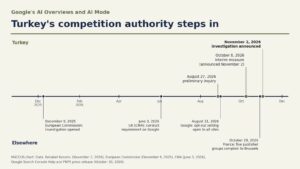
For sites that depend on Google traffic, the blocking dilemma remains: shutting out bots costs visibility if the same bots serve search and generated answers. Turkey’s competition authority addressed that point with an interim measure in October.
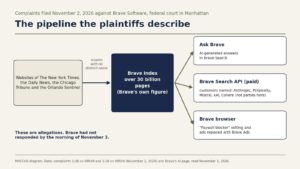
The press publishers’ right does not make up for lost clicks when an answer only repeats the facts: it “was never meant to protect those publishers against competition per se,” the Advocate General writes (point 208). French publisher groups have turned to competition law in Brussels, while US publishers are suing under US copyright law, as in The New York Times’ lawsuit against Brave filed on November 2.
For Like Company, two steps remain: the Court of Justice’s judgment, expected in about six months according to AFP, then the Hungarian court’s decision.
Sources
- Press release No 155/26, Opinion of the Advocate General in Case C-250/25, Like Company, Court of Justice of the European Union, November 3, 2026
- Opinion of Advocate General Szpunar, Case C-250/25, Like Company v Google Ireland Limited (provisional text, ECLI:EU:C:2026:919), CURIA, November 3, 2026
- Google AI chatbot may break press copyright rules: EU legal adviser, AFP, via The Post, November 4, 2026
- Related rights: the Autorité fines Google €250 million for non-compliance with some of its commitments made in June 2022, Autorité de la concurrence, March 20, 2024
Header image: MACCUS diagram of the proposed test. Data: Opinion of Advocate General Szpunar, Case C-250/25, point 240, and CJEU press release No 155/26, November 3, 2026