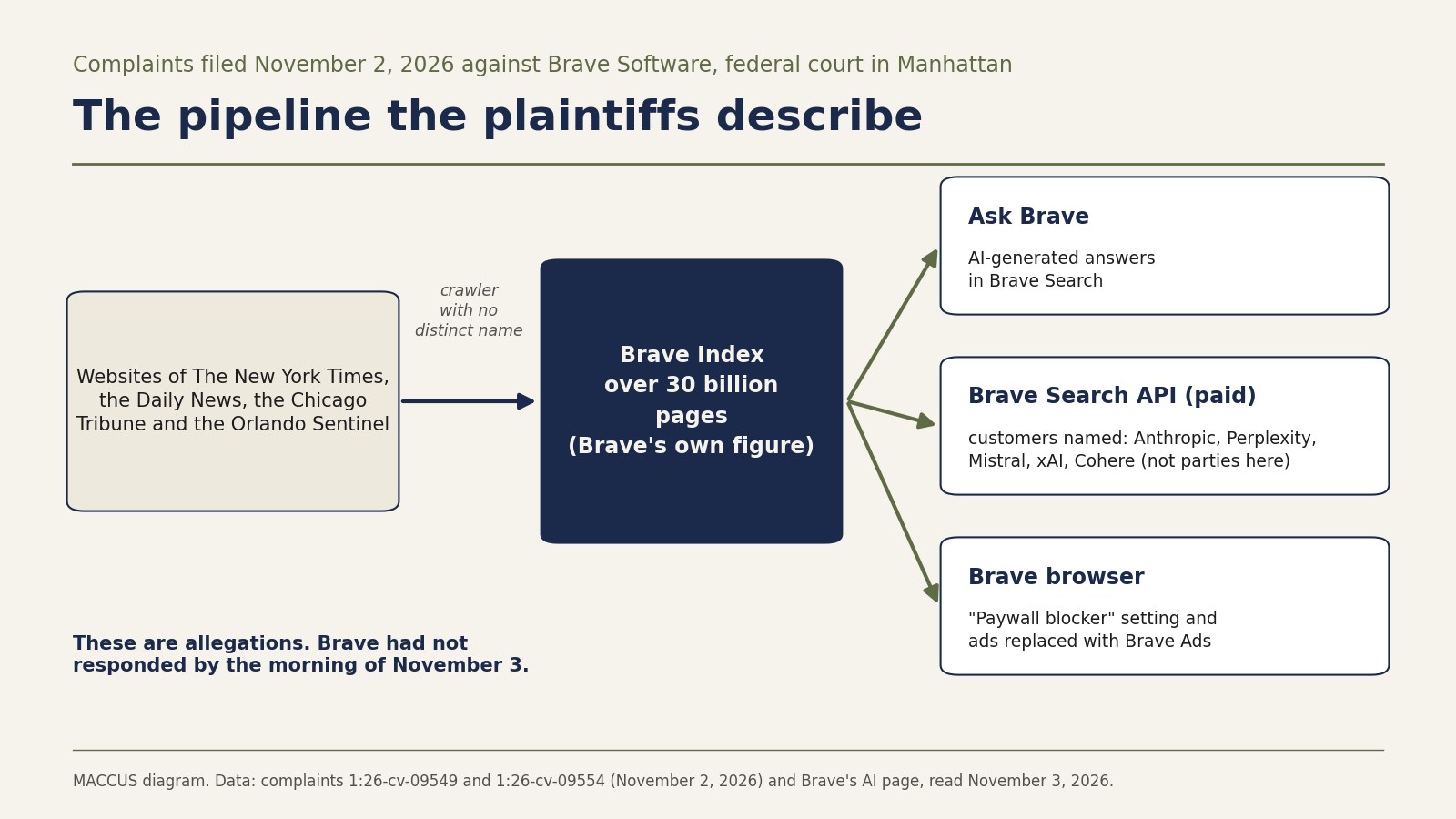

The New York Times sued Brave Software, the company behind the Brave browser and search engine, on November 2, 2026, in federal court in Manhattan. The same day, the publishers of the New York Daily News, the Chicago Tribune and the Orlando Sentinel filed a second complaint built on the same template. The plaintiffs accuse Brave of copying their articles into its search index, serving them up in its Ask Brave answer feature and selling them through its paid API to AI companies they name: Anthropic, Perplexity, Mistral, xAI and Cohere. Those five companies are named as Brave customers; none is a defendant in either case.
Brave had not responded in court or publicly by the morning of November 3. The case also matters to anyone who runs a website: the crawler that feeds Brave’s index does not identify itself under a distinct name. Our guide to AI crawlers and robots.txt explains how that file addresses each crawler by name.
Two complaints, five counts
The New York Times Company’s complaint (case 1:26-cv-09549) and the three dailies’ complaint (case 1:26-cv-09554) both demand a jury trial and are signed by the same attorney, Steven Lieberman of Rothwell, Figg, Ernst & Manbeck. They describe Brave as “the supplier, dealer, and distributor of stolen copyrighted content,” acting “like a burglar that misappropriates the content of publishers, and an AI ‘fence’ that sells stolen content to third parties.”
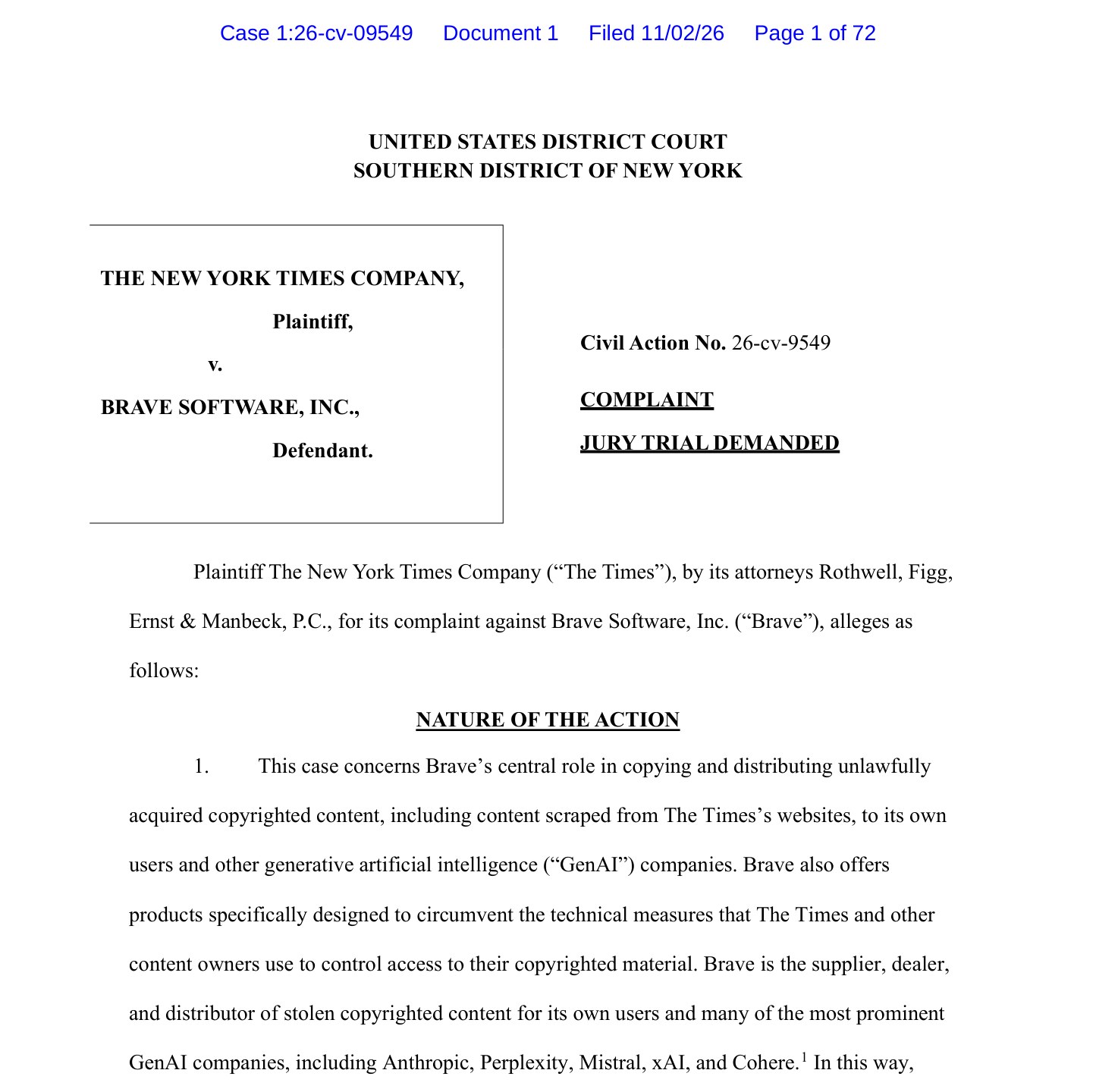
Each complaint pleads five counts: direct copyright infringement, contributory infringement, vicarious infringement, circumvention of technological protection measures under the Digital Millennium Copyright Act (DMCA) and unjust enrichment under New York law. The plaintiffs seek damages, restitution of profits and a permanent injunction, without naming a dollar figure. The Times says it owns more than 10 million registered copyrighted works.
The Times says it wrote to Brave CEO Brendan Eich twice, on August 11, 2025, and April 13, 2026. The second letter called the infringement willful and warned of “enhanced statutory damages up to $150,000 per infringement.” According to the complaint, Brave ignored both letters.
An index of more than 30 billion pages and three products
Brave says its index holds “over 30 billion” pages, and two of the three products the complaints target draw on it. The first, Ask Brave, is the AI feature of Brave Search: it answers questions by passing pages from the index to a language model, a technique Brave calls “AI Grounding.” According to the Times complaint, Brave Search handles more than 50 million queries a day, and a third of them get an AI-generated answer.
The Brave Search API, the second product, gives other companies paid access to the index. The complaints cite a September 2023 Brave guide that says the API’s “most common uses” are “training and grounding” large language models. They single out the “LLM Context” endpoint, which, according to Brave, returns page extracts “without need for further scraping.” Brave’s About page lists Cohere, Mistral, Perplexity and You.com among the API’s users.
On November 2, 2023, when it opened its Leo assistant to desktop users, Brave itself wrote that “Anthropic used Brave’s Search API to train their latest model, Claude 2, on high-quality data to help optimize Claude’s outputs for retrieval augmented generation (RAG) queries.”
The third product is the browser, which has a setting called “Paywall blocker.” The complaints say Brave promotes it as a way to “Bypass Paywalls” and that the browser replaces websites’ ads with Brave Ads. The trade site PPC Land notes that the setting sits among optional filter lists and that the complaints do not say whether it is switched on for new installations.
The tests in the complaints
Much of each complaint consists of exchanges with Ask Brave and API queries from the plaintiffs’ own investigation, set side by side with the original articles. Given only the URL of a paywalled Times article, Ask Brave offered to “pull up the full article,” then reproduced more than 400 words of it verbatim.
Queried with nothing but the headline of a Times article, the API’s LLM Context endpoint returned 1,291 of the article’s 1,295 words, verbatim. The three dailies’ complaint describes similar tests, including one that returned nearly 600 words of a Daily News article about Central Park’s horse carriages.
A crawler with no distinct name, by Brave’s design
The complaints say Brave “has never disclosed the name of its ‘bot'” and copied pages “without identifying itself” or giving websites any way to block it. The Times cites this as evidence of willful infringement.
Brave defends the choice on its crawler help page. The crawler does not advertise a distinct user agent, the company writes, “because we must avoid discrimination from websites that allow only Google to crawl them.” According to Brave, its crawler skips any page Googlebot is not allowed to crawl, and robots.txt is not used to keep a page out of the index: removing a page from Brave Search takes a noindex directive and a fresh crawl, which site owners can request through a form.
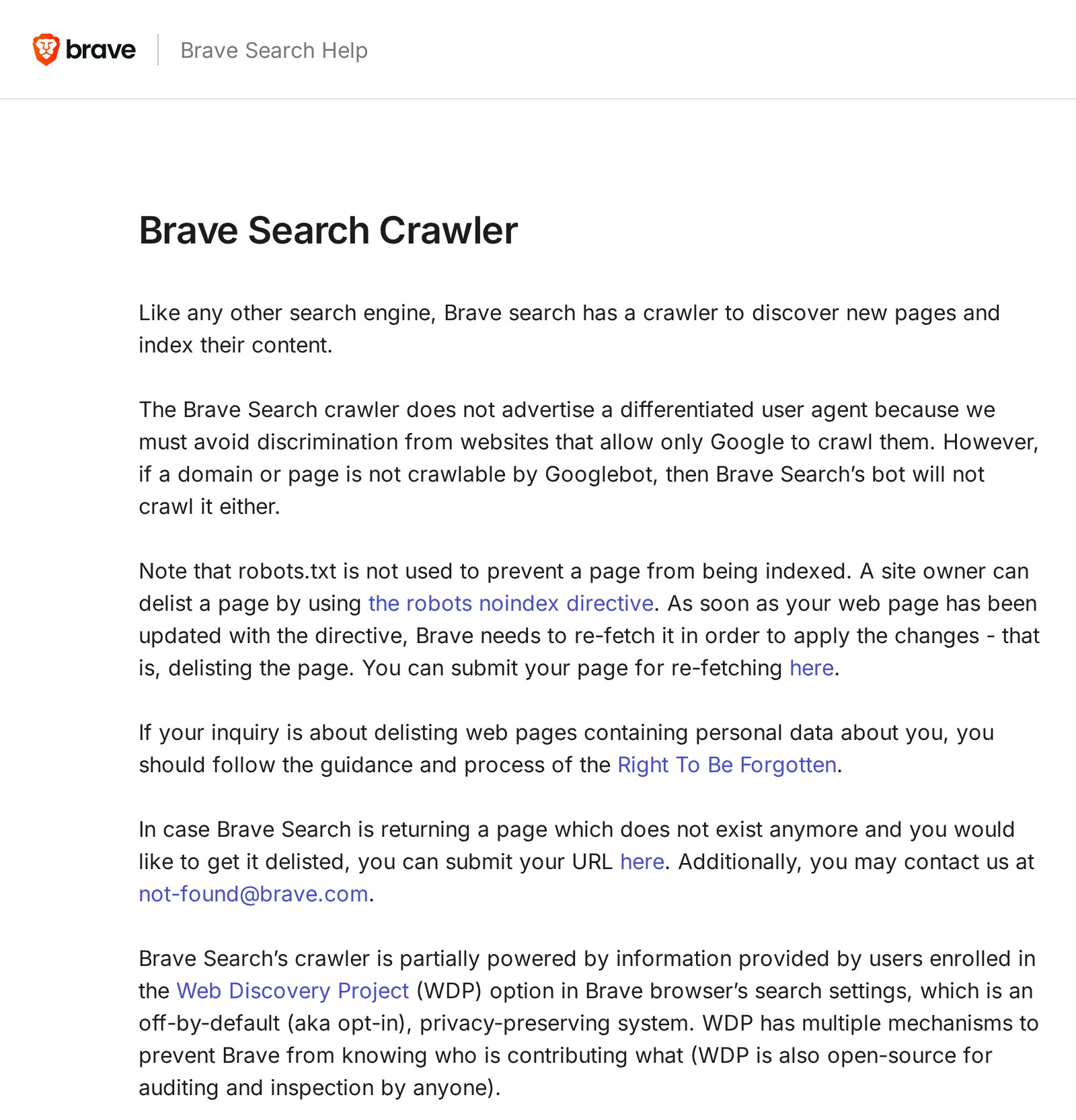
In practice, PPC Land notes, robots.txt offers no separate instruction for Brave: a publisher that wants Brave’s crawler out has to shut out Googlebot too. Brave is not among the four companies (Google, Microsoft, OpenAI and Anthropic) that said on October 30 they would honor a shared robots.txt signal against AI training.
Perplexity fires back, Brave has not responded
“We filed this lawsuit to hold Brave accountable for stealing our content to power its own products,” Times spokesperson Graham James told The Verge. Perplexity’s chief communications officer, Jesse Dwyer, responded that “The New York Times is overpaying its attorneys and underpaying its journalists.” Brave, Anthropic, Mistral and Cohere had not replied to The Verge.
In March 2025, after a cease-and-desist letter from News Corp, which owns The Wall Street Journal and the New York Post, Brave went to court first, asking a federal judge in San Francisco to declare its practices lawful. “Decades of legal precedent and practice confirm that it is not copyright infringement to index website content to maintain a search engine,” Brave argued in its filing, as quoted by The Register. “Instead, it is fair use.”
News Corp hit back on July 21, 2026, with counterclaims filed in federal court in Oakland, according to a Reuters report carried by The Spokesman-Review. The Times is already suing OpenAI, Microsoft and Perplexity, as TechCrunch and PPC Land note.
Allegations not yet tested in court
No judge has ruled. In several tests, prompts written by the plaintiffs asked Ask Brave to offer the full text before it reproduced long passages. The complaints do not show how often ordinary users get whole articles, PPC Land points out.
Both complaints claim that Brave “has made more than $100 million by copying and reselling publishers’ work,” without citing a source. The only other $100 million figure in the complaints, PPC Land writes, is a third-party estimate of Brave’s total 2025 revenue across all its businesses; Brave is privately held and does not publish its financial results.
The complaints do not say which Brave services the named customers use today, or whether any of them received the newspapers’ articles, the site adds. According to the three dailies’ complaint, the fifth count, which “does not depend on any copying,” concerns the revenue Brave allegedly earns by replacing the newspapers’ ads. PPC Land observes that the screenshots attached to the complaints show emptied ad slots, with no Brave ad in their place.
What it means
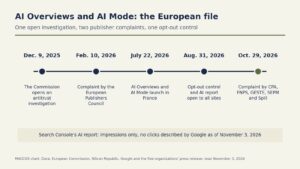
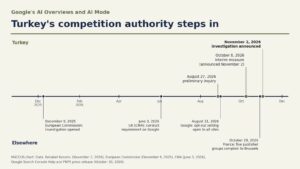
Publishers are moving up the AI supply chain. After suing model makers and answer engines, they are now targeting an index provider that rents out the web to AI companies. If the plaintiffs’ theory holds, licensing demands could extend to search API providers and their customers. In Europe and Turkey, publishers and regulators are still mostly going after Google: five French publisher groups filed a complaint with the European Commission over AI Overviews on October 29, and Turkey’s competition authority has imposed interim terms in favor of news publishers.
The case also turns the crawler’s lack of a distinct name into a legal question. The plaintiffs see it as a way to dodge blocking; Brave presents it as protection against sites that let only Google crawl them. The fifth count targets the revenue a browser would earn by swapping a site’s ads for its own, and it requires no copying. If a court accepts that theory, other ad-funded websites could take it up.
Several questions remain open: what defense Brave will raise, after arguing fair use against News Corp; whether a browser filter list circumvents a measure that “effectively controls access” under the DMCA; and how the named customers use the API today.
The next step is Brave’s response to the two complaints, which could take the form of a motion to dismiss. The News Corp case, meanwhile, is still pending in California.
Sources
- The New York Times Company v. Brave Software, Inc., complaint, No. 1:26-cv-09549, The New York Times Company, November 2, 2026
- Daily News, LP et al. v. Brave Software, Inc., complaint, No. 1:26-cv-09554, CourtListener, November 2, 2026
- Brave Search Crawler, Brave, read November 3, 2026
- Leo, Brave’s AI browser assistant that preserves users’ privacy, is now available to desktop users, Brave, November 2, 2023
- The New York Times sues Brave web browser for AI scraping and bypassing paywalls, The Verge, November 2, 2026
- New York Times and other outlets sue web browser Brave over alleged content scraping, TechCrunch, November 2, 2026
- New York Times and three papers sue Brave over AI answers and ad blocking, PPC Land, November 3, 2026
- Brave wants court to endorse scraping of News Corp content, The Register, March 13, 2025
Header image: MACCUS diagram of the allegations. Data: complaints 1:26-cv-09549 and 1:26-cv-09554 (November 2, 2026) and Brave’s AI page, read November 3, 2026.