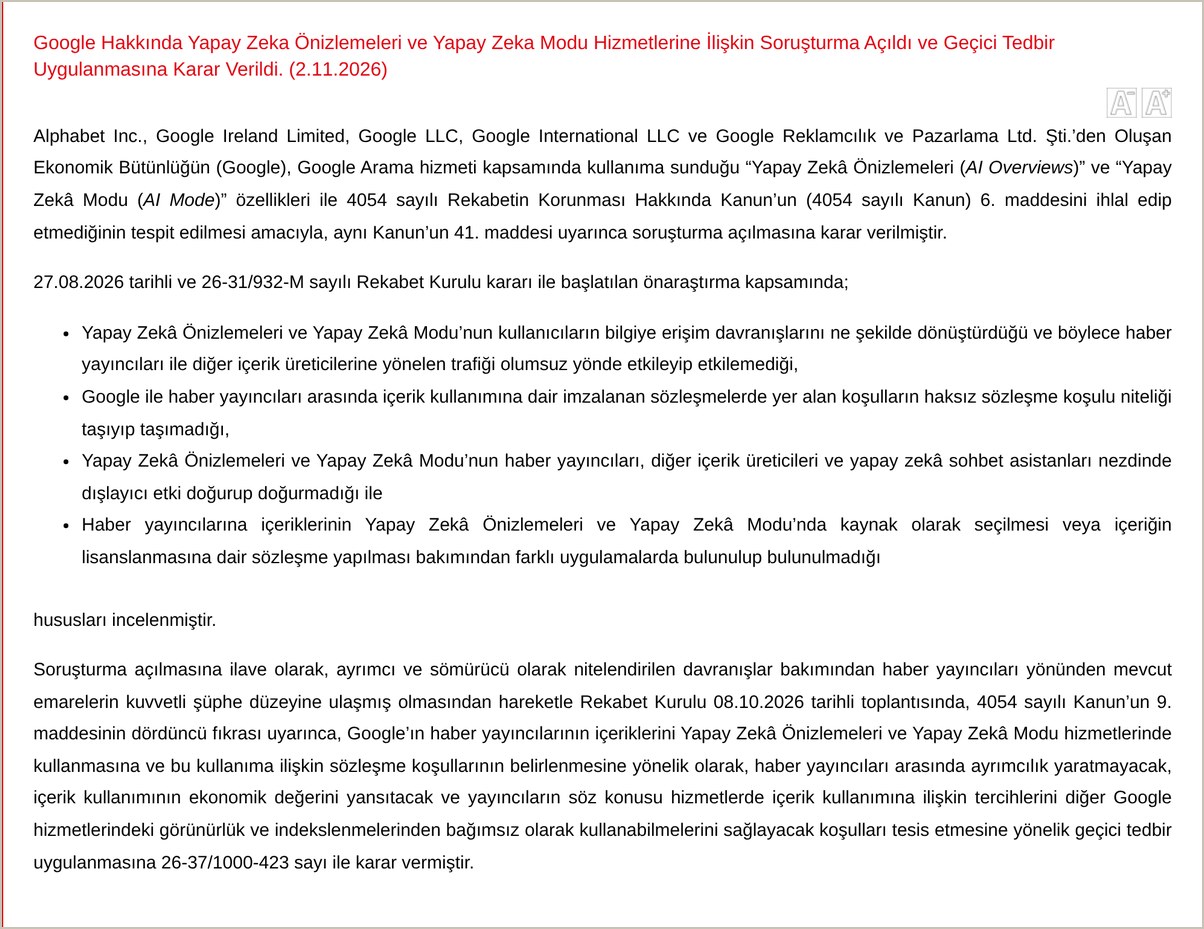
Turkey’s competition authority, Rekabet Kurumu, announced on November 2, 2026, that it is investigating Google for possible abuse of a dominant position with AI Overviews and AI Mode, two AI features of its search engine. Its ruling body, the Competition Board (Rekabet Kurulu), had already imposed an interim measure on October 8, and the two were announced together. Under that measure, Google must give news publishers non-discriminatory terms that reflect the economic value of using their content in the two features, and let them decide how that content is used there without any effect on their visibility or indexing in Google’s other services.
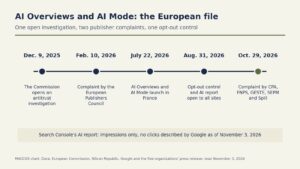
That last point echoes a concern that France’s Alliance de la presse d’information générale (APIG), a trade group for general-interest news publishers, raised after AI Overviews and AI Mode launched in France on July 22, 2026: in its view, pulling content out of AI answers costs publishers visibility. The Turkish measure covers only news publishers and sets no monetary amount.
Four questions from the preliminary inquiry
The investigation targets Alphabet Inc., Google Ireland Limited, Google LLC, Google International LLC and Google Reklamcılık ve Pazarlama Ltd. Şti., Google’s Turkish advertising and marketing arm. The authority treats them as a single economic unit. The case falls under Article 6 of Act No. 4054 on the Protection of Competition, which prohibits abuse of a dominant position. This is not the authority’s first Google case: in June 2025, it opened a separate investigation into Performance Max ad campaigns.
The AI Overviews case grew out of a preliminary inquiry that the Competition Board opened on August 27, 2026 (decision 26-31/932-M). It examined four questions. First, how the two features change the way people get information, and whether that hurts traffic to news publishers and other content creators. Second, whether the content-use contracts Google has signed with news publishers contain unfair terms.
The third question was whether the two features have an exclusionary effect on news publishers, other content creators and AI chat assistants. The fourth was whether Google treats news publishers differently when it picks their content as a source for AI Overviews and AI Mode, or when it signs licensing contracts.
An interim measure for news publishers only
The announcement says signs of “discriminatory and exploitative” conduct toward news publishers had reached the level of “strong suspicion” (our translation). On that basis, the Board decided at its October 8, 2026, meeting (decision 26-37/1000-423) to apply Article 9, paragraph 4, of the Act. That provision lets the Board impose interim measures when serious and irreparable harm is likely before a final decision, as long as they do not go beyond that decision’s scope.
The measure covers how Google uses news content in the two features and the contract terms that govern that use. Google must meet three requirements:
- no discrimination among news publishers
- terms that reflect the economic value of using the content
- the ability of each publisher to decide how its content is used in the two features, independently of its visibility and indexing in other Google services
Other content creators and AI assistants appear in the preliminary inquiry’s questions, but the interim measure does not mention them.
The authority’s news portal, Rekabet Haber, and its X account billed the decision on November 2 as a “fair share” measure (“adil paylaşım”). According to the portal, Google will not be able to force news sites into its AI answers and will have to offer them “equal, transparent and non-discriminatory” contract terms for the use and “remuneration” of their content (our translation). Turkish daily Sabah ran the phrase in its headline, though it appears nowhere in the official announcement.
No deadline or penalty in the announcement
The announcement sets no compliance deadline, mentions no fine and gives no traffic figure. The portal says it is entirely up to Google how to implement the measure and which commercial approach to take. The “strong suspicion” the Board cites is not a finding of infringement: the investigation still has to establish whether Google broke the law.
The authority was more specific in a related case. On June 5, 2026, it announced an investigation and an interim measure against Meta, both decided on May 14. The measure aims to let third-party AI assistants offer their services on WhatsApp. That announcement gave Meta one month from notification of the reasoned decision to comply, or face fines under Article 17.
Article 17 sets a fine of 0.05% of a company’s annual gross revenue for each day it fails to comply with an interim measure. The Google announcement does not cite it. By late morning Central European Time on November 2, we had found no public response from Google.
An opt-out setting already open to every site
Google started testing the “Search generative AI” setting in Search Console with a subset of UK sites on June 3, 2026, according to its blog. Google’s help page says the setting has been available to all websites worldwide since August 31. The exclude option removes a site’s links and content from AI Overviews, AI Mode and generative AI features in Discover. The site then gets no traffic or impressions from those features, as we reported in our piece on site descriptions in AI Overviews.
Google says the setting is not used as a ranking or inclusion signal elsewhere in Search and does not affect model training, which is handled by a separate control, Google-Extended. The help page says nothing about payment or licensing.
The Turkish measure was decided on October 8, more than a month after that worldwide rollout, and the announcement does not say whether the setting already meets the third requirement. The first two, on discrimination and economic value, are a separate matter.
Brussels, London and Paris weigh the same issue
The European Commission opened a formal abuse-of-dominance investigation into the same features on December 9, 2025. It is examining to what extent AI Overviews and AI Mode rely on web publishers’ content “without appropriate compensation for that, and without the possibility for publishers to refuse without losing access to Google Search.” On October 29, 2026, five French organizations (FNPS, CPA, Geste, SEPM and Spiil) filed a complaint with the Commission to feed into that investigation.
In France, APIG said on August 11 that it had taken the matter to the Autorité de la concurrence, France’s competition regulator. According to the French tech news site Next, it wants Google to honor its 2022 commitments, which run until 2027, to negotiate “in good faith, with transparency and without discrimination” (our translation).
On June 3, 2026, the UK’s Competition and Markets Authority (CMA) imposed what it calls a world-first requirement on Google: giving publishers effective tools to stop their content from powering AI features in search. The CMA says this puts publishers in a stronger position to negotiate with Google, and that if needed it will bring forward work on further measures to ensure “a fair exchange of value” between Google and publishers. On October 30, the CMA opened a separate investigation into Meta’s commercial terms, which also cover how Meta’s AI uses websites’ content.
What it means
Brussels is investigating both compensation and the ability to refuse, and has imposed nothing so far. London has mandated an opt-out, and Google began testing its setting in the UK on the day of the British decision; the CMA has left the question of value to possible later measures. On paper, the Turkish measure goes further: it already requires non-discriminatory terms that reflect the economic value of using the content. The requirement is interim, and the official announcement does not say whether Google must pay; the authority’s portal mentions “remuneration” but leaves the commercial approach to Google.
The measure covers only news publishers in Turkey. Other content creators fall outside it, and it has no direct effect in France or Belgium.
Several things remain unknown: Google’s deadline, how “economic value” will be assessed and what role the Search Console setting will play in compliance. The milestones to watch are Google’s response, publication of the reasoned decision, progress in the European investigation that the October 29 French complaint feeds into, and the Autorité de la concurrence’s decision on APIG’s referral.
Sources
- Google Hakkında Yapay Zeka Önizlemeleri ve Yapay Zeka Modu Hizmetlerine İlişkin Soruşturma Açıldı ve Geçici Tedbir Uygulanmasına Karar Verildi, Turkish Competition Authority (Rekabet Kurumu), November 2, 2026
- Google’ın yapay zekâ özetlerine “adil paylaşım” tedbiri, Rekabet Haber (news portal of the Turkish Competition Authority), November 2, 2026
- Meta Hakkında Soruşturma Açılmasına ve Geçici Tedbir Uygulanmasına Karar Verildi, Turkish Competition Authority (Rekabet Kurumu), June 5, 2026
- Commission opens investigation into possible anticompetitive conduct by Google in the use of online content for AI purposes, European Commission, December 9, 2025
- CMA secures fairer deal for publishers and improves Google search services in UK, Competition and Markets Authority, June 3, 2026
- Search generative AI control, Search Console Help, Google, accessed November 2, 2026
- « Aperçus IA » de Google : l’Alliance de la presse saisit l’Autorité de la concurrence, Next, August 11, 2026
- Google AI Overviews et AI Mode : la FNPS s’associe à une coalition inédite d’éditeurs français pour saisir la Commission européenne, FNPS, October 30, 2026
Header image: MACCUS chart. Data: Rekabet Kurumu, European Commission, CMA, Search Console Help and FNPS, read November 2, 2026.