
Tencent’s Hy team released the final version of Hy4, its large language model, on November 4, 2026, and made it available the same day through APIs on Tencent Cloud and the OpenRouter platform. In its launch post, written in Chinese, Tencent says Hy now ranks among the strongest open-source models “for the first time.” The weights of this version can’t be downloaded, though. Tencent says it “plans” to release them, gives no date and acknowledges a “large gap” between Hy4 and the top closed models (our translations).
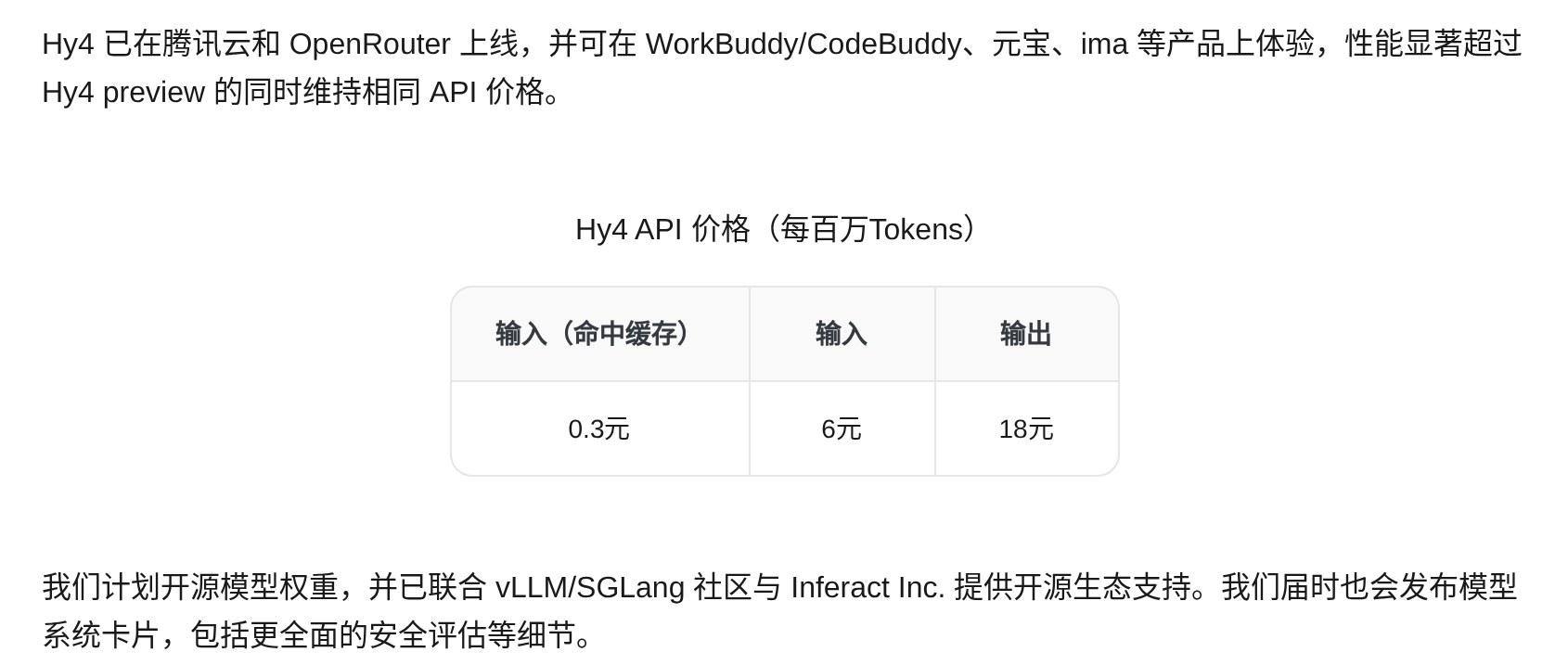
Compared with the preview released on August 28, Hy4 adds vision and computer use. API pricing is unchanged at 6 yuan per million input tokens and 18 yuan per million output tokens, or about €0.80 and €2.41 at the European Central Bank’s November 3 reference rate. The release comes two days after Meituan opened API access to LongCat-2.5, its model that plugs into Claude Code.
Vision and computer use, two firsts for Hy
Tencent says it substantially scaled up pre-training and post-training compared with the preview. The model can now read images, so it can handle fine-grained image detail and analyze complex charts. It can also operate a computer, using both the command line and the graphical interface. Tencent ran dedicated training on professional software such as Blender and CAD tools, and on long tasks that span several applications.
The post also claims gains in instruction following, long-document understanding, long-running tasks and deep research. In one demo, Hy4 locates a specific object in a satellite image; in another, it generates an interactive 3D model of a group of Tencent buildings.
A score table built mostly on Tencent’s own runs
In an appendix, Tencent publishes a table of 34 benchmarks that pits Hy4 against its preview, GLM-5.3, DeepSeek-V4.1-Flash and Kimi K3.1 Pro, plus two closed models, OpenAI’s GPT-6.1 Sol and Anthropic’s Claude Opus 5.5. Twenty of those benchmarks are Tencent’s own internal tests. Most competitor scores come from Tencent’s own runs, marked with an asterisk. Where a cell shows two values, the second one is Tencent’s.
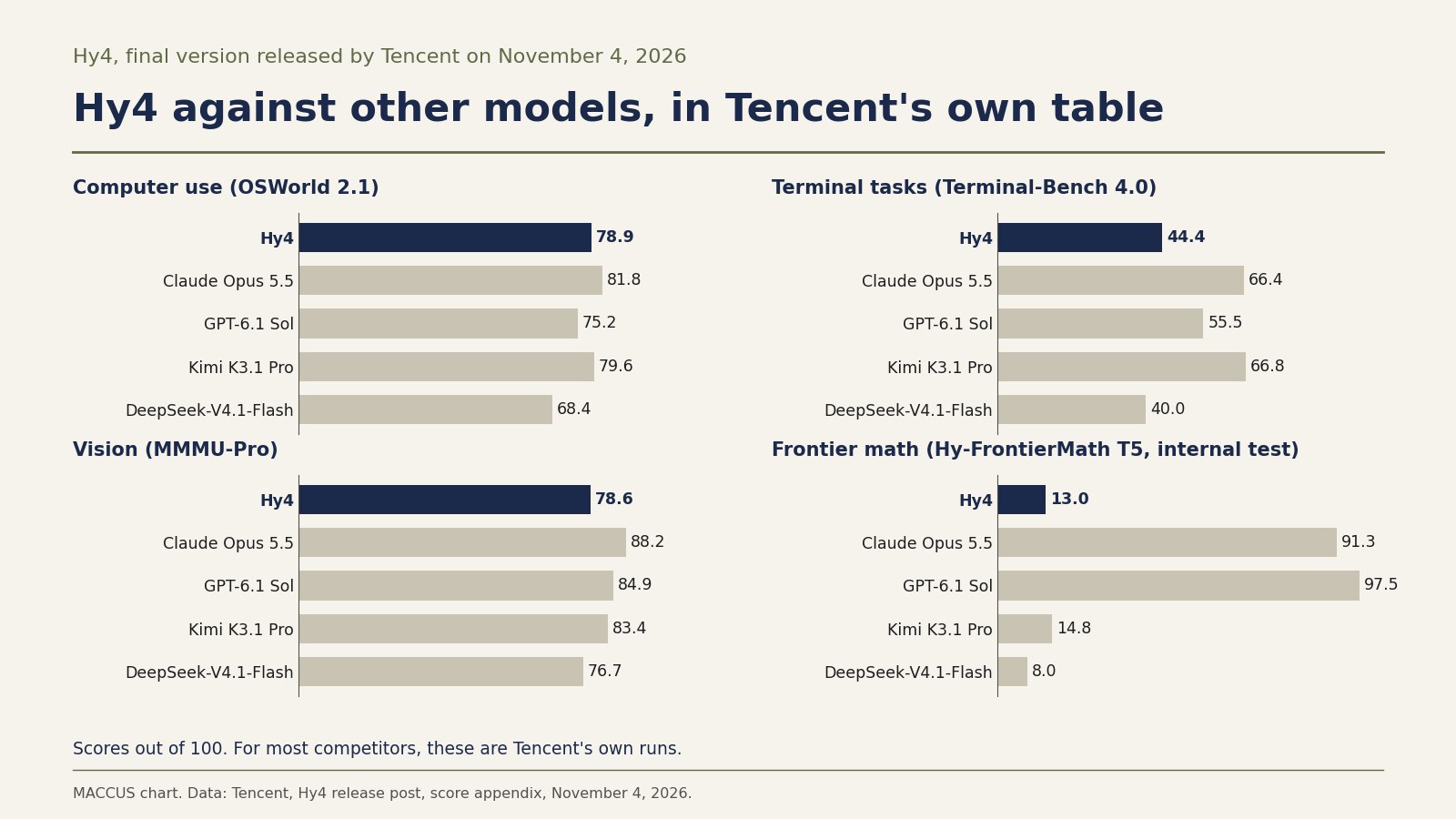
On the OSWorld 2.1 computer-use benchmark, Hy4 scores 78.9, compared with 81.8 for Claude Opus 5.5, 79.6 for Kimi K3.1 Pro and 75.2 for GPT-6.1 Sol (a Tencent run). The gap widens on terminal work: on Terminal-Bench 4.0, Hy4 reaches 44.4, while Tencent measures Claude Opus 5.5 at 66.4, Kimi K3.1 Pro at 66.8 and GPT-6.1 Sol at 55.5. The table puts Hy4 first on only two benchmarks: APEX-Agents v1.1, where it scores 75.2 to 74.8 for Claude Opus 5.5 in Tencent’s run, and Hy-LifeSearch, an internal Tencent search test.
The widest gap in the table comes on an internal Tencent math test. On Hy-FrontierMath T5, Hy4 scores 13.0, compared with 97.5 for GPT-6.1 Sol and 91.3 for Claude Opus 5.5. ProofBench, another internal test, gives it just 5.5, versus 70.5 and 42.2 for the same two models. On the ProgramBench coding test, Hy4 scores 30.0 to Claude Opus 5.5’s 56.5, and a note says Claude Opus 5.5 was blocked by content filters on 41 instances during Tencent’s run.
Finance and office work take center stage
Tencent says it built thousands of workspaces and more than 10,000 tasks drawn from real-world financial work. Working with Tencent FiT, its financial technology unit, it had 213 experts, 153 of them from financial institutions outside Tencent, evaluate the model on 579 tasks. According to Tencent, Hy4 ranks first among open models with 3.04 out of 4, ahead of DeepSeek-V4.1-Flash (2.97), Kimi K3.1 Pro and GLM-5.3 (2.68 each). No closed model appears in that comparison.
In its own tests, Tencent reports fewer errors after optimizing web search: the hallucination rate falls from 15.76% for the preview to 5.45%, and the share of errors caused by guessing drops from 23.1% to 5.6%. Hy4 can also edit Word, Excel and PowerPoint files alongside the user in real time.
The post quotes partners on their own evaluations of the model. The company behind the Manus agent reports a task completion rate of nearly 97% for creating and editing office documents. Jinmen, which runs a financial research platform for institutional investors, says Hy4 is the only Chinese model tied with Claude Opus 5.5 for second place in its internal evaluation. On data lookup, Jinmen ranks it first with 75.4 points, nearly 20 more than GPT-6.1 Sol.
Weights promised, no date
“We plan to open-source the model weights,” Tencent writes, adding that it has lined up support from the communities behind vLLM and SGLang, two inference engines, and from Inferact Inc. The model’s system card, with fuller safety evaluations, will come out “at that time.” As of early afternoon on November 4, Tencent’s Hugging Face account held only two Hy4 repositories, Hy4-preview and its FP8 version, both under the Apache 2.0 license. The “Model weights” button on the OpenRouter page links to a Hugging Face URL that isn’t publicly accessible.
The same day, the Chinese site IT Home recapped the preview’s specs, which are also listed on Hugging Face: 770 billion parameters, 49 billion of them active, and a context window of one million tokens. Tencent doesn’t give the architecture or the license of the final version. Until the weights are out, Hy4 can’t run as local AI on a company’s own servers: every request goes through Tencent’s API. On October 29, France’s Mistral AI released the weights of Mistral Large 4.
Until the system card arrives, safety gets three paragraphs in the post. Tencent says it kept only defensive cybersecurity data for training (proof-of-concept generation, vulnerability repair) and removed exploitation, reverse engineering and penetration testing content. An audit by in-house experts from its Xuanwu and Keen labs found no pronounced offensive risk. On biosecurity, Hy4 scores 30.4 out of 100 on Hy-BioExperimentBench, an in-house test, below the high-risk threshold Tencent set.
A single host on OpenRouter
On OpenRouter, Hy4 has only one provider, Tencent Cloud. The model page shows a 50% discount: $0.417 per million input tokens and $1.251 per million output tokens, down from $0.834 and $2.501, or about €0.37 and €1.12 after the discount. It lists a one-million-token context window and says the model isn’t currently available with EU in-region routing. That option, offered on OpenRouter’s Business and Enterprise plans, keeps the processing of prompts and completions in Europe.
Tencent also offers the model in its own apps, including the Yuanbao assistant, the ima knowledge base and the WorkBuddy and CodeBuddy tools.
The limits Tencent acknowledges
The post devotes a paragraph to the model’s limits. Tencent calls Hy4 “already one of the strongest open-source models,” but says the gap between it and the top closed models is still large, especially on difficult test sets Tencent built in-house: frontier math, long-horizon development, model iteration and visual question answering. Tencent also plans to release Hy4 flash soon, a faster version with better price-performance. The post cites no independent evaluation.
What it means
Hy4 adds to the list of large Chinese models available through an API on day one, this time with vision and computer use. Teams that pick their models on OpenRouter now have a final version that reads images, at the preview’s list price.
On computer use, Tencent’s table puts Hy4 close to Claude Opus 5.5 and Kimi K3.1 Pro. On terminal work, and even more on Tencent’s in-house math tests, it trails Claude Opus 5.5 and GPT-6.1 Sol by a wide margin, and Tencent itself concedes that the top closed models remain well ahead. These comparisons rest mostly on Tencent’s own runs and internal tests. The tie with Claude Opus 5.5 comes from a partner, Jinmen, using its own evaluation.
Whether Hy4 can be hosted in-house, the way Revolut runs the Chinese GLM model, depends on when the weights arrive and under what license. Until then, requests go through Tencent Cloud, the only host on OpenRouter, with no EU in-region routing.
Next to watch: a Hy4 repository on Hugging Face and its license, the final architecture, the promised system card, the first results from independent evaluators and the release of Hy4 flash.
Sources
- Hy4 正式发布, Tencent Hy, November 4, 2026
- Tencent: Hy4, OpenRouter, November 4, 2026
- In-Region Routing, OpenRouter, accessed November 4, 2026
- tencent/Hy4-preview, Hugging Face, August 28, 2026
- 腾讯混元 Hy4 正式版发布,号称首次跻身最强开源模型之列、为真实生产力而生, IT Home, November 4, 2026
Header image: MACCUS chart. Data: Tencent, Hy4 release post, score appendix, November 4, 2026