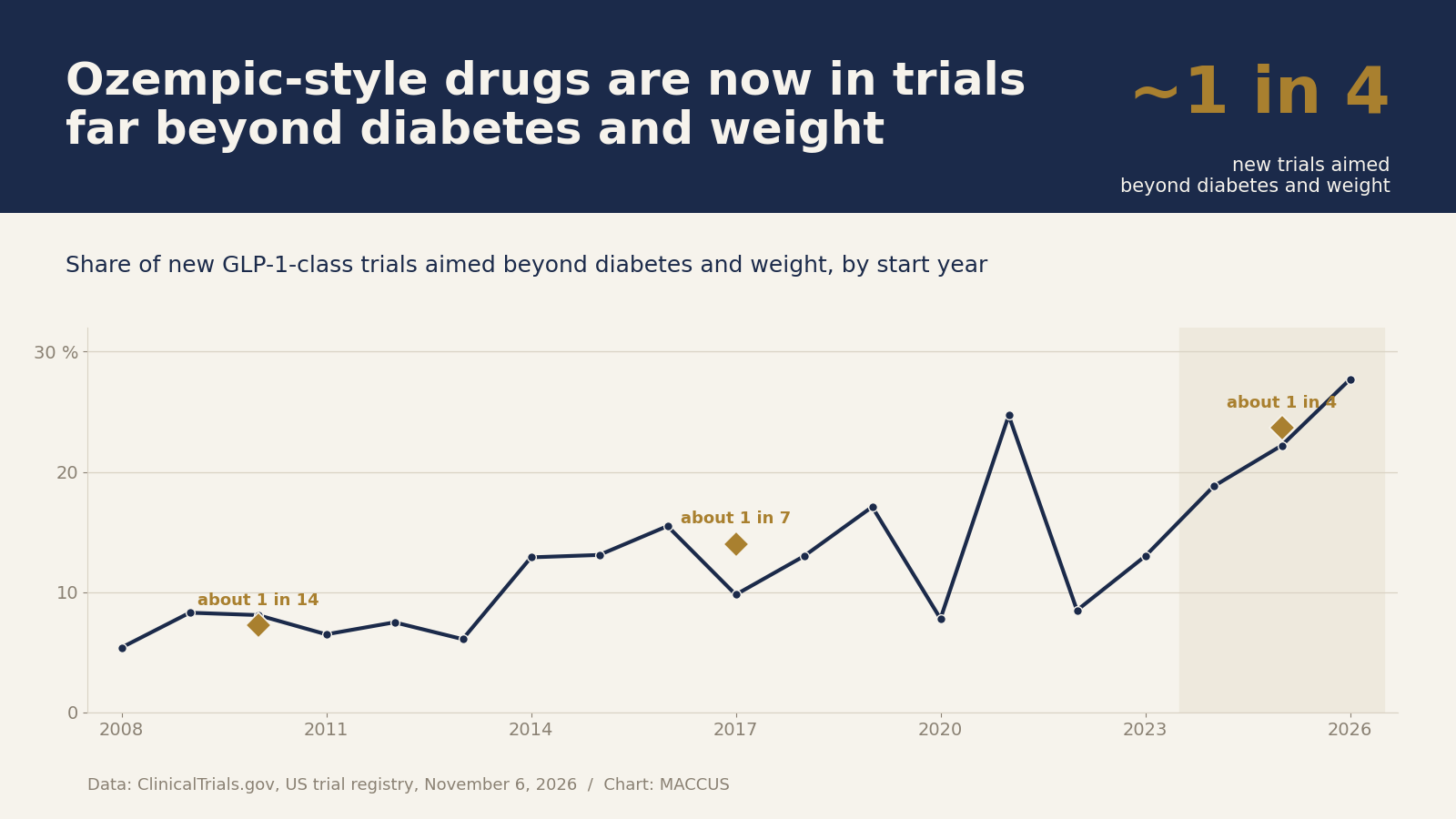

The diabetes drugs that became weight-loss blockbusters are now in human trials for heart failure, addiction, Alzheimer’s and even the biology of aging. Most of that research is still about diabetes and weight, about five in six of the trials. The change is how fast the rest is growing.
These are among the best-selling medicines in the world right now. Where they are tested next is a question about a great deal of money and a great many patients. So I went looking for how far the class has actually spread, in the one place that records it before any marketing does: the register where a trial is filed when it begins.
I went through ClinicalTrials.gov, the United States trial registry, and pulled every registered human study of a GLP-1 or incretin drug, the class that includes Ozempic, Wegovy and Mounjaro. That comes to at least eighteen hundred trials. I sorted each one by the disease it set out to treat, counted them by the year they began, and took 2026 only up to this week.
The reach past diabetes keeps widening
Fifteen years ago this barely happened. Of the new trials starting in the class back then, about one in fourteen aimed at anything other than diabetes, weight or cholesterol.
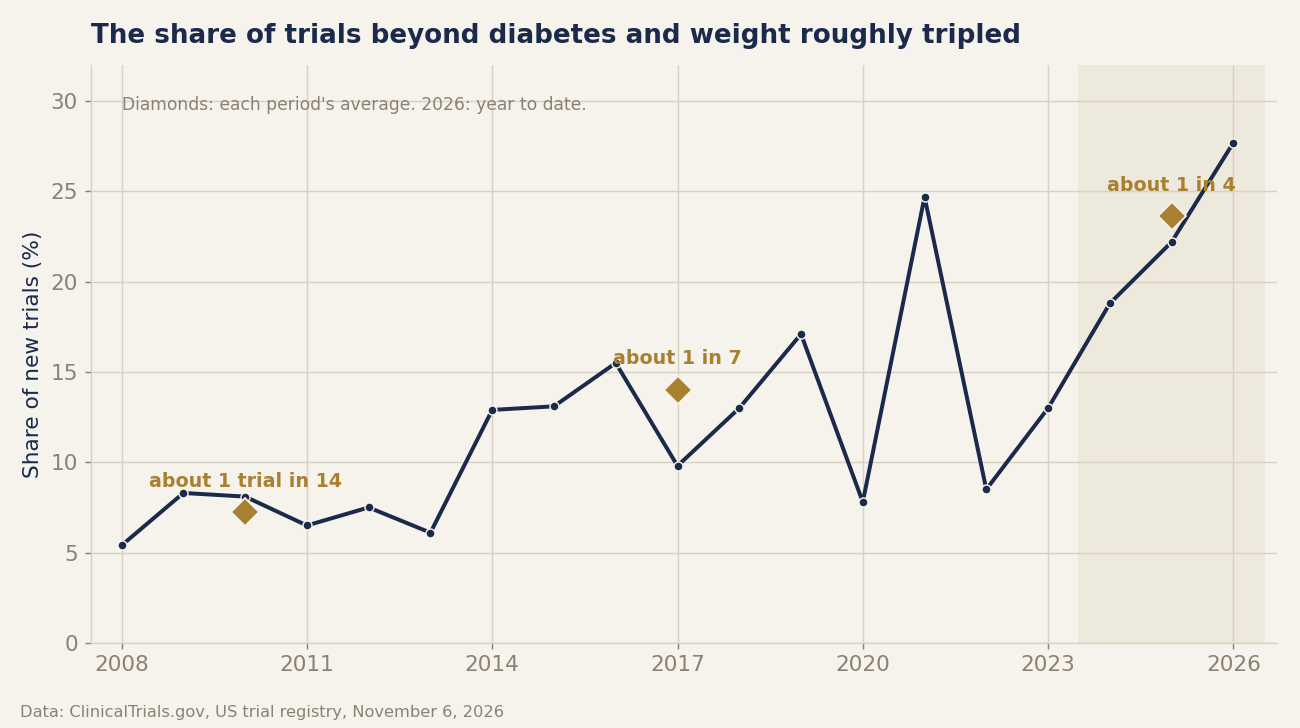
Today it is about one in four, and the line is still climbing.
Across those fifteen years the share aimed past diabetes and weight has roughly tripled. It is still a minority of the work, and a fast-growing one. The yearly figures jump around, so the chart is best read a decade at a time, not a year at a time.
The biology goes well beyond blood sugar
These drugs copy a gut hormone that blunts appetite, and the receptors it acts on sit all through the body: in the pancreas, the brain, the heart, the gut and the kidneys. A drug built to lower blood sugar keeps turning up effects in places its makers did not plan for. The commercial pull runs the same way: once a medicine becomes the best-selling product in its field, every company and every academic lab has a reason to find the next disease it might treat. Both forces push the same way, which is why the reach shows up as a broad fan of diseases rather than one careful step after another.
The map runs from the heart to the brain
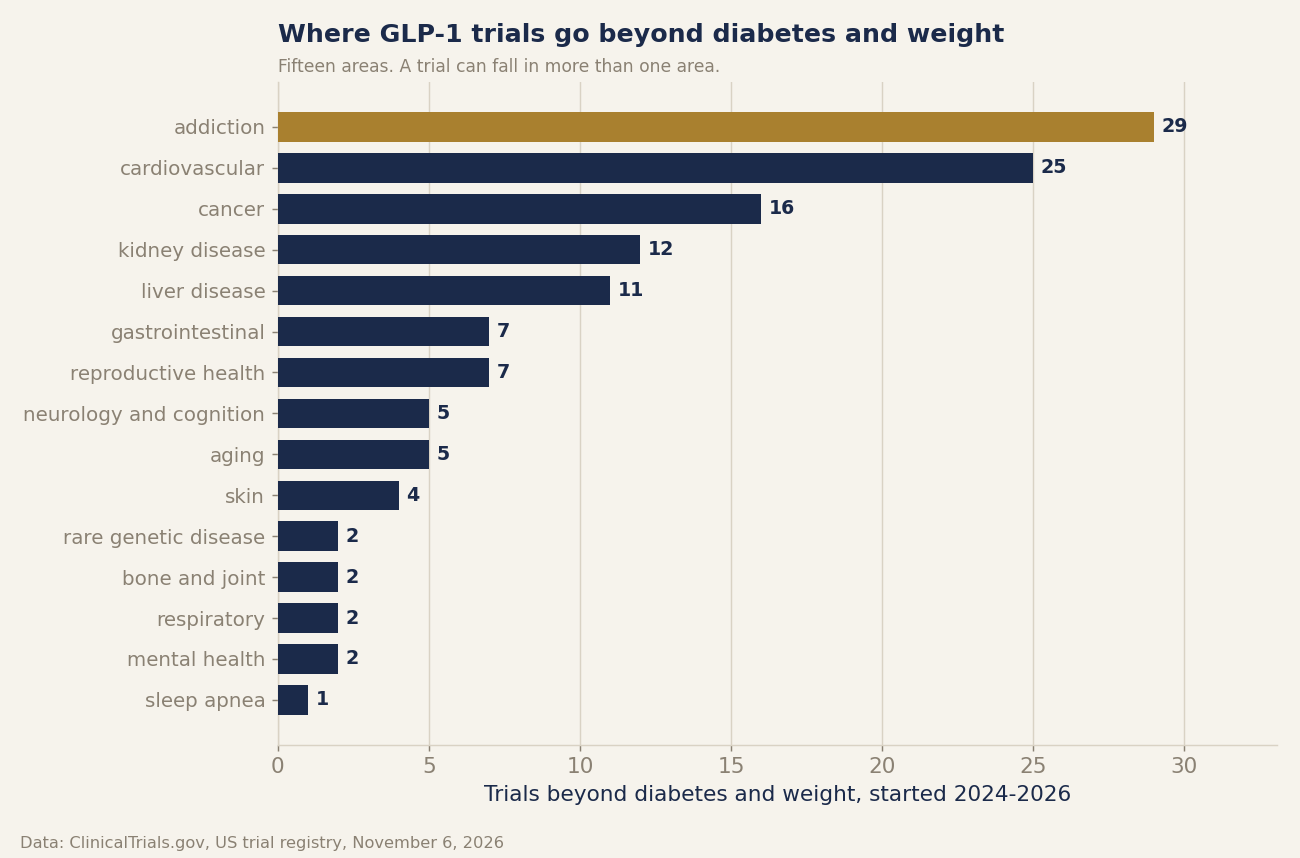
Fifteen separate disease areas turn up among the trials that began since 2024 and left diabetes and weight behind completely. Addiction leads, with studies testing whether the drugs quiet cravings for alcohol and other substances. Behind it come the heart, the kidneys, the liver and cancer. A single class of medicine is being aimed at much of the body at once, the way one new method can spread across an entire field once it starts to work.
The individual studies make the spread concrete. The US Department of Veterans Affairs is testing semaglutide, the drug sold as Ozempic, against alcohol use disorder. Imperial College London is trying it on Alzheimer’s disease. A research institute in New York is running a trial against biological aging itself. A university hospital in the Netherlands is studying it in heart failure, and a hospital in China is testing a related drug in MASH, a fatty-liver disease with no approved cure. Most of these have reached mid-stage testing, well past the first-in-human stage.
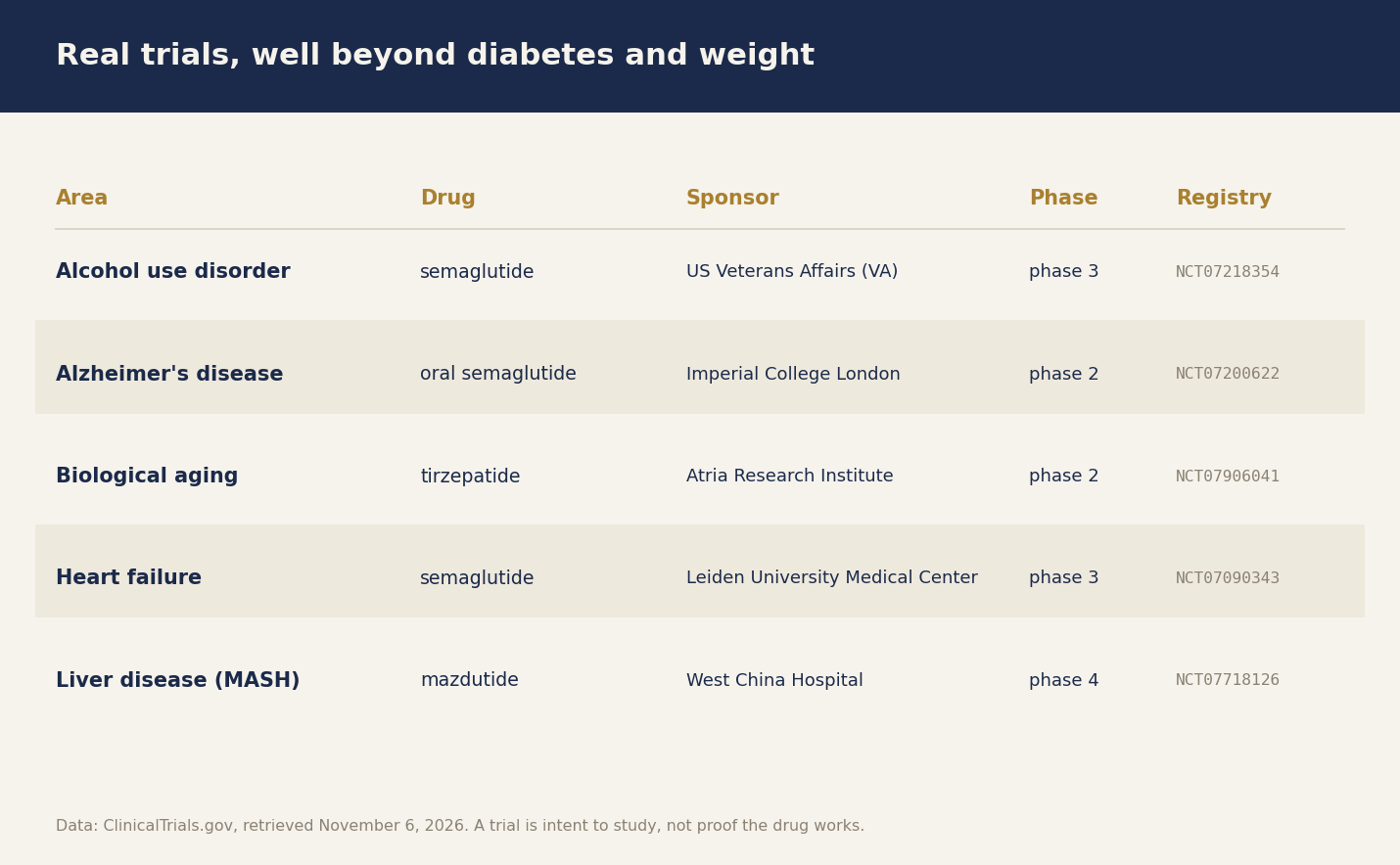
The addiction trials are the ones that make people reread the line. The drugs dull the reward that eating gives, and early signals suggest they may dull other rewards too. A shot meant to steady blood sugar is now being tried on heavy drinking and on cravings for stimulants. A veteran in the government trial is not enrolled for his weight. He is there to find out whether a weekly injection can make the next drink easier to turn down, something no pill has done reliably. That is a long way from a diabetes clinic.
No one planned this
Nobody set out to turn a diabetes drug into a treatment for much of medicine. Each research group had a plausible reason to try one: a signal in the brain here, a hint in the kidney there, a hospital with patients and a hypothesis. The pull to test is the same one that reshapes an industry once the economics shift under it. Each of those choices was reasonable on its own. Together they aim one drug class at an unusually wide stretch of human disease, with no one deciding that it should.
What it means
The pipeline is now far wider than the label on the box, and that is the part worth watching. A registered trial records an intention to study, and it proves nothing on its own. Most drug trials fail, and most of these will too. ClinicalTrials.gov is the American registry, so studies that run only in Europe or China are undercounted here, and the real spread is wider than my count.
For a European reader the second-order point is the one to sit with: the diseases that get a shot at a new treatment are being chosen, in large part, inside an American drug industry and its trial system. The direction is not subtle, and it rhymes with how a frontier moves once one bet pays off, fast and across a whole field at once.
If the share keeps climbing, the first approval of one of these drugs for a disease with nothing to do with blood sugar lands before the decade is out. The heart or the liver is the most likely place, where the trials are furthest along. These drugs already do more than treat diabetes. The open question now is how much of medicine they end up touching.
Sources
- ClinicalTrials.gov API, ClinicalTrials.gov, U.S. National Library of Medicine, retrieved November 6, 2026
- About ClinicalTrials.gov, ClinicalTrials.gov, U.S. National Library of Medicine, retrieved November 6, 2026
- Semaglutide for alcohol use disorder (NCT07218354), ClinicalTrials.gov, U.S. National Library of Medicine, retrieved November 6, 2026
- Oral semaglutide in Alzheimer’s disease (NCT07200622), ClinicalTrials.gov, U.S. National Library of Medicine, retrieved November 6, 2026
- Tirzepatide and biological aging (NCT07906041), ClinicalTrials.gov, U.S. National Library of Medicine, retrieved November 6, 2026
- Semaglutide in heart failure (NCT07090343), ClinicalTrials.gov, U.S. National Library of Medicine, retrieved November 6, 2026
- Mazdutide in MASH (NCT07718126), ClinicalTrials.gov, U.S. National Library of Medicine, retrieved November 6, 2026
Header image: chart by MACCUS, data from ClinicalTrials.gov, November 6, 2026.