In the same week, two research teams reported AI systems that plan biology experiments and then run them on real lab machines. Until now, AI has mostly suggested experiments for people to carry out; here the software did the physical work too. On November 4, 2026, the journal Nature published a paper from Shanghai Jiao Tong University describing AutoDNA, a lab where AI agents planned and ran molecular biology experiments on more than 20 machines. People mostly refilled reagents, the chemicals a lab runs on, and serviced the hardware. The same day, the AI company Anthropic reported that its model, Claude, had helped work out the first three-dimensional structure of a vault particle, a hollow protein shell, built from a protein that comes from a virus that infects bacteria. Scientists have not known what vault particles do for 40 years. Both teams gave hard numbers on how much faster the work went, and both listed where it still failed.
The AI-run DNA lab in Shanghai
The paper was received on October 1, 2025 and accepted on September 30, 2026. Its abstract says the system “autonomously orchestrates over 20 types of instruments across more than 11,000 steps” to run the basic steps of working with DNA: making it, copying it into RNA, making many copies, and reading its sequence. The abstract adds that “human intervention is limited to hardware maintenance tasks, such as reagent and labware replenishment,” meaning people refill chemicals and swap out labware like tubes and plates.
The team tested AutoDNA on four tasks. It made as much usable DNA as human experts. It ran several protocols at the same time, 3.2 times faster than running them one after another. It stored digital data in DNA and read the data back with no errors. It also found and confirmed a cancer-linked mutation, called KRAS G13D, in a patient sample.
The longest single run was the data-storage test. According to the Chinese outlet 36Kr and the Korean daily Chosun Ilbo, both relaying the team’s own release, that run lasted about 203.5 hours, roughly eight and a half days, and took 11,382 hardware steps. The system made and read back 78 DNA strands that encoded a single sentence, and recovered it without error. During the run, 36Kr reported, people were “mainly limited to regular disposal of experimental waste, and replenishment of reagents,” acting when the system prompted them. The sentence the team chose to store and read back was “Intelligence is the ability to adapt to change.”
Heidi Ledford, writing in Nature’s news pages, put the split plainly: “human hands are needed only to refresh reagents and to service hardware.” Haibo Chen, a computer scientist at the university and a co-author of the paper, told Nature that many existing systems still need people. In those, he said, “human experts are still required to configure the instruments,” and AI “is mostly added to handle just one part of the process.” Milad Abolhasani, a chemical engineer at North Carolina State University who did not work on the project, called AutoDNA “remarkable both for its degree of autonomy and because it can readily incorporate a diverse range of lab equipment.” He added that “the future of science is going to involve a lot of autonomous labs.”
Claude helps work out a vault particle’s structure
Anthropic’s team took on an older puzzle. Vault particles are hollow protein shells found in the cells of many kinds of organisms. Scientists found them in 1986 but have never worked out what they do. Anthropic reported the first 3D structure of a vault built from a bacteriophage protein, a protein encoded by a virus that infects bacteria. The shell is built from 96 copies of that protein, which the team named L05, and it holds about 25 percent more space inside than the human version, which uses 78 copies. In the lab, the shells were produced inside bacteria.
Under the scientists’ direction, the company says, Claude did several jobs. It searched protein databases, designed the DNA sequences the team ordered from suppliers, suggested a faster way to isolate the particles, and ran the software that turns microscope images into a 3D model.
Anthropic’s blog post lists the time it says Claude saved. “A vault purification that conventionally takes three days took us about 90 minutes,” the team writes, “and a first structural model was ready 34 hours later, which we estimate would normally have taken us weeks.” Purification here means separating the particles from everything else in the sample. The whole project ran, in the team’s words, “under four months.”
The search stage used a version of Claude built for science, which the company calls Claude Science, to scan about 15 billion proteins predicted by computers. It turned up related proteins in 29 groups of bacteria and four groups of archaea, a separate branch of single-celled microbes. The structure and the wider survey are written up in a preprint, a paper shared before independent scientists have checked it, posted on November 5 to bioRxiv, a free site for biology papers. The paper carries an open license and has not been peer reviewed. The post is one of several from Anthropic’s biology lab this fall. In late October, the company said Claude had helped a one-person company coordinate drug programs across 11 outside labs.
What each team says still fails
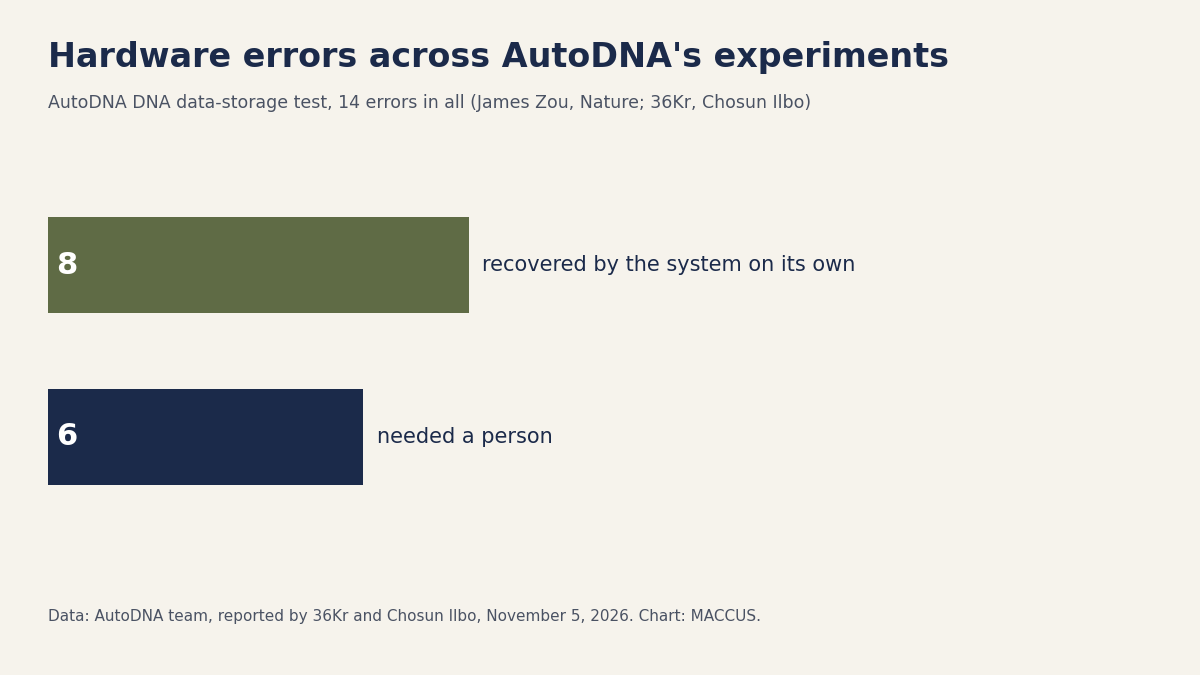
Both reports include their own limits, so the numbers are worth stating exactly rather than rounding up. AutoDNA’s team recorded 14 hardware errors across its experiments. James Zou, a data scientist at Stanford, gave the breakdown in the commentary Nature ran alongside the paper: the system fixed 8 on its own, and 6 needed a person. The team also warns that the randomness built into large language models, the AI systems behind tools like Claude, can change whether the same plan gives the same result when it is run again. It says the system cannot yet run experiments in live animals. The 11,382-step and 203.5-hour figures come from the team’s own release, relayed by 36Kr and Chosun Ilbo, not from the paper’s abstract.
Anthropic’s post is the company describing its own product, and it lists where that product failed. One protocol the model wrote called for a growth medium, the nutrient mix used to grow cells, with an additive that blocked part of the work and cost the team about two weeks. Early in the analysis of the microscope images, the model skipped a standard step and produced a flawed 3D map blended with its own mirror image, so the team told it to stop improvising.
Several questions are still open. The vaults’ job is unknown. So far the particles have been made only in E. coli, the bacterium labs use as a standard workhorse, rather than in the organisms where they occur in nature. Leonard Rome, who co-discovered vaults in 1986 and advised this project as a paid consultant, said the breadth of the finding “suggests that it is going to be a complicated function.”
What it means
In both projects, the slowest part of the work is shifting. Zou put the stakes this way in his commentary: an AI system “might design a promising biologically active molecule in minutes, but testing it can take weeks or months,” and the Shanghai work “can begin to close the gap between proposing an experiment and doing it.” Lab work is the newest field where AI has posted results, after mathematics and physics. In late October, a startup founder said an AI agent had chosen and carried out a gene therapy on a mouse on its own.
Review is still the slow part. AutoDNA first appeared as a preprint in July 2025. That earlier version ran a shorter data-storage test, 162.9 hours over 9,365 steps, compared with the 203.5 hours and 11,382 steps of the current system. The paper then took about a year to go from submission to publication. Anthropic says its own project went from a 15-billion-protein search to a finished structure in under four months. In both cases the planning speeds up, and the time that is left sits in the hardware, the reagents and the review.
The useful line to draw is between what was announced and what was shown. AutoDNA is a peer-reviewed paper, with a named list of the tasks people still did by hand. The vault structure is a preprint from a company describing its own product, with its own list of mistakes attached. In both projects the plan, the code and part of the analysis went to an AI model, while a smaller team of people kept the machines running and checked the results. That is still a long way from a lab with no scientists in it. The thing to watch next is whether either result holds up when another lab repeats it, on a different model, without the original authors guiding it.
Sources
- An AI-native experimental laboratory for autonomous biomolecular operations, Nature, November 4, 2026
- AI agents run this automated biology lab that sequences DNA and more, Nature, November 4, 2026
- AI agents enter the ‘wet lab’, Nature, November 4, 2026
- Shanghai Jiao Tong University AI Native Lab’s AutoDNA Published in Nature, 36Kr, November 5, 2026
- Chinese AI Scientist Completes 11,382-Step Experiment in 203 Hours, Chosun Ilbo, November 5, 2026
- Investigating vault particles with Claude, Anthropic, November 4, 2026
- Prokaryotic homologs of the major vault protein form engineerable vault nanocapsules, bioRxiv, November 5, 2026
- An AI-native experimental laboratory for autonomous biomolecular engineering, arXiv, July 3, 2025
Header image: charts by MACCUS, data from Anthropic (November 4, 2026) and the AutoDNA team via Nature, 36Kr and Chosun Ilbo (November 4 to 5, 2026)