On November 5, 2026, Google released Gemini Omni 1.2 Flash, a new version of its AI model that creates and edits video with sound. Clips can now run up to 15 seconds, up from 10 with version 1.1. The model is coming to Google Vids, the video editor in Google’s Workspace office suite, at no additional cost. In Google Ads, it now powers ad creation.
For developers, the price falls 30% from version 1.1, according to Google. They use the model through the Gemini API, a service for building Google’s models into their own software. One second of 720p video, basic high definition, costs about $0.07.
Anish Nangia, a product manager at Google’s AI lab, Google DeepMind, announced the release on The Keyword, the company blog. “For the first time, Gemini Omni is now generally available,” Nangia wrote. The next day, Google Cloud, the company’s cloud division, called it “production-ready.”
On October 20, Google introduced a Gemini hub built for small business owners, with easier connections to Google Ads, Google Workspace and other tools.
Longer clips, edited one prompt at a time
Users choose the clip length in one-second steps, from 3 to 15 seconds. Google says the new maximum is enough to show off a product or make a complete social media ad in one clip.
Conversational editing now works on full 15-second clips. Each new prompt, a written instruction, changes one element without remaking the whole video. That element can be the product, the background, the lighting, the weather or the aspect ratio, the shape of the frame. Google pitches this as a way to adapt the same ad for different audiences and ad placements.
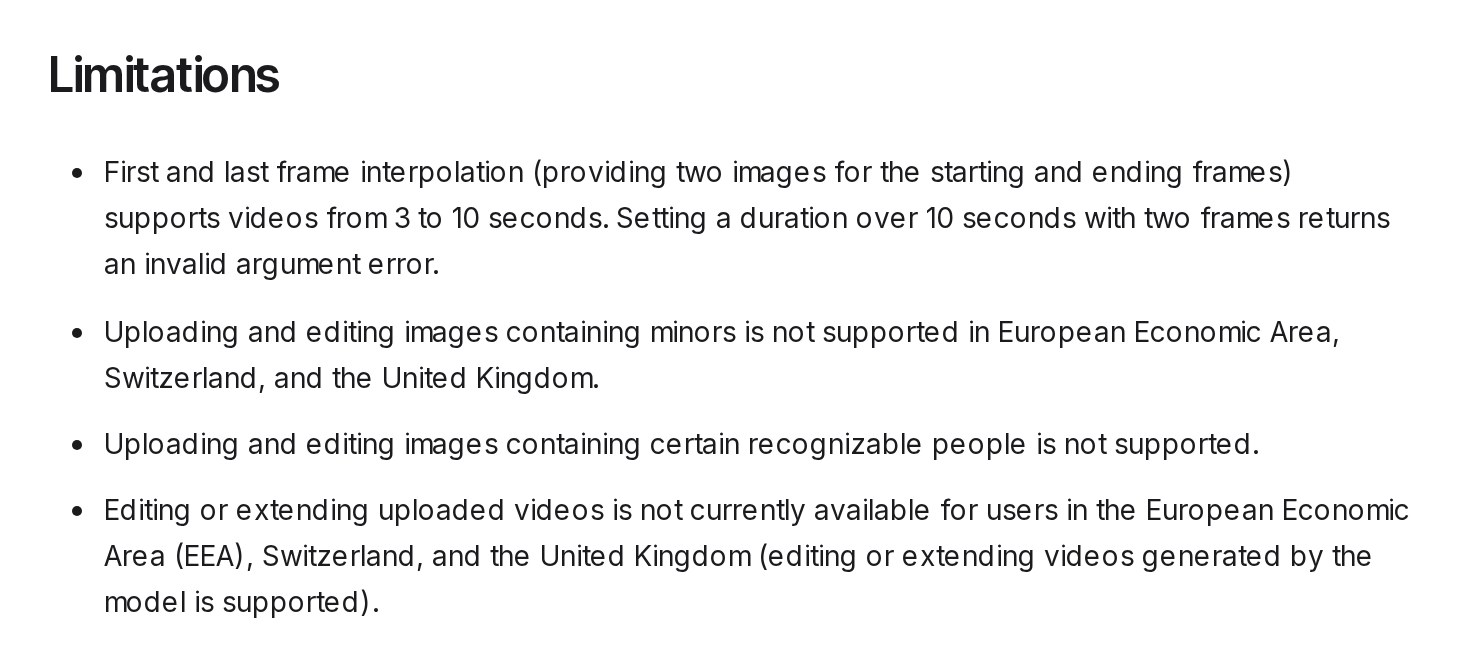
The API offers two frame formats: landscape (16:9) and portrait (9:16). Each follow-up prompt can extend a clip by 3 to 10 seconds, up to 30 seconds in total.
The model can also take reference material: photos of a character, a product or a style, motion clips of up to three seconds, and audio cues. According to Google, faces, clothing, packaging text and brand colors then stay consistent from one camera angle to the next. The API documentation allows up to six reference images but no audio references yet. On Google Cloud, only customers on an approved list can use audio references.
Google also promises more natural dialogue, sharper lip-sync and more distinct voices when several characters speak.
A 30% price cut on the API
Google bills the video the model generates in tokens, the units that measure an AI model’s input and output. Video output costs $12 per million tokens, down from $17.50 for Omni 1.1. One second of 720p video counts as 5,792 tokens, or about $0.07, versus about $0.10 with version 1.1. The API has no free tier for this model.
To keep costs down, Google recommends drafting at 360p or 720p, the two lowest resolutions, fixing details with a follow-up edit instead of regenerating the clip, then upscaling the best takes to a higher resolution. The documentation says 1080p (full HD) and 4K (ultra HD) are available only through upscaling.
| Resolution | Price per second | 15-second clip |
|---|---|---|
| 360p | $0.023 | $0.35 |
| 720p | $0.07 | $1.04 |
| 1080p (upscaled) | $0.104 | $1.56 |
| 4K (upscaled) | $0.209 | $3.13 |
The per-second prices come from the Gemini API pricing page, and the 15-second totals are our calculation. Both cover only the video output. The prompt and any reference images sent to the model cost extra, at $1.50 per million tokens.
Starting December 3, 2026, the API will redirect every request for Omni 1.1 to Omni 1.2, according to the documentation. Developers won’t need to change their code, and those requests will be billed at the Omni 1.2 rate.
Google Cloud, which also sells the model, offers Provisioned Throughput, a way to reserve guaranteed computing capacity in advance. The Gemini API doesn’t offer that option for this model.
Included in Vids, with a monthly cap
The model started rolling out in Google Vids on November 5, according to the Google Workspace Updates blog. It takes one to three days to reach accounts. A slider sets the clip length, and the feature has no separate setting in the admin console, where companies manage Workspace. Eligible plans include Workspace Business and Enterprise (Starter, Standard and Plus), personal Google accounts, and the paid Google AI Pro and Ultra subscriptions.
The model comes “at no additional cost” in Vids, but use is capped. The Vids help page, checked on November 7, allows 200 seconds of AI-generated video a month on Business Starter. That is a little over 13 clips of 15 seconds. The cap rises to 500 seconds on Business Standard and Plus and drops to 60 seconds on a personal Google account.
The help page doesn’t name the model. According to the Workspace Updates blog, an add-on license called AI Expanded Access raises Omni’s usage limits in Vids.
Google Ads, Flow and the Gemini app
In Google Ads, Omni 1.2 now powers Asset Studio, the tool for creating ad content. It makes horizontal, vertical and square videos for YouTube and other Google campaigns. Google announced this on November 5 in “Creative Drop #2,” a batch of new features posted on the US edition of its Accelerate with Google site. That post gives no price, no usage cap and no rule specific to Europe.
In late October, the search news site Search Engine Roundtable reported a separate video change. Google Ads had started adding, by default, the advertiser’s own videos found on its other channels to new Performance Max campaigns. Performance Max is the campaign type that serves ads across all of Google’s ad networks.
The model is also coming to Flow, Google’s tool for directing video scenes, and to the consumer Gemini app. In the app, 15-second videos are rolling out only to Google AI Ultra subscribers. The tech site Android Authority noted that Google hasn’t said whether free Flow users get every feature.
Google’s announcements disagree about Gemini for business, its Gemini offering for companies. The November 5 post says the model is generally available there. The Google Cloud post of November 6 first lists it as available, then says the model is “coming soon” to Gemini for business.
Tighter API limits in Europe, full support only in English
The API documentation sets restrictions for the European Economic Area, Switzerland and the United Kingdom. The European Economic Area is the 27 European Union countries plus Iceland, Liechtenstein and Norway. In those countries, editing or extending a video the user uploads “is not currently available.” Videos generated by the model can still be edited and extended in every region where the service is offered.
In the same countries, the API doesn’t support uploading or editing images that show minors. Everywhere, it doesn’t support voice editing or images showing “certain recognizable people.” Google doesn’t say whether these restrictions also apply in Vids or Google Ads.
Only English is “fully supported,” according to the documentation. Other languages “have not been evaluated,” Google warns: they may work, but results can vary. The Vids help page says many AI features in Vids are also available only in English for now.
Google’s claims come without benchmark numbers
Google publishes no benchmark numbers comparing Omni 1.2 Flash with version 1.1 or with rival models. Benchmarks are standard tests used to compare AI models. The claimed gains rest on Google’s own examples and on testimonials from customers chosen by Google Cloud.
Matt Rouif is CEO and co-founder of Photoroom, a Paris company that edits product photos. He says Photoroom chose Gemini Omni Flash to power its video ad maker and its product animation tool. He adds that 15-second videos were “a top user request.”
Richard Girges, chief technology officer of QuickFrame AI, says a complete connected TV ad now fits in a single clip at 1080p. QuickFrame AI is a tool for creating ads for social media and connected TV, meaning TV sets linked to the internet.
Google says work continues on fast sports action, complex physics and “rapid script changes,” a phrase the announcement doesn’t explain.
Every video carries SynthID, an invisible watermark that software can detect to check where content came from. Anthropic, which makes the Claude assistant, also puts an invisible watermark on text from its recent Claude models. The company had announced plans to extend it to four older models starting November 3.
What it means
The main change is access. Google’s video model is now stable, billed by the second and landing in two tools many businesses already pay for: Google Workspace and Google Ads.
On the API, a 15-second clip costs about a dollar of video output at 720p, and three times that in upscaled 4K. Google presents prompt-based edits as a way to save money but doesn’t say how an edit is billed.
No independent test came with the launch, so quality is still unproven. Two limits matter for professionals in Europe. For now, the API won’t edit videos they upload, and English is the only language Google says it has evaluated.
OpenAI is widening its animation tools too. On November 4, it began opening animated GIF creation to every ChatGPT user.
Google hasn’t said what usage limits and European rules apply to Omni 1.2 in Google Ads, or what the model’s own caps are in Vids. It is also unclear how well the model handles dialogue in languages other than English, and when it reaches Gemini for business. The next date to watch is December 3, when Omni 1.1 requests switch to version 1.2.
Sources
- Gemini Omni 1.2 Flash: Fast and cost-effective with longer clips, Google (The Keyword), November 5, 2026
- Gemini Omni 1.2 Flash: Fast, cost-effective, and reliable video generation and editing now generally available, Google Cloud, November 6, 2026
- Gemini Developer API pricing, Google AI Studio, accessed November 7, 2026
- Generate and edit videos with Gemini Omni Flash, Google AI Studio, accessed November 7, 2026
- Gemini Omni 1.2 Flash now in Vids with 15-second generations and improved quality, Google Workspace Updates, November 5, 2026
- Learn about availability of Gemini features in Google Vids, Google Docs Editors Help, accessed November 7, 2026
- Inside Creative Drop #2: Fresh AI features to get your campaigns holiday-ready, Google Ads (Accelerate with Google), November 5, 2026
- Google announces Gemini Omni 1.2 Flash with the ability to make 50% longer video clips, Android Authority, November 5, 2026
Header image: MACCUS chart. Data: Google, Gemini API pricing page, accessed November 7, 2026