
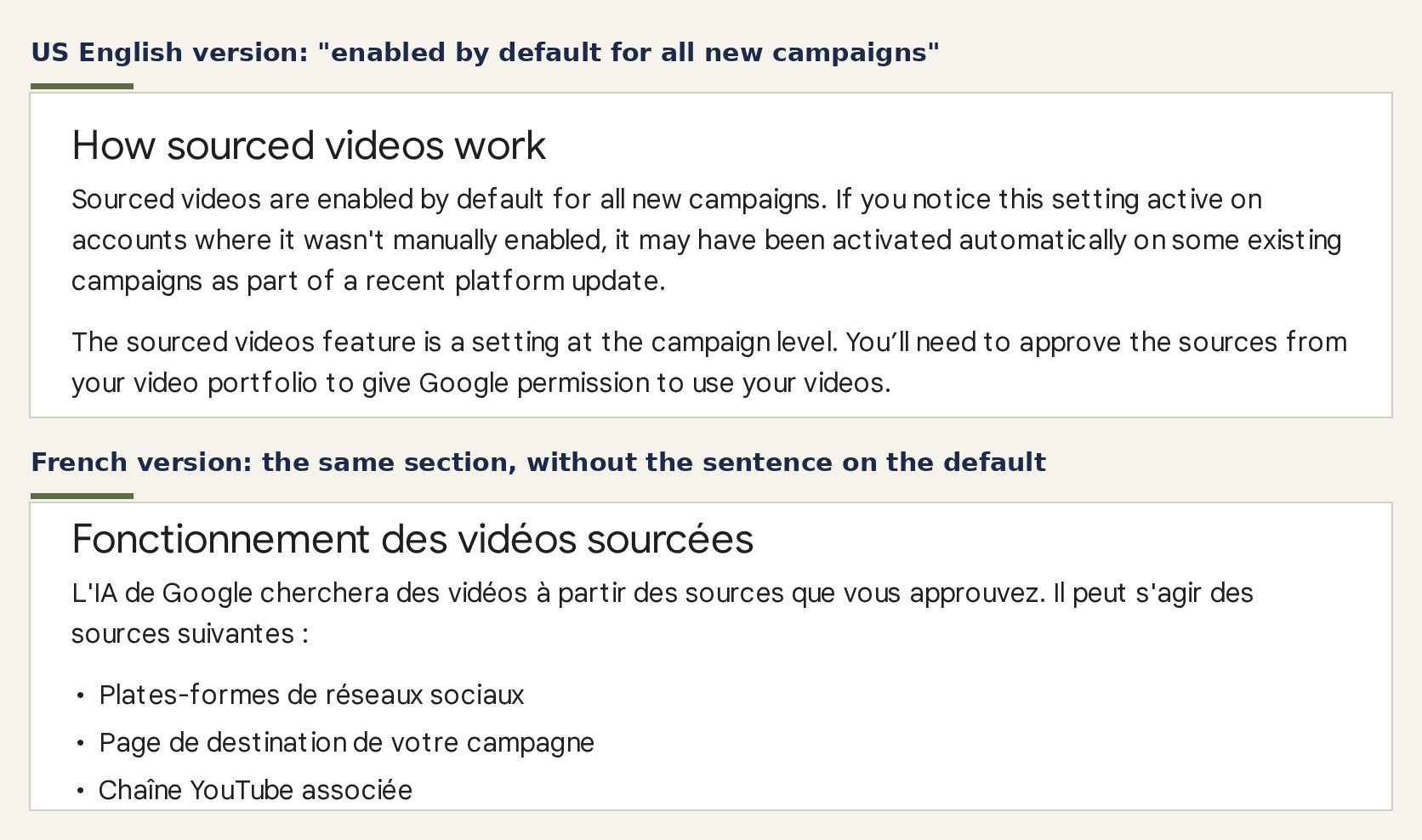
Google has changed how “sourced videos” work in Performance Max, its campaign type that serves ads across all of Google’s ad channels. According to the US English version of the Google Ads help page, checked on October 25, 2026, the feature is now “enabled by default for all new campaigns,” and it “may have been activated automatically on some existing campaigns as part of a recent platform update.” That lets Google add up to 10 videos per asset group, found on social media platforms, on the campaign’s landing page or on the advertiser’s linked YouTube channel.
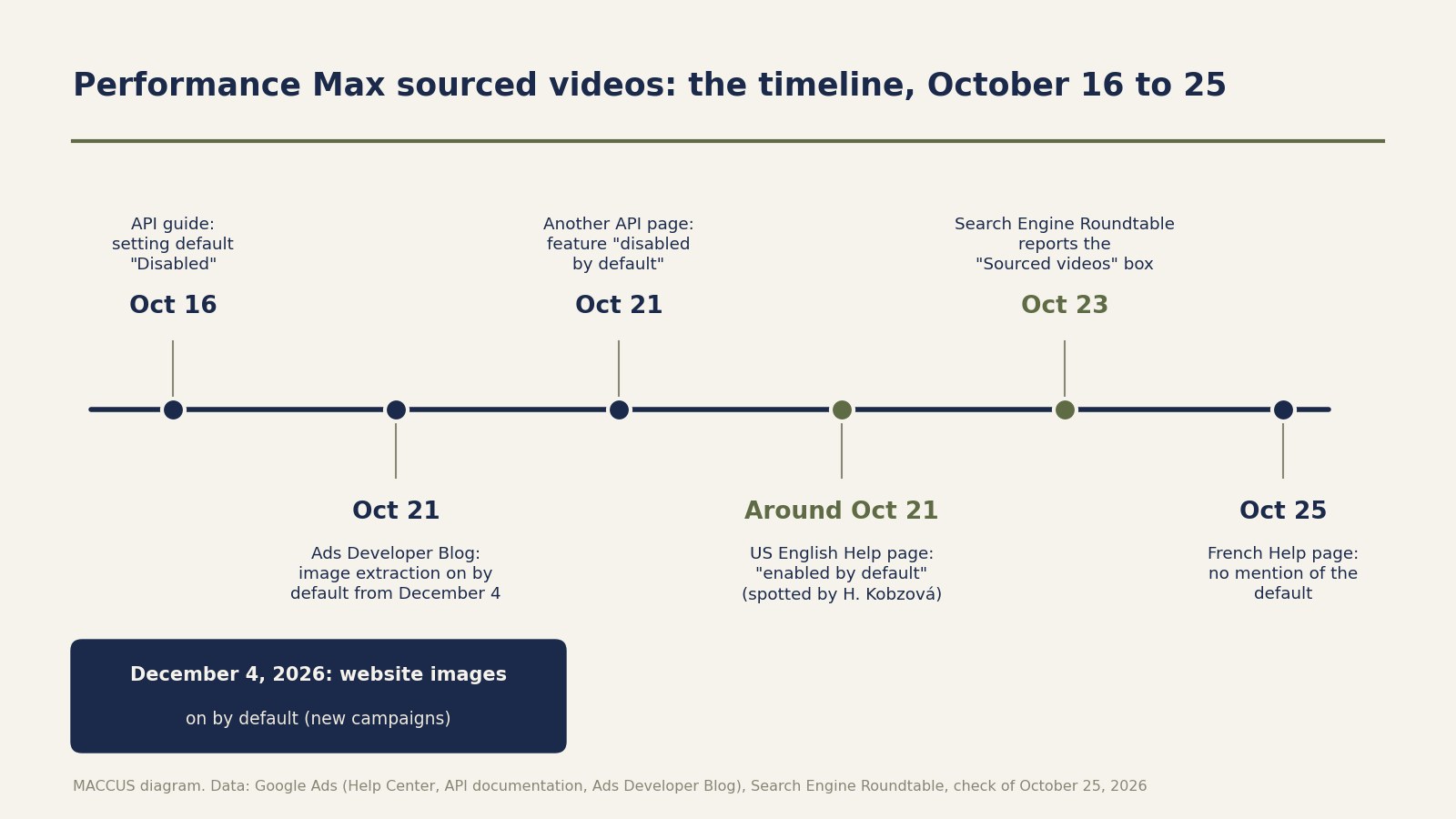
Google hasn’t announced the change or given a date for it. Hana Kobzová, founder of the trade site PPC News Feed, spotted it in the documentation, and Barry Schwartz reported it on Search Engine Roundtable on October 23, 2026. The French version of the same help page doesn’t mention the new default yet.
A box that comes checked
The setting sits in the “Asset optimization” menu of each Performance Max campaign. Search Engine Roundtable published a screenshot: the option carries a “New” label and reads “Use videos from other channels.” Reva Minkoff flagged it on LinkedIn, asking whether anyone had seen it yet.
Kobzová summed up the change in a line quoted by Search Engine Roundtable: it “no longer requires advertisers to opt-in manually.” Until now, Google used these videos only if the advertiser checked the box. In a new campaign, the advertiser has to uncheck it to keep them out.
Three possible sources and 10 videos per asset group
The help page lists three kinds of sources: “social media platforms,” the campaign’s landing page and the linked YouTube channel. The Google Ads API documentation narrows down the first one. It refers to “organic social channels linked on your landing page,” meaning the advertiser’s accounts that the page links to.
Google’s system picks videos based on their relevance to the campaign, their “performance potential” and how well they follow best practices, such as aspect ratio. The selection is refreshed on a recurring basis, and a video taken down from its original platform disappears from Google Ads too. These videos run alongside the ones the advertiser uploaded and the ones made with Google’s video generation tools.
To qualify, a campaign needs a daily budget of more than $5, about €4.50 at the European Central Bank’s reference rate for October 23, 2026. The advertiser also has to approve the sources in its “video portfolio” to give Google permission to use its videos, and can change that list at any time. The US English page says the feature is rolling out in stages and may not be available in every account yet.
A YouTube channel in the business’s name, owned by Google
Any video the campaign serves has to be hosted on a YouTube channel. Google says sourced videos will be uploaded to “a dedicated Google-owned YouTube channel” that carries the advertiser’s logo and business name and sends viewers to its landing page. Antonio Fernandez, founder of the agency Relevant Audience, gave an example in an analysis published October 24: a clip shared on Instagram or embedded on a product page can end up on YouTube, under the business’s brand, on a channel that Google owns.
He also noted that the page doesn’t say who can see that channel or how long the copies stay there. In its help article on video assets for Performance Max, Google already describes a “House channel,” a Google-managed YouTube channel that spares advertisers from creating their own. On it, an advertiser can’t access YouTube Analytics, edit the title or description, add a custom thumbnail or appeal a video takedown. Google doesn’t say whether sourced videos end up on a House channel.
Automatic video isn’t new in Performance Max. The same help article says that if an advertiser provides no video, “Google will create videos automatically when possible,” using its other assets.
Google’s own documents contradict each other
The US English version of the help page describes the feature as on by default. The French and UK English versions, checked on October 25, 2026, between 1:10 and 1:20 a.m. Brussels time, include neither that sentence nor the note about the staged rollout. The French version only says the “Vidéos sourcées” (sourced videos) box can be unchecked to turn the feature off.
The API’s asset automation settings guide, updated October 16, lists the default for this setting (AUTOMATED_VIDEO_CRAWL) as “Disabled.” Another page of the same documentation, updated October 21, still calls it an “optional feature” that “is disabled by default” and has to be turned on explicitly. Google doesn’t say whether the API and the interface have different defaults.
Google doesn’t date the update that may have checked the box in existing campaigns, or say which campaigns it touched. Nothing on the page says whether an auto-enabled campaign serves videos before the advertiser has approved any sources, even though the page presents that approval as the permission Google needs. It’s also silent on rights to music or to videos shot by third parties. Fernandez points to the same gaps.
Website images follow on December 4
On October 21, 2026, Dora Sun of the Google Ads API team announced on the Google Ads Developer Blog that image extraction will be on by default for every new Performance Max campaign starting December 4, 2026, in the API, the interface and Google Ads Editor. The feature scans landing pages for high-resolution images and uses them across Search, YouTube, Display, Discover, Gmail and Maps.
The new default will apply even when dynamic images are turned off at the account level. Until now, a campaign with no setting of its own followed the account-level setting. Existing campaigns keep their current configuration. The post also includes an instruction that the sourced videos page lacks: “As with all automated asset features, confirm that you own all legal rights or permissions to the images published on your landing pages and allow Google to utilize them for commercial and advertising purposes.”
What it means
For a new Performance Max campaign, the burden shifts: an advertiser who doesn’t want its social media videos in its ads now has to say so, campaign by campaign. The US English page names no country exceptions and describes a staged rollout, so advertisers in France and Belgium may be affected, even though the French help page says nothing about it.
Other recent and upcoming settings work the same way, including outside Google. Google has been able to add automated promotions to ads since October 12, OpenAI will let its AI rewrite ChatGPT ads by default at the end of October, and starting October 28, a tap on a Meta ad may, unless the advertiser opts out, open a Meta storefront before the advertiser’s site. In all four cases, the platform turns the option on by default and it’s up to the advertiser to turn it off.
Google describes sourced videos as a time saver and a way to improve performance, without publishing any numbers to back that up. For retailers and creators, the more immediate question is rights. Relevant Audience gives two examples: a video posted with music from a platform’s library, or shot by a creator under a contract limited to organic posts, isn’t necessarily cleared for paid ads. The copyright and music rules that govern influencer content in France and Belgium still apply, and Google’s post on images says that, for all automated asset features, confirming the rights falls to the advertiser.
Still unknown: the date of the update, which campaigns it touched, which social platforms Google crawls and the exact status of the YouTube channel. Three signals are worth watching: an announcement or clarification from Google; an update to the API documentation, which still describes the option as off by default; and changes to the French version of the help page. On December 4, landing page images will move to the same default in new campaigns.
Sources
- About sourced videos in Performance Max campaigns, Google Ads Help (US English version), accessed October 25, 2026
- À propos des vidéos sourcées dans les campagnes Performance Max, Google Ads Help (French version), accessed October 25, 2026
- Google Ads Asset Optimization Sourced Videos On/Off Toggle, Search Engine Roundtable, October 23, 2026
- Asset automation settings, Google Ads API documentation, updated October 16, 2026
- Assets in a Performance Max Campaign, Google Ads API documentation, updated October 21, 2026
- Upcoming changes to image extraction in Performance Max campaigns starting December 4, 2026, Google Ads Developer Blog, October 21, 2026
- About video assets for Performance Max campaigns, Google Ads Help (US English version), accessed October 25, 2026
- Google Performance Max turns on sourced videos by default, Relevant Audience, October 24, 2026
Header image: MACCUS diagram, data from Google Ads (Help Center, API documentation, Ads Developer Blog) and Search Engine Roundtable, October 16 to 25, 2026