A study for the European Commission finds that EU rules have done little to make online advertising by Google, Meta and Amazon more transparent. The rules were meant to let advertisers and publishers (the websites that sell ad space) verify what ads cost and what they deliver. According to the 571-page study, posted by the EU Publications Office on October 29, 2026, neither group has seen a significant improvement.
The research firm AWO wrote the study for DG CNECT, the Commission’s digital policy department. Its authors, Nick Botton, Lex Zard and Oana Goga, assessed several EU laws, including the DMA and the DSA. The Digital Markets Act (DMA) sets obligations for “gatekeepers,” the very large platforms the Commission designates. The Digital Services Act (DSA), an EU law on online platforms, also sets rules for their advertising.
The study’s summary calls the transparency gains since the DMA took effect “piecemeal, and insufficient.” In its view, advertisers and publishers still lack the information to make informed decisions about where to spend their money. The manuscript dates from April 2026, and the report says it reflects only the authors’ views. PPC Land, a trade site, summarized the study on November 5.
Three DMA obligations with no notable effect
Article 5(2) of the DMA bars gatekeepers from combining a user’s personal data across their services for advertising unless the user consents. According to the study, the rule and the platforms’ compliance measures “do not appear to have had a significant impact” on the market.
An association of ad-tech intermediaries, the firms that broker ads between advertisers and websites, calls the result a “great disappointment,” because “nothing has changed.” It suggests the design of the consent prompts led most users to opt in.
Articles 5(9) and 5(10) require gatekeepers to tell advertisers and publishers, on request, the price paid for each ad and the amount passed on to the publisher. Access to this data has not significantly improved, the study finds. Advertisers still don’t see the details of the automated auctions that set the price of each ad view.
Google, for example, gives publishers in the European Economic Area (the EU plus Iceland, Norway and Liechtenstein) files on bids and on impressions, meaning ad views. According to a publishers’ trade group, the files lack a shared identifier, so a bid can’t be matched to the ad view it produced. One publisher calls them “worthless.” Google does offer that link in a separate file, the group says, but it costs extra and leaves out bids aimed at users in the region.
In their DMA compliance reports, Amazon, Google and Meta say they already complied with these articles before the rules took effect. In its 2025 report, Google writes that it has taken no new measures for these articles since March 6, 2024.
Article 6(8) requires gatekeepers to give advertisers and publishers the data they need to verify their ads’ performance themselves. That access “has not meaningfully improved,” the study finds. The data isn’t detailed enough for an outside firm to verify results, and advertisers have little insight into where their ads appear.
Most surveyed advertisers rely on the platforms’ own figures
The authors interviewed 60 stakeholders, including 14 advertisers, Amazon, Apple, Google and Meta. The research firm RONIN International also surveyed 50 advertisers: 20 in Germany, 13 in France, 7 in Ireland, 6 in the Netherlands, 3 in Belgium and 1 in Austria. Of those 50, 37 work at companies with 250 or more employees.
Almost all respondents (96%) measure their results with the built-in tools of Google, Meta or Amazon. Only a third (34%) rely on an independent measurement firm. On pricing, they split evenly: 48% say they have enough information to understand ad prices and why they change, and 48% say they don’t.
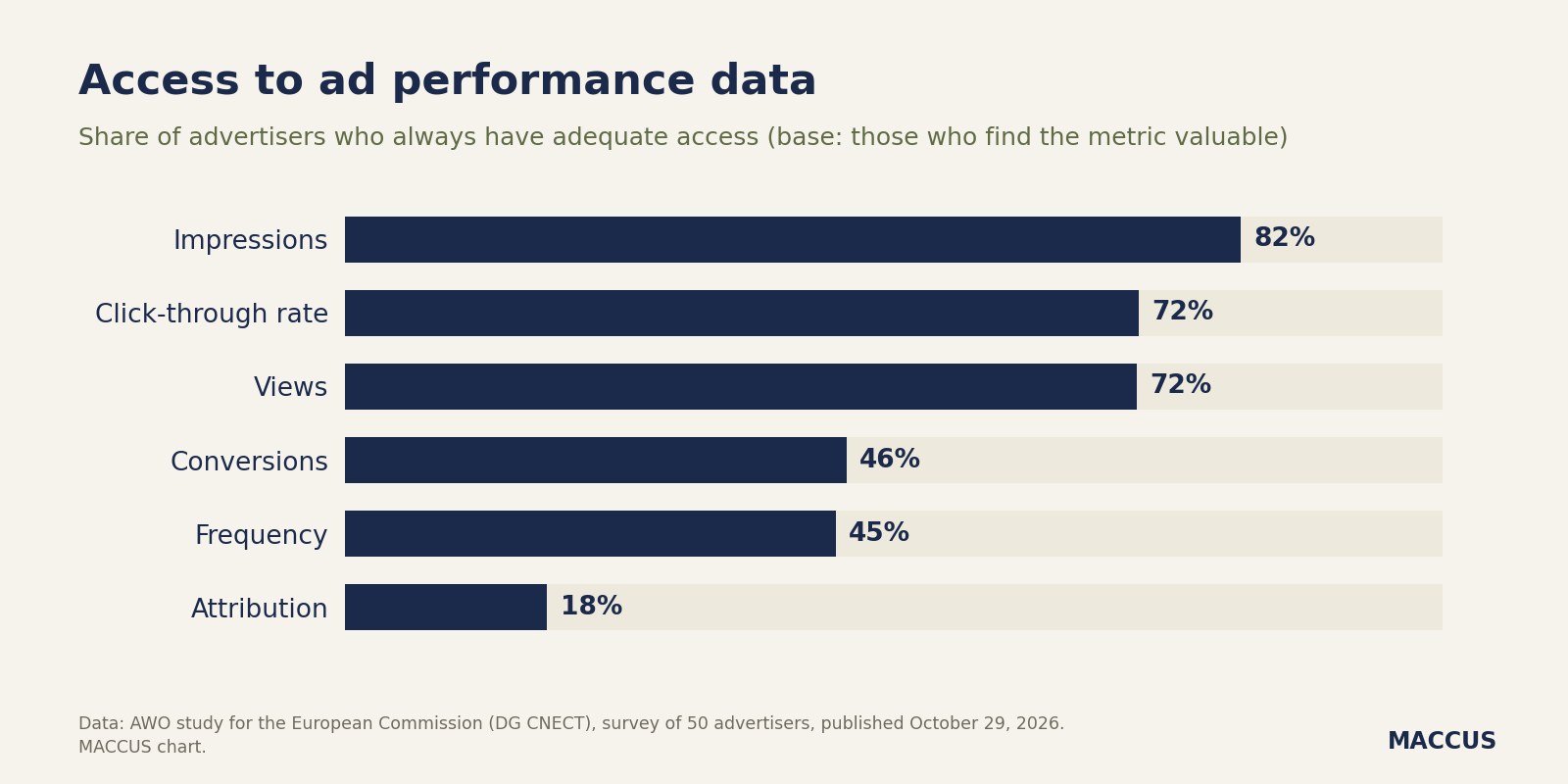
Nearly six in ten (58%) say they receive raw data on each ad view that would let them verify results themselves. On specific metrics, the survey counts only the respondents who find each one valuable. Among them, 82% say they always have adequate access to impression counts. Only 18% say the same for attribution, meaning the share of a sale credited to each ad the customer saw.
AI-driven targeting worries advertisers
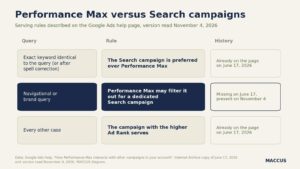
The study looks at tools that hand audience selection to an algorithm, such as Google’s Performance Max and Meta’s Advantage+. Performance Max runs a single campaign across all of Google’s ad networks. Of the 50 respondents, 60% have used Performance Max, 48% Advantage+ and 12% Performance+, Amazon’s equivalent. Just over a quarter (28%) have used none of them.
The results respondents report lean positive: 12% see a large increase in performance and 44% a small one, while 8% see a small decrease. Yet the growing use of AI by platforms and ad-tech intermediaries worries them. They fear less control over targeting (62%), performance that is harder to verify (46%) and higher costs (28%). Only 8% have no concerns.
In interviews, several advertisers describe these tools as “black boxes.” “The problem with some of the more AI-driven systems is that they deliver anywhere,” one agency says. One advertiser says Performance Max “forces you to use inventory or ad formats that you wouldn’t otherwise use because you know they don’t work, and you cannot exclude them.” In late October, the US English version of Google’s Ads help page said Performance Max now adds advertisers’ own videos found online to new campaigns by default.
Scam ads and the DSA’s public ad libraries
The DSA requires very large platforms to keep ad libraries, public registers of the ads shown on their services. Fewer than half of the respondents (48%) know these libraries exist. A quarter (26%) say they have been hit by scam ads or ads that infringe their intellectual property, such as ads impersonating their brand. None of them used the libraries to find those ads; those who use the libraries do so to watch competitors.
The study finds that the DSA has not made it any clearer how well the large platforms’ measures against harmful ads work. It cites the cybersecurity firm Gen Threat Labs: of 14.5 million Meta ads shown in the EU and the UK, 30.9% “pointed to a scam, phishing or malware link.” In the survey, Facebook is the platform most often named as the worst for ad fraud (32.7% of respondents) and for ads shown next to problematic content (30.6%).
What the authors propose to the Commission
The authors say the Commission could set the minimum data platforms must provide without a new law. It would use an implementing act, a decision under Article 8(2) of the DMA that spells out how a platform must comply.
That minimum would include the URL of each ad placement and a shared transaction ID. One example is the Shared Campaign Identifier from IAB Tech Lab, a technical standards body for the digital ad industry. Verification firms could also collect their own data.
A second tool, a delegated act under Article 12, could require more transparency on auctions. Such an act is a Commission rule that adds to the DMA’s obligations. Advertisers would then see minimum bid prices, the number of advertisers in an auction and the kinds of companies that win it. The DSA ad libraries could also show whether a tool like Performance Max was used for targeting.
The study also floats an EU task force against ad fraud. Another idea is to break up companies that operate on both the buying and the selling side of advertising, especially Google.
The study’s limits
The survey paints a milder picture than the interviews, where many advertisers describe the market as opaque: 76% of respondents are satisfied with their measurement tools. Two-thirds (68%) even say the performance data from Google, Meta and Amazon has improved since 2022, a period that began before the DMA applied. According to the study, some advertisers care less about these issues than publishers, whose revenue depends on them, which contributes to the slow pace of change.
The sample is small and skews toward large companies: 6 of the 50 respondents work at organizations with fewer than 50 employees. Without public data, the authors could not assess how well the platforms screen ads.
What it means
The study changes no rules. Funded by the Commission, it documents what advertisers report. The platform that sells the ad space also measures how well the ads work, and independent verification remains a minority practice. The platforms say they already complied, while a publishers’ trade group sees “no discernible change.”
The criticism in the interviews targets the most widely used tools, Performance Max and Advantage+. Meanwhile, Google is widening what Performance Max does by default. At Meta, the average price per ad rose 14% in a year (10% in Europe).
Google’s DMA compliance coincides with a drop in reported impressions for Business Profiles, the listings that show a local business on Google. In late September, about 15,000 profiles tracked by GMBapi in the European Economic Area lost more than 70% of their Search impressions. GMBapi mainly blames a change in how Google counts those impressions.
The study doesn’t say whether the Commission will follow its recommendations. The next signals to watch are a possible implementing act on performance data, which would need no new law, and a delegated act on auction transparency. A third signal is the joint guidelines on the DMA and the GDPR, the EU’s data protection law. A draft has gone through public consultation.
Sources
- Study on “Online advertising at the crossroads of different regulatory frameworks”: final report (Nick Botton, Lex Zard, Oana Goga, AWO, for DG CNECT), Publications Office of the European Union, October 29, 2026
- Regulation (EU) 2022/1925 on contestable and fair markets in the digital sector (Digital Markets Act), EUR-Lex, September 14, 2022
- EU study finds DMA has not opened Google, Meta and Amazon ad auction data, PPC Land, November 5, 2026
Header image: MACCUS chart, data from the AWO study for the European Commission (survey of 50 advertisers), published October 29, 2026