On November 11, 2026, Amazon Web Services (AWS) released AWS Emulator. The free program imitates more than 200 of Amazon’s cloud services on a developer’s computer. In a post on About Amazon, senior principal engineer Matthew Goldberg wrote that the emulator “was written entirely by autonomous agents” and that “our team hasn’t written or reviewed any of the code.”
When we checked GitHub early on November 13, the emulator’s repository, its code archive, held 30,681 commits, or saved changes, made between October 21 and November 12. All are signed by automated identities; none carries a person’s name. About 13,500 are fixes, about 8,800 file bug reports and about 8,300 are automatic merges that sync the code.
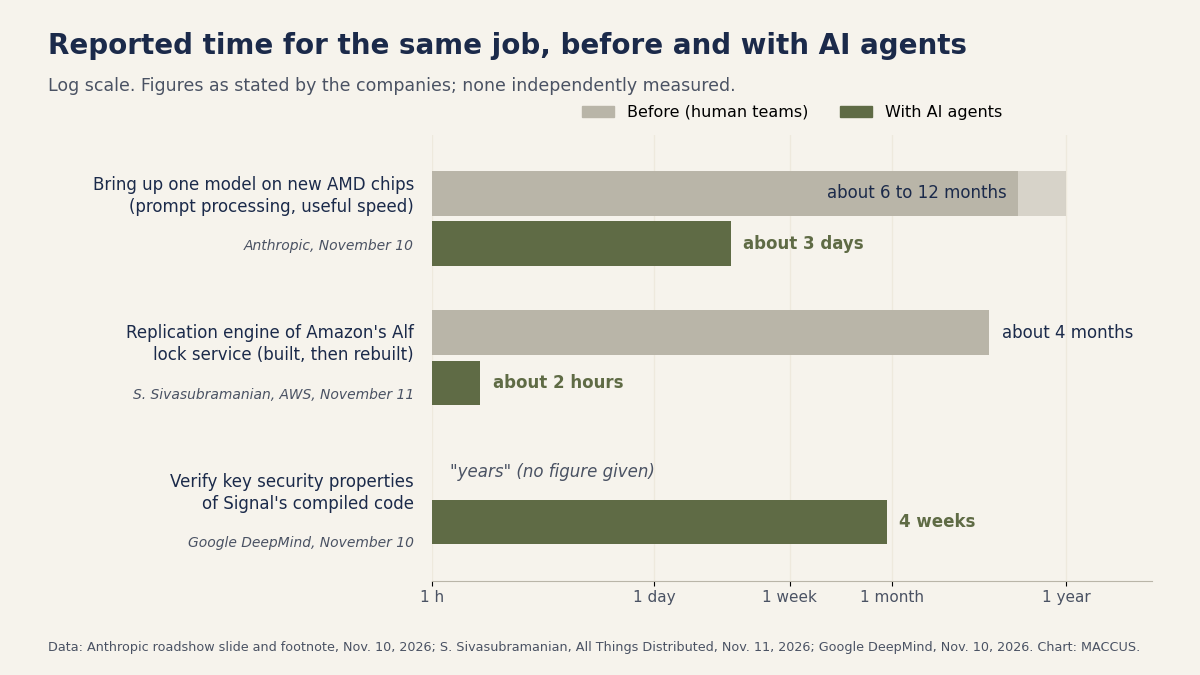
The same week, three other engineering jobs that once took months or years were reported done in hours, days or weeks. Google DeepMind said it proved key security properties of the Signal messaging app’s encryption code in four weeks. Claude maker Anthropic told investors its Mythos model got one of its models running on AMD chips in about three days. AWS vice president Swami Sivasubramanian wrote that an agent rebuilt in about two hours a component he and a colleague took about four months to build.
Three teams of agents and a merge gate
Goldberg describes three teams of agents, which GeekWire reports run on Amazon Bedrock AgentCore, AWS’s service for hosting agents. The first team writes “fidelity tests,” real-world scenarios such as creating a message queue, sending a message and deleting the queue. It derives them from AWS’s public API models, more than 400 machine-readable descriptions of what the services accept and return. AWS counts “tens of thousands” of these tests, each checked “against real AWS before submitting.”
The second team replays the tests against the emulator and files bug reports for the failures, grouping those that seem to share a cause. The third team assigns one agent to each report. The starting point, Goldberg writes, was “an empty web server that could handle requests for the 438 AWS API Models but did nothing.”
No change reaches the main code without passing a merge gate. The gate rejects code that fails to compile into a runnable program. It also runs agents that check coding standards, security and whether the change breaks tests that used to pass. Failed changes go back to the agent for rework.
“Without this merge gate, we wouldn’t trust what our agents are building,” Goldberg writes. He counts “thousands of issues fixed every day as hundreds of agents concurrently work on the codebase.”
Pull requests are code changes proposed for review before merging. GitHub said in October that agents started more than 40% of the pull requests opened on its platform in September. At AWS, by Amazon’s account, no person reviews what the agents merge.
The public commit log
The code first lands in AWS’s internal repositories and reaches GitHub at the end of each release, under CC0, which puts it in the public domain. Its first commit, “Initial emulator scaffold,” is dated October 21 at 20:54 UTC and signed “Scaffolder.”
GitHub’s contributor list names five authors. IssueFinderAgent made 17,122 commits: the bug reports and the merges. IssueFixerAgent made 13,520, Scaffolder 29, TraceIdMigration 6 and ReleaseManagerAgent 4. The names are labels written by AWS’s tooling: they show which part of the system made a change and say nothing about how closely people watched.
The bug reports are saved as files in the repository, with open ones in a folder called things-that-do-not-work.
Early on November 12, when our report on an AI physics proof mentioned the emulator, the repository listed 29,684 commits. By its last update late that evening, it had 997 more. For comparison, Anthropic said in October that it had merged 30,401 code changes into its main code repository in one day in September.
The 22-day history covers only this public version. Goldberg writes that the agents have built “many versions.” In an earlier one, they “decided to build their own Python interpreter” to run AWS Lambda functions, customer code AWS runs on demand. The team then told them to reuse existing libraries.
A weekend prototype first
Goldberg traces the idea to Anthropic’s demonstration, earlier this year, that agents could build a C compiler. He gave Kiro, AWS’s coding agent, a three-step prompt: write tests based on the AWS command-line tool, adjust them until they pass against real AWS, then build an in-memory version that passes the same tests.
After 15 minutes, Kiro returned “a passable first version” of Amazon SQS, AWS’s message queue service. Over a weekend it built a rough version of the rest of AWS, and his team began using it “that Monday.” Goldberg adds: “Turning that into a robust product took more than a weekend.”
Three other jobs done far faster, reported the same week
On November 10, Google DeepMind said its researchers and several AI models turned Signal’s security goals into formal specifications, precise statements of what the code must guarantee. They did so “with human experts reviewing every one.” Agents running on Gemini Carbon, a Google model, then wrote “over six million lines of Lean” to show that Signal’s compiled cryptographic code meets those specifications. Lean is a machine-checked proof language.
The agents flagged “just one percent of the codebase” for a human second look. DeepMind says the work took four weeks, “a task that historically takes expert teams years.” We covered a similar machine-checked approach when Claude wrote no-crash proofs across 123 open-source libraries.
The AMD claim comes from the video of Anthropic’s IPO roadshow, which began on November 10. Co-founder Tom Brown says that “bringing on a new chip platform took dozens of engineers months of work,” and that Mythos “got Claude running on AMD in just three days with basically no human intervention.”
A roadshow slide compares about 3 days with about 6 to 12 months the traditional way. Its footnote limits the figure to the time to “bring up prompt processing for one Anthropic model on AMD MI355X GPUs at a useful level of performance.” Prompt processing is the step where a model reads its input. The MI355X is an AMD AI chip.
Sivasubramanian told his own story on the blog of Amazon chief technology officer Werner Vogels. About 20 years ago, he and Al Vermeulen spent “about four months” building the replication engine of Alf, a lock service. Such a service stops two programs from changing the same data at once. Alf was based on Paxos, a protocol that lets a group of servers agree on one value.
This time, he supervised Kiro “for four nights” before seeing that it “had no way to check its results.” He adds: “Once it had a spec and a test environment, the rebuild took about two hours.”
Caveats from AWS and others
AWS’s README on GitHub says: “Don’t use it for production workloads or to test security.” The user guide says the emulator does not evaluate permission policies the way AWS does and “never denies a request signed with its own key.”
The emulator keeps no separation between accounts or AWS Regions, the cloud’s geographic zones. Apart from global services, it is checked against the real cloud in only one Region, US West (Oregon). Code it runs for a user, such as a Lambda function, is not isolated and “can read and change your files.”
Devin Pratt of the research firm IDC told InfoWorld that at launch the emulator “does not simulate throttling or outages.” Those are AWS’s limits on request rates and its service failures. He counts them among the gaps that “matter most for resilience.”
The merge gate that replaces human review relies on agents for its code reviews. AWS publishes no error rate beyond its own fidelity scores for each release.
Wired, republished by Ars Technica, notes that DeepMind found no new vulnerabilities in the parts it examined. It adds that DeepMind did not verify the whole Signal app and got a head start from Signal’s earlier verification work, and that Google declined to share the cost.
The Decoder points out that Anthropic’s AMD figures come from investor material and have not been independently verified. Sivasubramanian’s two hours describe one component, rebuilt by one of its original designers.
What it means
In each case a machine could check the result. The emulator’s tests are checked against real AWS, DeepMind’s proofs pass or fail in Lean, and a chip either runs Anthropic’s model at a useful speed or does not. Where that check existed, the reported time fell from months or years to hours, days or weeks.
Human work moved to deciding what gets checked. Sivasubramanian writes that the engineer’s job is to “build the specs, tests, and merge gates that decide when that work is correct,” and that AWS expects “agents to build and check most software.”
None of these reports shows how often a passing check hides a wrong answer. AWS’s tests cover what its agents thought to test, and the backlog of known gaps is public. Goldberg says coming posts will explain how AWS measures fidelity and holds its quality and security bar. Sivasubramanian promises more at re:Invent, AWS’s annual conference.
Sources
- How we built the agents that built AWS Emulator, Matthew Goldberg, About Amazon, November 11, 2026
- AWS Emulator and the engineer’s job when agents write the code, Swami Sivasubramanian, All Things Distributed, November 11, 2026
- aws/aws-emulator (repository, README and commit history), Amazon Web Services, GitHub, release v1.0.338 of November 12, 2026
- What is AWS Emulator?, AWS Emulator User Guide, Amazon Web Services, read November 13, 2026
- AWS unveils local emulator service to help enterprises accelerate app development and testing, Anirban Ghoshal, InfoWorld, November 11, 2026
- Introducing AlphaProof Code: a breakthrough in verifying complex software at depth, Pushmeet Kohli and Swarat Chaudhuri, Google DeepMind, November 10, 2026
- Anthropic IPO: roadshow video, chapter “Approach to compute”, Anthropic, November 10, 2026
- Anthropic says AI is eroding Nvidia’s CUDA lead, cutting an AMD chip switch from months to three days, Matthias Bastian, The Decoder, November 11, 2026
Header image: chart by MACCUS, data from the GitHub API for github.com/aws/aws-emulator, read November 13, 2026